


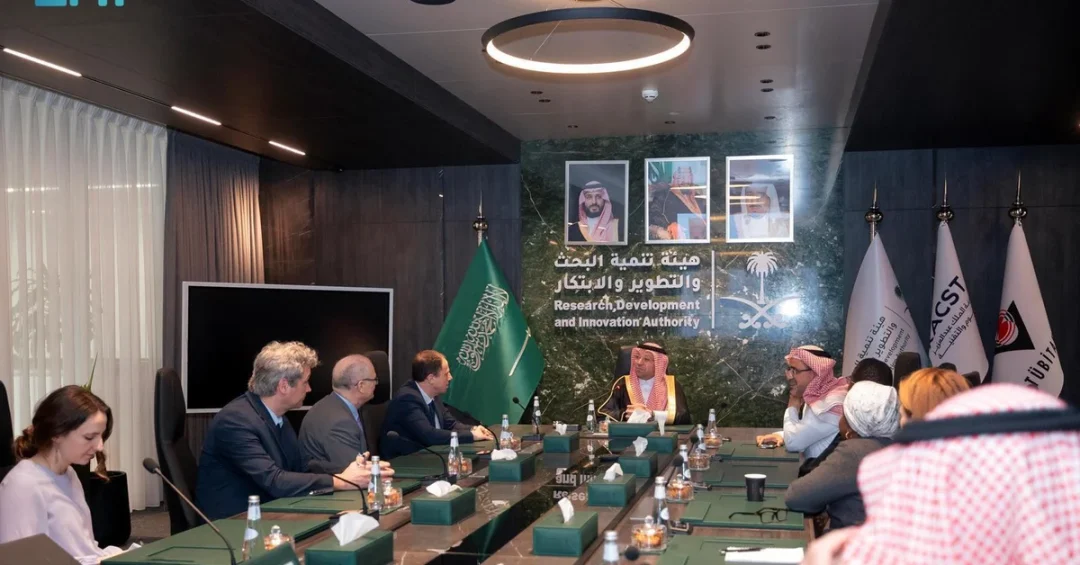
Saudi Arabia hosted a pivotal meeting of the Executive Committee and the International Steering Committee of the Global Research Council (GRC) at the headquarters of King Abdulaziz City for Science and Technology (KACST) in Riyadh, as the Kingdom prepares to welcome the 13th annual GRC meeting for the first time in the Middle East and North Africa region from May 18 to 22, 2025. The preparatory gathering, reported by the Saudi Press Agency (SPA), brought together senior research leaders from around the world to review the scientific program and finalize arrangements for the landmark Riyadh summit, which will be organized by the Research, Development and Innovation Authority (RDIA) and KACST in partnership with the Scientific and Technological Research Council of Türkiye (TÜBİTAK).
The meeting underscored Saudi Arabia’s growing stature in the global scientific community and its commitment to advancing research and development as a cornerstone of its long-term national strategy. With representatives joining both in person and via virtual channels from Europe, Asia, the Pacific, Sub-Saharan Africa, and the MENA region, the session highlighted the Kingdom’s ability to convene world-class expertise and foster international collaboration in an era of rapid technological change. The event also served as a clear signal that Saudi Arabia is ready to host major global scientific gatherings that shape the future of research policy and funding.
Context and Background
What does it mean for a nation to host the world’s leading research funding organizations for the first time in its region? For Saudi Arabia, the answer lies in years of deliberate investment in science, technology, and innovation. The Global Research Council is a voluntary, multilateral organization comprising heads of research councils from across the globe, dedicated to promoting the sharing of data and best practices, and to fostering collaboration among research funding agencies. Its annual meetings are among the most influential gatherings in the international research community, setting agendas that influence how billions of dollars in research funding are allocated worldwide.
The preparatory meeting in Riyadh, chaired in part by Dr. Munir bin Mahmoud Al-Desouki, Vice Chairman of the Board of Governors of the GRC and a member of the Board of Governors for the MENA region, welcomed the Acting Secretary-General of the Council and participants from different regions. Dr. Al-Desouki’s leadership role within the GRC reflects the Kingdom’s increasing influence in global scientific governance. The fact that the 13th annual meeting will be held in the MENA region for the first time since the council’s establishment is a testament to Saudi Arabia’s rising profile as a hub for research, development, and innovation.
This is not an isolated achievement. It builds on a broader national transformation that has seen Saudi Arabia establish new institutions, launch ambitious research programs, and forge international partnerships at an unprecedented pace. The hosting of the GRC meeting aligns with the Kingdom’s Vision 2030, which places knowledge, innovation, and human capital development at the heart of its economic diversification agenda. By bringing the global research community to Riyadh, Saudi Arabia is positioning itself not just as a participant in global science, but as a leader and convener.
Key Details of the Preparatory Meeting
What exactly was on the agenda during this high-level preparatory session? According to the Saudi Press Agency, participants reviewed the scientific program for the May 2025 annual meeting, which will center on two critical themes: “Research Management in the Era of Artificial Intelligence” and “Working Together in Co-Creation to Address Global Challenges.” These topics reflect the most pressing issues facing research institutions today, from the transformative potential of AI in accelerating discovery to the need for cross-border collaboration on challenges such as climate change, health security, and sustainable development.
The meeting also covered the future directions of the GRC, reports from its various working groups, and mechanisms for translating the council’s principle statements into actionable executive plans that enable research councils to formulate effective policies. This focus on implementation is significant, as it demonstrates a commitment to moving beyond dialogue toward tangible outcomes that benefit societies worldwide. Participants examined reports from the five GRC member regions—Europe, Asia, the Pacific, Sub-Saharan Africa, and the MENA region—and discussed the council’s role in strategic planning for research funding.
Additionally, the agenda included discussions on the Governing Board’s agenda and a proposal to host a future Board meeting at one of the member councils. Such procedural matters, while less visible to the public, are essential to the smooth functioning of international scientific cooperation. They ensure that the GRC remains responsive to its members’ needs and that its decisions are grounded in regional perspectives. The Riyadh preparatory meeting thus served as a crucial step in ensuring that the May 2025 annual meeting will be both productive and impactful.
International and Regional Impact
Why does Saudi Arabia’s role as host matter beyond its borders? The Kingdom’s hosting of the GRC meeting reaffirms its prominent position in the global scientific community and highlights the efforts of its scientific institutions at both regional and international levels in supporting research, development, and innovation. For the MENA region, this is a historic moment. The region has long been underrepresented in global research governance, and Saudi Arabia’s leadership in bringing the GRC’s annual meeting to Riyadh signals a new era of inclusion and recognition.
International participants at the preparatory meeting represented a diverse cross-section of the world’s research councils, reflecting the GRC’s truly global membership. Their engagement with Saudi institutions such as KACST and the RDIA demonstrates confidence in the Kingdom’s capabilities and its commitment to international cooperation. The event also underscores Saudi Arabia’s ongoing efforts to strengthen cooperation between research councils in the MENA region, reinforcing its global presence and contributing to knowledge and innovation advancement. By facilitating dialogue between regions, the Kingdom is helping to bridge gaps in research capacity and foster a more equitable global scientific landscape.
Economic and Strategic Significance
How does hosting a global research meeting translate into economic and strategic benefits? For Saudi Arabia, the connection is direct. Research and development are key drivers of economic diversification, job creation, and competitiveness. By positioning itself as a hub for global research collaboration, the Kingdom attracts talent, investment, and partnerships that feed into its growing knowledge economy. The May 2025 GRC meeting will bring hundreds of delegates to Riyadh, generating economic activity in the hospitality, transportation, and services sectors, while also creating opportunities for Saudi researchers and institutions to forge lasting connections with international peers.
Strategically, the event reinforces Saudi Arabia’s soft power and its role as a bridge between regions. The partnership with TÜBİTAK, Türkiye’s leading research body, highlights the Kingdom’s ability to build constructive relationships across geopolitical boundaries. The focus on artificial intelligence in research management is particularly timely, as AI is reshaping industries and economies worldwide. By leading discussions on this topic, Saudi Arabia positions itself at the forefront of a technological revolution that will define the coming decades. The meeting also supports the Kingdom’s goal of increasing research expenditure and output, as outlined in Vision 2030 and related national strategies.
Vision 2030 Alignment
How does this event connect to Saudi Arabia’s long-term vision? Vision 2030, launched by Crown Prince Mohammed bin Salman, aims to transform the Kingdom into a diversified, knowledge-based economy. A central pillar of this vision is the development of a vibrant research, development, and innovation ecosystem. The RDIA, established to drive this agenda, works to align research funding with national priorities, foster collaboration between academia and industry, and enhance the Kingdom’s global scientific standing. Hosting the GRC annual meeting is a direct manifestation of these efforts, showcasing Saudi Arabia’s progress and its commitment to international engagement.
The unprecedented support for the R&D and innovation sector provided by the Kingdom’s leadership has created an environment where such global events can thrive. By bringing the world’s research leaders to Riyadh, Saudi Arabia is not only showcasing its achievements but also learning from best practices and sharing its own experiences. This two-way exchange is essential for building a sustainable research ecosystem. As the Kingdom continues its journey toward Vision 2030, its role as a convener of global scientific dialogue will only grow, contributing to a future where Saudi Arabia is recognized not just for its energy resources, but for its intellectual capital and innovative capacity.
20 Questions
Q1. What is the Global Research Council (GRC)?
A1. The GRC is a voluntary multilateral organization comprising heads of research councils worldwide. It promotes data sharing, best practices, and collaboration among research funding agencies to advance global science.
Q2. Where was the recent GRC preparatory meeting held?
A2. The meeting was hosted in Riyadh at the headquarters of King Abdulaziz City for Science and Technology (KACST), as reported by the Saudi Press Agency.
Q3. When will the 13th annual GRC meeting take place?
A3. The 13th annual GRC meeting will be held in Riyadh from May 18 to 22, 2025, marking the first time it is hosted in the MENA region.
Q4. Who is organizing the 2025 GRC annual meeting?
A4. The meeting is organized by Saudi Arabia’s Research, Development and Innovation Authority (RDIA) and KACST, in partnership with the Scientific and Technological Research Council of Türkiye (TÜBİTAK).
Q5. What are the key topics of the 2025 GRC meeting?
A5. The meeting will focus on “Research Management in the Era of Artificial Intelligence” and “Working Together in Co-Creation to Address Global Challenges.”
Q6. Who chaired the preparatory meeting?
A6. Dr. Munir bin Mahmoud Al-Desouki, Vice Chairman of the GRC Board of Governors and member for the MENA region, welcomed participants and led discussions.
Q7. Which regions were represented at the preparatory meeting?
A7. Participants represented Europe, Asia, the Pacific, Sub-Saharan Africa, and the MENA region, joining in person and virtually.
Q8. What is the significance of Saudi Arabia hosting the GRC annual meeting?
A8. It reaffirms Saudi Arabia’s prominent position in the global scientific community and highlights its commitment to supporting R&D and innovation internationally.
Q9. How does this event align with Vision 2030?
A9. Vision 2030 aims to build a knowledge-based economy. Hosting the GRC meeting showcases Saudi Arabia’s progress in research, development, and innovation, key pillars of the vision.
Q10. What is KACST?
A10. King Abdulaziz City for Science and Technology is a leading Saudi scientific institution that supports research and innovation, and co-organizes the 2025 GRC meeting.
Q11. What is the RDIA?
A11. The Research, Development and Innovation Authority is a Saudi government body established to drive the Kingdom’s R&D agenda and align it with national priorities.
Q12. What is TÜBİTAK?
A12. TÜBİTAK is the Scientific and Technological Research Council of Türkiye, a key partner in organizing the 2025 GRC annual meeting in Riyadh.
Q13. What did participants review at the preparatory meeting?
A13. They reviewed the scientific program, future directions of the council, working group reports, and mechanisms for translating principle statements into executive plans.
Q14. Why is the focus on artificial intelligence important?
A14. AI is transforming research management and discovery. Discussing it positions Saudi Arabia at the forefront of a technological revolution shaping global science.
Q15. How does the GRC benefit its member regions?
A15. The GRC facilitates strategic planning for research funding, shares best practices, and fosters collaboration to address global challenges collectively.
Q16. What economic benefits does hosting the GRC meeting bring to Saudi Arabia?
A16. It attracts global delegates, stimulates hospitality and services, and creates opportunities for Saudi researchers to build international partnerships, boosting the knowledge economy.
Q17. What is the role of Dr. Munir Al-Desouki in the GRC?
A17. He serves as Vice Chairman of the Board of Governors and represents the MENA region, playing a key role in guiding the council’s strategic direction.
Q18. How does this event strengthen Saudi Arabia’s soft power?
A18. By convening global research leaders, Saudi Arabia demonstrates leadership, builds bridges between regions, and enhances its reputation as a hub for innovation and dialogue.
Q19. What are the next steps after the preparatory meeting?
A19. Final preparations will continue for the May 2025 annual meeting, where research councils will adopt policies and action plans based on the discussions.
Q20. What does Saudi Arabia’s hosting of the GRC signify for the MENA region?
A20. It marks a historic first for the region, signaling greater inclusion in global research governance and inspiring neighboring countries to enhance their scientific collaboration.
Reader Feedback
We value your thoughts. Please share your feedback on this article.
Your feedback helps us improve our coverage.
Related articles
 Tarshid Launches Solar PV Project at Qassim University
 stc Group Boosts Two Holy Mosques Connectivity by Over 120%
 Saudi Arabia Selects 40 Students for ISEF 2025
 The Garage Academy Launches to Boost Saudi Tech Startups
 SDAIA Lists ALLaM 7B Arabic AI Model on Hugging Face
 SDAIA Represents Saudi Arabia at Global AI Partnership Session