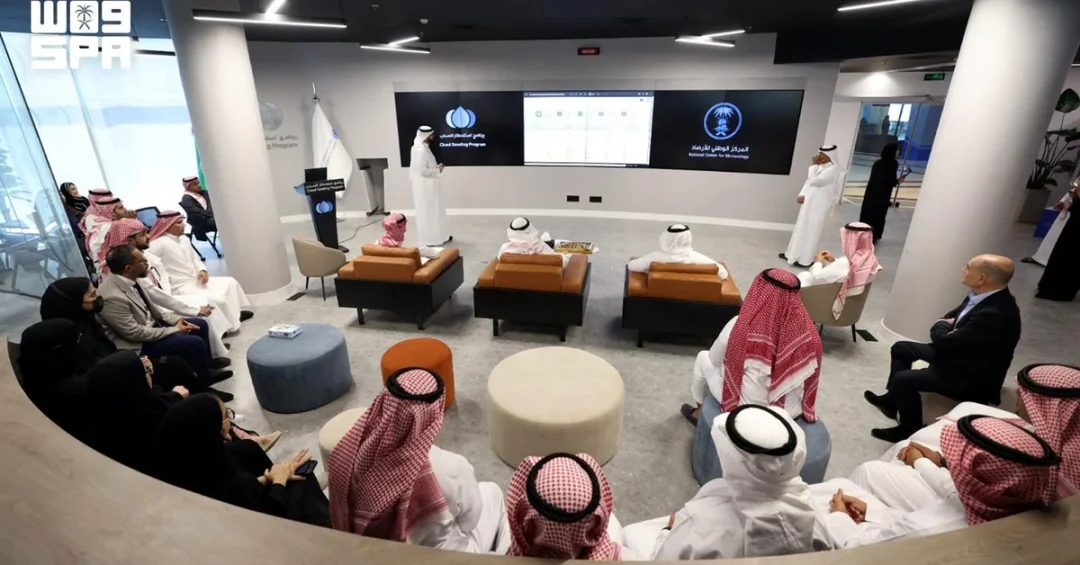
The National Center for Meteorology (NCM) has inaugurated an advanced cloud seeding operations briefing room at its headquarters in Jeddah, a facility designed to accelerate decision-making and strengthen coordination across the Kingdom’s Regional Cloud Seeding Program. The opening was led by Dr. Ayman bin Salem Ghulam, CEO of the National Center for Meteorology and General Supervisor of the Regional Cloud Seeding Program, in the presence of a number of the center’s leaders and officials, according to the Saudi Press Agency.
The new operations room represents a significant step in the ongoing development of Saudi Arabia’s cloud seeding capabilities, providing an integrated and unified platform that supports daily operations through the display of data and performance indicators, the review of weather forecasts and operational plans, and the assessment of the readiness of aircraft, systems, and teams. But what does this development reveal about the Kingdom’s broader ambitions in weather modification and environmental management? The facility is intended to enhance communication, speed up response times, and improve decision-making across all elements of the program.
Context and Background
How did Saudi Arabia become a regional leader in cloud seeding operations? The Kingdom’s interest in weather modification dates back many years, driven by the reality of an arid climate and limited natural freshwater resources. The Regional Cloud Seeding Program, overseen by the National Center for Meteorology, has grown into one of the most ambitious initiatives of its kind in the Middle East, bringing together meteorological expertise, aviation assets, and advanced technologies to enhance precipitation in targeted areas. The program reflects a long-term strategic commitment to water security, a priority that has only intensified as the Kingdom pursues the economic and social transformation outlined in Vision 2030.
The inauguration of the advanced briefing room is part of efforts to develop the program’s working environment and strengthen integration and coordination among relevant teams and entities. It also aims to enhance readiness for cloud seeding operations, accelerate decision-making, and improve implementation efficiency. Officials have consistently emphasized that operational success in cloud seeding depends not only on sophisticated aircraft and seeding materials but also on the speed and quality of the decisions that guide their deployment. The new room directly addresses that requirement by creating a shared space where information flows rapidly between specialists.
The facility also underscores the National Center for Meteorology’s institutional development. Under Dr. Ghulam’s leadership, the center has expanded its role from traditional weather forecasting into a broader mandate that includes climate research, early warning systems, and international cooperation. The briefing room is the latest expression of that evolution, positioning the Kingdom to respond more effectively to weather patterns while contributing to regional knowledge-sharing.
Key Details
What makes the new operations room different from previous arrangements? According to the Saudi Press Agency, the room brings together meteorological operations, aviation, ground services, cloud seeding technologies, technical teams, and relevant departments in a shared working environment. This integration enhances operational integration, facilitates the prompt resolution of issues, and unifies efforts to achieve the program’s operational objectives. Rather than coordinating across separate locations and communication channels, teams can now work side by side, reviewing the same data and aligning their actions in real time.
The room comprises five operational teams, has a capacity of up to 60 people, and includes 16 office spaces. It also provides a professional environment for workshops, training programs, and knowledge-sharing sessions through a unified platform that covers operational, technical, and training needs. The design reflects a deliberate effort to combine day-to-day operational control with capacity-building, ensuring that the program’s human capital develops alongside its technical capabilities. The inclusion of dedicated training space is particularly notable, as it allows new personnel to learn directly from experienced operators in a live operational context.
During the inauguration, Dr. Ghulam stressed the importance of continuing to develop the program’s operations and making optimal use of modern capabilities and technologies to enhance operational readiness and efficiency. He underscored the importance of teamwork and strengthening coordination among all teams involved in cloud-seeding operations. He also praised the program teams for their field, technical, and operational efforts, affirming full support for developing and empowering their capabilities, providing an appropriate environment for them to perform their duties efficiently, and continuously improving the tools and methods that contribute to achieving the program’s objectives and enhancing the quality of its operations.
International and Regional Impact
How might this development influence cloud seeding efforts beyond Saudi Arabia’s borders? The Kingdom’s Regional Cloud Seeding Program is explicitly regional in scope, and the operational improvements unveiled in Jeddah have implications for cooperation with neighboring countries that share similar climate challenges. By demonstrating a structured, technology-driven approach to weather modification, Saudi Arabia offers a model that other nations in the Middle East and North Africa can study and potentially adapt. The briefing room’s integrated platform could serve as a template for joint operations and data-sharing arrangements in the future.
The facility also strengthens the Kingdom’s position in international meteorological forums. Saudi Arabia has been an active participant in global discussions on water security, climate adaptation, and environmental sustainability. A more efficient cloud seeding program enhances the credibility of the Kingdom’s contributions to those discussions, backed by measurable operational results rather than theoretical commitments. As countries around the world grapple with increasingly unpredictable rainfall patterns, the Saudi experience is likely to attract growing attention from policymakers and scientists alike.
Economic and Strategic Significance
Why does cloud seeding matter for Saudi Arabia’s economic future? Water availability is a foundational requirement for agriculture, industry, and urban development, and the Kingdom’s Vision 2030 agenda includes ambitious goals for economic diversification that depend on reliable water resources. Enhanced precipitation can support agricultural productivity in targeted regions, recharge groundwater aquifers, and reduce the pressure on desalination infrastructure that currently supplies much of the country’s potable water. Every additional volume of rainfall captured through cloud seeding contributes to a more sustainable water balance.
The operational efficiencies introduced by the new briefing room also have financial dimensions. Faster decision-making and improved coordination reduce the cost of each cloud seeding mission by minimizing wasted flight hours and ensuring that aircraft are deployed when atmospheric conditions are most favorable. The room’s ability to display performance indicators allows program managers to track the return on investment of each operation and to refine strategies over time. This data-driven approach aligns with the broader emphasis on efficiency and accountability that characterizes Saudi public sector modernization.
Strategically, the program contributes to national resilience. By reducing dependence on a single source of water, cloud seeding diversifies the Kingdom’s water portfolio and mitigates risks associated with supply disruptions or infrastructure failures. The advanced operations room is therefore not merely an administrative upgrade but an element of long-term national planning, reinforcing the Kingdom’s capacity to manage its natural resources in an uncertain climate future.
Vision 2030 Alignment
How does the cloud seeding program connect to the Kingdom’s long-term transformation? Vision 2030, launched under the leadership of Crown Prince Mohammed bin Salman, sets out a comprehensive roadmap for diversifying the economy, improving quality of life, and ensuring environmental sustainability. Water security is a cross-cutting priority within that roadmap, and the Regional Cloud Seeding Program represents a practical, science-based contribution to achieving it. The new briefing room enhances the program’s ability to deliver results, supporting the broader goal of building a resilient and self-reliant nation.
The inauguration also reflects the Vision 2030 emphasis on government efficiency and technological adoption. By creating a unified platform that integrates meteorological data, aviation operations, and technical teams, the National Center for Meteorology is demonstrating the kind of modern, connected public institution that the Vision envisions. The facility’s training and knowledge-sharing components further support human capital development, ensuring that Saudi professionals are equipped with the skills needed to lead in this specialized field. As the program continues to evolve, it will remain a visible example of how the Kingdom is applying innovation to address fundamental challenges and to secure a prosperous future for its people and the region.
20 Questions
Q1. What is the advanced cloud seeding operations briefing room?
A1. It is a new facility at the National Center for Meteorology headquarters in Jeddah, designed to support daily cloud seeding operations through integrated data display, forecast review, and readiness assessment.
Q2. Who inaugurated the new operations room?
A2. Dr. Ayman bin Salem Ghulam, CEO of the National Center for Meteorology and General Supervisor of the Regional Cloud Seeding Program, inaugurated the room in the presence of center leaders and officials.
Q3. What is the main purpose of the briefing room?
A3. The room aims to enhance readiness for cloud seeding operations, accelerate decision-making, improve implementation efficiency, and strengthen integration and coordination among relevant teams and entities.
Q4. How many operational teams work in the room?
A4. The room comprises five operational teams, bringing together meteorological operations, aviation, ground services, cloud seeding technologies, technical teams, and relevant departments in a shared working environment.
Q5. What is the capacity of the new operations room?
A5. The room has a capacity of up to 60 people and includes 16 office spaces, providing a professional environment for workshops, training programs, and knowledge-sharing sessions.
Q6. What kind of data does the room display?
A6. The room displays data and performance indicators, reviews weather forecasts and operational plans, and assesses the readiness of aircraft, systems, and teams to support daily operations.
Q7. How does the room improve decision-making?
A7. By providing a unified platform where all relevant teams share information in real time, the room enhances communication, speeds up response times, and facilitates prompt resolution of operational issues.
Q8. What did Dr. Ghulam emphasize during the inauguration?
A8. He stressed the importance of developing the program’s operations, using modern capabilities and technologies, enhancing operational readiness and efficiency, and strengthening teamwork and coordination among all teams.
Q9. What support did Dr. Ghulam affirm for the program teams?
A9. He affirmed full support for developing and empowering their capabilities, providing an appropriate work environment, and continuously improving tools and methods to achieve the program’s objectives.
Q10. What is the Regional Cloud Seeding Program?
A10. It is a program supervised by the National Center for Meteorology that aims to enhance precipitation in targeted areas of Saudi Arabia and the region using cloud seeding technologies and aircraft.
Q11. Why is cloud seeding important for Saudi Arabia?
A11. Cloud seeding supports water security in an arid climate by enhancing rainfall, which can recharge groundwater, support agriculture, and reduce pressure on desalination infrastructure.
Q12. How does the new room support training?
A12. It provides a professional environment for workshops, training programs, and knowledge-sharing sessions through a unified platform that covers operational, technical, and training needs for program personnel.
Q13. What entities are integrated in the new room?
A13. Meteorological operations, aviation, ground services, cloud seeding technologies, technical teams, and relevant departments are all brought together in the shared working environment.
Q14. How does the room enhance operational integration?
A14. By uniting teams in one location with shared data and communication channels, the room facilitates prompt issue resolution and aligns efforts toward the program’s operational objectives.
Q15. What is the National Center for Meteorology?
A15. It is the Saudi government agency responsible for weather forecasting, climate research, and oversight of the Regional Cloud Seeding Program, headquartered in Jeddah.
Q16. How does this development align with Vision 2030?
A16. It supports water security, government efficiency, technological adoption, and human capital development, all of which are priorities under Vision 2030’s comprehensive transformation roadmap.
Q17. What are the economic benefits of improved cloud seeding operations?
A17. Faster decision-making and better coordination reduce mission costs by minimizing wasted flight hours and ensuring aircraft deploy when atmospheric conditions are most favorable for seeding.
Q18. How might this facility affect regional cooperation?
A18. As part of a regional program, the improved operations room can serve as a model for neighboring countries facing similar climate challenges and support joint data-sharing initiatives.
Q19. What technologies are used in cloud seeding?
A19. Cloud seeding typically involves aircraft dispersing seeding materials into suitable clouds to encourage precipitation, guided by meteorological data, radar, and forecasting systems.
Q20. What is the expected outcome of the new operations room?
A20. The room is expected to improve operational readiness, accelerate decision-making, enhance efficiency, and strengthen coordination, ultimately increasing the effectiveness of the Regional Cloud Seeding Program.
Reader Feedback
We value your thoughts. Please share your feedback on this article.
Your feedback helps us improve our coverage.