


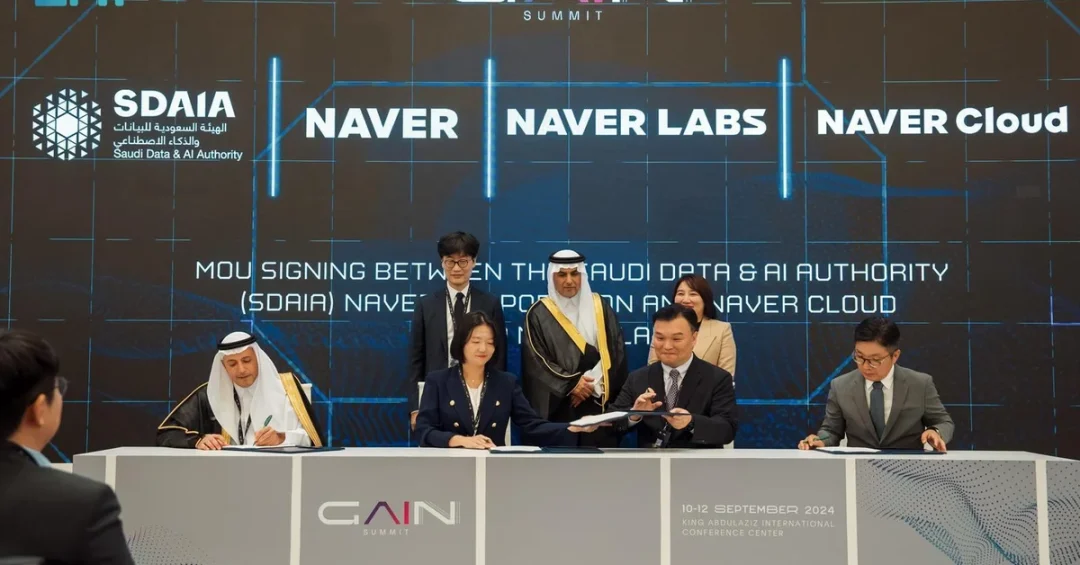
The Saudi Data and AI Authority (SDAIA) signed a Memorandum of Understanding (MoU) with NAVER LABS and NAVER CLOUD to design an advanced Arabic large language model and its applications, as announced by the Saudi Press Agency (SPA). The agreement was formalized during the third Global AI Summit (GAIN) held in Riyadh, marking a significant step in Saudi Arabia’s efforts to enhance the Arabic language in the field of artificial intelligence.
Context and Background
The MoU reflects Saudi Arabia’s commitment to advancing AI technologies and promoting the Arabic language globally. SDAIA, under the leadership of President Dr. Abdullah Alghamdi, has been at the forefront of integrating AI with Arabic language processing. The partnership with NAVER LABS and NAVER CLOUD, represented by Dr. Sangok Seok, Dr. Yoon Kim, and Dr. Choi Soo-Yeon, aims to leverage cutting-edge technical developments to create data-center solutions and cloud platform services for digital transformation.
The signing ceremony was hosted by Dr. Abdullah Alghamdi and attended by the Republic of Korea Ambassador to Saudi Arabia, Choi-Byung-Huyk, highlighting the strengthening ties between Saudi Arabia and South Korea in technology and innovation. This collaboration aligns with SDAIA’s ongoing initiatives to position Arabic at the forefront of AI research and application.
Key Details
The partnership focuses on developing an Arabic language model that can understand and generate Arabic text with high accuracy. This includes applications such as data-center solutions and cloud-based digital transformation services. SDAIA’s previous efforts include the preparation of a dictionary of data and AI terms in collaboration with the King Salman Global Academy for the Arabic Language, and the “Your Voice” application that converts speech to text in classical Arabic and local dialects.
During the second Global AI Summit in 2022, SDAIA launched the “ALLaM” application, which serves the Arabic language by improving language models for tasks such as writing and understanding Arabic poetry, parsing Arabic sentences, and helping children learn Arabic in an engaging way. The new MoU builds on these achievements, aiming to further enhance Arabic language processing capabilities.
Implications and Impact
This collaboration is expected to have significant implications for the region and beyond. By developing a robust Arabic large language model, SDAIA and NAVER aim to facilitate digital transformation across various sectors, including education, healthcare, and government services. It also strengthens Saudi Arabia’s position as a leader in AI innovation, particularly in the Arabic-speaking world.
Furthermore, the partnership underscores the growing international cooperation in AI research and development, with South Korean expertise complementing Saudi Arabia’s strategic vision. This could lead to increased investment and knowledge exchange between the two countries, fostering economic growth and technological advancement.
Vision 2030 Alignment
This initiative is closely aligned with Saudi Vision 2030, which seeks to diversify the economy and promote digital innovation. By advancing AI and Arabic language technologies, SDAIA contributes to the Kingdom’s goals of becoming a global hub for technology and innovation, and enhancing the quality of life for its citizens. The partnership with NAVER is a testament to Saudi Arabia’s commitment to building a knowledge-based economy and fostering international collaborations that drive progress.
20 Questions
Q1. What is the purpose of the MoU signed by SDAIA with NAVER LABS and NAVER CLOUD?
A1. The MoU aims to design an advanced Arabic large language model and its applications, enhancing Arabic language processing in AI and providing data-center and cloud solutions for digital transformation.
Q2. When and where was the MoU signed?
A2. The MoU was signed during the third Global AI Summit (GAIN) in Riyadh on September 10, 2024, as part of Saudi Arabia’s efforts to promote the Arabic language in AI.
Q3. Who signed the MoU on behalf of SDAIA?
A3. The MoU was signed by Dr. Esam Alwagait, Director of the National Information Center at SDAIA, during the summit hosted by SDAIA President Dr. Abdullah Alghamdi.
Q4. Which organizations represented NAVER in the signing?
A4. NAVER LABS and NAVER CLOUD were represented by Dr. Sangok Seok and Dr. Yoon Kim, while Dr. Choi Soo-Yeon represented NAVER Corporation, showcasing the collaboration.
Q5. What are the key objectives of this partnership?
A5. The partnership aims to employ technical developments to create an Arabic language model, offer data-center solutions, and participate in cloud platforms for digital transformation solutions, enhancing AI applications.
Q6. How does this MoU align with SDAIA’s previous initiatives?
A6. It builds on SDAIA’s efforts like the data and AI dictionary with the King Salman Global Academy and the “Your Voice” application, further advancing Arabic language technology and AI integration.
Q7. What is the significance of the “Your Voice” application?
A7. “Your Voice” converts speech to text in classical Arabic and local dialects, useful for meeting minutes and interactive audio systems, demonstrating SDAIA’s innovation in Arabic language processing.
Q8. What was the ALLaM application launched by SDAIA?
A8. Launched in 2022, ALLaM serves the Arabic language by improving language models for writing and understanding poetry, parsing sentences, and helping children learn Arabic effectively.
Q9. How does this partnership benefit Saudi Arabia’s digital transformation?
A9. It provides advanced AI tools and cloud solutions that can enhance various sectors, including education and government services, supporting Saudi Arabia’s digital economy goals.
Q10. What role does the Korean Ambassador play in this collaboration?
A10. The Republic of Korea Ambassador to Saudi Arabia, Choi-Byung-Huyk, hosted the signing, highlighting the strong bilateral ties and cooperation in technology between the two nations.
Q11. How does this MoU enhance the Arabic language in AI?
A11. By developing a large language model specifically for Arabic, it improves AI’s ability to understand and generate Arabic, promoting the language’s use in global tech contexts.
Q12. What are the expected outcomes of the Arabic large language model?
A12. The model is expected to enable better natural language processing, support applications like translation and content generation, and facilitate Arabic language learning and research.
Q13. How does this partnership reflect Saudi Vision 2030?
A13. It aligns with Vision 2030 by fostering innovation, diversifying the economy, and positioning Saudi Arabia as a leader in AI and technology, enhancing global competitiveness.
Q14. What is the Global AI Summit (GAIN)?
A14. GAIN is an international event hosted by Saudi Arabia that brings together experts to discuss AI advancements, showcasing the Kingdom’s commitment to technological leadership and collaboration.
Q15. What other collaborations has SDAIA undertaken for Arabic language?
A15. SDAIA has partnered with the King Salman Global Academy for the Arabic Language to create a data and AI dictionary, and developed applications like ALLaM and “Your Voice.”
Q16. How will NAVER contribute to this partnership?
A16. NAVER LABS and NAVER CLOUD will provide technical expertise in AI and cloud computing, helping design the Arabic language model and integrate it into digital solutions.
Q17. What are data-center solutions mentioned in the MoU?
A17. These solutions involve cloud-based infrastructure and services that support AI applications, enabling efficient data processing and storage for digital transformation initiatives.
Q18. Why is the Arabic language important in AI development?
A18. Arabic is spoken by millions worldwide, and integrating it into AI ensures inclusivity, enhances user experience, and preserves cultural heritage in the digital age.
Q19. What impact will this MoU have on Saudi Arabia’s tech sector?
A19. It will boost AI research, attract investments, create job opportunities, and strengthen Saudi Arabia’s position as a regional hub for technology and innovation.
Q20. How does this collaboration with South Korea benefit Saudi Arabia?
A20. It fosters knowledge exchange, strengthens diplomatic ties, and combines South Korea’s advanced tech with Saudi Arabia’s strategic vision, driving mutual growth and innovation.
Reader Feedback
We value your thoughts. Please share your feedback on this article.
Your feedback helps us improve our coverage.
Related articles
 SDAIA and NVIDIA Partner to Boost Arabic AI Capabilities
 GEOSA, Huawei Sign MoU to Develop KSA MapGPT
 SDAIA’s ALLaM Recognized as Top Arabic Language Model
 SDAIA and Microsoft Launch ALLaM Arabic AI on Azure
 Elm Sponsors Global AI Summit in Riyadh
 SDAIA and IBM Sign MoU to Establish AI Center of Excellence