


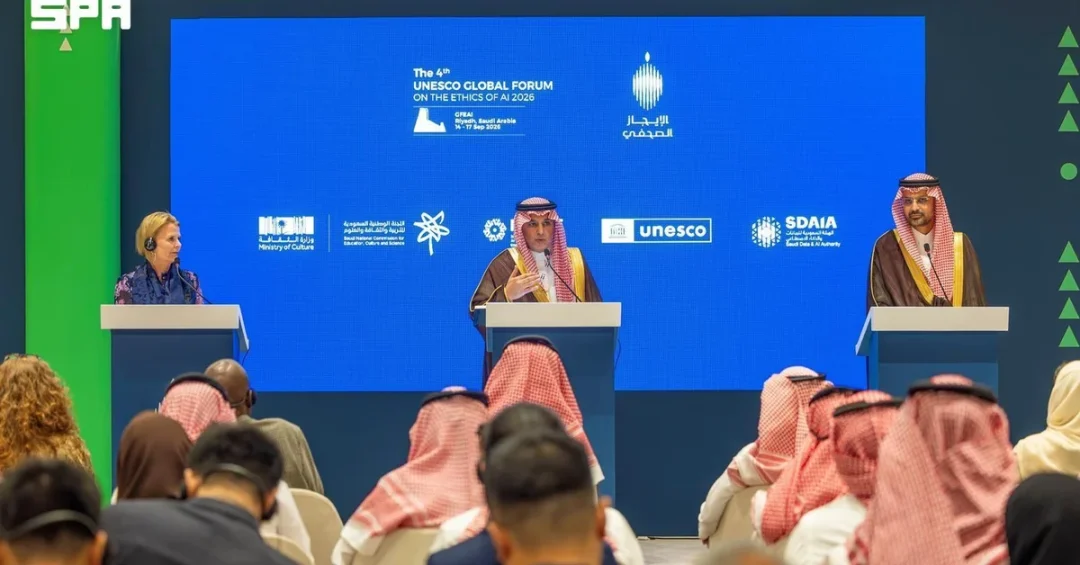
Saudi Data and Artificial Intelligence Authority (SDAIA) President Dr. Abdullah Alghamdi emphasized the need to balance AI innovation with ethical governance at a press briefing for the fourth UNESCO Global Forum on the Ethics of Artificial Intelligence, held in Riyadh from September 14 to 17, 2026. The forum, hosted in the Saudi capital, underscores the Kingdom’s growing leadership in global AI discussions and its commitment to ensuring that advanced technologies benefit all segments of society.
Context and Background
The fourth UNESCO Global Forum on the Ethics of Artificial Intelligence brought together policymakers, experts, and stakeholders from around the world to address the challenges and opportunities presented by AI. Saudi Arabia’s selection as host reflects its proactive role in shaping global AI governance frameworks. Dr. Alghamdi noted that the forum coincides with Saudi Arabia’s designation of 2026 as the Year of Artificial Intelligence, highlighting the Kingdom’s strategic focus on AI development and responsible deployment.
Saudi Arabia was among the first countries to sign UNESCO’s Recommendation on the Ethics of Artificial Intelligence and has proposed the establishment of the International Center for AI Research and Ethics (ICAIRE), further demonstrating its commitment to international cooperation in this field.
Key Details
During the press briefing, Dr. Alghamdi stressed that Saudi Arabia’s approach to AI adoption combines support for innovation with robust governance measures. ‘We must accelerate innovation while ensuring sound governance so that the benefits of AI remain accessible to individuals, communities, and sectors alike,’ he said. He highlighted the launch of more than 40 academic programs in data and AI, and noted that over 1.2 million participants have graduated from the One Million Saudis in AI (SAMAI) Initiative. The Kingdom has also launched SAMAI 2 and several AI governance initiatives.
UNESCO Deputy Director-General Åsa Regnér underscored the need to broaden access to AI benefits and develop inclusive policies that keep humans in control of the technology. She emphasized international cooperation and exchange of expertise as vital to ensuring responsible AI development. ICAIRE Acting Director-General Dr. Majid Alshehry added that translating ethical principles into practice is a priority, with a focus on capacity-building in developing countries, knowledge sharing, empowering women and youth, and strengthening AI governance capabilities.
Implications and Impact
The outcomes of this forum are expected to influence global AI policies, particularly in developing nations where capacity-building is crucial. Saudi Arabia’s leadership in hosting such events reinforces its position as a bridge between technological advancement and ethical considerations. The Kingdom’s initiatives, such as SAMAI, serve as a model for other countries seeking to build a skilled AI workforce. Furthermore, the establishment of ICAIRE will facilitate research and dialogue on AI ethics, promoting a balanced approach worldwide.
By championing inclusive AI governance, Saudi Arabia is contributing to a global framework that ensures AI benefits are shared equitably, aligning with the United Nations Sustainable Development Goals.
Vision 2030 Alignment
Saudi Arabia’s focus on AI innovation and governance is a cornerstone of Vision 2030, which aims to diversify the economy and create a knowledge-based society. The development of AI talent through initiatives like SAMAI and the promotion of ethical AI practices are integral to achieving the Vision’s objectives. As the Kingdom continues to invest in digital transformation, its leadership in global AI ethics will not only drive domestic growth but also enhance its role as a responsible global player, committed to harnessing technology for the betterment of humanity.
20 Questions
Q1. What is the main topic of the fourth UNESCO Global Forum on the Ethics of Artificial Intelligence?
A1. The forum focuses on balancing AI innovation with ethical governance to ensure benefits are accessible to all, and it addresses global challenges and opportunities in AI development and regulation.
Q2. When and where was the fourth UNESCO Global Forum on the Ethics of AI held?
A2. It was held in Riyadh, Saudi Arabia, from September 14 to 17, 2026, bringing together international experts and policymakers to discuss AI ethics.
Q3. Who is the President of the Saudi Data and Artificial Intelligence Authority (SDAIA)?
A3. Dr. Abdullah Alghamdi is the President of SDAIA, and he emphasized the importance of balancing AI innovation with governance at the forum’s press briefing.
Q4. What did Dr. Alghamdi say about Saudi Arabia’s approach to AI?
A4. He stated that Saudi Arabia combines support for innovation with governance measures, policies, and controls to ensure optimal use of AI technologies for the benefit of all.
Q5. What is the One Million Saudis in AI (SAMAI) Initiative?
A5. SAMAI is a Saudi initiative that has graduated over 1.2 million participants in AI, aiming to build a skilled workforce and promote AI literacy across the Kingdom.
Q6. What is SAMAI 2?
A6. SAMAI 2 is a follow-up initiative to the original SAMAI program, designed to further advance AI skills and knowledge among Saudis, as announced by Dr. Alghamdi.
Q7. How many academic programs in data and AI has Saudi Arabia launched?
A7. Saudi Arabia has launched more than 40 academic programs in data and AI, contributing to human capital development in these fields.
Q8. What is the International Center for AI Research and Ethics (ICAIRE)?
A8. ICAIRE is a proposed international center by Saudi Arabia to promote research and ethics in AI, aiming to translate ethical principles into practice globally.
Q9. Who is the Acting Director-General of ICAIRE?
A9. Dr. Majid Alshehry is the Acting Director-General of ICAIRE, and he stressed the importance of implementing ethical AI principles and capacity-building.
Q10. What did UNESCO Deputy Director-General Åsa Regnér emphasize?
A10. She emphasized the need to broaden access to AI benefits, develop inclusive policies, and ensure humans remain in control of the technology through international cooperation.
Q11. Why is 2026 significant for Saudi Arabia in terms of AI?
A11. Saudi Arabia designated 2026 as the Year of Artificial Intelligence, highlighting its commitment to AI development and governance, coinciding with the UNESCO forum.
Q12. What role did Saudi Arabia play in UNESCO’s AI ethics recommendation?
A12. Saudi Arabia was among the first countries to sign UNESCO’s Recommendation on the Ethics of Artificial Intelligence, demonstrating its early commitment to ethical AI.
Q13. What are ICAIRE’s priorities according to Dr. Alshehry?
A13. ICAIRE’s priorities include capacity-building in developing countries and Africa, knowledge sharing, empowering women and youth, and strengthening AI governance capabilities.
Q14. How does the forum aim to impact global AI policies?
A14. The forum aims to influence global AI policies by promoting ethical governance, inclusive dialogue, and capacity-building, especially in developing nations.
Q15. What is the significance of Saudi Arabia hosting this forum?
A15. Hosting the forum reinforces Saudi Arabia’s leadership in AI ethics and governance, showcasing its role as a bridge between technological advancement and ethical considerations.
Q16. How does Saudi Arabia’s AI strategy align with Vision 2030?
A16. Saudi Arabia’s AI strategy supports Vision 2030 by diversifying the economy, creating a knowledge-based society, and promoting ethical AI practices for sustainable development.
Q17. What governance initiatives has Saudi Arabia launched for AI?
A17. Saudi Arabia has launched several AI governance initiatives, including ethical frameworks and policies, to ensure responsible AI development and use.
Q18. What is the expected outcome of the fourth UNESCO Global Forum?
A18. The forum is expected to produce recommendations and foster international cooperation to ensure AI benefits are shared equitably and ethically worldwide.
Q19. How does Saudi Arabia support AI capacity-building in developing countries?
A19. Through ICAIRE and other initiatives, Saudi Arabia supports capacity-building by sharing knowledge, providing training, and promoting inclusive AI governance in developing countries.
Q20. What does the future hold for Saudi Arabia’s role in global AI governance?
A20. Saudi Arabia is poised to continue leading in AI ethics and governance, driving innovation while ensuring ethical practices, in line with Vision 2030 and global cooperation.
Reader Feedback
We value your thoughts. Please share your feedback on this article.
Your feedback helps us improve our coverage.