


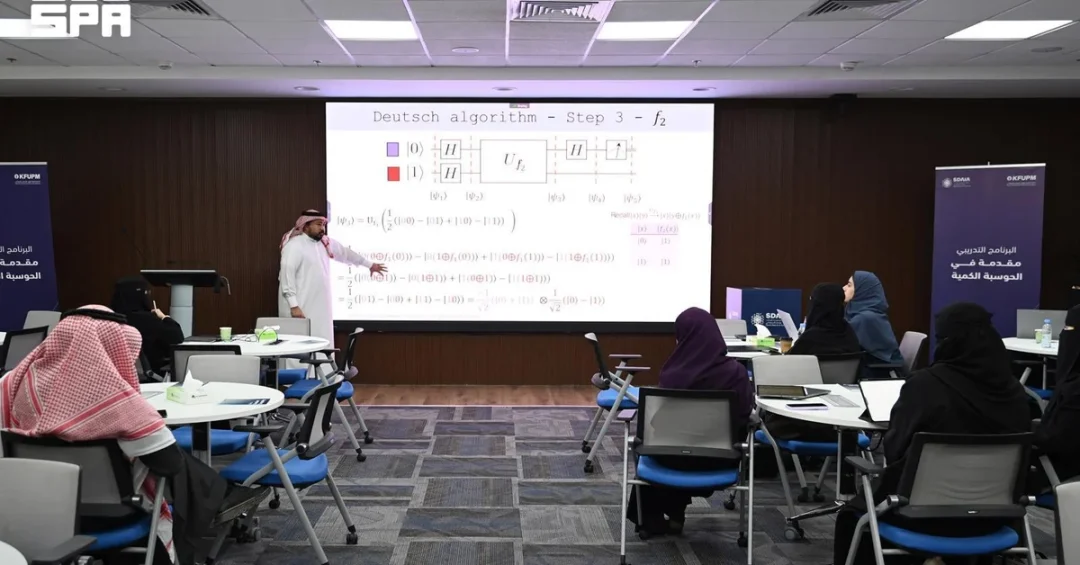
The Saudi Data and Artificial Intelligence Authority (SDAIA) has trained more than 70 specialists in quantum computing during 2026 through its academy, positioning the Kingdom at the forefront of a technology race that analysts expect to redefine computing power, national security, and economic competitiveness over the coming decade. The programs, delivered by SDAIA Academy in cooperation with King Fahd University of Petroleum and Minerals, combined theoretical instruction with practical laboratories and prototype development, according to information released through official Saudi channels. Is any nation today able to ignore a technology that promises to transform cryptography, logistics, finance, and scientific discovery simultaneously?
The initiative reflects a deliberate, structured approach to emerging technology adoption. Rather than waiting for quantum computing to mature commercially, SDAIA has moved early to build a national talent pipeline capable of understanding, evaluating, and eventually deploying quantum systems. The academy’s portfolio in 2026 included a Quantum Computing Boot Camp launched earlier in the year, a Strategic Transformation Toward Quantum Technologies program held on April 14, 2026 for leaders and decision-makers, and a follow-up boot camp on September 13, 2026 focused on advanced applications and integration with generative and agentic artificial intelligence. Together, these efforts signal that the Kingdom intends to be a participant in shaping the quantum era, not merely a consumer of its outputs.
Context and Background
Why has quantum computing become such a central preoccupation for governments and technology institutions worldwide? The answer lies in the technology’s fundamental departure from classical computing. Where conventional machines process information as binary bits, quantum computers use quantum bits, or qubits, that can exist in multiple states simultaneously. This property, combined with quantum entanglement and interference, allows certain classes of problems to be solved exponentially faster than classical systems can manage. For sectors such as cryptography, materials science, drug discovery, and complex optimization, the implications are profound, and the nations that master the technology early are expected to hold significant strategic advantages.
SDAIA recognized this dynamic early. The authority, which leads Saudi Arabia’s national data and artificial intelligence agenda, established SDAIA Academy as a vehicle for developing specialized human capital in deep and emerging technologies. Quantum computing became a distinct focus area because of its cross-cutting nature: it touches data security, artificial intelligence, energy, logistics, and finance, all sectors central to the Kingdom’s economic diversification plans. The academy’s programs were designed not only to teach the fundamentals but also to help specialists assess feasibility, identify adoption challenges, and explore integration pathways with existing data and AI infrastructure. That practical orientation distinguishes the effort from purely academic study.
The global context reinforces the urgency. Major economies across Asia, Europe, and North America have launched national quantum initiatives, and private investment in quantum startups has grown substantially. International bodies have warned that quantum computers capable of breaking current encryption standards could emerge within the next decade or two, creating what is often called a ‘harvest now, decrypt later’ risk for data already intercepted today. In this environment, building domestic expertise is a matter of both economic opportunity and national resilience. Saudi Arabia’s early investment through SDAIA Academy addresses both dimensions, preparing professionals who can advise on policy, design secure systems, and evaluate emerging quantum platforms with informed judgment.
Key Details
What exactly did SDAIA Academy deliver during 2026? The authority’s training portfolio spanned multiple formats and audiences. The Quantum Computing Boot Camp, launched earlier in the year with King Fahd University of Petroleum and Minerals, was aimed at specialists in computer science and related disciplines. Its purpose was to enable participants to understand the fundamentals of quantum computing and to use its modern tools, bridging the gap between academic theory and hands-on practice. King Fahd University of Petroleum and Minerals, based in Dhahran, is one of the Kingdom’s leading technical institutions, and its collaboration with SDAIA Academy ensured that the program combined rigorous academic grounding with applied, industry-relevant instruction.
The Strategic Transformation Toward Quantum Technologies program, held on April 14, 2026, extended the academy’s reach beyond technical specialists to leaders and decision-makers. This program addressed the strategic dimensions of quantum technologies, including quantum communication, cryptography, and sensing, as well as their expected impact on critical infrastructure. By engaging senior figures, SDAIA ensured that quantum awareness is embedded at the level where investment, policy, and institutional strategy are shaped. The decision to brief leaders alongside engineers reflects a mature understanding that technology adoption is not solely a technical challenge but also a governance and planning one.
The September 13, 2026 boot camp focused on advanced quantum computing applications and opportunities for integration with generative and agentic artificial intelligence. Participants explored promising applications in optimization and decision-making, cybersecurity and cryptography, financial services, and logistics. The program included practical laboratories and projects using quantum simulators and platforms, with opportunities to experiment with real quantum hardware subject to availability. These activities enabled participants to develop prototypes and assess their feasibility and technical limitations, an approach that builds realistic expectations alongside technical skill. By combining classical and quantum computing capabilities in problem-solving exercises, the boot camp mirrored how the technology is likely to be deployed in practice: as a hybrid tool that augments, rather than replaces, existing systems.
International and Regional Impact
How does Saudi Arabia’s quantum training effort resonate beyond its borders? The Kingdom’s engagement with quantum computing places it among a growing group of nations investing in the technology’s foundations. In the region, Saudi Arabia’s structured approach, anchored in a national authority and delivered through a dedicated academy, offers a model that combines public-sector coordination with academic partnership. The collaboration with King Fahd University of Petroleum and Minerals demonstrates how national institutions can pool expertise, and the involvement of decision-makers signals that quantum is being treated as a strategic domain rather than a niche research interest. For international partners, this creates opportunities for collaborative research, joint training, and technology exchange.
The emphasis on integration with artificial intelligence is particularly significant internationally. Generative and agentic AI systems are already transforming how organizations process information and make decisions, and the prospect of combining these capabilities with quantum optimization and simulation opens new frontiers. By training specialists to explore this intersection, SDAIA Academy is preparing a workforce that can contribute to global conversations about hybrid computing architectures. The boot camp’s focus on cybersecurity and cryptography also aligns with international priorities, as governments and enterprises worldwide seek to prepare for the eventual arrival of quantum-resistant encryption standards. Saudi Arabia’s early engagement in these areas positions it as a constructive participant in international efforts to secure the digital economy.
Economic and Strategic Significance
What does quantum readiness mean for Saudi Arabia’s economy? The sectors identified in SDAIA Academy’s programs, optimization, cybersecurity, financial services, and logistics, are precisely those where quantum advantage is expected to deliver measurable value. In logistics, quantum algorithms could improve routing and supply chain efficiency, a priority for a Kingdom that sits at the crossroads of global trade. In financial services, quantum computing may enhance portfolio optimization, risk modeling, and fraud detection, supporting the growth of Riyadh as a regional financial hub. In cybersecurity, the development of quantum-resistant cryptography is becoming an urgent requirement for banks, utilities, and government systems. By training specialists who understand these applications, SDAIA is building the human infrastructure needed to capture value as the technology matures.
The strategic significance extends to critical infrastructure protection. The April 2026 program for leaders addressed quantum communication, cryptography, and sensing, technologies with direct implications for the security of energy installations, communications networks, and data centers. Quantum sensing, for example, can enable highly precise measurement and detection capabilities, while quantum communication offers theoretically secure channels for transmitting sensitive information. Preparing decision-makers to evaluate these technologies ensures that the Kingdom’s infrastructure planning incorporates quantum considerations from the outset. This forward-looking stance reduces the risk of costly retrofitting later and strengthens the resilience of systems on which the national economy depends.
Vision 2030 Alignment
How does quantum computing training connect to Saudi Vision 2030? The Vision, launched in 2016 under the leadership of Crown Prince Mohammed bin Salman, seeks to diversify the economy, develop human capital, and build a knowledge-based society. SDAIA Academy’s quantum programs directly serve these objectives by investing in national talent, particularly among male and female university students, and by strengthening the integration of technical training with academic knowledge. The focus on emerging technologies aligns with the Vision’s ambition to create high-value jobs and to position the Kingdom as a hub for innovation and digital transformation. Every specialist trained in quantum fundamentals is a potential contributor to research, entrepreneurship, or public-sector modernization.
The broader institutional context reinforces this alignment. SDAIA itself was established to drive the national data and AI agenda, and its academy functions as a pipeline for skills that the Vision identifies as essential. By moving early on quantum computing, the Kingdom is not only preparing for a future technology but also signaling to investors, researchers, and global partners that it intends to compete in the most advanced domains of the digital economy. The combination of theoretical education and practical training, delivered through boot camps, leadership programs, and hands-on laboratories, reflects the Vision’s emphasis on measurable outcomes and real-world impact. As quantum computing advances from laboratory curiosity to industrial tool, Saudi Arabia will have a cohort of professionals ready to apply it in service of national priorities and global collaboration.
20 Questions
Q1. What is quantum computing?
A1. Quantum computing is a type of computing that uses quantum bits, or qubits, which can exist in multiple states at once. This allows certain complex problems to be solved far faster than classical computers can manage.
Q2. Why is SDAIA focusing on quantum computing?
A2. SDAIA recognized the technology’s potential early and aims to build national capabilities so Saudi professionals can keep pace with global advances and apply quantum computing to research and vital sectors.
Q3. How many specialists did SDAIA Academy train in quantum computing in 2026?
A3. SDAIA Academy trained more than 70 specialists during 2026 through programs, boot camps, and training courses designed to deepen understanding of quantum fundamentals and applications.
Q4. What was the Quantum Computing Boot Camp?
A4. Launched earlier in 2026 with King Fahd University of Petroleum and Minerals, the boot camp enabled computer science specialists to understand quantum fundamentals and use modern quantum tools.
Q5. Who participated in the Strategic Transformation Toward Quantum Technologies program?
A5. The program, held on April 14, 2026, was designed for leaders and decision-makers, addressing strategic dimensions such as quantum communication, cryptography, and sensing.
Q6. What topics were covered in the April 2026 leadership program?
A6. It covered quantum communication, cryptography, and sensing, along with the expected impact of these technologies on critical infrastructure and strategic planning.
Q7. What did the September 13, 2026 boot camp focus on?
A7. It focused on advanced quantum computing applications and integration with generative and agentic artificial intelligence to develop solutions combining classical and quantum capabilities.
Q8. Which sectors were highlighted in the September boot camp?
A8. Participants explored optimization and decision-making, cybersecurity and cryptography, financial services, and logistics, with practical laboratories using quantum simulators and platforms.
Q9. Did participants work with real quantum hardware?
A9. Yes, the boot camp included opportunities to experiment with real quantum hardware subject to availability, alongside simulators, enabling prototype development and feasibility assessment.
Q10. Why is integration with artificial intelligence important?
A10. Combining quantum computing with generative and agentic AI can unlock new solutions in optimization, security, and decision-making, creating hybrid systems that outperform classical approaches alone.
Q11. How does quantum computing relate to cybersecurity?
A11. Quantum computers could eventually break current encryption, making quantum-resistant cryptography essential. SDAIA’s programs prepare specialists to understand and address this challenge.
Q12. What role does King Fahd University of Petroleum and Minerals play?
A12. The university partnered with SDAIA Academy on the Quantum Computing Boot Camp, providing academic expertise and helping bridge theoretical knowledge with practical application.
Q13. How does this effort support Saudi Vision 2030?
A13. It develops human capital, promotes a knowledge-based economy, and prepares Saudi professionals for high-value roles in emerging technologies, directly supporting Vision 2030 objectives.
Q14. Who benefits from SDAIA Academy’s quantum programs?
A14. Specialists in computer science and related fields, university students, and leaders and decision-makers all benefit through tailored programs that build skills and strategic awareness.
Q15. What are quantum simulators used for?
A15. Quantum simulators allow participants to model quantum algorithms and experiments without needing physical quantum hardware, making training more accessible and scalable.
Q16. Why is early engagement in quantum computing important?
A16. Early engagement builds expertise, informs policy, and positions the Kingdom to capture economic and strategic benefits as the technology matures and adoption accelerates globally.
Q17. What economic sectors could benefit most from quantum computing?
A17. Logistics, financial services, cybersecurity, energy, and scientific research are among the sectors expected to gain from quantum optimization, simulation, and secure communication capabilities.
Q18. How does SDAIA’s approach differ from purely academic study?
A18. SDAIA Academy combines theoretical education with practical training, including laboratories, prototypes, and hardware experimentation, ensuring participants can assess real-world feasibility and limitations.
Q19. What is the significance of training leaders alongside specialists?
A19. Training leaders ensures that strategic decisions about investment, infrastructure, and policy are informed by a clear understanding of quantum technologies and their implications.
Q20. What comes next for SDAIA’s quantum efforts?
A20. SDAIA is expected to continue expanding its quantum programs, deepening integration with AI, and building a national talent pool ready to apply quantum technologies across priority sectors.
Reader Feedback
We value your thoughts. Please share your feedback on this article.
Your feedback helps us improve our coverage.