


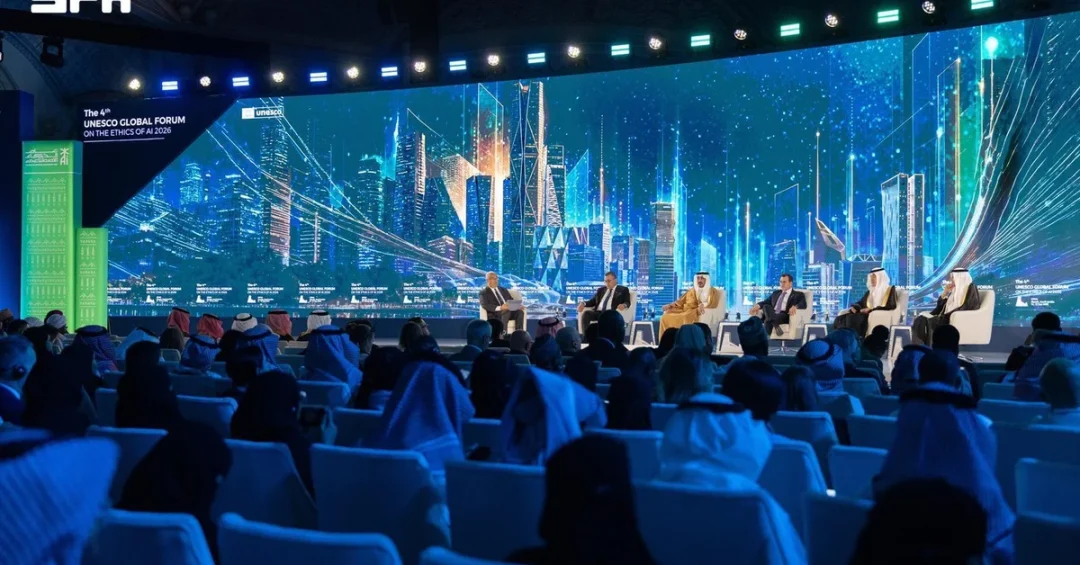
The fourth edition of the UNESCO Global Forum on the Ethics of Artificial Intelligence (GFEAI 2026) concluded in Riyadh on Thursday, September 17, 2026, drawing 60 ministers and heads of delegations and international organizations, 200 speakers from around the world, and more than 10,000 visitors, according to the Saudi Press Agency. Held from September 14 to 17, the forum marked the first time the global gathering was hosted in an Arab country, underscoring the Kingdom of Saudi Arabia’s expanding role in shaping international dialogue on responsible artificial intelligence. Organized by the Saudi Data and Artificial Intelligence Authority (SDAIA) in partnership with the United Nations Educational, Scientific and Cultural Organization (UNESCO), the event featured more than 100 sessions, workshops, and side events, alongside a series of initiatives and agreements announced by Saudi and international institutions.
Could a single global forum in Riyadh reshape how nations govern artificial intelligence? The scale of GFEAI 2026 suggests the answer may be yes. Discussions across the four days focused on translating ethical AI principles into concrete policies and practices within institutions and technical systems, strengthening responsible governance, managing emerging risks, and building human capacity, while accounting for countries’ differing priorities and levels of readiness. The forum’s outcomes, ranging from new capacity-building frameworks to professional certifications and multilingual glossaries, reflect a deliberate Saudi-led effort to move AI ethics from abstract principle to operational reality on the world stage.
Context and Background
Why has the ethics of artificial intelligence become one of the most urgent questions in global governance? As AI systems spread rapidly across economies, public services, and daily life, governments and international bodies have sought common ground on how to harness the technology’s benefits while guarding against its risks. UNESCO’s Global Forum on the Ethics of AI was established as a direct response to that need, following the adoption of the UNESCO Recommendation on the Ethics of Artificial Intelligence, the first global standard-setting instrument of its kind, agreed by 193 member states. The forum has since become a recurring platform for policymakers, researchers, and industry leaders to compare approaches and align priorities.
Bringing the fourth edition to Riyadh was a significant milestone. According to the Saudi Press Agency, GFEAI took place in an Arab country for the first time, a development that reflects both the Kingdom’s growing convening power and the trust placed in its institutions by multilateral partners. SDAIA organized the event in partnership with UNESCO, in cooperation with the International Center for AI Research and Ethics (ICAIRE), and in coordination with the Saudi National Commission for Education, Culture and Science. That coalition of Saudi and international bodies gave the forum a distinctive character, combining global standard-setting expertise with regional perspectives that are often underrepresented in technology governance debates.
The timing also matters. As countries race to adopt AI in healthcare, education, energy, and public administration, the gap between principle and practice has become a central concern. GFEAI 2026 was designed to close that gap by focusing on implementation, institutional readiness, and measurable capacity. For Saudi Arabia, hosting the forum aligned with a broader national strategy to position the Kingdom not only as an adopter of advanced technology but also as a contributor to the rules and norms that will govern it internationally.
Key Details and Major Announcements
What concrete outcomes emerged from four days of intensive dialogue? The Saudi Data and Artificial Intelligence Authority announced a series of deliverables that give the forum’s discussions tangible form. SDAIA launched five capacity-building frameworks in data and AI, alongside four professional certifications in data management and governance. These frameworks and certifications are intended to give institutions, professionals, and governments practical tools for building the skills required to deploy AI responsibly, moving beyond declarations into workforce readiness and organizational standards.
GFEAI also honored eight government entities that achieved advanced levels in the first assessment cycle of the National AI Index. The Ministry of Energy was recognized in the “Excellence” category, while seven other entities were honored in the “Empowerment” category. The recognition program signals that AI readiness is being measured and rewarded within Saudi public institutions, creating incentives for ministries and agencies to adopt governance practices, improve data quality, and integrate AI into service delivery in ways that align with national priorities.
In the area of language and knowledge infrastructure, SDAIA and the King Salman Global Academy for Arabic Language, in partnership with ICAIRE, launched the third edition of the Data and AI Glossary. This edition adds Spanish and more than 200 new terms, bringing the glossary’s total to more than 1,400 terms across four languages. The expansion matters because consistent terminology is a prerequisite for international cooperation: regulators, engineers, and researchers must share a common vocabulary if ethical standards are to be translated into compatible technical and legal frameworks.
Human capital featured prominently as well. ICAIRE, in partnership with IBM, launched the third edition of the Elevate initiative, which aims to train 25,000 women in AI. ICAIRE also announced a program in cooperation with the Islamic World Educational, Scientific and Cultural Organization (ICESCO) and in partnership with the Apolitical platform. That program aims to train 10,000 public-sector leaders over two years, with plans to expand to include ICESCO member states. Together, these initiatives reflect a dual focus on broadening participation in AI and equipping decision-makers with the literacy needed to govern the technology wisely.
International and Regional Impact
How does a forum held in Riyadh influence conversations far beyond the Gulf region? The presence of 60 ministers and heads of delegations and international organizations, along with 200 speakers and more than 10,000 visitors, indicates that GFEAI has become a genuinely global meeting point. By hosting the first edition of the forum in an Arab country, Saudi Arabia helped ensure that the perspectives of the region, including its development priorities and cultural contexts, were part of the global conversation rather than an afterthought. That inclusivity strengthens the legitimacy of international AI governance efforts.
The partnerships announced at the forum extend the impact further. The cooperation between ICAIRE and ICESCO, which aims to train 10,000 public-sector leaders over two years with expansion to ICESCO member states, links Saudi-led capacity building to a broad network of countries across the Islamic world and beyond. Similarly, the Elevate initiative with IBM connects a Saudi-based ethics center to a global technology company with deep expertise in AI. These arrangements illustrate a model in which Saudi institutions act as conveners and catalysts, connecting multilateral organizations, private-sector leaders, and national governments around shared goals.
The forum also reinforced the role of UNESCO’s Recommendation on the Ethics of AI as a common reference point. By concentrating on implementation, participants addressed a persistent challenge in global technology governance: the difficulty of turning agreed principles into everyday practice in institutions and technical systems. The emphasis on managing risks and accounting for differing levels of national readiness gave the discussions a pragmatic tone suited to a diverse membership, from advanced economies to emerging adopters.
Economic and Strategic Significance
Why should businesses and investors pay attention to AI ethics forums? The frameworks, certifications, and governance tools launched at GFEAI 2026 have direct implications for how companies operate. As governments adopt national AI indices and require adherence to ethical standards, firms that can demonstrate compliance and competence in data management and governance will be better positioned to win public contracts and participate in digital economy projects. The professional certifications introduced by SDAIA, for example, create a benchmark that employers and regulators can use to assess workforce readiness.
The strategic dimension is equally important. Artificial intelligence is a foundational technology for economic diversification, and countries that help shape its governance gain influence over the terms on which it is deployed. By hosting GFEAI and launching initiatives that span training, terminology, and institutional assessment, Saudi Arabia is building soft power in a domain that will define the next decade of global competition and cooperation. The National AI Index, which recognized eight government entities in its first assessment cycle, provides a domestic mechanism for continuous improvement that can be showcased internationally as a model for public-sector AI readiness.
The economic logic extends to talent. Training 25,000 women in AI through the Elevate initiative and equipping 10,000 public-sector leaders through the ICESCO-linked program addresses a global skills shortage that constrains growth. For Saudi Arabia, these programs support the development of a knowledge economy and expand participation in high-value fields, while for partner countries they offer access to structured capacity building that might otherwise take years to assemble. The forum thus functions as a marketplace of ideas and a launchpad for programs with measurable reach.
Vision 2030 Alignment
How does a global AI ethics forum connect to Saudi Arabia’s long-term national transformation? Vision 2030, the Kingdom’s comprehensive reform strategy, places technology, innovation, and human capital at the center of economic diversification and quality of life improvements. SDAIA’s role as organizer of GFEAI, and its launch of capacity-building frameworks and professional certifications, directly supports the Vision’s objectives of building a digital economy, fostering a skilled workforce, and enhancing government effectiveness. The recognition of government entities through the National AI Index reinforces a culture of performance and accountability in public institutions.
The forum’s emphasis on ethics and responsible governance also aligns with the Vision’s broader commitment to sustainable, inclusive development. Initiatives such as the Data and AI Glossary, which now spans more than 1,400 terms in four languages, and the training programs for women and public-sector leaders, reflect a vision of technological progress that leaves no segment of society behind. By hosting the first GFEAI in the Arab world and partnering with UNESCO, ICAIRE, IBM, ICESCO, and the Apolitical platform, Saudi Arabia demonstrated that its national ambitions and its international responsibilities are increasingly intertwined. As the Kingdom continues to invest in AI and data governance, forums like GFEAI serve as a bridge between domestic achievement and global leadership, positioning Saudi Arabia as a constructive force in shaping the ethical future of artificial intelligence.
20 Questions
Q1. What was the fourth UNESCO Global Forum on the Ethics of AI?
A1. It was a major international gathering organized by SDAIA in partnership with UNESCO, held in Riyadh from September 14 to 17, 2026, focused on translating ethical AI principles into policies, practices, and governance frameworks worldwide.
Q2. How many participants attended GFEAI 2026?
A2. The forum drew 60 ministers and heads of delegations and international organizations, 200 speakers from around the world, and more than 10,000 visitors, according to the Saudi Press Agency.
Q3. Why was hosting GFEAI in Riyadh significant?
A3. It was the first time the global forum was held in an Arab country, reflecting Saudi Arabia’s growing role in international AI governance and the trust placed in its institutions by multilateral partners.
Q4. Who organized the forum?
A4. SDAIA organized GFEAI in partnership with UNESCO, in cooperation with the International Center for AI Research and Ethics, and in coordination with the Saudi National Commission for Education, Culture and Science.
Q5. What were the main themes of discussion?
A5. Discussions focused on translating ethical AI principles into institutional and technical practices, strengthening responsible governance, managing risks, and building capacity while considering countries’ differing priorities and readiness levels.
Q6. What capacity-building frameworks did SDAIA launch?
A6. SDAIA launched five capacity-building frameworks in data and AI, along with four professional certifications in data management and governance, providing practical tools for institutions and professionals.
Q7. What is the National AI Index assessment cycle?
A7. It is a national evaluation that measures AI readiness and adoption across government entities. In its first cycle, eight entities achieved advanced levels and were honored at the forum.
Q8. Which entity received the Excellence category recognition?
A8. The Ministry of Energy was recognized in the Excellence category of the National AI Index’s first assessment cycle, while seven other entities were honored in the Empowerment category.
Q9. What is the Data and AI Glossary?
A9. It is a multilingual reference launched by SDAIA and the King Salman Global Academy for Arabic Language with ICAIRE. Its third edition adds Spanish and over 200 new terms, totaling more than 1,400 terms in four languages.
Q10. Why is the glossary expansion important?
A10. Consistent terminology across languages helps regulators, engineers, and researchers cooperate effectively, supporting the translation of ethical standards into compatible technical and legal frameworks internationally.
Q11. What is the Elevate initiative?
A11. Elevate is an ICAIRE program in partnership with IBM. Its third edition aims to train 25,000 women in artificial intelligence, expanding participation in a field where gender gaps persist globally.
Q12. What program did ICAIRE announce with ICESCO?
A12. ICAIRE announced a program with ICESCO and the Apolitical platform to train 10,000 public-sector leaders over two years, with plans to expand participation to ICESCO member states.
Q13. How many sessions and events took place?
A13. GFEAI featured more than 100 sessions, workshops, and side events, including initiatives and agreements announced by participating institutions and partners over the four-day program.
Q14. What role did UNESCO play in the forum?
A14. UNESCO partnered with SDAIA to organize the forum, continuing its work on the Recommendation on the Ethics of AI, the first global standard-setting instrument on AI ethics adopted by 193 member states.
Q15. What is ICAIRE’s role in these initiatives?
A15. The International Center for AI Research and Ethics cooperates with SDAIA on the forum and leads programs such as Elevate and the ICESCO-linked leadership training, advancing research and capacity building.
Q16. How does the forum support responsible AI governance?
A16. By focusing on implementation, risk management, and institutional readiness, the forum helps countries move from abstract principles to concrete policies, technical standards, and measurable capacity-building outcomes.
Q17. What economic benefits can result from these initiatives?
A17. They build workforce skills, create professional benchmarks, and support digital economy growth, helping countries and companies compete in AI-driven markets while adhering to ethical governance standards.
Q18. How does GFEAI align with Saudi Vision 2030?
A18. It supports Vision 2030 goals of building a digital economy, developing human capital, and enhancing government effectiveness, while positioning Saudi Arabia as a constructive global leader in AI ethics.
Q19. What does the National AI Index recognition signal?
A19. It signals that AI readiness is being measured and rewarded within Saudi public institutions, encouraging ministries and agencies to adopt governance practices and integrate AI into service delivery.
Q20. What is the broader significance of GFEAI 2026?
A20. It strengthened international cooperation on AI ethics, showcased Saudi-led initiatives with global reach, and reinforced Riyadh’s role as a convening power in technology governance for the benefit of humanity.
Reader Feedback
We value your thoughts. Please share your feedback on this article.
Your feedback helps us improve our coverage.
Related articles
 King Saud University Medical City launches Saudi Telesurgery Program
 Saudi Arabia, OECD, GPAI Host AI Policy Tools Session
 Saudi Arabia Showcases AI Capacity-Building at UNESCO Forum
 SDAIA Honors 20+ Companies for AI Ethics at UNESCO Forum
 UNESCO Launches RAM 2.0 with ICAIRE to Bolster AI Governance
 SDAIA Showcases Responsible AI Policy at UNESCO Forum