


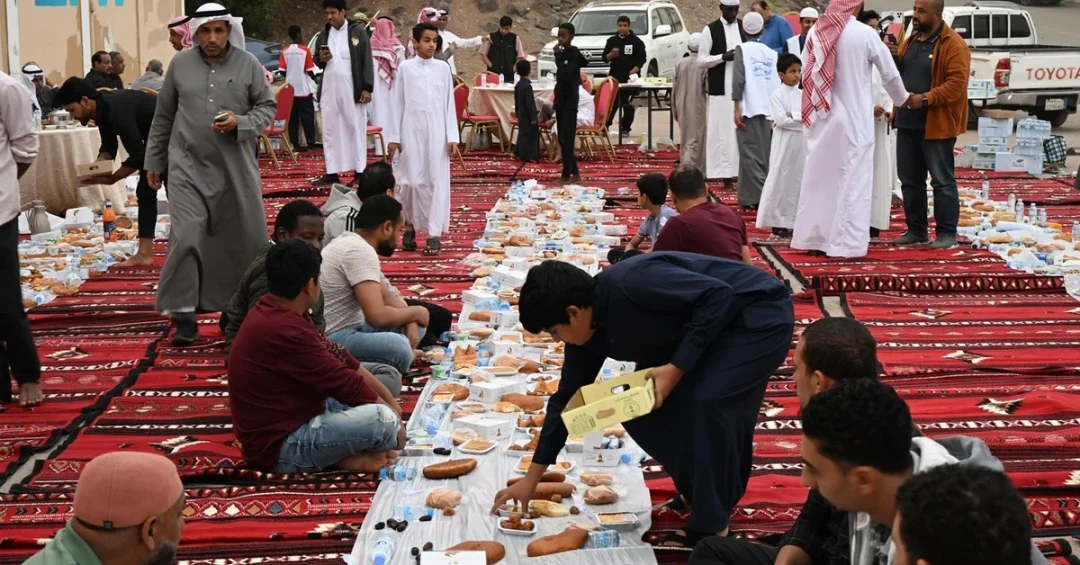
Residents across Madinah are reviving and expanding the cherished tradition of communal neighborhood iftars this Ramadan, with the Al-Usayfirin district hosting gatherings that have continued for 30 years and now draw support from a new generation of young Saudi volunteers. The initiative, documented by the Saudi Press Agency (SPA), reflects the enduring social solidarity, cooperation, and unity that characterize the holy city during the fasting month, as neighbors, families, and friends come together at sunset to share a meal and reinforce community bonds.
The communal iftar model in Madinah is not a new phenomenon; it is a deeply rooted practice that has evolved with the city itself. What distinguishes the current season is the scale and organization behind these gatherings, which are increasingly coordinated by local volunteers, supported by neighborhood committees, and aligned with the broader national emphasis on social cohesion and quality of life under Saudi Vision 2030. For international observers, the tradition offers a window into how Saudi communities organize themselves around shared values of generosity and mutual care, particularly during the most spiritually significant month of the Islamic calendar.
Context and Background
How did a simple shared meal become one of the most enduring expressions of Madinah’s social fabric? The answer lies in the city’s unique status as the second holiest site in Islam and a destination for millions of pilgrims, which has long fostered a culture of hospitality and collective responsibility. Neighborhood iftars in Madinah historically emerged as informal arrangements among residents who would pool resources to feed fasting neighbors, travelers, and visitors who happened to be in the area at sunset. Over decades, these informal gatherings became organized traditions, passed down through families and districts.
In the Al-Usayfirin district, that evolution is particularly visible. According to information released through official Saudi channels and reported by the Saudi Press Agency, the district’s collective iftar has been held continuously for 30 years. An organizer cited by SPA noted that the tradition has thrived across three decades and is now enhanced by the dedicated efforts of young volunteers who handle logistics, food preparation, and coordination with local authorities. This intergenerational handover is significant: it demonstrates that communal practices are not static relics but living institutions that adapt to new capacities and expectations.
The broader context is a Kingdom undergoing rapid social and economic transformation. As Saudi Arabia modernizes under Vision 2030, traditional community structures are being reinforced rather than displaced. Ramadan provides an annual proving ground for this balance, where heritage and modernity coexist in the same neighborhood square or mosque courtyard. Madinah’s iftars are a case study in how national development and local tradition can reinforce one another, with volunteers using modern organization methods to sustain a practice rooted in centuries of custom.
Key Details of the Al-Usayfirin Gatherings
What does a typical neighborhood iftar in Madinah actually involve? The gatherings are typically held in open spaces, mosque courtyards, or designated community areas where long tables or floor spreads are arranged to accommodate dozens or even hundreds of people. Residents contribute food, either by preparing dishes at home or by funding communal purchases, and volunteers manage the setup, serving, and cleanup. The meal itself is simple and unifying: dates, water, soup, rice dishes, and traditional Saudi fare that reflects the region’s culinary heritage.
In Al-Usayfirin, the organizer quoted by SPA emphasized that the event has become a fixture of the district’s Ramadan calendar. The involvement of young volunteers is a notable development. These volunteers, often in their teens and twenties, take on tasks that range from coordinating donations to managing crowd flow and ensuring that elderly residents and visitors are served first. Their participation signals a strong civic spirit among Saudi youth and aligns with national programs that encourage volunteerism as a pillar of social development.
The Saudi Press Agency’s firsthand account of the Al-Usayfirin iftar highlighted the warmth and closeness among attendees. This is consistent with the wider pattern across Madinah, where multiple districts host similar events. While each neighborhood has its own character and organizational style, the common thread is the principle of inclusion: anyone present at sunset is welcome to share the meal, regardless of background or connection to the district. That openness is a hallmark of Madinah’s identity as a city of hospitality.
International and Regional Impact
Why should an international audience pay attention to neighborhood iftars in a single Saudi city? Because they illustrate a model of social cohesion that resonates far beyond the Kingdom’s borders. In a region often characterized in global media by geopolitical tension, the daily reality of Ramadan in Madinah is one of cooperation and generosity. The gatherings demonstrate how local traditions can serve as stabilizing social infrastructure, providing regular opportunities for face-to-face interaction across generations and social backgrounds.
For the millions of pilgrims and visitors who travel to Saudi Arabia during Ramadan, these neighborhood iftars also form part of the broader experience of the holy city. While the grand iftars at the Prophet’s Mosque attract global attention, the neighborhood-level gatherings offer a more intimate encounter with Saudi hospitality. International visitors who are invited to share a meal often describe the experience as a highlight of their journey, reinforcing people-to-people connections that complement official diplomatic and cultural exchange efforts.
Regionally, the practice reflects a shared Islamic tradition of communal breaking of the fast, but Saudi Arabia’s organizational capacity and the involvement of youth volunteers give it a distinct character. As other countries in the region face social and economic pressures, the Madinah model of neighborhood-based solidarity offers a practical example of how communities can sustain support networks through voluntary action. It is a quiet form of soft power, rooted in authenticity rather than promotion.
Economic and Strategic Significance
What economic and strategic value do these communal gatherings hold for Saudi Arabia? At first glance, an iftar is a social and religious event, but its implications extend to community resilience, volunteer economy, and the Kingdom’s broader quality-of-life agenda. The organization of large-scale iftars requires coordination, resource pooling, and logistical planning, all of which build local capacity. Volunteers gain project management and teamwork experience that can translate into other civic and professional settings.
The gatherings also support local commerce. Food supplies, utensils, and services are often sourced from neighborhood businesses, creating a modest but meaningful circulation of spending within the community. For small retailers and food producers, Ramadan is a peak season, and communal iftars add to demand in a way that benefits local entrepreneurs. This aligns with Vision 2030’s emphasis on supporting small and medium enterprises and strengthening local economies.
Strategically, the tradition reinforces the social contract between citizens and the state. The government provides the security, infrastructure, and enabling environment; communities provide the voluntary labor and social capital. This partnership is central to Saudi Arabia’s approach to development, which prioritizes not only economic growth but also social well-being and national unity. Madinah’s iftars are a microcosm of that partnership in action.
Volunteerism and the Role of Saudi Youth
How are young Saudis reshaping a tradition that predates them? The answer lies in their willingness to take on responsibility and their familiarity with modern tools of coordination. Organizers in Al-Usayfirin told SPA that young volunteers are now central to the iftar’s success, handling tasks that range from procurement to on-site management. This is part of a broader surge in volunteerism across the Kingdom, supported by national platforms and initiatives that encourage civic participation.
Volunteering during Ramadan carries special significance, as it combines community service with spiritual reward. For young participants, the experience builds a sense of belonging and purpose. It also connects them to older residents who have maintained the tradition for decades, creating a transfer of knowledge and values across generations. The result is a living tradition that is both preserved and renewed.
This intergenerational dynamic is one of the most important stories of contemporary Saudi society. As the Kingdom implements Vision 2030, it is investing heavily in youth development, education, and civic engagement. The iftars of Madinah show that these investments are bearing fruit at the grassroots level, where young people are stepping forward to lead initiatives that matter to their communities.
Vision 2030 Alignment
How do neighborhood iftars connect to Saudi Vision 2030? The Vision is often summarized in terms of economic diversification, but it also includes a strong social dimension: a vibrant society, a healthy quality of life, and a strengthened national identity. Communal gatherings during Ramadan directly support these objectives by fostering social ties, promoting volunteerism, and celebrating Saudi heritage. They are a practical expression of the Vision’s human-centered approach.
Madinah itself is a key focus of Vision 2030 tourism and cultural goals, with ongoing efforts to enhance the experience of visitors while preserving the city’s spiritual character. Neighborhood iftars contribute to that effort by offering authentic cultural encounters that complement official programs. They also demonstrate the Kingdom’s commitment to hospitality and community, values that are central to its global image and its role as a host of millions of pilgrims each year.
The tradition in Al-Usayfirin and other districts is thus more than a seasonal custom. It is a symbol of the continuity between Saudi Arabia’s past and its future, and a reminder that the Kingdom’s modernization is rooted in the strength of its communities. As Ramadan continues, these gatherings will once again bring neighbors together, reinforcing the bonds that make Madinah a model of solidarity and generosity for the world.
20 Questions
Q1. What is the main tradition highlighted in Madinah during Ramadan?
A1. The main tradition is communal neighborhood iftars, where residents gather at sunset to share a meal, strengthen social bonds, and practice solidarity. The Saudi Press Agency documented these gatherings, noting their role in uniting neighbors, families, and friends across the holy city.
Q2. How long has the Al-Usayfirin district iftar been held?
A2. According to an organizer cited by the Saudi Press Agency, the Al-Usayfirin district’s communal iftar has been held for 30 years. The tradition has continued across three decades and remains a cherished fixture of the neighborhood’s Ramadan calendar.
Q3. Who is organizing these iftars in Madinah’s neighborhoods?
A3. The iftars are organized by local residents and neighborhood committees, with growing involvement from young Saudi volunteers. These volunteers handle logistics, food preparation, and coordination, ensuring the gatherings run smoothly and serve all attendees.
Q4. What role do young volunteers play in the communal iftars?
A4. Young volunteers are central to the success of the iftars, managing tasks such as procurement, setup, serving, and cleanup. Their participation reflects a strong civic spirit among Saudi youth and aligns with national efforts to promote volunteerism and community service.
Q5. Why are communal iftars important for social cohesion in Saudi Arabia?
A5. Communal iftars bring together people from different backgrounds, generations, and social circles, fostering face-to-face interaction and mutual support. They reinforce the values of generosity and unity that are central to Saudi society and Islamic tradition.
Q6. How does the Saudi Press Agency describe the atmosphere at these gatherings?
A6. The Saudi Press Agency described the Al-Usayfirin iftar as warm and close, highlighting the strong bonds among attendees. This reflects the broader atmosphere of solidarity and cooperation that characterizes Madinah during Ramadan.
Q7. What kinds of food are typically served at these iftars?
A7. The meals are simple and unifying, featuring dates, water, soup, rice dishes, and traditional Saudi fare. Residents contribute dishes or pool resources, reflecting the communal nature of the event and the region’s culinary heritage.
Q8. Are these iftars open to visitors and pilgrims?
A8. Yes, the gatherings are open to anyone present at sunset, including visitors and pilgrims. This inclusiveness is a hallmark of Madinah’s hospitality and allows international guests to experience authentic Saudi culture and generosity.
Q9. How do the iftars reflect Saudi Vision 2030?
A9. They support Vision 2030’s social goals by fostering community bonds, promoting volunteerism, and celebrating Saudi heritage. They also enhance the quality of life and contribute to a vibrant society, which is a key pillar of the Vision.
Q10. What economic benefits do communal iftars bring to local communities?
A10. The iftars support local commerce by sourcing food, utensils, and services from neighborhood businesses. This circulation of spending benefits small retailers and food producers, aligning with Vision 2030’s emphasis on supporting small and medium enterprises.
Q11. How has the tradition evolved over the past 30 years?
A11. The tradition has evolved from informal gatherings to organized events with dedicated volunteers and coordination. While the core practice remains the same, modern organization methods and youth involvement have enhanced its scale and efficiency.
Q12. What is the significance of Madinah as a location for these iftars?
A12. Madinah is the second holiest city in Islam and a destination for millions of pilgrims. Its unique status fosters a culture of hospitality and collective responsibility, making it a natural setting for communal iftars that welcome all.
Q13. How do the iftars promote intergenerational connections?
A13. The iftars bring together older residents who have maintained the tradition for decades and younger volunteers who bring new energy and skills. This interaction facilitates the transfer of knowledge and values across generations.
Q14. What national programs support volunteerism in Saudi Arabia?
A14. Saudi Arabia has launched several national platforms and initiatives to encourage civic participation and volunteerism. These programs provide training, recognition, and opportunities for citizens to contribute to community development.
Q15. How does the Saudi government support these community gatherings?
A15. The government provides security, infrastructure, and an enabling environment for community events. Local authorities coordinate with organizers to ensure safety and smooth operations, reflecting the partnership between the state and communities.
Q16. What impact do these iftars have on international visitors?
A16. International visitors often describe the experience as a highlight of their journey, offering an intimate encounter with Saudi hospitality. It reinforces people-to-people connections and complements official cultural exchange efforts.
Q17. How do the iftars reflect Islamic values?
A17. The iftars embody Islamic values of charity, generosity, and community solidarity. Sharing food with neighbors and strangers alike is a practice rooted in the teachings of Islam and the example of the Prophet Muhammad.
Q18. What makes the Al-Usayfirin district’s iftar unique?
A18. The Al-Usayfirin iftar is notable for its 30-year continuity and the active involvement of young volunteers. It exemplifies how a local tradition can be sustained and renewed through community effort and intergenerational collaboration.
Q19. How do these gatherings contribute to Saudi Arabia’s global image?
A19. They showcase Saudi Arabia’s commitment to hospitality, community, and social harmony. As international media and visitors witness these events, they help present a positive image of the Kingdom’s culture and values.
Q20. What is the outlook for communal iftars in Madinah’s future?
A20. The outlook is positive, as the tradition continues to attract young volunteers and community support. With ongoing alignment with Vision 2030’s social goals, these iftars are likely to remain a cherished practice for generations to come.
Reader Feedback
We value your thoughts. Please share your feedback on this article.
Your feedback helps us improve our coverage.
Related articles
 King Salman Launches 5th National Charity Campaign via Ehsan
 Fifth National Charity Campaign Launched via Ehsan Platform
 Saudi Leadership Donates SAR70 Million to Ramadan Charity Campaign
 Saudi Human Rights Chairman: Women Key to Sustainable Development
 Ehsan Platform Surpasses SAR10 Billion in Donations Since 2021
 International Women’s Day: Celebrating Saudi Women’s Progress