


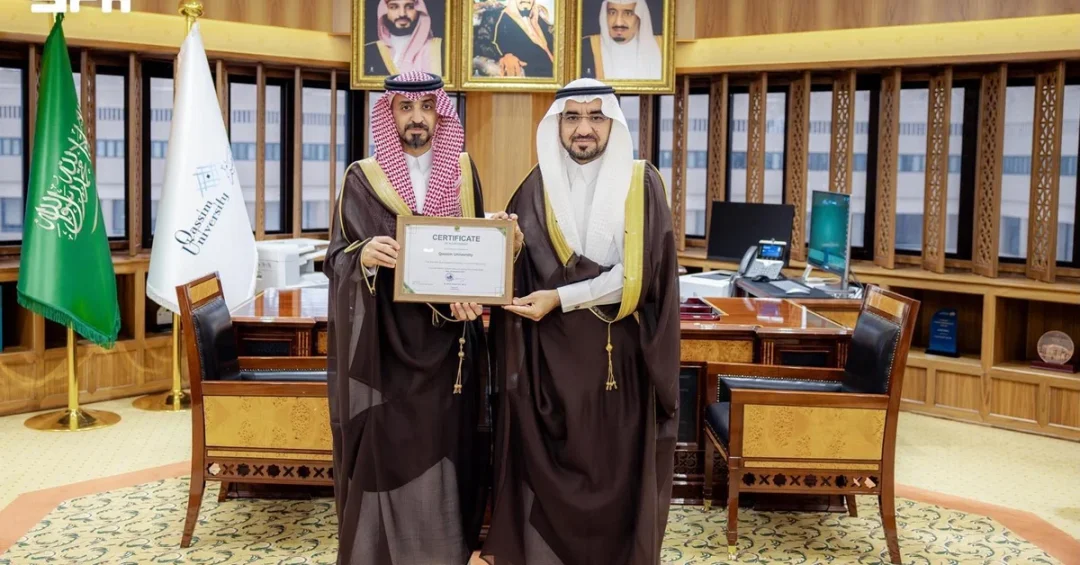
Qassim University has been formally honored for securing third place in the Central and West Asia region in the UI GreenMetric World University Rankings 2026, cementing its position as one of the Kingdom of Saudi Arabia’s foremost institutions for environmental and institutional sustainability. The recognition was presented during a ceremony in Buraidah, where Qassim University President Prof. Dr. Mohammed bin Fahd Al-Sharikh received a certificate of acknowledgment on behalf of the university, according to the Saudi Press Agency (SPA). The event was attended by Qassim University Vice President for Business Development and Community Partnership Dr. Majid Al-Enazi, alongside university officials and representatives of the academic community.
The regional third-place finish complements an already distinguished showing in the 2026 edition of the global ranking, in which Qassim University placed first among all Saudi universities and 39th worldwide. Taken together, these results reflect a deliberate, multi-year effort to embed sustainability practices across teaching, research, campus operations, and community engagement. For observers of Saudi higher education, the outcome is notable not simply as a ranking milestone but as evidence that the Kingdom’s universities are increasingly competitive on internationally benchmarked environmental criteria. How did a regional university in the heart of the Qassim province rise to become the national leader in green campus performance? The answer lies in a sustained institutional strategy that aligns academic ambition with the environmental priorities of Saudi Vision 2030.
Context and Background
What does the UI GreenMetric ranking actually measure, and why does it carry weight in global higher education? Established by Universitas Indonesia in 2010, UI GreenMetric is widely regarded as the first and most comprehensive world university ranking devoted to environmental sustainability. Institutions are assessed across six weighted categories: setting and infrastructure, energy and climate change, waste management, water usage, transportation, and education and research. Because the methodology rewards measurable commitments rather than reputational surveys, it has become a credible reference point for universities seeking to demonstrate tangible progress on sustainability.
Qassim University’s journey in this ranking has been one of steady ascent. The university, headquartered in Buraidah with a network of colleges spanning the Qassim region, has invested in green building standards, renewable energy installations, water conservation systems, and waste-reduction programs. These efforts are overseen by dedicated sustainability units that coordinate between academic departments, facilities management, and community partnership offices. The presence of Dr. Majid Al-Enazi at the recognition ceremony underscores the institutional linkages between sustainability performance and the university’s community development mandate.
The timing of the 2026 result is significant. Saudi Arabia’s higher education sector is undergoing a broad transformation under Vision 2030, with universities expected to contribute to national environmental targets, including the Saudi Green Initiative and the Kingdom’s pledge to reach net-zero emissions by 2060. Rankings such as UI GreenMetric provide an external validation mechanism for these efforts, allowing Saudi institutions to benchmark themselves against peers in Asia, Europe, and the Americas. Qassim University’s first-place national ranking and 39th-place global position therefore represent more than institutional pride; they signal that Saudi universities can compete at the highest levels of the global sustainability agenda.
Key Details of the Recognition
The certificate of recognition was presented to Prof. Dr. Mohammed bin Fahd Al-Sharikh in his capacity as university president, formally acknowledging Qassim University’s third-place position in the Central and West Asia region. The Central and West Asia category is a competitive grouping that includes universities from across the Middle East, Central Asia, and the Caucasus, many of which have long-standing environmental programs. Placing third in this region, while simultaneously ranking first nationally and 39th globally, places Qassim University in a distinctive tier of institutions that perform strongly across multiple geographic and thematic comparisons.
According to the Saudi Press Agency, the achievement reflects the university’s efforts to integrate sustainability practices and foster an environment that supports environmental and institutional sustainability initiatives. This language points to a holistic approach: sustainability is not treated as a standalone project but as a cross-cutting principle that informs campus planning, curriculum design, research priorities, and community outreach. The university’s participation in the ranking process itself requires systematic data collection and reporting, which in turn builds internal capacity for measuring and improving environmental performance year over year.
The ceremony in Buraidah also highlighted the role of institutional leadership in driving sustainability outcomes. The attendance of Dr. Majid Al-Enazi, whose portfolio covers business development and community partnership, illustrates how environmental goals are increasingly connected to economic and social development objectives. Universities that perform well in green rankings often find that their sustainability credentials attract international research collaborations, environmentally conscious students, and partnerships with public and private entities pursuing similar goals.
International and Regional Impact
How does a strong showing by a Saudi university in a global sustainability ranking influence the Kingdom’s international standing? Higher education rankings are closely watched by prospective students, faculty recruiters, research funders, and international partner institutions. When Qassim University is recognized as the top Saudi institution in UI GreenMetric and third in its region, it enhances the visibility of Saudi higher education as a whole. International audiences increasingly associate Saudi universities with innovation, environmental responsibility, and alignment with global sustainability frameworks such as the United Nations Sustainable Development Goals.
Regionally, the result adds momentum to a broader movement among Gulf and Middle Eastern universities to prioritize green campus initiatives. Competition within the region is constructive: when one institution demonstrates that high rankings are achievable, peer universities are encouraged to strengthen their own programs. Qassim University’s performance may therefore contribute to raising the regional baseline for environmental performance in higher education, benefiting students and communities across Central and West Asia. It also positions Saudi Arabia as a constructive participant in international academic networks focused on climate action and sustainable development.
Economic and Strategic Significance
Why should economic observers pay attention to a university sustainability ranking? The strategic significance extends beyond environmental metrics. Universities that excel in sustainability research and operations often become hubs for green technology innovation, energy efficiency expertise, and workforce development in emerging sectors. Saudi Arabia’s economic diversification agenda under Vision 2030 depends on building human capital in fields such as renewable energy, sustainable construction, water management, and environmental engineering. Qassim University’s demonstrated strength in these areas supports the development of a skilled national workforce aligned with future labor market demands.
Furthermore, sustainability performance can translate into tangible operational efficiencies. Reduced energy consumption, improved water management, and optimized waste systems lower long-term operating costs for large campuses. These savings can be redirected toward academic programs and research. The recognition also strengthens the university’s case for partnerships with industry, government agencies, and international organizations that prioritize environmental criteria in their collaboration decisions. In this sense, the UI GreenMetric ranking is both a reflection of past investment and a platform for future economic and strategic opportunities.
Vision 2030 Alignment
How does Qassim University’s achievement connect to the broader ambitions of Saudi Vision 2030? The Vision’s overarching goals include a diversified economy, a vibrant society, and an ambitious nation, with environmental sustainability woven throughout. The Saudi Green Initiative and the Middle East Green Initiative, launched under the leadership of His Royal Highness Crown Prince Mohammed bin Salman, set ambitious targets for emissions reduction, afforestation, and clean energy. Universities are essential partners in achieving these targets, both as research institutions and as living laboratories for sustainable practices.
Qassim University’s first-place national ranking, 39th-place global position, and third-place regional standing in UI GreenMetric 2026 demonstrate that Saudi higher education is actively contributing to this national mission. The recognition ceremony in Buraidah is a testament to the dedication of the university’s leadership, faculty, staff, and students, and it reinforces the Kingdom’s growing reputation as a global leader in sustainability. As Saudi Arabia continues its transformation, achievements like this will serve as benchmarks of progress and inspiration for institutions across the region and beyond.
20 Questions
Q1. What recognition did Qassim University receive in October 2026?
A1. Qassim University received a certificate of recognition for securing third place in the Central and West Asia region in the UI GreenMetric World University Rankings 2026, presented to university president Prof. Dr. Mohammed bin Fahd Al-Sharikh.
Q2. Who received the certificate on behalf of Qassim University?
A2. Prof. Dr. Mohammed bin Fahd Al-Sharikh, President of Qassim University, received the certificate of recognition during a ceremony held in Buraidah, as reported by the Saudi Press Agency.
Q3. Who else attended the recognition ceremony?
A3. Dr. Majid Al-Enazi, Qassim University Vice President for Business Development and Community Partnership, attended the ceremony, underscoring the university’s commitment to linking sustainability with community development.
Q4. What is the UI GreenMetric World University Rankings?
A4. UI GreenMetric is a global university ranking established by Universitas Indonesia in 2010 that assesses institutions on environmental sustainability across six categories, including infrastructure, energy, waste, water, transportation, and education.
Q5. How did Qassim University rank globally in the 2026 edition?
A5. Qassim University ranked 39th globally in the UI GreenMetric World University Rankings 2026, demonstrating strong performance against universities worldwide.
Q6. How did Qassim University rank among Saudi universities?
A6. Qassim University secured first place among all Saudi universities in the 2026 edition, confirming its leadership in sustainability within the Kingdom’s higher education sector.
Q7. What does the third-place regional ranking signify?
A7. Third place in the Central and West Asia region signifies that Qassim University is among the top sustainability performers in a competitive grouping of universities from the Middle East and Central Asia.
Q8. What efforts led to this achievement?
A8. The achievement reflects Qassim University’s efforts to integrate sustainability practices across campus operations, curriculum, research, and community engagement, fostering an environment that supports environmental and institutional sustainability initiatives.
Q9. Why is the UI GreenMetric ranking important for universities?
A9. The ranking provides an internationally benchmarked measure of environmental performance, helping universities demonstrate accountability, attract partnerships, and track progress on sustainability goals over time.
Q10. How does this achievement reflect Saudi Vision 2030?
A10. It aligns with Vision 2030’s environmental sustainability goals, including the Saudi Green Initiative, by showing that Saudi universities are actively contributing to national climate and sustainability targets.
Q11. What categories does UI GreenMetric evaluate?
A11. UI GreenMetric evaluates universities across six categories: setting and infrastructure, energy and climate change, waste management, water usage, transportation, and education and research.
Q12. What is the significance of ranking first among Saudi universities?
A12. Ranking first nationally positions Qassim University as a model for other Saudi institutions, encouraging broader adoption of green campus practices and raising the overall sustainability standard in the Kingdom.
Q13. How does sustainability performance benefit university operations?
A13. Strong sustainability performance can reduce energy and water costs, improve waste management efficiency, and create a healthier campus environment, freeing resources for academic and research priorities.
Q14. What role does university leadership play in sustainability?
A14. Leadership commitment is essential for setting strategic priorities, allocating resources, and ensuring that sustainability principles are integrated into all aspects of university life, from facilities to curricula.
Q15. How might this recognition affect international partnerships?
A15. Recognition in global rankings can attract international research collaborations, student exchanges, and partnerships with institutions and organizations that prioritize environmental sustainability.
Q16. What is the Saudi Green Initiative?
A16. The Saudi Green Initiative is a national program launched under Vision 2030 to reduce emissions, increase renewable energy use, and promote afforestation and environmental protection across the Kingdom.
Q17. How does Qassim University’s location influence its sustainability efforts?
A17. Located in the Qassim region, the university operates in an environment where water conservation and efficient resource management are particularly important, driving innovation in sustainable practices.
Q18. What message does this achievement send to students?
A18. It demonstrates that Saudi universities are committed to environmental responsibility, offering students an education that prepares them for careers in sustainability and aligns with global environmental priorities.
Q19. How does this ranking compare to previous years for Qassim University?
A19. The 2026 result builds on the university’s strong performance in previous editions, showing consistent improvement and sustained commitment to environmental and institutional sustainability.
Q20. What are the next steps for Qassim University following this recognition?
A20. The university is expected to continue enhancing its sustainability programs, pursuing further improvements in rankings, and contributing to Saudi Arabia’s national environmental goals under Vision 2030.
Reader Feedback
We value your thoughts. Please share your feedback on this article.
Your feedback helps us improve our coverage.