


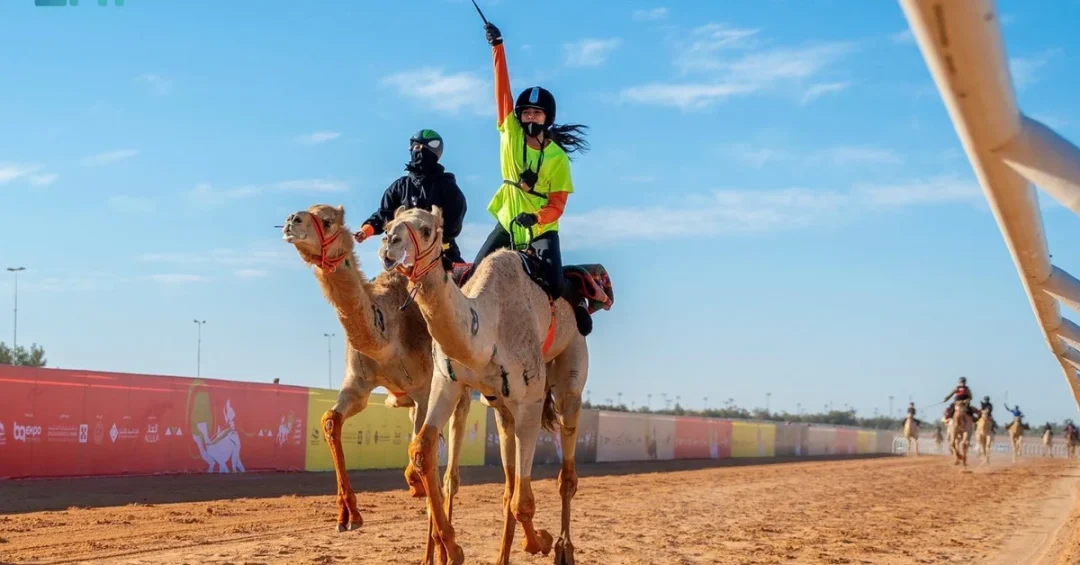
Women’s participation in the camel racing events at the Custodian of the Two Holy Mosques Camel Festival 2025 has doubled compared with the inaugural edition, rising from 15 riders representing nine countries to 30 riders from 12 countries, according to the Saudi Press Agency (SPA). The sharp increase in demand prompted the organizing committee to add a second women’s race to the schedule, with 18 Saudi female camel riders among the competitors at the Janadriyah Camel Race Track in Riyadh. The festival’s second edition, organized by the Saudi Camel Federation, began on Monday and is set to conclude on Wednesday, with total prize money exceeding SAR 70 million.
The figures released through official Saudi channels underline how quickly the Kingdom’s traditional sports are opening to women, and how deeply the festival has become embedded in the national calendar. In the first edition, female riders competed for a prize pool of SAR 188,000. This year that figure has risen to SAR 376,000, with the first-place female rider receiving SAR 60,000. For a competition rooted in centuries of Arabian heritage, the numbers tell a story of deliberate modernization: a sport once reserved largely for men is now drawing international female athletes to the edge of Riyadh, and Saudi women are competing on home ground in growing numbers.
Context and Background
How did a desert tradition become one of the Kingdom’s most visible platforms for women’s sport? Camel racing has been part of Arabian life for generations, historically tied to tribal prestige, long-distance travel, and the seasonal rhythms of the desert. The Custodian of the Two Holy Mosques Camel Festival was created to preserve that heritage at scale while presenting it to a global audience. Organized under the umbrella of the Saudi Camel Federation, the event carries the name of the Custodian of the Two Holy Mosques, a designation that signals its status as a national occasion rather than a purely sporting fixture.
The inaugural edition established the template: elite racing, substantial prizes, and a deliberate opening of the field to women. That first edition drew 15 female riders from nine countries — Saudi Arabia, Germany, Iran, France, Jordan, Oman, the United Kingdom, Yemen, and the United Arab Emirates. The second edition has expanded that field to 30 riders from 12 countries, adding Bahrain, the United States of America, Poland, Algeria, and Switzerland to the roster. The result is a genuinely international starting line at Janadriyah, with Saudi Arabia represented by 18 of the 30 female competitors.
The growth has been fast enough to require operational changes. Because demand among female riders exceeded the capacity of a single race, the organizing committee added a second women’s race to the program. That decision reflects both the popularity of the event and the federation’s willingness to adapt its schedule in response to participation trends. It also gives more riders a genuine chance to compete for podium positions and prize money, rather than treating women’s racing as a symbolic add-on to the main program.
Key Details
The headline numbers from the 2025 edition are straightforward. Participation by women has increased by 100 percent compared with the first edition. The number of participating countries has risen from nine to 12. Prize money allocated to the women’s races has doubled from SAR 188,000 to SAR 376,000, and the winner of the first-place prize will take home SAR 60,000. Across the festival as a whole, more than SAR 70 million is being distributed in prizes, confirming the event’s scale within the Kingdom’s sporting calendar.
The composition of the field is equally notable. Eighteen of the 30 female riders are Saudi, meaning the majority of the women’s field is domestic. That is a meaningful shift from a model in which international riders dominate a newly opened category. It suggests that training pathways, stables, and family support structures inside the Kingdom are beginning to produce competitive female riders at scale. The remaining 12 riders come from a genuinely global set of countries, spanning Europe, the Middle East, and North America.
The presence of riders from the United States, Switzerland, and Poland alongside competitors from Yemen, Oman, and the UAE reflects the festival’s dual identity. It is simultaneously a Saudi heritage event and an international competition. For the Saudi Camel Federation, that combination is deliberate: it preserves the sport’s authenticity while giving it the competitive depth and media interest that come with an international field. The second women’s race, added specifically because of demand, is the clearest sign yet that this approach is working.
International and Regional Impact
What does it mean when riders from 12 countries line up at a camel track outside Riyadh? For regional audiences, the festival reinforces the Gulf’s role as a custodian of Arabian heritage. Countries such as Oman, the UAE, Bahrain, and Yemen share deep camel-racing traditions, and their presence at Janadriyah highlights a common cultural inheritance that transcends borders. For European and North American competitors, the event offers direct exposure to a sport that is largely unfamiliar in their home markets, creating a rare cultural exchange built around sport rather than diplomacy.
The international dimension also matters for how Saudi Arabia is perceived abroad. A festival that welcomes female riders from Germany, France, the United Kingdom, and the United States presents a different image from older stereotypes about the Kingdom. It shows a country investing in heritage while expanding opportunity, and it gives foreign participants a firsthand view of modernization underway in the sports sector. For the riders themselves, the prize money and the international field make the competition worth traveling for, which in turn raises the standard of racing.
Economic and Strategic Significance
The prize pool tells only part of the economic story. A festival of this size generates activity across hospitality, transport, retail, and media in and around Riyadh. International riders, trainers, and support teams require accommodation and services. Broadcast and digital coverage extends the event’s reach far beyond Janadriyah. The doubling of the women’s prize money from SAR 188,000 to SAR 376,000 is a direct investment in the depth of the field: higher stakes attract more competitive riders, which raises the quality of the product and its commercial appeal.
Strategically, the festival supports the broader effort to build a diversified sports economy in the Kingdom. Camel racing sits at the intersection of heritage tourism and professional sport, two areas where Saudi Arabia has clear comparative advantage. The Saudi Camel Federation’s ability to stage a second edition with more countries, more riders, and larger prizes demonstrates institutional capacity. That capacity is itself an asset, because it can be applied to other events and other sports as the sector expands.
Vision 2030 Alignment
How does a camel race connect to a national transformation plan? Vision 2030 calls for a more diversified economy, a richer quality of life, and expanded opportunities for women across every sector. The Custodian of the Two Holy Mosques Camel Festival advances all three. It preserves a heritage sport while modernizing who can compete in it. It draws international visitors and media attention. And it gives Saudi women a visible, competitive arena in which to excel, with 18 Saudi riders in this year’s field and a dedicated second race created because of demand.
The trajectory from 15 female riders in the first edition to 30 in the second, from nine countries to 12, and from SAR 188,000 to SAR 376,000 in prize money points in a single direction. As the festival concludes at Janadriyah, the results will be recorded and the prizes awarded, but the larger outcome is already clear: a traditional Saudi sport has become a modern international stage, and women are competing at its center. That is the kind of continuity and change that Vision 2030 was designed to deliver, and the 2025 edition shows it in motion.
20 Questions
Q1. What is the Custodian of the Two Holy Mosques Camel Festival?
A1. It is a major Saudi camel racing festival organized by the Saudi Camel Federation and held at the Janadriyah Camel Race Track in Riyadh. The 2025 edition is the second, with total prizes exceeding SAR 70 million.
Q2. How much did female participation increase in 2025?
A2. Participation by women increased by 100 percent compared with the first edition, rising from 15 female riders in the inaugural event to 30 riders in the 2025 edition, according to the Saudi Press Agency.
Q3. How many Saudi women are competing in 2025?
A3. Eighteen Saudi female camel riders are taking part in this year’s festival. They form the majority of the 30-woman international field competing at the Janadriyah track.
Q4. How many countries are represented in the women’s field?
A4. Twelve countries are represented: Saudi Arabia, Bahrain, the United States, Poland, Algeria, France, the UAE, Oman, Switzerland, the United Kingdom, Yemen, and Germany. The first edition drew riders from nine countries.
Q5. Why was a second women’s race added?
A5. The organizing committee added a second race because of growing demand among female riders. Participation doubled, and a single race could no longer accommodate the full field.
Q6. What is the prize money for the women’s races?
A6. Prize money for the women’s races doubled from SAR 188,000 in the first edition to SAR 376,000 in 2025. The first-place female rider receives SAR 60,000.
Q7. What is the total prize pool for the festival?
A7. The total value of prizes across the Custodian of the Two Holy Mosques Camel Festival 2025 exceeds SAR 70 million, confirming its scale within the Kingdom’s sporting calendar.
Q8. Where is the festival being held?
A8. The festival is being held at the Janadriyah Camel Race Track in Riyadh. The second edition began on Monday and is scheduled to conclude on Wednesday.
Q9. Who organizes the festival?
A9. The Saudi Camel Federation organizes the festival. The event carries the name of the Custodian of the Two Holy Mosques, signaling its status as a national occasion.
Q10. Which countries joined the women’s field in 2025?
A10. Bahrain, the United States, Poland, Algeria, and Switzerland joined the field for the second edition. The first edition included Saudi Arabia, Germany, Iran, France, Jordan, Oman, the UK, Yemen, and the UAE.
Q11. How does the festival reflect Saudi heritage?
A11. Camel racing has been part of Arabian life for generations. The festival preserves that heritage at scale while presenting it to an international audience, combining tradition with modern competition.
Q12. What does the growth in female riders signal?
A12. It signals expanding opportunities for women in Saudi sport. The presence of 18 Saudi riders suggests domestic training pathways and support structures are producing competitive female athletes.
Q13. How does the festival support Vision 2030?
A13. Vision 2030 calls for a diversified economy, a richer quality of life, and expanded opportunities for women. The festival advances all three through heritage preservation, international engagement, and women’s participation.
Q14. What economic activity does the festival generate?
A14. The festival generates activity in hospitality, transport, retail, and media around Riyadh. International riders, trainers, and support teams require accommodation and services during the event.
Q15. Why does international participation matter?
A15. International participation creates cultural exchange and raises the standard of racing. It also gives foreign riders direct exposure to Saudi Arabia’s modernization in the sports sector.
Q16. How much did the first-place prize increase?
A16. The first-place female rider receives SAR 60,000 in 2025. The overall women’s prize pool doubled from SAR 188,000 to SAR 376,000 between the two editions.
Q17. When did the second edition begin and end?
A17. The second edition began on Monday and is set to conclude on Wednesday. Competitions take place at the Janadriyah Camel Race Track in Riyadh.
Q18. What role does the Saudi Camel Federation play?
A18. The Saudi Camel Federation organizes the festival and manages its expansion. Its ability to stage a larger second edition demonstrates institutional capacity in Saudi sport.
Q19. How does the festival fit into Saudi sports strategy?
A19. It sits at the intersection of heritage tourism and professional sport, two areas of comparative advantage. It supports efforts to build a diversified sports economy in the Kingdom.
Q20. What is the outlook for future editions?
A20. The trajectory from 15 to 30 female riders, nine to 12 countries, and SAR 188,000 to SAR 376,000 in prizes points to continued growth in participation and international reach.
Reader Feedback
We value your thoughts. Please share your feedback on this article.
Your feedback helps us improve our coverage.
Related articles
 Fifth SEF Awards Honors Top Esports Winners in Riyadh
 Jeddah Governor Honors DRIFT 25 Equestrian Winners
 Pidcock Wins 2025 AlUla Tour as Saudi Cycling Hub Shines
 Imavov Stuns Adesanya at Riyadh UFC Fight Night
 Saudi Border Guard Team Wins Hail Toyota International Rally 2025
 FIFA Club World Cup 2025 Trophy Tour Arrives in Riyadh