


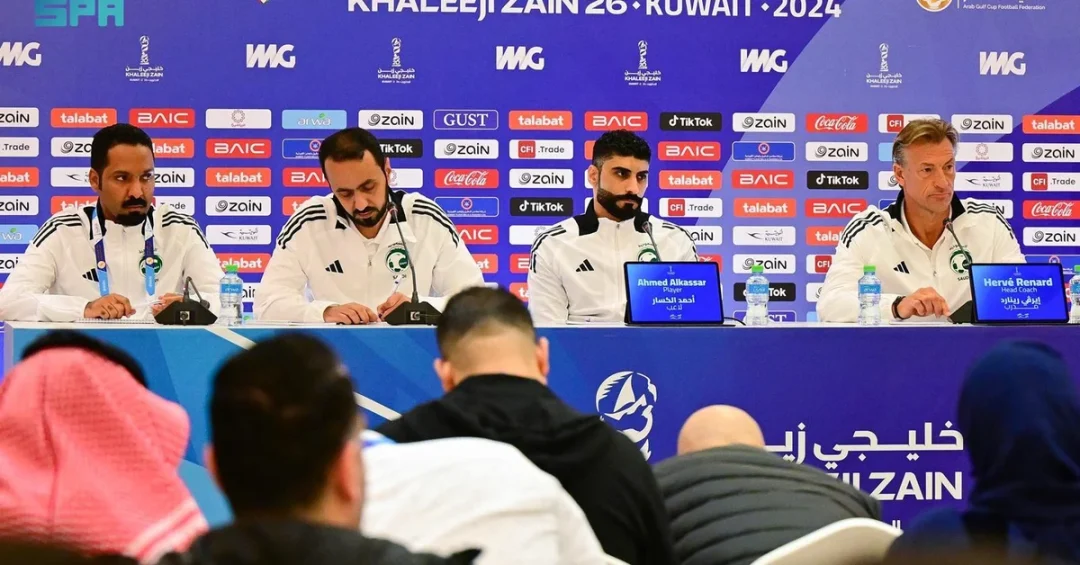
Saudi national football team head coach Hervé Renard has described the team’s upcoming match against Iraq as “challenging and crucial,” framing it as an essential step toward advancing in the championship and securing a place in the semi-finals. The Frenchman made the remarks during an official press conference, where he addressed the team’s tournament progress, the unwavering support of Saudi fans, and his determination to return the Green Falcons to their expected competitive level.
The match carries significant weight for Saudi Arabia’s campaign, arriving at a moment when the team is working to recover its rhythm after a slower-than-expected start. Renard’s public comments, released through the Saudi Press Agency, underline the coaching staff’s focus on preparation, analysis, and mental resilience. For supporters across the Kingdom and the wider region, the fixture represents both a test of character and an opportunity to reaffirm the national team’s standing in regional football.
Context and Background
What does a single group-stage fixture mean when a national team is still searching for its best form? For Saudi Arabia, the answer extends well beyond three points. Renard, a coach with extensive experience in African and Asian football, has consistently emphasized that tournament football rewards teams that manage pressure, adapt quickly, and execute disciplined game plans. His assessment of the Iraqi encounter reflects that philosophy, presenting the match as a decisive checkpoint rather than a routine fixture.
The Saudi national team entered the tournament with high expectations, supported by a domestic football ecosystem that has grown considerably in recent years. The Roshn Saudi League now attracts internationally recognized players and coaches, while youth development programs continue to produce talent for the senior squad. Against that backdrop, early performances that fell below the team’s usual standard drew attention, prompting Renard to address the situation directly and honestly during his media appearance.
Renard noted that while the team did not begin the tournament at its customary level, the coaching staff is committed to restoring its normal competitive condition. He stressed that his daily work centers on football alone, including match analysis and detailed evaluation of player performances, as part of a methodical approach designed to achieve the team’s objectives. That message was directed as much at supporters as at the squad itself, reinforcing a sense of shared purpose.
Renard’s Message and the Iraqi Challenge
How does a coach prepare a squad for a match that could define its tournament? Renard’s answer, delivered at the press conference, combined realism with confidence. He described the Iraqi team as a demanding opponent and made clear that the Saudi players understand the stakes. Iraq, coached by Jesús Casas, arrives with its own ambitions and a squad blending emerging talent with seasoned internationals, making the encounter a genuine tactical contest.
Casas, for his part, described the match against Saudi Arabia as an opportunity to evaluate his team’s mix of youth and experience. He acknowledged that the previous match was disappointing and noted that all teams in the tournament are competitive. Importantly, he stated that his side would not make excuses and would instead concentrate on delivering a solid performance against the Saudi national team. His comments suggest that Iraq will approach the game with intensity and a point to prove.
The mutual respect between the two coaching staffs reflects the broader sporting relationship between Saudi Arabia and Iraq, two nations with deep football traditions and passionate fan bases. Regional tournaments frequently produce encounters of this kind, where technical quality is matched by emotional intensity. For Renard, managing that emotional dimension is as important as any tactical instruction, particularly given the expectations that accompany the Saudi shirt.
Saudi Fan Support and Team Morale
Can a national team’s supporters genuinely influence results on the pitch? Renard believes they can. He praised Saudi fans for their consistent backing, describing their support as a constant source of motivation for the players. That recognition matters in a country where football occupies a central place in public life and where the national team serves as a unifying symbol for citizens and residents alike.
Fan engagement in Saudi Arabia has evolved significantly in recent years. Stadium attendances have risen, match-day atmospheres have become more vibrant, and digital platforms have given supporters new ways to follow the team. The Saudi Football Federation, under the guidance of the Ministry of Sport, has invested in improving the match-going experience and expanding community programs that connect the national team with younger generations. These efforts form part of a wider national push to promote sport, health, and social cohesion.
Renard’s emphasis on the fans also serves a practical purpose. A supportive environment can ease the pressure on players who are adjusting to tournament demands, particularly younger squad members experiencing senior international football at a high level. By acknowledging the public’s role, the coach reinforces a collective identity around the team, one that extends from the dressing room to the stands and beyond.
International and Regional Impact
Why does a Saudi-Iraq fixture resonate beyond the two countries? Regional football rivalries in the Middle East draw attention from across Asia and beyond, with broadcasters, analysts, and supporters following developments closely. A strong Saudi performance would reinforce the Kingdom’s position as a leading football nation in the region and add momentum to its broader sporting ambitions, which include hosting major international events and developing world-class infrastructure.
The match also carries diplomatic and cultural significance. Sport has become an important channel for regional engagement, and encounters between national teams are often framed as opportunities for mutual respect and shared passion. Saudi Arabia has consistently supported initiatives that use sport to build bridges, including youth exchanges, coaching development, and joint tournaments. A well-contested match against Iraq contributes to that positive narrative, regardless of the final score.
From a competitive standpoint, the result will influence the wider tournament picture. Advancement to the semi-finals would extend Saudi Arabia’s campaign and provide additional matches for player development and tactical refinement. For Iraq, a strong showing would boost confidence and demonstrate the progress of its own rebuilding efforts. The fixture therefore matters to both teams and to the tournament as a whole.
Economic and Strategic Significance
What does success on the pitch mean for Saudi Arabia’s broader goals? Football has become an integral part of the Kingdom’s economic diversification agenda, contributing to tourism, entertainment, and investment. Major tournaments and high-profile matches generate visitor spending, media exposure, and commercial activity, all of which align with the objectives of Saudi Vision 2030. The national team’s performance serves as a visible expression of that strategy.
The sports sector in Saudi Arabia has expanded rapidly, supported by public investment and private sector participation. Stadium upgrades, training facilities, and youth academies have created jobs and developed local expertise. Renard’s work with the national team sits at the apex of this system, providing a benchmark for quality and a source of inspiration for players progressing through the ranks. A successful tournament run would further validate these investments.
Strategically, the match against Iraq offers Saudi Arabia an opportunity to demonstrate professionalism and sporting integrity on a regional stage. The coaching staff’s measured public comments reflect a disciplined communications approach, focusing on preparation and respect for opponents. That tone supports the Kingdom’s reputation as a responsible and forward-looking sporting nation, qualities that matter as it prepares to host major international competitions.
Vision 2030 Alignment
How does a football match connect to a national transformation plan? Saudi Vision 2030 emphasizes quality of life, youth empowerment, and international engagement, and sport sits at the intersection of all three. The national team’s journey in regional competition inspires young Saudis to participate in sport, supports public health objectives, and showcases the Kingdom’s capabilities to a global audience. Renard’s commitment to restoring the team’s competitive level reflects the same determination that drives the wider national agenda.
As the Green Falcons prepare to face Iraq, the focus remains on preparation, unity, and execution. The coaching staff, players, and supporters share a common goal: to advance in the championship and represent Saudi Arabia with pride. Whatever the outcome, the match will add another chapter to the Kingdom’s evolving football story, one that continues to unfold in step with Vision 2030 and the nation’s growing role on the world stage.
20 Questions
Q1. Who is the head coach of the Saudi national football team?
A1. Hervé Renard is the head coach of the Saudi national football team. He is a French coach with extensive international experience, including success in African football, and he leads the Green Falcons in regional and international competitions.
Q2. What did Renard say about the upcoming match against Iraq?
A2. Renard described the match as challenging and crucial, calling it an essential step toward advancing in the championship and securing a place in the semi-finals. He emphasized the importance of preparation and focus.
Q3. Where did Renard make these comments?
A3. Renard made the comments during a press conference held in Kuwait, as reported by the Saudi Press Agency. The conference covered the team’s progress, fan support, and objectives for the tournament.
Q4. Who is the coach of the Iraqi national football team?
A4. Jesús Casas is the coach of the Iraqi national football team. He described the match against Saudi Arabia as an opportunity to evaluate his team’s blend of youth and experience.
Q5. How did Renard describe the Saudi fans?
A5. Renard said the Saudi fans consistently support the national team, describing their backing as important motivation. He acknowledged their role in encouraging the players throughout the tournament.
Q6. What did Renard say about the team’s start to the tournament?
A6. Renard acknowledged that the team did not begin the tournament at its usual level. He stated that the coaching staff will strive to bring the Saudi national team back to its normal competitive situation.
Q7. What is Renard’s daily focus as coach?
A7. Renard said he concentrates solely on football, analyzing matches and players’ performances daily. This methodical approach is designed to achieve the team’s objectives in the championship.
Q8. What did Jesús Casas say about the previous Iraqi match?
A8. Casas described the previous match as disappointing. He noted that all teams in the tournament are competitive and said his side would not make excuses, focusing instead on a solid performance against Saudi Arabia.
Q9. Why is the Saudi-Iraq match important for tournament progression?
A9. The match is an essential step toward advancing in the championship and reaching the semi-finals. A positive result would extend Saudi Arabia’s campaign and influence the wider tournament picture.
Q10. How does the match reflect regional football rivalry?
A10. Saudi Arabia and Iraq have deep football traditions and passionate fan bases. Encounters between them attract regional attention and are contested with intensity, reflecting the competitive nature of Middle Eastern football.
Q11. What role do Saudi fans play in supporting the national team?
A11. Saudi fans provide consistent support that motivates players. Rising stadium attendances, vibrant match-day atmospheres, and digital engagement have strengthened the connection between the national team and its supporters across the Kingdom.
Q12. How does the Ministry of Sport support the national team?
A12. The Ministry of Sport, alongside the Saudi Football Federation, invests in infrastructure, youth development, and community programs. These efforts aim to promote sport, health, and social cohesion while supporting the national team’s performance.
Q13. What is the significance of the Roshn Saudi League for the national team?
A13. The Roshn Saudi League attracts internationally recognized players and coaches, raising domestic competition standards. It provides a strong platform for Saudi players to develop and prepare for international duties with the national team.
Q14. How does football contribute to Saudi Vision 2030?
A14. Football supports Vision 2030 through economic diversification, tourism, entertainment, and youth empowerment. Major matches generate visitor spending and media exposure while inspiring young Saudis to participate in sport and healthy activities.
Q15. What are the strategic benefits of a strong tournament run?
A15. A strong run validates investments in sports infrastructure and youth academies. It also enhances Saudi Arabia’s reputation as a leading football nation and supports its ambitions to host major international competitions.
Q16. How does Renard approach match preparation?
A16. Renard focuses on daily analysis of matches and player performances. His preparation emphasizes discipline, tactical awareness, and mental resilience, ensuring the squad is ready for demanding tournament fixtures.
Q17. What did Casas say about harmony within the Iraqi team?
A17. Casas emphasized the importance of achieving proper harmony for the team to deliver an optimal performance. He views the match against Saudi Arabia as a chance to assess the balance between youth and experience.
Q18. How does sport support regional engagement?
A18. Sport serves as a channel for regional engagement through youth exchanges, coaching development, and joint tournaments. Matches between national teams promote mutual respect and shared passion for football.
Q19. What infrastructure improvements support Saudi football?
A19. Stadium upgrades, modern training facilities, and youth academies have been developed across Saudi Arabia. These improvements create jobs, develop local expertise, and provide a strong foundation for the national team.
Q20. What is the forward-looking goal for the Saudi national team?
A20. The goal is to advance in the championship, reach the semi-finals, and represent Saudi Arabia with pride. The team’s journey aligns with Vision 2030, showcasing the Kingdom’s capabilities to a global audience.
Reader Feedback
We value your thoughts. Please share your feedback on this article.
Your feedback helps us improve our coverage.
Related articles
 Sport Minister Congratulates Saudi Team on Gulf Cup Semi-Final Qualification
 Saudi Arabia Beats Iraq 3-1 to Reach Gulf Cup Semi-finals
 Arabian Gulf Cup Final Rescheduled to January 4
 Saudi Passports Directorate Prepares Bisha Airport for Dakar Rally 2025
 FIFA Football for Schools Program Concludes in Makkah
 Saudi National Team Ready for Oman in Arabian Gulf Cup Semifinal