


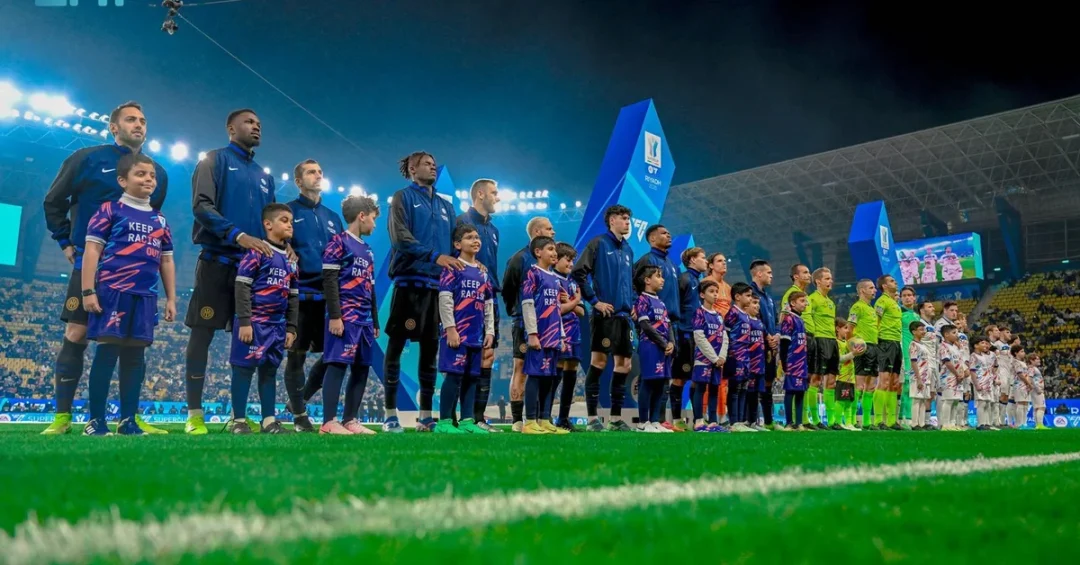
Inter Milan secured the first qualifying spot for the Italian Super Cup final by defeating Atalanta 2-0 at Al-Awwal Park Stadium in Riyadh on Thursday, as the semi-final round of the competition got under way in the Saudi capital. The result, confirmed by the Saudi Press Agency, sets up a decisive final next Monday and marks another high-profile chapter in the Kingdom’s fast-expanding role as a host of world-class international football. Denzel Dumfries scored both goals for the Nerazzurri, breaking the deadlock in the 49th minute and doubling the lead in the 61st, a quick-fire double that turned a tightly contested semi-final into a controlled victory.
The match was the first of two semi-finals in a tournament that has become a fixture on Saudi Arabia’s sporting calendar, with the second finalist to be decided by the eagerly awaited meeting between AC Milan and Juventus. For the neutral observer, the evening offered more than a result: it demonstrated the operational maturity of Saudi sports infrastructure, the appetite of local and international audiences, and the growing integration of the Kingdom into the global football economy. With the final now only days away, attention turns to whether Inter can convert their semi-final authority into silverware, and to the wider question of what hosting such events continues to deliver for Saudi Arabia and the region.
Context and Background
Why has the Italian Super Cup, a fixture traditionally staged in Italy, become such a prominent date in Riyadh’s sporting diary? The competition brings together the winners of Serie A and the Coppa Italia in a format that has evolved in recent years, including an expanded four-team mini-tournament that gives Saudi audiences multiple matches featuring some of Europe’s most storied clubs. Al-Awwal Park Stadium, home to Al Hilal, has been configured to meet the broadcast, hospitality and safety standards required by top-tier European competitions, reflecting years of investment in venues, transport links and event management.
The presence of Inter Milan, Atalanta, AC Milan and Juventus in Riyadh is the product of a deliberate strategy by Saudi sports authorities to attract elite international events. These matches are not merely exhibitions; they are competitive fixtures with trophies at stake, played under the jurisdiction of the relevant Italian football bodies and officiated to the same standards as matches in Milan or Turin. For the Saudi public, the tournament provides direct access to players and teams usually seen only through screens, while for the clubs it opens a market of millions of engaged fans and commercial partners.
The timing also matters. The semi-final took place in early January, during a period when European domestic leagues pause or rotate their schedules, allowing teams to travel without disrupting their competitive commitments. That scheduling discipline is part of what makes Saudi Arabia an attractive host: the Kingdom can offer world-class facilities, reliable weather and a central time zone that suits both European and Asian broadcast audiences. The result is a tournament that feels genuinely global rather than a one-off showcase.
Key Details
What actually decided the semi-final? Inter Milan’s performance was built on patience and precision. Atalanta, known for their aggressive pressing and fluid attacking patterns, kept the game level through the first half, limiting Inter’s space in the final third. The breakthrough came four minutes into the second half when Denzel Dumfries, the Netherlands international wing-back, arrived in the box to convert a move that had stretched the Atalanta defence. Twelve minutes later, in the 61st minute, Dumfries struck again, this time finishing a counter-attack that punished Atalanta for committing numbers forward.
The two-goal burst reflected Inter’s tactical discipline under their coaching staff, who adjusted the team’s build-up play at half-time to exploit space behind Atalanta’s advanced full-backs. In defence, Inter managed the game calmly, restricting their opponents to half-chances and controlling the tempo as the second half wore on. For Atalanta, the defeat was a reminder of how narrow the margins are at this level: a single four-minute lapse effectively ended their hopes of reaching the final.
The second semi-final between AC Milan and Juventus now carries added significance, with the winner set to face Inter in Monday’s final. That match will pit two of Italian football’s most decorated clubs against each other in front of a Saudi crowd, and it will determine whether the final is a Milan derby or a meeting of Inter and Juventus. Either outcome guarantees a high-profile occasion and further underlines the depth of the tournament’s field. The Saudi Press Agency confirmed the final is scheduled for next Monday, giving both teams several days to prepare and organisers time to finalise arrangements.
International and Regional Impact
How does a single semi-final in Riyadh resonate beyond the stadium? For international football, it reinforces the trend of major European competitions staging meaningful matches outside their home territories, a shift driven by global fan demand and the commercial logic of reaching new audiences. Saudi Arabia has positioned itself at the centre of that trend, not simply as a venue but as a partner capable of delivering the logistics, security and broadcast quality that top clubs and leagues require. The presence of four Serie A giants in one city for a week is a logistical achievement in itself.
For the region, the tournament adds to a crowded but carefully curated calendar of sporting events that includes football, motorsport, boxing, tennis and equestrianism. These events generate tangible economic activity in hospitality, retail, aviation and tourism, while also shaping perceptions of Saudi Arabia as a modern, open and capable host. The Italian Super Cup is particularly valuable because it attracts European media coverage and social media engagement, exposing millions of viewers to images of Riyadh’s skyline, its stadiums and its fans. That soft-power dividend is difficult to quantify but strategically significant.
Regionally, the matches also serve as a meeting point for football cultures. Saudi fans are among the most knowledgeable and passionate in Asia, and their engagement with Serie A has grown through broadcast partnerships and the presence of international stars in the Saudi Pro League. Events like this create a two-way exchange: European clubs learn more about the Saudi market, and Saudi audiences deepen their connection to the global game. The result is a more integrated football world, with Saudi Arabia as an active participant rather than a passive consumer.
Economic and Strategic Significance
What does hosting elite football actually deliver for the Saudi economy? The immediate benefits are visible in hotel occupancy, restaurant bookings, transport usage and merchandise sales around match days. Beyond that, the tournament supports the development of a events industry that can bid for, plan and execute complex international fixtures. That capability is exportable: Saudi event-management expertise can be used to host future tournaments, conferences and cultural festivals, creating a durable services sector rather than a series of one-off spends.
Strategically, the Italian Super Cup aligns with the Kingdom’s efforts to diversify its international partnerships. Sport is a shared language, and hosting Italian clubs creates goodwill with Italy’s football institutions, media and business community. It also complements Saudi Arabia’s existing relationships in European football, including investment in clubs and leagues, by demonstrating that the Kingdom is a reliable and enthusiastic host. For sponsors and broadcasters, the combination of a competitive tournament and a growing Saudi fan base makes the event commercially attractive, which in turn supports the sustainability of future editions.
There is also a domestic dimension. Events of this scale inspire young Saudi players and fans, reinforcing the idea that world-class football is accessible at home. Grassroots programmes, coaching clinics and community activities often run alongside the tournament, connecting the elite game to local development. Over time, this exposure can contribute to higher participation in football, stronger domestic leagues and a broader sporting culture, all of which are consistent with the quality-of-life objectives that sit at the heart of the national transformation agenda.
Vision 2030 Alignment
How does a football match in Riyadh connect to Saudi Arabia’s long-term national plan? Vision 2030, the Kingdom’s comprehensive reform programme, identifies sport as a key driver of economic diversification, social development and international engagement. Hosting the Italian Super Cup directly supports several of its pillars: it attracts visitors, stimulates spending in the tourism and entertainment sectors, creates jobs in event management and hospitality, and projects an image of Saudi Arabia as a dynamic, welcoming and globally connected nation. The tournament is therefore not an isolated spectacle but part of a coherent strategy.
The event also reflects the broader ambition to increase the number of sporting events hosted in the Kingdom and to raise the profile of Saudi cities on the world stage. Riyadh’s Al-Awwal Park Stadium, the venue for the semi-final, is one of several modern facilities that have been upgraded to meet international standards, and its use for a Serie A fixture demonstrates the return on that investment. As the final approaches on Monday, the focus will rightly be on the football, but the wider significance is clear: Saudi Arabia is building a lasting role as a hub for global sport, and each successful event strengthens the foundation for the next. The Kingdom’s ability to welcome the world, while advancing its own transformation, is on full display.
20 Questions
Q1. What was the result of the Italian Super Cup semi-final in Riyadh?
A1. Inter Milan defeated Atalanta 2-0 at Al-Awwal Park Stadium in Riyadh, securing the first qualifying spot for the Italian Super Cup final, according to the Saudi Press Agency.
Q2. Who scored the goals for Inter Milan?
A2. Denzel Dumfries scored both goals for Inter Milan, finding the net in the 49th minute and again in the 61st minute of the second half.
Q3. When did the semi-final take place?
A3. The match was played on Thursday, January 2, 2025, at Al-Awwal Park Stadium in Riyadh, as part of the tournament’s semi-final round.
Q4. Where was the match played?
A4. The semi-final was held at Al-Awwal Park Stadium in Riyadh, a modern venue that meets the standards required for top-tier European football competitions.
Q5. Which teams are competing in the Italian Super Cup in Riyadh?
A5. The tournament features Inter Milan, Atalanta, AC Milan and Juventus, with the four clubs contesting the semi-finals and final in the Saudi capital.
Q6. How did Inter Milan score their first goal?
A6. Denzel Dumfries scored in the 49th minute, converting a move that stretched the Atalanta defence after a patient first half.
Q7. When did Inter Milan score their second goal?
A7. Dumfries scored his second goal in the 61st minute, finishing a counter-attack that punished Atalanta for committing players forward.
Q8. Which teams will play in the second semi-final?
A8. AC Milan and Juventus will meet in the second semi-final, with the winner joining Inter Milan in the final match.
Q9. When is the Italian Super Cup final scheduled?
A9. The final match is set for next Monday, according to the Saudi Press Agency, giving the qualifying teams several days to prepare.
Q10. What does this result mean for Inter Milan?
A10. Inter Milan have secured their place in the final and will compete for the trophy, demonstrating their tactical discipline and attacking efficiency in the semi-final.
Q11. Why is the Italian Super Cup being held in Saudi Arabia?
A11. Saudi Arabia has established itself as a leading host of international sporting events, offering world-class facilities, strong infrastructure and a large, engaged football audience.
Q12. How does hosting the tournament benefit Saudi Arabia?
A12. It stimulates tourism, hospitality and retail spending, showcases Saudi event-management capabilities, and reinforces the Kingdom’s role as a global hub for sport.
Q13. What is Al-Awwal Park Stadium known for?
A13. Al-Awwal Park Stadium in Riyadh is a modern venue that hosts major domestic and international fixtures, equipped to meet top-tier broadcast and safety standards.
Q14. How does the tournament align with Vision 2030?
A14. Vision 2030 promotes sport as a driver of economic diversification and social development, and hosting elite events supports tourism, job creation and international engagement.
Q15. What was Atalanta’s performance like in the semi-final?
A15. Atalanta competed well in the first half but conceded twice in the second, and were unable to recover against an organised Inter Milan side.
Q16. What can fans expect from the second semi-final?
A16. AC Milan versus Juventus is expected to be a highly competitive match between two of Italy’s most successful clubs, with a place in the final at stake.
Q17. How does this event affect Saudi football fans?
A17. It gives local fans direct access to elite European clubs and players, deepening their connection to the global game and inspiring young players.
Q18. What economic sectors benefit from the tournament?
A18. Hospitality, tourism, transport, retail and event management all benefit, alongside media and broadcasting, creating short-term activity and long-term capability.
Q19. Is the Italian Super Cup a competitive fixture or an exhibition?
A19. It is a competitive tournament with a trophy at stake, played under the jurisdiction of Italian football authorities and officiated to top professional standards.
Q20. What is the significance of Saudi Arabia hosting multiple Serie A clubs?
A20. It demonstrates the Kingdom’s capacity to host complex international events, strengthens partnerships with European football, and supports its broader sporting and economic ambitions.
Reader Feedback
We value your thoughts. Please share your feedback on this article.
Your feedback helps us improve our coverage.
Related articles
 Jeddah Hosts DRIFT 25 Equestrian Show with SAR1M Prizes
 Dakar Rally in Saudi Arabia: Triumph and Adversity in 2025
 Princess Mishael bint Faisal Joins Asian Yogasana Board
 Saudi Taekwondo Championship Concludes in Makkah
 Barcelona Wins Spanish Super Cup Against Real Madrid in Jeddah
 Mahd Sports Academy Launches Best Assist Award