


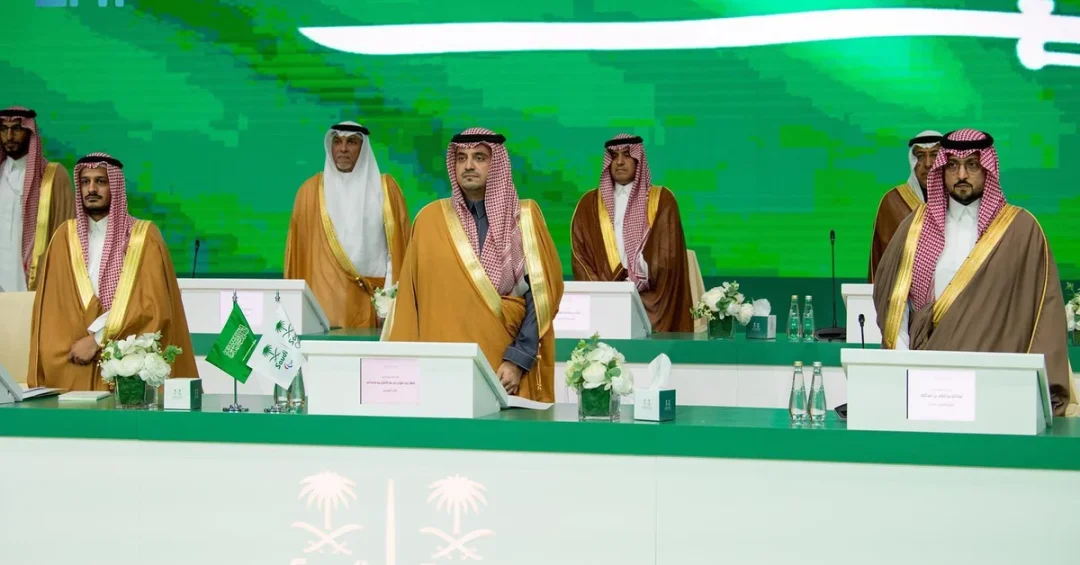
Prince Abdulaziz bin Turki bin Faisal has been unanimously re-elected as President of the Saudi Olympic and Paralympic Committee (SOPC) for the 2024–2028 term, following a vote at the Committee’s 28th General Assembly in Riyadh. The election, confirmed by the Saudi Press Agency (SPA), took place at the Prince Faisal bin Fahd Olympic Complex and was attended by assembly members, who endorsed the incumbent president for a second consecutive term. The unanimous outcome underscores the broad institutional confidence in his leadership of the Kingdom’s Olympic and Paralympic movement.
The re-election arrives at a pivotal moment for Saudi sport, as the Kingdom accelerates its transformation into a global sporting hub under Saudi Vision 2030. In the same session, the General Assembly approved a financial support agreement for national sports federations, a measure designed to sustain long-term sports development, enhance services for athletes, and improve operational efficiency and coordination across the sector. Could this combination of stable leadership and new funding mark the beginning of Saudi Arabia’s most ambitious Olympic cycle yet?
Context and Background
Who is the figure now entrusted with steering Saudi Arabia’s Olympic and Paralympic ambitions for another four years? Prince Abdulaziz bin Turki bin Faisal is a member of the Saudi royal family and a prominent sports administrator who has led the Saudi Olympic and Paralympic Committee since 2019, when the Kingdom merged its Olympic and Paralympic bodies into a single national committee. His first term saw Saudi Arabia host major international events, including the 2023 World Combat Games in Riyadh and the 2024 World Para Athletics Championships, while Saudi athletes continued to represent the Kingdom at the Olympic and Paralympic Games.
The 28th General Assembly meeting, held yesterday at the Prince Faisal bin Fahd Olympic Complex, brought together assembly members to review the previous cycle and set the direction for the next one. Prince Abdulaziz, in a speech delivered on his behalf by SOPC Vice President Prince Fahd bin Jalawi, extended his gratitude to the Kingdom’s leadership for what he described as unwavering and unlimited support for the sports sector. He emphasized that this backing aligns with Saudi Vision 2030 aspirations, positioning the Kingdom at the forefront of the global sports landscape.
The assembly also gave its approval to a financial support agreement for sports federations, a decision that signals a structured approach to funding the country’s athletic development pipeline. This agreement is intended to ensure the sustainability of sports development, enhance the services provided to athletes, and improve operational efficiency and coordination across relevant entities. Together, the re-election and the funding agreement form a coherent strategy: stable leadership at the top, and predictable resources flowing to the federations that produce future champions.
Key Details of the General Assembly
What exactly did the General Assembly decide, and why does it matter for Saudi athletes? The 28th General Assembly unanimously elected Prince Abdulaziz bin Turki bin Faisal as president for the 2024–2028 term, according to the Saudi Press Agency. The vote took place at the Prince Faisal bin Fahd Olympic Complex in Riyadh with the participation of assembly members, and the unanimity of the result was a clear endorsement of the direction set during the previous Olympic cycle.
In his address, delivered on his behalf by SOPC Vice President Prince Fahd bin Jalawi, Prince Abdulaziz expressed appreciation to the members of the SOPC board for their dedicated efforts throughout the previous Olympic cycle. He also thanked the General Assembly for their confidence in his leadership for a second term. The tone of the remarks was forward-looking, framing the re-election not as a personal milestone but as a mandate to continue building the institutional foundations of Saudi sport.
The financial support agreement approved during the meeting is perhaps the most operationally significant outcome. By committing to structured financial backing for sports federations, the SOPC is addressing one of the most persistent challenges in athletic development: ensuring that national federations have the resources to train athletes, hire qualified coaches, and compete internationally on a consistent basis. The agreement also emphasizes improving operational efficiency and coordination across relevant entities, suggesting a more integrated approach to how the Kingdom’s sporting ecosystem functions.
International and Regional Impact
How does the re-election of a national Olympic committee president resonate beyond Saudi borders? In recent years, Saudi Arabia has become one of the most visible players in global sport, hosting Formula 1 races, top-tier boxing events, the Dakar Rally, and world championship competitions across multiple disciplines. A stable, experienced leadership at the helm of the SOPC provides international federations and event organizers with a reliable partner as the Kingdom bids for and hosts an expanding calendar of major events.
Regionally, Saudi Arabia’s sports diplomacy has become a cornerstone of its broader engagement with the Gulf, the wider Middle East, and the international community. The re-election of Prince Abdulaziz bin Turki bin Faisal signals continuity in a strategy that has seen Saudi Arabia host the 2034 FIFA World Cup, a milestone that will require years of preparation and coordination with global football authorities. The SOPC’s role in developing athletes who can compete at the highest level is directly linked to the Kingdom’s ability to deliver on such commitments.
For the Paralympic movement in particular, Saudi Arabia has steadily raised its profile. Saudi para-athletes have won medals at the Paralympic Games, and the Kingdom hosted the 2024 World Para Athletics Championships in Riyadh, a first for the region. The unanimous re-election of the SOPC president suggests that the Kingdom’s commitment to Paralympic sport will remain a priority, reinforcing its reputation as an inclusive sporting nation.
Economic and Strategic Significance
Why does sports governance matter to Saudi Arabia’s economic agenda? The sports sector is increasingly viewed not only as a source of national pride but as an economic engine. Major events attract tourism, stimulate hospitality and retail spending, and create jobs. The financial support agreement for sports federations approved by the General Assembly is therefore more than an administrative decision; it is an investment in a sector that contributes to the diversification of the Saudi economy away from oil dependence.
Under Vision 2030, the Kingdom has set ambitious targets for sports participation, aiming to increase the proportion of the population that exercises regularly and to expand the number of sports facilities and programs. The SOPC’s work in developing Olympic and Paralympic athletes complements broader government initiatives, including the Quality of Life Program, which seeks to make Saudi cities more livable and to expand cultural and recreational opportunities for citizens and residents.
The strategic significance of stable sports leadership extends to the Kingdom’s international standing. Hosting global events and performing well at the Olympic and Paralympic Games enhances Saudi Arabia’s soft power and showcases its modernization to international audiences. The re-election of Prince Abdulaziz bin Turki bin Faisal ensures that the institutional knowledge gained during the previous cycle is retained and built upon, rather than disrupted by a change in leadership.
Vision 2030 Alignment
How does the SOPC’s new term connect to Saudi Vision 2030? Prince Abdulaziz bin Turki bin Faisal explicitly linked the leadership’s support for sport to Vision 2030, stating that the backing positions the Kingdom at the forefront of the global sports landscape. This alignment is not rhetorical: Vision 2030 identifies sport as a key enabler of a vibrant society and a diversified economy, and the SOPC is one of the institutions tasked with delivering on that promise.
The 2024–2028 term will be critical. Saudi Arabia is preparing to host the 2034 FIFA World Cup, continuing to attract international events, and investing in grassroots and elite sports development. The financial support agreement for federations provides the practical means to turn these ambitions into results. With a unanimous mandate and a clear strategic framework, Prince Abdulaziz bin Turki bin Faisal and the SOPC are positioned to lead Saudi sport through a defining era, one in which the Kingdom’s athletes, institutions, and hosting capabilities are showcased on the world stage. Is there any doubt that the next four years will be among the most consequential in Saudi sporting history?
20 Questions
Q1. Who has been re-elected as president of the Saudi Olympic and Paralympic Committee?
A1. Prince Abdulaziz bin Turki bin Faisal was unanimously re-elected as president of the Saudi Olympic and Paralympic Committee for the 2024–2028 term during the 28th General Assembly meeting.
Q2. When and where did the SOPC General Assembly meeting take place?
A2. The 28th General Assembly meeting was held at the Prince Faisal bin Fahd Olympic Complex in Riyadh, with participation from assembly members, as reported by the Saudi Press Agency.
Q3. What was the outcome of the vote for the SOPC presidency?
A3. The General Assembly unanimously elected Prince Abdulaziz bin Turki bin Faisal, reflecting broad institutional confidence in his leadership and continuity for the Olympic and Paralympic movement.
Q4. What did Prince Abdulaziz say about the Kingdom’s leadership support?
A4. He extended gratitude and appreciation to the Kingdom’s leadership for their unwavering and unlimited support for the sports sector, noting that it aligns with Saudi Vision 2030 aspirations.
Q5. Who delivered Prince Abdulaziz’s speech on his behalf?
A5. SOPC Vice President Prince Fahd bin Jalawi delivered the speech on behalf of Prince Abdulaziz bin Turki bin Faisal during the General Assembly meeting in Riyadh.
Q6. What financial agreement was approved during the meeting?
A6. The General Assembly approved a financial support agreement for sports federations to ensure sustainable sports development, enhance athlete services, and improve operational efficiency across relevant entities.
Q7. Why is the financial support agreement significant for sports federations?
A7. It provides predictable funding to national federations, helping them train athletes, hire qualified coaches, and compete internationally, which strengthens the Kingdom’s athletic development pipeline.
Q8. What does the re-election mean for the SOPC’s previous Olympic cycle efforts?
A8. It ensures continuity of the institutional knowledge and strategies developed during the previous cycle, allowing the SOPC to build on past achievements rather than restart with new leadership.
Q9. How does this development align with Saudi Vision 2030?
A9. Vision 2030 identifies sport as a key enabler of a vibrant society and diversified economy, and the SOPC’s leadership and funding decisions directly support those national objectives.
Q10. What major international events has Saudi Arabia hosted recently?
A10. Saudi Arabia has hosted Formula 1 races, top-tier boxing events, the Dakar Rally, the 2023 World Combat Games, and the 2024 World Para Athletics Championships, among other global competitions.
Q11. How does the re-election impact Saudi Arabia’s preparations for the 2034 FIFA World Cup?
A11. Stable leadership at the SOPC supports long-term planning and coordination with international football authorities, which is essential for delivering a successful 2034 FIFA World Cup.
Q12. What role does the SOPC play in Paralympic sport development?
A12. The SOPC oversees both Olympic and Paralympic sport in Saudi Arabia, supporting para-athletes who have won medals and helping the Kingdom host events like the 2024 World Para Athletics Championships.
Q13. Who is Prince Abdulaziz bin Turki bin Faisal?
A13. He is a member of the Saudi royal family and a prominent sports administrator who has led the Saudi Olympic and Paralympic Committee since 2019, when the Olympic and Paralympic bodies merged.
Q14. What did Prince Abdulaziz express to the SOPC board members?
A14. He expressed his appreciation to the members of the SOPC board for their dedicated efforts throughout the previous Olympic cycle, acknowledging their contributions to the committee’s work.
Q15. How does the financial support agreement improve operational efficiency?
A15. It promotes better coordination across relevant entities, ensuring that resources are used effectively and that federations can deliver services to athletes more consistently.
Q16. What economic benefits can hosting major sports events bring to Saudi Arabia?
A16. Major events attract tourism, stimulate hospitality and retail spending, create jobs, and contribute to the diversification of the Saudi economy away from oil dependence.
Q17. How does the SOPC’s work complement the Quality of Life Program?
A17. The SOPC’s athlete development efforts complement the Quality of Life Program by expanding sports participation, improving facilities, and enhancing recreational opportunities for citizens and residents.
Q18. What does the unanimous vote signify for Prince Abdulaziz’s leadership?
A18. The unanimous vote signifies strong institutional confidence in his leadership and a shared commitment among assembly members to continuity in the Kingdom’s Olympic and Paralympic strategy.
Q19. What will be the focus of the SOPC during the 2024–2028 term?
A19. The focus will include sustaining sports development, enhancing athlete services, improving operational efficiency, and preparing Saudi athletes for international competitions, including the 2034 FIFA World Cup.
Q20. How does this re-election position Saudi Arabia in the global sports landscape?
A20. It reinforces Saudi Arabia’s position as a leading global sports hub, ensuring stable leadership as the Kingdom hosts major events and pursues excellence in Olympic and Paralympic competition.
Reader Feedback
We value your thoughts. Please share your feedback on this article.
Your feedback helps us improve our coverage.
Related articles
 Jeddah Corniche Circuit Ready for F1 Saudi Arabian GP 2025
 Crown Prince Receives Dakar Rally Winner Yazeed Al-Rajhi
 SOPC Reappoints Al-Juffali as Saudi Special Olympics President
 ANOCA Recognizes World Camelids Sport in Major Boost
 SOPC Vice President Attends ANOCA General Meetings
 Sports Investment Forum 2025: Boosting Saudi Sports Growth