


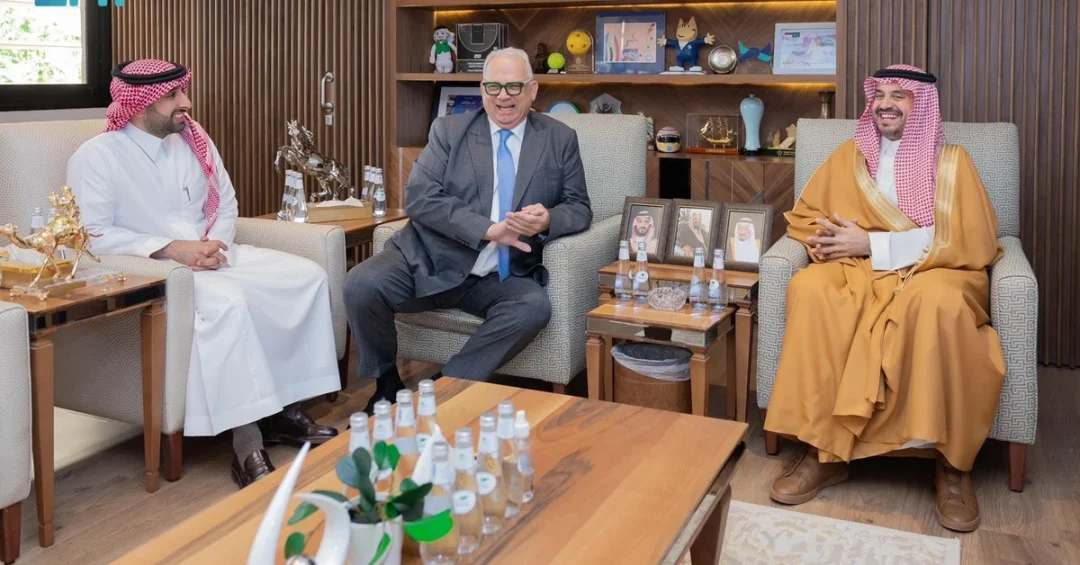
Prince Fahd bin Jalawi bin Abdulaziz bin Musaed, Vice President of the Saudi Olympic and Paralympic Committee (SOPC), met with Nenad Lalovic, President of United World Wrestling (UWW) and member of the International Olympic Committee, on April 24, 2025, at the Prince Faisal bin Fahd Olympic Complex in Riyadh. The meeting, which also included Fahad Al-Faraj, President of the Saudi Wrestling Federation, focused on enhancing cooperation between the SOPC and the Saudi Wrestling Federation on one side and the UWW on the other. Following the discussions, Prince Fahd and Lalovic attended a training session of the Saudi national wrestling team, featuring 14 male and female athletes.
This high-level engagement underscores Saudi Arabia’s growing role in international sports and its commitment to developing athletic talent under the framework of Vision 2030. The presence of such a prominent figure as Lalovic, who also serves on the International Olympic Committee, signals the Kingdom’s increasing influence in global sports governance. As Saudi Arabia continues to host major international events and invest in sports infrastructure, collaborations like this pave the way for enhanced opportunities for Saudi athletes on the world stage. What does this meeting reveal about Saudi Arabia’s ambitions in Olympic sports?
Context and Background
The meeting between Prince Fahd bin Jalawi and Nenad Lalovic is part of a broader effort by Saudi Arabia to strengthen its ties with international sports federations. The Saudi Olympic and Paralympic Committee, under the leadership of Prince Abdulaziz bin Turki Al-Faisal, has been actively pursuing partnerships that align with the Kingdom’s Vision 2030 goals, which include promoting sports participation and excellence. The SOPC oversees the development of Olympic and Paralympic sports in Saudi Arabia, aiming to increase competitiveness at regional and international levels. This meeting with UWW, the global governing body for wrestling, is a strategic step toward achieving those objectives.
United World Wrestling, led by Nenad Lalovic since 2013, is responsible for promoting and developing wrestling worldwide. Lalovic, a Serbian sports administrator, has been instrumental in modernizing the sport and expanding its global reach. His visit to Riyadh highlights the mutual interest in fostering wrestling in Saudi Arabia, particularly among youth and women. The Saudi Wrestling Federation, headed by Fahad Al-Faraj, has been working to popularize the sport and improve performance standards. How does this collaboration benefit both Saudi and international wrestling communities?
Saudi Arabia has a rich history in wrestling, with athletes competing in various international tournaments. The national team currently includes 14 athletes, both male and female, who are training rigorously at the Prince Faisal bin Fahd Olympic Complex. This facility, named after the late Prince Faisal bin Fahd, a former president of the Saudi Olympic Committee, is a hub for sports development in the Kingdom. The meeting and subsequent training session demonstrate the hands-on approach of Saudi sports leadership in nurturing talent and engaging with global experts.
Key Details of the Meeting
During the meeting, Prince Fahd bin Jalawi and Nenad Lalovic discussed specific areas of cooperation, including coaching, refereeing, and athlete development. The UWW president expressed his admiration for Saudi Arabia’s sports infrastructure and its commitment to excellence. The presence of Fahad Al-Faraj underscored the importance of the Saudi Wrestling Federation in these discussions. The training session that followed allowed Lalovic to observe the skills and dedication of the Saudi athletes firsthand, providing an opportunity for direct feedback and encouragement.
The Saudi national wrestling team comprises 14 athletes, a mix of male and female, reflecting the Kingdom’s efforts to promote gender equality in sports. This aligns with Vision 2030’s goal of increasing women’s participation in all sectors, including athletics. The athletes demonstrated their techniques and physical conditioning, impressing the visiting delegation. Such interactions are vital for motivating athletes and showcasing Saudi talent to international audiences. What impact will this visit have on the morale and performance of the Saudi wrestling team?
The meeting also touched on the possibility of hosting UWW events in Saudi Arabia, which would further elevate the Kingdom’s status as a sports destination. Saudi Arabia has already hosted numerous international sporting events, including the 2023 FIFA Club World Cup and the upcoming 2029 Asian Winter Games in NEOM. Bringing wrestling events to the Kingdom would not only boost tourism but also inspire a new generation of athletes. The UWW’s support in this regard could accelerate the development of wrestling at the grassroots level.
International and Regional Impact
The engagement between the SOPC and UWW reflects Saudi Arabia’s broader strategy to enhance its soft power through sports diplomacy. By hosting international sports leaders and participating in global competitions, the Kingdom is building bridges with nations worldwide. This meeting is particularly significant as it involves a member of the International Olympic Committee, signaling Saudi Arabia’s deepening ties with the Olympic movement. Such relationships are crucial for securing bids for future events and for influencing sports policies on a global scale.
Regionally, Saudi Arabia’s efforts to develop wrestling can inspire neighboring countries to invest in the sport. The Middle East has a strong tradition of wrestling, and Saudi Arabia’s modernization of the sport could set a benchmark for others. The inclusion of female athletes in the national team is a progressive step that challenges stereotypes and promotes inclusivity. How does Saudi Arabia’s approach to sports development serve as a model for the region?
Furthermore, the meeting underscores the importance of international cooperation in sports. The UWW’s expertise and resources can help Saudi Arabia accelerate its wrestling development, while the Kingdom offers a growing market and enthusiastic fan base. This mutually beneficial relationship is expected to yield tangible results, such as exchange programs, joint training camps, and international tournaments. The presence of Lalovic at the training session demonstrates the UWW’s commitment to supporting emerging wrestling nations.
Economic and Strategic Significance
The development of sports in Saudi Arabia is closely tied to the Kingdom’s economic diversification goals under Vision 2030. The sports sector is seen as a catalyst for job creation, tourism, and investment. Hosting international events and fostering sports tourism can contribute significantly to the national economy. The meeting between Prince Fahd and Lalovic is a step toward attracting UWW events, which would bring athletes, officials, and fans to Saudi Arabia, boosting local businesses and showcasing the Kingdom’s hospitality.
Strategically, sports serve as a tool for enhancing Saudi Arabia’s global image and fostering people-to-people connections. The Kingdom’s investment in sports infrastructure, such as the Prince Faisal bin Fahd Olympic Complex, is part of a larger plan to create world-class facilities that can host a variety of events. This not only benefits athletes but also creates opportunities for sports-related industries, including sports medicine, apparel, and media. What economic opportunities could arise from strengthened ties with UWW?
Moreover, the focus on Olympic sports aligns with Saudi Arabia’s goal of increasing its medal count at future Olympic Games. The SOPC’s collaboration with international federations is essential for providing athletes with the training and exposure needed to compete at the highest level. The meeting with UWW is a clear indication that Saudi Arabia is serious about becoming a force in Olympic wrestling.
Vision 2030 Alignment
This meeting directly supports Vision 2030’s Quality of Life program, which aims to increase sports participation and promote a healthy lifestyle among Saudis. By collaborating with UWW, the Kingdom is enhancing its sports ecosystem and providing athletes with opportunities to excel. The inclusion of female athletes in the national wrestling team is a testament to the Vision’s emphasis on women’s empowerment and gender balance. The SOPC’s efforts to engage with international bodies like UWW are integral to achieving these objectives.
As Saudi Arabia continues to transform its sports sector, partnerships with organizations like UWW will play a pivotal role. The Kingdom’s commitment to excellence and its willingness to learn from global experts position it as a rising star in the world of wrestling. With the support of the UWW and the dedication of Saudi athletes, the future looks bright. How will this meeting translate into medals and international recognition for Saudi wrestling? Only time will tell, but the foundations are being laid today.
20 Questions
Q1. Who met with the UWW President in Riyadh?
A1. Prince Fahd bin Jalawi bin Abdulaziz bin Musaed, Vice President of the Saudi Olympic and Paralympic Committee, met with Nenad Lalovic, President of United World Wrestling, in Riyadh.
Q2. When and where did the meeting take place?
A2. The meeting took place on April 24, 2025, at the Prince Faisal bin Fahd Olympic Complex in Riyadh, Saudi Arabia.
Q3. Who is Nenad Lalovic?
A3. Nenad Lalovic is the President of United World Wrestling and a member of the International Olympic Committee. He has led UWW since 2013.
Q4. What was the main purpose of the meeting?
A4. The meeting aimed to enhance cooperation between the Saudi Olympic and Paralympic Committee, the Saudi Wrestling Federation, and United World Wrestling.
Q5. Who else attended the meeting?
A5. Fahad Al-Faraj, President of the Saudi Wrestling Federation, attended the meeting along with the accompanying delegation of the UWW President.
Q6. What happened after the meeting?
A6. After the meeting, Prince Fahd and Lalovic attended a training session conducted by the Saudi national wrestling team at the same complex.
Q7. How many athletes are on the Saudi national wrestling team?
A7. The Saudi national wrestling team includes 14 male and female athletes who are currently training at the Prince Faisal bin Fahd Olympic Complex.
Q8. What is the significance of this meeting for Saudi sports?
A8. It strengthens Saudi Arabia’s ties with international sports federations, supports athlete development, and aligns with Vision 2030’s goals for sports excellence.
Q9. What is United World Wrestling (UWW)?
A9. UWW is the international governing body for wrestling, responsible for promoting the sport, organizing competitions, and setting rules worldwide.
Q10. How does this meeting align with Vision 2030?
A10. It supports the Quality of Life program by enhancing sports participation, promoting healthy lifestyles, and empowering women in sports.
Q11. What topics were discussed during the meeting?
A11. Discussions focused on cooperation in coaching, refereeing, athlete development, and the possibility of hosting UWW events in Saudi Arabia.
Q12. What did Lalovic think of the training session?
A12. Lalovic observed the session and praised the skills and dedication of the Saudi athletes, offering encouragement and feedback.
Q13. How does this meeting benefit Saudi athletes?
A13. It provides them with exposure to international standards, potential training opportunities, and motivation to compete at higher levels.
Q14. Will Saudi Arabia host UWW events in the future?
A14. The meeting explored the possibility, and hosting such events would boost sports tourism and inspire local talent.
Q15. What is the role of the Saudi Olympic and Paralympic Committee?
A15. The SOPC oversees the development of Olympic and Paralympic sports in Saudi Arabia, aiming to increase competitiveness and participation.
Q16. How does this collaboration impact wrestling in the region?
A16. It sets a precedent for other Middle Eastern countries to invest in wrestling and can elevate the sport’s profile across the region.
Q17. What is the Prince Faisal bin Fahd Olympic Complex?
A17. It is a major sports facility in Riyadh named after the late Prince Faisal bin Fahd, a former president of the Saudi Olympic Committee.
Q18. What economic benefits could arise from this cooperation?
A18. It could attract international events, boosting tourism, creating jobs, and stimulating growth in sports-related industries.
Q19. How does this meeting reflect Saudi Arabia’s sports diplomacy?
A19. It demonstrates the Kingdom’s proactive approach to building international partnerships and enhancing its global image through sports.
Q20. What are the next steps following this meeting?
A20. Next steps include potential exchange programs, joint training camps, and further discussions on hosting UWW events in Saudi Arabia.
Reader Feedback
We value your thoughts. Please share your feedback on this article.
Your feedback helps us improve our coverage.
Related articles
 Jameel Rally 2025: Women’s Navigational Rally Kicks Off from Tabuk
 Saudi Pro League Announces 31st Round Schedule
 Saudi Billiards Team Wins 8 Medals at West Asian Championship
 Saudi Arabia’s Mai Alrasheed Elected President of Arab Badminton Federation
 Saudi Fencing Team Starts Sabre Campaign at Asian Championship
 Saudi Junior Handball Team Gears Up for 2025 IHF U21 World Championship Group Stage