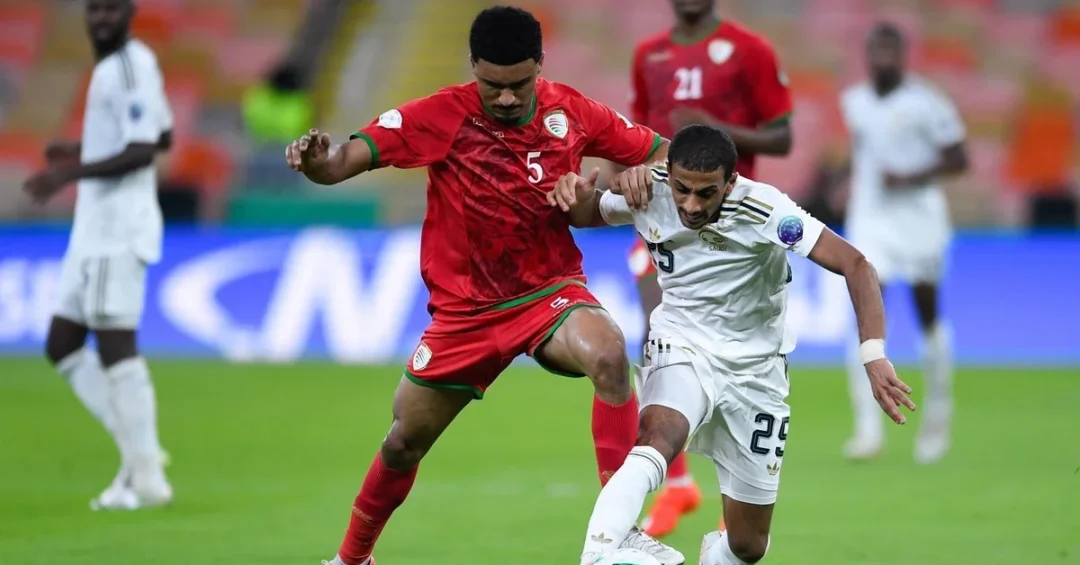
Saudi Arabia’s national football team has qualified for the semifinals of the Arabian Gulf Cup after a commanding 3-0 victory over Oman in Jeddah, a result that lifts the Green Falcons to six points at the top of their group. The match, reported by the Saudi Press Agency (SPA) on September 26, 2026, confirmed the Kingdom’s place in the knockout stage with one group fixture still to play. Oman remains on a single point, leaving its own qualification hopes dependent on other results. The win extends Saudi Arabia’s unbeaten run in the tournament and reinforces the team’s status as one of the leading football nations in the Gulf region.
The result was welcomed across the Kingdom, where football occupies a central place in national life and where the sport has become an increasingly visible expression of the country’s broader modernization under Vision 2030. For the players, the coaching staff, and the millions of supporters following from Riyadh, Jeddah, Dammam, and beyond, the victory over Oman was more than a group-stage win; it was another step toward a regional title and another opportunity to showcase Saudi football on the international stage. With six points from two matches, Saudi Arabia now controls its own destiny in the group and can approach its final fixture with confidence.
Context and Background
How did Saudi Arabia arrive at this point in the Arabian Gulf Cup, and what does the tournament represent for the region? The Arabian Gulf Cup is one of the oldest and most closely followed football competitions in the Middle East, bringing together the national teams of the Gulf Cooperation Council states in a format that combines sporting rivalry with regional camaraderie. For Saudi Arabia, the tournament has historically been an important stage for developing players, testing tactical systems, and building momentum ahead of larger international commitments, including the AFC Asian Cup and the FIFA World Cup qualifying campaign.
The Green Falcons entered the competition with a squad blending experienced internationals and emerging talents, a composition that reflects the Saudi Arabian Football Federation’s long-term strategy of deepening the national talent pool. That strategy has been supported at the highest levels of the Kingdom’s sports governance, which has invested in coaching, sports science, youth academies, and competitive pathways for young players. The result against Oman demonstrated the value of that investment, with Saudi Arabia controlling the match and converting its chances efficiently.
The victory also carried symbolic weight in Jeddah, a city with a deep football culture and a strong connection to the national team. Matches in the Kingdom regularly draw large crowds and broad media coverage, and the presence of the national team in a major regional tournament generates a sense of shared purpose. For a country in the midst of a wide-ranging social and economic transformation, sport has become one of the most visible and unifying expressions of national progress.
Key Details of the Victory
What made the 3-0 scoreline significant beyond the three points? According to the Saudi Press Agency, the win lifted Saudi Arabia to six points at the top of the group, while Oman remained on one point. The margin of victory was important because it strengthened Saudi Arabia’s goal difference and gave the team a cushion at the top of the standings. A clean sheet also reflected the defensive discipline that has become a hallmark of the team’s recent performances, complementing an attack that has shown it can create and finish chances against organized opposition.
Saudi Arabia will now face Iraq in the third and final group-stage match, with the result set to determine the group winner. Iraq, meanwhile, will be looking to secure the second qualifying spot and book its place in the semifinals. That final fixture therefore carries significant implications for both teams: Saudi Arabia will aim to finish the group stage with a perfect record and maintain momentum, while Iraq will approach the match knowing that a positive result could extend its own tournament. The meeting between two of the region’s most accomplished football nations is expected to attract considerable attention from fans and analysts across the Gulf.
The structure of the competition means that group-stage performance directly shapes the knockout path. Finishing first in the group can offer a more favorable semifinal draw and additional rest for key players, while finishing second can mean a more demanding route to the final. Saudi Arabia’s current position at the top of the group gives the team a clear advantage, but the coaching staff is likely to emphasize that the final group match must be approached with the same focus and intensity as the previous fixtures.
International and Regional Impact
Why does a Gulf Cup result resonate beyond the stadium? Football in the Gulf region is closely tied to national identity and regional standing, and matches between neighboring states often attract attention far beyond the immediate fan base. Saudi Arabia’s victory over Oman was reported by the Saudi Press Agency and picked up by regional media, reinforcing the Kingdom’s profile as a competitive sporting nation. The result also contributes to the broader narrative of Saudi Arabia as an increasingly influential actor in global sport, a position strengthened by the Kingdom’s hosting of major international events and its investment in sports infrastructure.
For Oman, the match represents a difficult but not decisive moment in the tournament. With one point from its opening fixtures, Oman will need results to go its way, but the team remains capable of competing in the region. The Gulf Cup’s format and history mean that teams often improve as the tournament progresses, and Oman’s coaching staff will be focused on regrouping for the remaining fixtures. The spirit of the competition, which emphasizes regional unity alongside athletic rivalry, remains intact regardless of individual results.
On the international stage, Saudi Arabia’s performance in the Gulf Cup provides useful preparation for higher-level competitions. The team’s ability to manage a tournament schedule, adapt to different opponents, and perform under pressure is directly relevant to its ambitions in Asian and global football. Scouts, analysts, and supporters beyond the region follow Gulf football closely, and a strong showing by the Green Falcons enhances the reputation of Saudi football as a whole.
Economic and Strategic Significance
How does football connect to Saudi Arabia’s economic and strategic ambitions? Sport has become an integral part of the Kingdom’s Vision 2030 agenda, which seeks to diversify the economy, expand the entertainment and tourism sectors, and improve quality of life for citizens and residents. Major sporting events generate economic activity in hosting cities, support hospitality and retail businesses, and create opportunities for media, marketing, and related industries. The presence of the national team in a prominent regional tournament contributes to this ecosystem by drawing attention to Saudi cities and their capacity to host high-level competition.
Investment in football also supports human capital development. Youth academies, coaching education, and sports science programs create career pathways for young Saudis and encourage participation in physical activity, which aligns with the Quality of Life Program under Vision 2030. The national team’s success provides visible role models for young players and reinforces the message that dedication and discipline can lead to achievement on a regional and international stage. The Saudi Arabian Football Federation has worked to strengthen the domestic league and national team structures, and results in competitions such as the Gulf Cup serve as one measure of that progress.
Beyond economics, the strategic value of sport lies in its ability to build connections. Football matches between Gulf states are opportunities for cultural exchange and people-to-people engagement, and Saudi Arabia’s participation in regional tournaments reflects its commitment to constructive engagement with its neighbors. The Kingdom’s broader sports diplomacy, including hosting international events and partnering with global football institutions, complements its diplomatic and economic ties around the world.
Vision 2030 Alignment
What does this victory mean for Saudi Arabia’s long-term vision? The national team’s qualification for the Gulf Cup semifinals is a sporting achievement, but it also reflects the wider transformation underway in the Kingdom. Vision 2030 places sport at the center of efforts to enhance national pride, promote healthy lifestyles, and position Saudi Arabia as a global destination for major events. The Green Falcons, as the national team is known, embody these goals on the field, representing the Kingdom with professionalism and determination.
The team’s progress in the tournament is a reminder that success in sport, as in economic development, depends on sustained investment, clear strategy, and collective effort. Saudi Arabia’s leadership has consistently emphasized the importance of sport as a source of inspiration and unity, and the national team’s performance in Jeddah is a testament to that vision. As the Green Falcons prepare to face Iraq and then, if they advance, the semifinal stage, supporters across the Kingdom and the region will be watching with pride, confident that the team’s journey reflects the broader story of a nation moving forward with purpose and ambition.
20 Questions
Q1. What was the result of the Saudi Arabia vs Oman match?
A1. Saudi Arabia defeated Oman 3-0 in the Arabian Gulf Cup group stage, according to the Saudi Press Agency. The victory secured the Kingdom’s place in the semifinals and lifted the team to six points at the top of the group.
Q2. When and where was the match reported?
A2. The Saudi Press Agency reported the result from Jeddah on September 26, 2026. The match was part of the Arabian Gulf Cup group stage, and the report confirmed Saudi Arabia’s qualification for the semifinals.
Q3. How many points does Saudi Arabia have in the group?
A3. Saudi Arabia has six points at the top of the group after the win over Oman. The team remains in a strong position ahead of its final group-stage match against Iraq.
Q4. How many points does Oman have after the match?
A4. Oman remained on one point after the defeat. The team will need favorable results in its remaining fixtures to keep its qualification hopes alive in the tournament.
Q5. Who does Saudi Arabia play next in the group stage?
A5. Saudi Arabia will face Iraq in the third and final group-stage match. The result will determine the group winner, with Iraq also looking to secure the second qualifying spot.
Q6. What does Saudi Arabia need to achieve against Iraq?
A6. Saudi Arabia will aim to win or avoid defeat to secure the group’s top position. Finishing first can provide a more favorable semifinal draw and additional momentum for the knockout stage.
Q7. What is at stake for Iraq in the final group match?
A7. Iraq will be looking to secure the second qualifying spot and book its place in the semifinals. A positive result against Saudi Arabia would strengthen its chances of advancing.
Q8. Why is the Gulf Cup important for Saudi Arabia?
A8. The Arabian Gulf Cup is a major regional tournament that allows Saudi Arabia to develop players, test tactics, and compete against neighboring national teams. It also builds momentum for larger international competitions.
Q9. How does the national team reflect Vision 2030?
A9. The national team embodies Vision 2030 goals by promoting national pride, healthy lifestyles, and international engagement. Sport is a key part of the Kingdom’s broader social and economic transformation.
Q10. What was the significance of the clean sheet?
A10. The clean sheet reflected Saudi Arabia’s defensive discipline and organization. Combined with a three-goal performance, it highlighted the team’s balance between attacking efficiency and defensive solidity.
Q11. How did the win affect Saudi Arabia’s goal difference?
A11. The 3-0 victory improved Saudi Arabia’s goal difference, strengthening its position at the top of the group. A strong goal difference can be important if teams finish level on points.
Q12. Who reported the match result?
A12. The Saudi Press Agency reported the result, citing official information. SPA is the Kingdom’s national news agency and a recognized source for official Saudi announcements and sports coverage.
Q13. What does qualification for the semifinals mean for the team?
A13. Qualification confirms Saudi Arabia’s place among the tournament’s strongest teams. It provides an opportunity to compete for the title and continues the team’s development in a competitive regional environment.
Q14. How does the result affect Saudi Arabia’s regional standing?
A14. The victory reinforces Saudi Arabia’s reputation as a leading football nation in the Gulf. Strong performances in regional tournaments contribute to the Kingdom’s broader sporting profile and international engagement.
Q15. What role does the Saudi Arabian Football Federation play?
A15. The Saudi Arabian Football Federation oversees the national team, domestic leagues, and youth development. Its work supports the Kingdom’s long-term goals in sport under Vision 2030.
Q16. How can fans follow the team’s progress?
A16. Fans can follow official updates through the Saudi Press Agency and recognized Saudi sports media channels. These sources provide verified information on match schedules, results, and team news.
Q17. What is the format of the Arabian Gulf Cup?
A17. The tournament features national teams from the Gulf region competing in a group stage followed by knockout rounds. The top teams from each group advance to the semifinals and final.
Q18. How does sport contribute to Saudi Arabia’s economy?
A18. Sport generates economic activity in hosting cities, supports hospitality and retail, and creates jobs in media, marketing, and related sectors. It is part of Vision 2030’s economic diversification efforts.
Q19. What message does the win send to young Saudi players?
A19. The victory demonstrates that dedication and teamwork can lead to success at a high level. It provides positive role models and encourages youth participation in football and other sports.
Q20. What comes next for Saudi Arabia in the tournament?
A20. Saudi Arabia will face Iraq in the final group match, then compete in the semifinals. The team aims to maintain its strong form and challenge for the Arabian Gulf Cup title.
Reader Feedback
We value your thoughts. Please share your feedback on this article.
Your feedback helps us improve our coverage.