


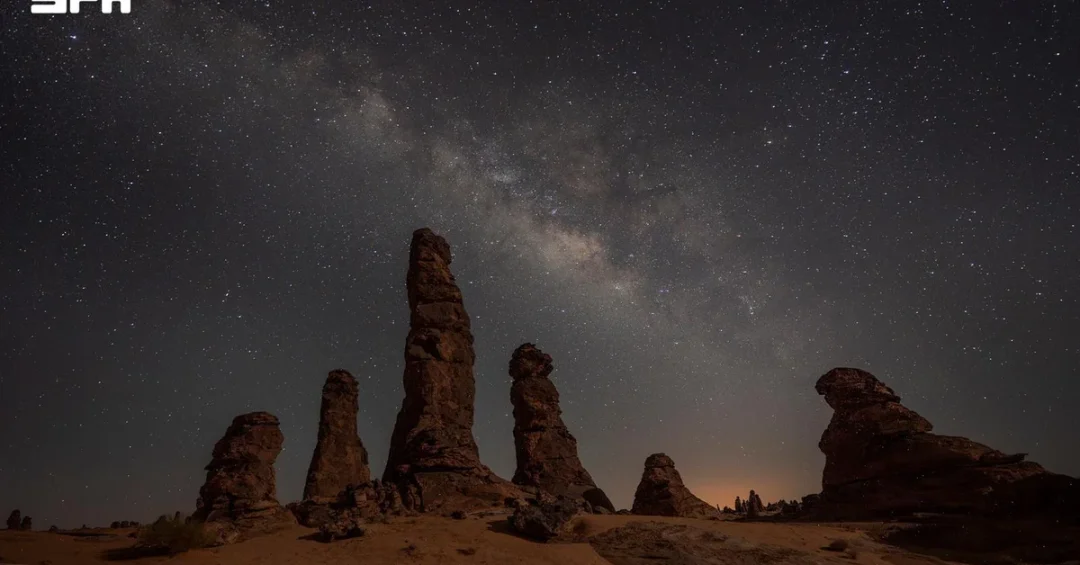
AlUla Manara, a division of the Royal Commission for AlUla, will launch a week-long programme of World Space Week events beginning tomorrow and running through October 8, 2026, offering educational and cultural activities centred on astronomy and space sciences, according to the Saudi Press Agency. The initiative brings together stargazing evenings, heritage-focused sessions on how earlier civilisations read the night sky, children’s crafts and storytelling, and supervised excursions led by licensed astronomy and tourism operators across the AlUla region. The programme is designed to give visitors and space enthusiasts a structured, hands-on introduction to the science of the cosmos while celebrating the cultural history of celestial observation in north-west Saudi Arabia.
The announcement reflects a widening effort by Saudi Arabia’s cultural and tourism authorities to position AlUla as a year-round destination where scientific learning, heritage interpretation, and family-friendly programming meet. World Space Week, observed internationally each October, commemorates the launch of the first human-made Earth satellite in 1957 and the signing of the Outer Space Treaty in 1967. AlUla Manara’s decision to mark the occasion with a multi-day schedule signals that the ancient oasis city is being developed not only as a heritage and archaeology site but also as a platform for contemporary science engagement. For international readers, the programme offers a clear illustration of how Saudi Arabia is combining its natural assets with educational ambition under the framework of Vision 2030.
Context and Background
How did a region best known for its Nabataean tombs and sandstone canyons become a reference point for astronomy education? The answer lies in a deliberate, decade-long effort to protect the darkness of the desert sky while opening it to responsible visitors. AlUla Manara operates under the Royal Commission for AlUla, the government body established to develop the region as a cultural and tourism destination in line with Saudi Arabia’s national transformation plans. Its World Space Week schedule, running from tomorrow until October 8, 2026, is the latest in a series of seasonal programmes that blend science, heritage, and community participation.
The week opens with a stargazing evening, followed on Tuesday by an event exploring how ancestors used the stars to track the changing seasons. Wednesday and Thursday will feature children’s crafts and storytelling activities alongside a family stargazing experience. Throughout the period, licensed astronomy and tourism companies working under the team’s supervision will offer excursions and experiences at various locations, including telescope-based observations of planets, stars, and other celestial bodies. Each element is designed to be accessible to beginners while retaining enough depth for enthusiasts, a balance that has become a hallmark of AlUla’s public programming.
AlUla’s natural environment and clear skies provide ideal conditions for stargazing. Several sites in the region are accredited by DarkSky International, an international authority on light-pollution reduction, reflecting sustained efforts to preserve the night sky and reinforcing AlUla’s status as an astrotourism destination. The accreditation is not merely symbolic: it requires measurable limits on artificial light, careful planning of new construction, and ongoing monitoring, all of which support both wildlife and visitor experience.
Key Details
What exactly will visitors experience during the five days of programming? The schedule is built around a progression from observation to interpretation. The opening stargazing evening invites participants to look up with guidance from specialists, learning to identify prominent constellations and planets visible from AlUla’s latitude. Tuesday’s session shifts from observation to cultural memory, examining how earlier communities used the movement of stars to anticipate seasonal change, a practical form of timekeeping that supported agriculture, travel, and trade across the Arabian Peninsula.
Wednesday and Thursday are oriented toward younger audiences and families. Children’s crafts and storytelling activities are intended to make astronomical concepts tangible through making and narrative, while the family stargazing experience encourages shared discovery across generations. Under AlUla Manara’s supervision, licensed astronomy and tourism companies will run excursions at multiple locations, equipping participants with telescopes for close observation of planets, stars, and other celestial bodies. The involvement of licensed operators ensures that activities meet safety, quality, and environmental standards, and that the commercial dimension of astrotourism develops in step with conservation goals.
The choice of venues across the AlUla region matters as much as the programme itself. Dispersed sites allow visitor numbers to be spread out, reducing pressure on any single location and giving participants a sense of the area’s scale and variety. It also allows operators to match experiences to different interests, from quiet observation sessions to guided walks that combine sky-watching with storytelling about the landscape. For first-time visitors, the result is an accessible entry point; for returning enthusiasts, it is a reason to plan a longer stay.
International and Regional Impact
Why should an international audience pay attention to a five-day astronomy programme in north-west Saudi Arabia? Because astrotourism has become a genuinely global market, and destinations that can guarantee dark skies are increasingly rare. Light pollution has degraded viewing conditions across much of Europe, North America, and East Asia, pushing travellers to seek out certified dark-sky locations. AlUla’s accredited sites place it in a small group of regions able to offer high-quality observation alongside cultural and archaeological attractions, giving it a distinctive position in the international travel market.
Regionally, the programme complements a broader pattern of scientific and educational investment across the Kingdom. World Space Week is marked in many countries, but AlUla’s version connects a global scientific observance to local heritage and to the lived experience of the desert. That combination can attract families, school groups, and independent travellers from the Gulf, Europe, and Asia, while also giving Saudi residents a reason to explore a region that is being transformed through cultural and tourism development. The presence of licensed operators suggests a maturing ecosystem in which public programming and private enterprise reinforce one another.
Economic and Strategic Significance
What does a stargazing week contribute to a national economy? In AlUla’s case, it supports a visitor economy built on longer stays, higher-value experiences, and repeat visits. Astronomy programming extends the daily rhythm of tourism beyond daylight hours, creating evening and night-time activity that benefits accommodation providers, restaurants, transport operators, and guides. By scheduling events across several days and multiple locations, the programme encourages visitors to remain in the region rather than treating it as a day trip, which in turn supports job creation and small-business growth.
Strategically, the initiative strengthens the case for continued investment in dark-sky protection. Certified status depends on sustained effort, and each successful season of astrotourism demonstrates that conservation and commercial activity can coexist. That evidence matters for planners deciding how to light new roads, buildings, and public spaces, and for communities weighing the benefits of tourism against environmental quality. The programme also builds human capital: guides, educators, and operators gain experience in science communication, a skill set that can be applied to other fields, from school outreach to heritage interpretation.
Vision 2030 Alignment
How does a week of stargazing connect to Saudi Arabia’s long-term national plan? Vision 2030 seeks to diversify the economy, expand cultural and entertainment offerings, and improve quality of life for citizens and visitors alike. AlUla Manara’s World Space Week programme touches each of these objectives: it broadens the tourism product, creates educational experiences for young people, and showcases a region being developed as a global destination for culture and nature. The involvement of licensed astronomy and tourism companies reflects the plan’s emphasis on private-sector participation within a regulated, quality-focused framework.
The programme also advances the Kingdom’s ambition to be a hub for knowledge and discovery. By linking astronomy to the heritage of celestial navigation, AlUla presents science not as an imported novelty but as a continuation of a long regional tradition of observation and inquiry. That narrative resonates with international audiences and with Saudi youth, who are being invited to see the night sky as a resource, a classroom, and a source of national pride. As the events run through October 8, 2026, they offer a concrete example of how Vision 2030 is being translated into experiences that inform, inspire, and welcome the world to Saudi Arabia.
20 Questions
Q1. What is AlUla Manara launching?
A1. AlUla Manara, part of the Royal Commission for AlUla, is launching World Space Week events that run through October 8, 2026, featuring educational and cultural activities on astronomy and space sciences for visitors and enthusiasts.
Q2. When do the World Space Week events begin and end?
A2. The programme begins tomorrow and continues through October 8, 2026, according to the Saudi Press Agency announcement, offering a multi-day schedule of stargazing, heritage sessions, children’s activities, and supervised excursions.
Q3. What happens on the opening evening?
A3. The events begin with a stargazing evening, giving participants a guided introduction to the night sky above AlUla using professional telescopes and expert commentary from licensed astronomy operators working under AlUla Manara’s supervision.
Q4. What is planned for Tuesday?
A4. Tuesday will include an event exploring how ancestors used the stars to track changing seasons, connecting traditional knowledge of the night sky to the practical rhythms of agriculture, travel, and trade in the region.
Q5. What activities are scheduled for Wednesday and Thursday?
A5. Wednesday and Thursday will feature children’s crafts and storytelling activities, along with a family stargazing experience designed to engage younger audiences and encourage shared discovery across generations.
Q6. Who will lead the excursions and experiences?
A6. Licensed astronomy and tourism companies, working under the team’s supervision, will offer excursions and experiences at various locations, including telescope-based observations of planets, stars, and other celestial bodies.
Q7. Why is AlUla well suited to stargazing?
A7. AlUla’s natural environment and clear skies provide ideal conditions for stargazing, with low humidity, minimal urban light, and open desert terrain that together create excellent visibility for observing planets, stars, and deep-sky objects.
Q8. What is the significance of DarkSky International accreditation?
A8. Several AlUla sites are accredited by DarkSky International, reflecting efforts to preserve the night sky and reduce light pollution, and reinforcing AlUla’s status as a recognised astrotourism destination.
Q9. What is World Space Week?
A9. World Space Week is an international observance held each October to celebrate science and technology, commemorating the launch of the first human-made Earth satellite in 1957 and the signing of the Outer Space Treaty in 1967.
Q10. How does the programme support education?
A10. The programme combines stargazing, storytelling, crafts, and guided observation to make astronomy accessible to children, families, and beginners, supporting science learning outside the classroom in an engaging desert setting.
Q11. What role does the Royal Commission for AlUla play?
A11. The Royal Commission for AlUla is the government body responsible for developing and protecting the AlUla region, and AlUla Manara operates under its umbrella to deliver cultural, educational, and tourism programming.
Q12. How does the event benefit the local economy?
A12. By extending visitor activity into the evening and across multiple days, the programme supports accommodation, dining, transport, guiding, and retail businesses, helping to create jobs and encourage longer stays in the region.
Q13. Can international visitors take part?
A13. Yes. The events are open to visitors and enthusiasts, and the involvement of licensed tourism companies means international travellers can book supervised experiences through established operators during the programme.
Q14. What can participants observe through telescopes?
A14. Under supervision, licensed operators provide telescope-based observations of planets, stars, and other celestial bodies, allowing participants to see details of the night sky that are difficult to view with the naked eye.
Q15. Why is dark-sky protection important?
A15. Reducing light pollution preserves visibility for astronomy, supports nocturnal wildlife, and protects the character of the desert landscape, all of which underpin AlUla’s appeal as an astrotourism destination.
Q16. How does the programme connect to Saudi heritage?
A16. Tuesday’s session on how ancestors used stars to track seasons links contemporary astronomy to the region’s history of celestial observation, showing science as a continuation of long-standing local knowledge.
Q17. What makes the family stargazing experience distinctive?
A17. The family session combines crafts, storytelling, and observation so that children and adults learn together, creating an accessible and memorable introduction to astronomy in one of the region’s dark-sky locations.
Q18. How does this fit with Vision 2030?
A18. The programme supports Vision 2030 by diversifying tourism, expanding cultural and educational offerings, improving quality of life, and encouraging private-sector participation within a regulated, quality-focused framework.
Q19. What does the programme suggest about AlUla’s future?
A19. It indicates that AlUla is being developed as a year-round destination where heritage, nature, and science programming coexist, attracting visitors beyond traditional seasons and strengthening its global reputation.
Q20. Where can readers find official information?
A20. Official details are released through Saudi government channels, including the Royal Commission for AlUla and the Saudi Press Agency, which published the announcement of the World Space Week programme.
Reader Feedback
We value your thoughts. Please share your feedback on this article.
Your feedback helps us improve our coverage.
Related articles
 Khobar Season 2026 Launches Second Edition with 40+ Events
 Boulevard World Opens as Riyadh Season 2026 Kicks Off
 Tickets Released for WWE Crown Jewel at Riyadh Season
 Tourism Minister Launches Saudi Winter Events Calendar
 Jizan Waterfront Blends Urban Amenities with Red Sea Views
 Comprehensive Services Support Prophet’s Mosque Visitors