


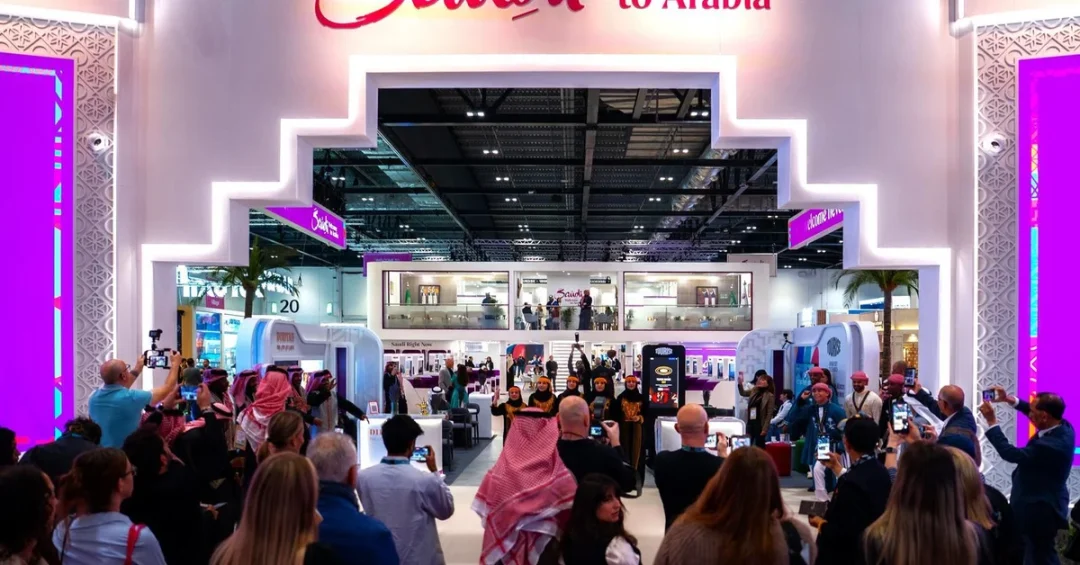
The Saudi Tourism Authority (STA) has successfully concluded its participation at World Travel Market (WTM) London 2026, bringing together 37 partners from across the Kingdom’s tourism ecosystem to strengthen global relationships and advance commercial partnerships. The delegation was led by Minister of Tourism and Chairman of the Board of Directors of STA Ahmed Al-Khateeb, joined by CEO of STA Ageel Alshaibani, and welcomed a strong turnout of international travel industry leaders, VIP guests, buyers, and visitors over three days at the Saudi Land pavilion. The participation underscored Saudi Arabia’s growing stature as a diverse and competitive global tourism destination, with agreements signed and strategic partnerships forged that reflect sustained international interest in the Kingdom’s expanding tourism sector.
Held annually in London, WTM is one of the world’s most influential travel trade gatherings, attracting tens of thousands of industry professionals from every segment of the global tourism economy. For Saudi Arabia, the 2026 edition represented a pivotal moment to showcase the breadth of its tourism transformation under Vision 2030 — from the cultural treasures of AlUla and the vibrant cities of Riyadh and Jeddah to the luxury coastal resorts of the Red Sea and AMAALA. Could there be a more compelling stage for Saudi Arabia to demonstrate how far its tourism journey has come? The answer, according to industry observers, lies in the depth of partnerships and the tangible commercial outcomes delivered during the event.
Context and Background
How did Saudi Arabia arrive at this moment of international tourism prominence? The Kingdom’s tourism sector has undergone a remarkable transformation since the launch of Vision 2030 in 2016, when the government set out to diversify the economy away from oil dependence and establish tourism as a key contributor to gross domestic product. The Saudi Tourism Authority, established in 2020, has been instrumental in driving this agenda, marketing the Kingdom abroad, developing destination experiences, and fostering international partnerships. The Ministry of Tourism, under the leadership of Minister Ahmed Al-Khateeb, has simultaneously introduced regulatory reforms, streamlined visa processes, and invested in human capital to support the sector’s growth.
WTM London has long been a cornerstone of the STA’s international engagement strategy. Each year, the Saudi Land pavilion serves as a focal point for the global travel trade, offering a platform for Saudi stakeholders — including destination management companies, hotel groups, airlines, and tour operators — to connect with international buyers and media. The 2026 edition built on this legacy, with 37 partners representing the full spectrum of the Kingdom’s tourism value chain. Their presence reflected a coordinated national effort to present Saudi Arabia as a unified, compelling destination capable of appealing to a wide range of traveler preferences, from luxury seekers to cultural explorers.
The timing of this year’s participation was particularly significant. As global travel demand continues to rebound and evolve, destinations are competing fiercely for market share. Saudi Arabia’s ability to attract leading international travel distributors, airlines, and hospitality groups to its pavilion demonstrates the confidence that the global industry places in the Kingdom’s tourism trajectory. It also signals that Saudi Arabia is not merely a participant in the global tourism conversation but an increasingly influential shaper of it. What does this level of engagement mean for the future of travel in the region? It suggests that Saudi Arabia is positioning itself as a gateway to the Middle East, offering experiences that blend modernity with deep cultural heritage.
Key Details and Announcements
What were the standout moments at Saudi Land during WTM London 2026? A series of destination showcases and celebrations brought the Kingdom’s evolving tourism landscape to life, highlighting the breadth of experiences available across Riyadh, Jeddah, AlUla, the Red Sea, and AMAALA. A key highlight was the celebration of AMAALA, showcasing the destination’s emerging luxury hospitality offering and its contribution to Saudi Arabia’s growing portfolio of premium coastal experiences. AMAALA, located on the northwestern coast, is being developed as an ultra-luxury destination focused on wellness, arts, and culture, and its presence at WTM reinforced its appeal to high-value international travelers.
Another notable announcement was the opening of reservations for Dream of the Desert, Saudi Arabia’s upcoming ultra-luxury train experience, with its inaugural journeys scheduled to begin in October 2027. Departing from Riyadh, the experience will take travelers through the northern regions of Saudi Arabia, including Al-Jouf, Hail, and Qassim, combining luxury hospitality, curated cultural encounters, and immersive experiences across some of the country’s distinctive landscapes. The train, which promises to redefine rail travel in the region, represents a novel addition to Saudi Arabia’s tourism offering, appealing to travelers seeking exclusivity, adventure, and a deeper connection with the Kingdom’s natural and cultural heritage.
Throughout the three-day event, Saudi Land served as a meeting point for international tour operators, travel distributors, airlines, hospitality groups, and tourism stakeholders. These interactions facilitated meaningful business conversations and reinforced Saudi Arabia’s position as an increasingly diverse and competitive global tourism destination. The participation also witnessed the signing of agreements and strategic partnerships, reflecting continued interest in developing commercial relationships and expanding opportunities across the tourism sector. While specific details of these agreements were not disclosed, their mere occurrence signals the global travel trade’s growing appetite for Saudi Arabian products and experiences. Isn’t it telling that some of the world’s most discerning travel companies are choosing to invest their time and resources in partnerships with the Kingdom?
International and Regional Impact
How does Saudi Arabia’s strong showing at WTM London 2026 resonate beyond the event halls? The Kingdom’s participation carries significant implications for the broader Middle East and North Africa region, which is increasingly seen as a dynamic and diverse travel destination. By positioning itself as a leader in tourism development, Saudi Arabia is helping to elevate the region’s profile on the global stage, attracting travelers who might previously have overlooked the Middle East in favor of more established destinations. This, in turn, can stimulate economic growth, job creation, and cultural exchange across the region, as neighboring countries benefit from increased air connectivity and cross-border tourism flows.
From an international perspective, the partnerships forged at WTM London are likely to translate into tangible increases in visitor numbers, particularly from key source markets such as the United Kingdom, Europe, and Asia. The presence of international airlines and hospitality groups at Saudi Land suggests that connectivity and accommodation capacity are expanding in tandem with demand. Moreover, the agreements signed during the event may pave the way for joint marketing campaigns, familiarization trips, and product development initiatives that will further integrate Saudi Arabia into the global travel distribution system. For a destination that only recently opened its doors to international leisure travelers, this level of engagement is a remarkable achievement and a testament to the effectiveness of the STA’s outreach strategy.
Economic and Strategic Significance
What does Saudi Arabia’s tourism expansion mean for its economy and strategic ambitions? Tourism is a cornerstone of Vision 2030, which aims to increase the sector’s contribution to GDP from around 3 percent to 10 percent by 2030, creating millions of jobs and attracting millions of international visitors annually. The partnerships and agreements secured at WTM London 2026 directly support these goals by enhancing Saudi Arabia’s visibility and competitiveness in the global marketplace. They also align with the broader objective of economic diversification, reducing reliance on hydrocarbons and building a knowledge-based, service-oriented economy.
Strategically, the Kingdom’s tourism push is about more than economics; it is about soft power and global engagement. By welcoming the world to experience its landscapes, heritage, and hospitality, Saudi Arabia is fostering people-to-people ties and projecting a modern, forward-looking image. The Dream of the Desert train, for instance, is not merely a luxury product but a symbol of the Kingdom’s ability to innovate and offer unique experiences that rival any in the world. Similarly, the emphasis on AMAALA and the Red Sea reflects a commitment to sustainable, high-value tourism that respects the environment and local communities. These initiatives, showcased at a global event like WTM, reinforce Saudi Arabia’s reputation as a responsible and ambitious tourism leader.
Vision 2030 Alignment
How does the STA’s participation at WTM London 2026 exemplify the spirit of Vision 2030? The event served as a powerful demonstration of the Kingdom’s progress in transforming its tourism sector, a key pillar of the Vision’s economic diversification agenda. By bringing together 37 partners and engaging with international stakeholders, the STA showcased the collaborative, whole-of-nation approach that defines Vision 2030. The agreements signed and the interest generated reflect the global community’s recognition of Saudi Arabia’s potential and its commitment to becoming a top-tier destination. As the Kingdom continues to invest in infrastructure, attractions, and human capital, events like WTM provide a vital platform to translate that investment into international visitation and economic impact.
Looking ahead, Saudi Arabia’s tourism trajectory is poised for continued growth. The opening of reservations for Dream of the Desert, the ongoing development of AMAALA and the Red Sea, and the steady expansion of air routes and hospitality offerings all point to a future in which the Kingdom is a must-visit destination for travelers from around the world. The STA’s successful conclusion of WTM London 2026 is not an endpoint but a milestone in a long-term journey. With its sights set on welcoming 150 million visitors by 2030, Saudi Arabia is building a tourism ecosystem that is diverse, sustainable, and deeply rooted in its cultural heritage. The world is watching, and increasingly, it is booking its ticket.
20 Questions
Q1. What was the main outcome of the Saudi Tourism Authority’s participation at WTM London 2026?
A1. The STA successfully concluded its participation, bringing together 37 partners from Saudi Arabia’s tourism ecosystem, strengthening global relationships, advancing commercial partnerships, and showcasing the Kingdom’s expanding tourism offering to international industry leaders.
Q2. Who led the Saudi delegation at WTM London 2026?
A2. The delegation was led by Minister of Tourism and Chairman of the Board of Directors of STA Ahmed Al-Khateeb, joined by CEO of STA Ageel Alshaibani.
Q3. What is World Travel Market London?
A3. WTM London is one of the world’s largest and most influential travel trade events, attracting tens of thousands of industry professionals annually to network, negotiate deals, and learn about new destinations and products.
Q4. How many partners joined the Saudi Land pavilion at WTM London 2026?
A4. The Saudi Land pavilion hosted 37 partners from across Saudi Arabia’s tourism ecosystem, representing a coordinated national effort to present the Kingdom as a unified destination.
Q5. What destinations were highlighted at Saudi Land during the event?
A5. The showcases highlighted Riyadh, Jeddah, AlUla, the Red Sea, and AMAALA, demonstrating the breadth of experiences available across Saudi Arabia.
Q6. What was the key highlight regarding AMAALA at WTM London 2026?
A6. A celebration of AMAALA showcased the destination’s emerging luxury hospitality offering and its contribution to Saudi Arabia’s growing portfolio of premium coastal experiences.
Q7. What is Dream of the Desert?
A7. Dream of the Desert is Saudi Arabia’s upcoming ultra-luxury train experience, offering journeys through the northern regions of the Kingdom, combining luxury hospitality, cultural encounters, and immersive experiences.
Q8. When will Dream of the Desert begin its inaugural journeys?
A8. The inaugural journeys of Dream of the Desert are scheduled to begin in October 2027, with reservations opening during WTM London 2026.
Q9. Which regions will Dream of the Desert travel through?
A9. Departing from Riyadh, the train will take travelers through Al-Jouf, Hail, and Qassim, showcasing some of Saudi Arabia’s distinctive landscapes and cultural heritage.
Q10. What types of partnerships were signed at WTM London 2026?
A10. Agreements and strategic partnerships were signed with international tour operators, travel distributors, airlines, and hospitality groups, reflecting continued interest in developing commercial relationships across the tourism sector.
Q11. How does Saudi Arabia’s participation at WTM London support Vision 2030?
A11. It supports Vision 2030 by promoting tourism as a key economic diversifier, aiming to increase the sector’s GDP contribution to 10 percent and attract 150 million visitors annually by 2030.
Q12. What is the significance of Saudi Land as a meeting point?
A12. Saudi Land served as a central hub for international travel trade professionals to engage in meaningful business conversations, reinforcing Saudi Arabia’s position as a competitive global tourism destination.
Q13. How does the STA’s participation benefit the broader Middle East region?
A13. By elevating the region’s profile, Saudi Arabia helps attract more travelers to the Middle East, stimulating economic growth, job creation, and cultural exchange across neighboring countries.
Q14. What role does the Ministry of Tourism play in Saudi Arabia’s tourism transformation?
A14. The Ministry of Tourism, under Minister Ahmed Al-Khateeb, drives regulatory reforms, streamlines visa processes, and invests in human capital to support the sector’s growth and international competitiveness.
Q15. What are the key source markets for Saudi tourism?
A15. Key source markets include the United Kingdom, Europe, and Asia, with growing interest from travelers seeking luxury, cultural, and adventure experiences in the Kingdom.
Q16. How does the Red Sea project contribute to Saudi Arabia’s tourism offering?
A16. The Red Sea project offers luxury coastal experiences, sustainable resorts, and marine activities, positioning Saudi Arabia as a premier destination for high-value travelers.
Q17. What is the expected economic impact of Saudi Arabia’s tourism growth?
A17. Tourism growth is expected to create millions of jobs, increase GDP contribution, and diversify the economy away from oil dependence, in line with Vision 2030 objectives.
Q18. How does Dream of the Desert enhance Saudi Arabia’s tourism product?
A18. It adds a unique ultra-luxury rail experience that combines adventure, culture, and hospitality, appealing to travelers seeking exclusivity and a deeper connection with Saudi heritage.
Q19. What does the strong turnout at Saudi Land indicate about global interest in Saudi tourism?
A19. The strong turnout of international travel industry leaders, buyers, and visitors indicates growing global confidence in Saudi Arabia as an attractive and competitive tourism destination.
Q20. What is the next step for Saudi Arabia’s tourism sector after WTM London 2026?
A20. The STA will continue to build on the partnerships and momentum gained, working to expand global connectivity, distribution, and visitation, and supporting the Kingdom’s goal of becoming a top-tier destination by 2030.
Reader Feedback
We value your thoughts. Please share your feedback on this article.
Your feedback helps us improve our coverage.
Related articles
 SPA Lens Captures First Signs of Spring West of Turaif
 Light Rain Falls on AlUla Governorate
 Saudi Tourism Minister Inaugurates ‘Saudi Land’ at WTM London 2026
 Al-Ardiyat: A Gem of Natural and Heritage Tourism in Saudi Arabia
 Jabal Sanadil: Jazan’s Natural Gem
 Eastern Region Municipality Prepares 680 Camping Sites in 6-Million-Square-Meter Desert Park