


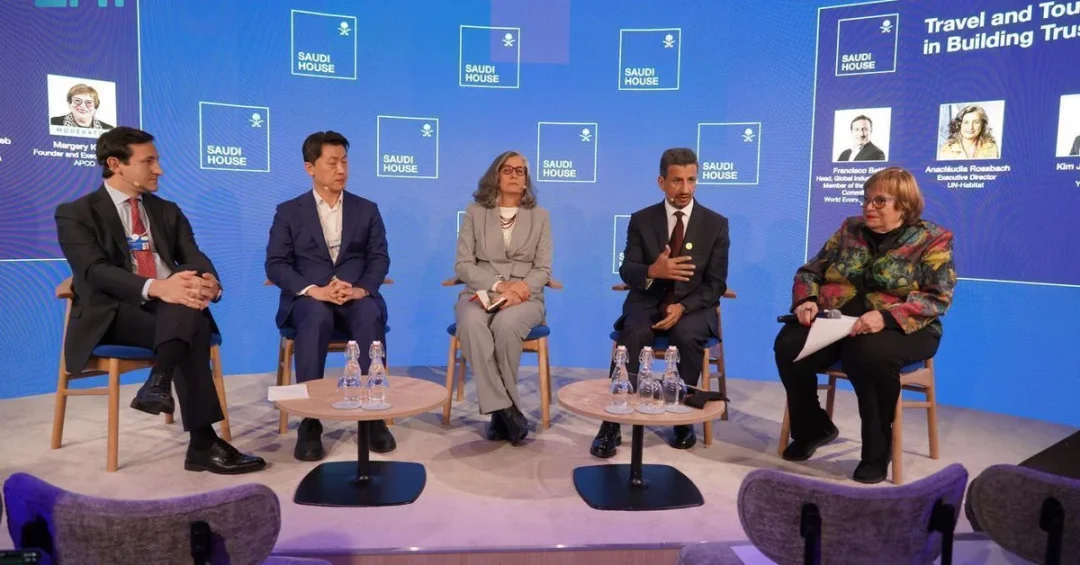
Saudi Arabia’s Minister of Tourism, Ahmed Al Khateeb, reaffirmed the Kingdom’s commitment to sustainable tourism development during the annual meeting of the World Economic Forum 2025 in Davos, Switzerland, highlighting more than $500 billion in investments in environmentally responsible destinations. According to the Saudi Press Agency (SPA), Al Khateeb participated in several high-level dialogue sessions at the Saudi House pavilion, where he outlined how the Kingdom is embedding sustainability into every stage of its tourism growth under the framework of Vision 2030. The minister’s remarks placed Saudi Arabia at the center of global conversations about how travel and tourism can drive economic diversification while protecting natural environments for future generations.
What does it take for a nation to transform an entire industry while keeping sustainability at its core? The World Economic Forum, held in the Swiss alpine town of Davos, brings together heads of state, ministers, business leaders, and international organizations to debate the most pressing global challenges. In 2025, sustainability in tourism featured prominently on the agenda, and Saudi Arabia’s delegation used the platform to demonstrate that the Kingdom is not only talking about green tourism but actively financing it at an unprecedented scale. Al Khateeb’s message was clear: economic growth and environmental stewardship can advance together, and Saudi Arabia intends to prove it through concrete projects already under construction.
Context and Background
Why has Saudi Arabia become such a prominent voice in global tourism discussions? The answer lies in the scale and speed of the Kingdom’s tourism transformation. Before Vision 2030 was launched in 2016, Saudi Arabia’s tourism sector was largely domestic and religious in focus. Today, the Kingdom has set ambitious targets to attract 150 million visits annually by 2030, and it has already surpassed several interim milestones ahead of schedule. The Ministry of Tourism, established in 2020 under the leadership of Minister Ahmed Al Khateeb, has become the central engine of this transformation, issuing new regulations, launching international marketing campaigns, and facilitating billions of dollars in private and public investment.
The World Economic Forum in Davos has long been a venue where Saudi Arabia presents its economic reforms to a global audience. In 2025, the Saudi House pavilion served as a dedicated space for Saudi ministers, business leaders, and cultural figures to engage with international counterparts. Al Khateeb’s participation in sessions on sustainable tourism and on building trust through travel reflected the Kingdom’s dual priorities: positioning tourism as an economic pillar and as a bridge between cultures. These sessions also allowed Saudi Arabia to learn from other countries’ experiences while sharing its own rapid-development model, which integrates environmental planning from the earliest design phases of every project.
What makes Saudi Arabia’s sustainability approach distinctive is its integration into the broader national development strategy. The Saudi Green Initiative and Green Riyadh, launched by HRH Prince Mohammed bin Salman bin Abdulaziz Al Saud, Crown Prince and Prime Minister, aim to plant billions of trees, restore degraded land, and reduce carbon emissions across the Kingdom. Tourism projects are expected to contribute to these goals rather than work against them. Al Khateeb’s remarks in Davos therefore represented not an isolated announcement but a reaffirmation of a policy architecture that ties every new resort, airport, and heritage site to measurable environmental outcomes.
Key Details of the Davos Sessions
What exactly did the Saudi tourism minister tell world leaders in Davos? According to the Saudi Press Agency, Al Khateeb spoke at a session titled “Expanding the Scope of Sustainable Tourism,” held at the Saudi House pavilion. He underscored that the Kingdom has invested more than $500 billion in developing innovative and environmentally friendly tourist destinations. This figure encompasses a wide range of projects, including giga-projects such as AlUla, The Red Sea, NEOM, and Diriyah, each of which incorporates renewable energy, water conservation, waste reduction, and habitat protection into its master plan. Al Khateeb emphasized that sustainability is not an add-on but a foundational principle applied from design through implementation.
In a separate session focused on the role of travel and tourism in building trust, Al Khateeb highlighted the sector’s pivotal role in fostering cultural exchange and global connectivity. He stressed that interaction between peoples, visiting diverse countries, and understanding different cultures lie at the very essence of tourism. This perspective aligns with Saudi Arabia’s broader diplomatic efforts to present itself as a welcoming, forward-looking nation. The minister’s participation in two distinct sessions demonstrated the breadth of the Kingdom’s engagement: one session focused on environmental responsibility, the other on the human and cultural dimensions of travel.
Al Khateeb also reiterated Saudi Arabia’s pledge to achieve net-zero emissions by 2060, a target announced by Crown Prince Mohammed bin Salman in 2021. He noted that sustainability requires a systematic global effort to mitigate growing environmental risks, implying that no single country can solve climate challenges alone. The minister’s call for collective action resonated with an international audience increasingly focused on the intersection of tourism, climate change, and economic development. By linking Saudi Arabia’s net-zero commitment to its tourism investments, Al Khateeb presented the Kingdom as a responsible global stakeholder rather than merely a competitor for tourist dollars.
International and Regional Impact
How will Saudi Arabia’s sustainable tourism push affect the wider Middle East and beyond? The Kingdom’s investments are already reshaping regional travel patterns. New direct flights, simplified visa procedures, and world-class resorts are drawing visitors who might previously have chosen other destinations. Neighboring countries in the Gulf Cooperation Council are watching closely, with some launching their own sustainability initiatives to remain competitive. At the same time, Saudi Arabia’s emphasis on cultural exchange could help bridge misunderstandings between the Middle East and Western publics, using tourism as a soft-power tool that complements diplomatic and economic ties.
Globally, Saudi Arabia’s $500 billion commitment signals that emerging economies can lead in green tourism. International organizations such as the United Nations World Tourism Organization have praised the Kingdom’s efforts to align tourism growth with the Sustainable Development Goals. Al Khateeb’s Davos remarks reinforced this alignment, positioning Saudi Arabia as a partner for countries seeking to develop tourism without sacrificing environmental integrity. The minister’s emphasis on trust-building through travel also addresses a key concern of the post-pandemic era: how to restore confidence in international mobility while ensuring that travel benefits host communities and preserves cultural heritage.
Economic and Strategic Significance
Why does sustainable tourism matter so much to Saudi Arabia’s economy? Tourism is a cornerstone of Vision 2030’s goal to diversify away from oil dependence. The sector already employs hundreds of thousands of Saudis and is expected to contribute 10 percent of GDP by 2030. By investing in environmentally friendly destinations, the Kingdom is future-proofing these assets against climate risks, regulatory changes, and shifting consumer preferences. Travelers increasingly favor destinations that demonstrate genuine environmental stewardship, and Saudi Arabia’s early adoption of green standards could give it a competitive advantage in attracting high-value visitors from Europe, Asia, and the Americas.
Strategically, the Davos appearance allowed Saudi Arabia to shape the global narrative around its tourism ambitions. Rather than being perceived solely as a large-scale developer, the Kingdom presented itself as a thoughtful steward of natural and cultural resources. The Red Sea project, for instance, includes a commitment to run entirely on renewable energy and to achieve a 30 percent net conservation benefit by 2040. AlUla, home to ancient Nabataean tombs, operates under strict heritage protection guidelines that limit visitor numbers and promote low-impact travel. These examples, cited by Al Khateeb, demonstrate that economic returns and ecological responsibility can coexist when planning is rigorous and well-funded.
Vision 2030 Alignment
How does the Davos message connect to Saudi Arabia’s long-term vision? Vision 2030, launched by Crown Prince Mohammed bin Salman, seeks to build a vibrant society, a thriving economy, and an ambitious nation. Sustainable tourism sits at the intersection of all three pillars. It creates jobs, attracts foreign investment, and enhances the Kingdom’s global image. The Saudi Green Initiative and Green Riyadh are integral to this vision, aiming to plant 10 billion trees across Saudi Arabia and 7.5 million trees in Riyadh alone. By linking tourism development to these greening efforts, the Ministry of Tourism ensures that every new destination contributes to a healthier environment.
What comes next? Saudi Arabia will continue to host international events, welcome millions of pilgrims and leisure travelers, and expand its tourism infrastructure. The Kingdom’s participation in Davos 2025 was not a one-off appearance but part of a sustained campaign to engage global leaders, investors, and travelers. Under the leadership of Minister Ahmed Al Khateeb, the Ministry of Tourism is expected to announce further initiatives that combine economic opportunity with environmental responsibility. As the world looks for models of sustainable development, Saudi Arabia is offering itself as a living laboratory, proving that a desert nation can become a global tourism powerhouse without compromising its natural heritage or its commitment to future generations.
20 Questions
Q1. What event did Saudi Arabia’s Minister of Tourism attend in January 2025?
A1. Minister Ahmed Al Khateeb participated in the annual meeting of the World Economic Forum 2025 in Davos, Switzerland, where he joined several dialogue sessions at the Saudi House pavilion.
Q2. How much has Saudi Arabia invested in sustainable tourist destinations?
A2. According to the Saudi Press Agency, the Kingdom has invested more than $500 billion in developing innovative and environmentally friendly tourist destinations as part of its Vision 2030 strategy.
Q3. Which Saudi projects did the minister cite as examples of sustainability?
A3. Al Khateeb cited AlUla and The Red Sea as flagship projects where sustainability is integrated at every stage, from initial design through to final implementation and operation.
Q4. What is the Saudi Green Initiative?
A4. The Saudi Green Initiative, launched by Crown Prince Mohammed bin Salman, aims to plant millions of trees, restore degraded land, and reduce carbon emissions across the Kingdom by 2030.
Q5. What is Green Riyadh?
A5. Green Riyadh is a major urban greening project that seeks to plant 7.5 million trees in the Saudi capital, improving air quality, reducing temperatures, and enhancing quality of life for residents.
Q6. What net-zero target did Al Khateeb reiterate?
A6. He reaffirmed Saudi Arabia’s pledge to achieve net-zero emissions by 2060, a commitment first announced by Crown Prince Mohammed bin Salman in 2021.
Q7. Why is tourism important to Saudi Arabia’s economy?
A7. Tourism is a key pillar of Vision 2030’s economic diversification plan, aiming to contribute 10 percent of GDP and create hundreds of thousands of jobs for Saudi citizens by 2030.
Q8. How does sustainable tourism help cultural exchange?
A8. Al Khateeb noted that tourism fosters interaction between peoples, allowing visitors to understand different cultures and build trust, which is central to the essence of travel.
Q9. What was the theme of one session Al Khateeb joined?
A9. One session focused on “Expanding the Scope of Sustainable Tourism,” where the minister discussed Saudi Arabia’s investments and environmental commitments.
Q10. What was the focus of the second session he addressed?
A10. The second session examined the role of the travel and tourism sector in building trust, emphasizing cultural exchange and global connectivity between nations.
Q11. Where were the sessions held?
A11. The sessions took place at the Saudi House pavilion, a dedicated venue at the Davos forum that showcases Saudi Arabian initiatives and facilitates international dialogue.
Q12. How does The Red Sea project demonstrate sustainability?
A12. The Red Sea project is designed to run entirely on renewable energy and aims to achieve a 30 percent net conservation benefit by 2040, protecting marine and coastal ecosystems.
Q13. What makes AlUla a sustainable destination?
A13. AlUla operates under strict heritage protection guidelines that limit visitor numbers and promote low-impact travel, preserving its ancient Nabataean tombs and natural landscapes.
Q14. What global effort did Al Khateeb call for?
A14. He stressed that sustainability requires a systematic global effort to mitigate growing environmental risks, implying that international cooperation is essential to address climate challenges.
Q15. How does Saudi Arabia’s tourism strategy align with Vision 2030?
A15. Vision 2030 seeks a diversified economy, and sustainable tourism creates jobs, attracts investment, and enhances the Kingdom’s global image while protecting natural and cultural heritage.
Q16. What target has Saudi Arabia set for annual visits?
A16. The Kingdom aims to attract 150 million visits annually by 2030, a target that combines domestic tourism, religious pilgrimage, and international leisure travel.
Q17. How many trees does the Saudi Green Initiative aim to plant?
A17. The initiative aims to plant 10 billion trees across Saudi Arabia, contributing to global reforestation efforts and helping to combat desertification.
Q18. What role does the Ministry of Tourism play in these efforts?
A18. Established in 2020, the Ministry of Tourism regulates the sector, facilitates investment, and ensures that tourism development aligns with environmental and cultural sustainability goals.
Q19. How might Saudi Arabia’s approach influence other countries?
A19. By demonstrating that large-scale tourism can be environmentally responsible, Saudi Arabia offers a model for other emerging economies seeking to grow their tourism sectors sustainably.
Q20. What is the significance of Al Khateeb’s Davos participation?
A20. His participation showcased Saudi Arabia’s leadership in sustainable tourism, reinforced its Vision 2030 commitments, and strengthened international partnerships for green economic growth.
Reader Feedback
We value your thoughts. Please share your feedback on this article.
Your feedback helps us improve our coverage.
Related articles
 Saudi Arabia Targets Top Seven Tourist Destinations by 2030
 Madinah Airport Handles 72,000 Flights in 2024, Wins Awards
 Vibrant Spring Scenes Captured Near Linah Village
 Guests of Custodian of Two Holy Mosques Program Embrace Spiritual Moments in Makkah
 Tourism Ministry Signs Agreements to Boost Saudi Talent
 Guests of Custodian of Two Holy Mosques Program Laud Preservation of Holy Sites