


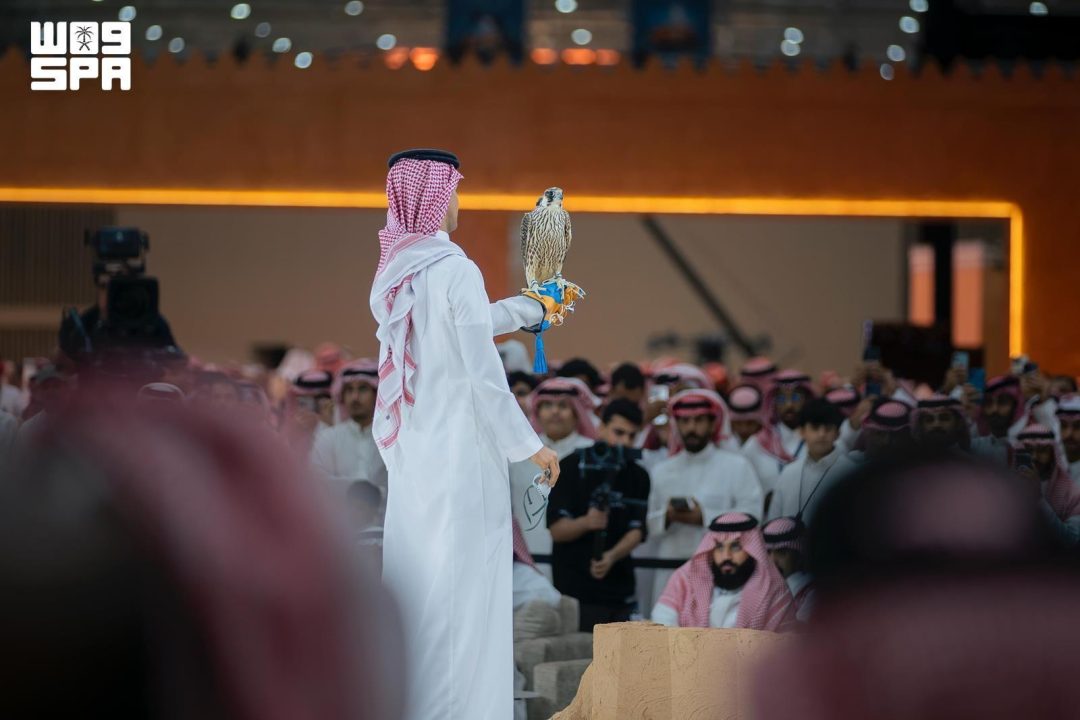
A juvenile peregrine falcon sold for SAR101,000 on the opening evening of the National Center for Falcons’ 2026 auction at the International Saudi Falcons and Hunting Exhibition in Riyadh, with bidding on the bird starting at SAR30,000.
Suudi basın ajansı SPA’nın bildirdiğine göre the bird was trapped in Al-Hamad in the Northern Borders Region. The sale took place yesterday evening, October 1, 2026, as the auction opened.
The auction runs through November 30 and accepts only juvenile migratory peregrine falcons trapped within Saudi Arabia. Adult peregrine falcons and saker falcons are excluded to help conserve their populations.
Those are the facts SPA published: one bird, one price, one starting bid, one trapping location, one opening date, one closing date, and one set of eligibility rules. Everything else — the identity of the buyer, the number of bidders in the room, the total number of birds offered on opening night, the cumulative value of sales so far — was not in the bulletin.
What does a single opening-night sale of SAR101,000 tell us about the market that will unfold between now and November 30? On its own, very little. A juvenile peregrine falcon trapped in Al-Hamad in the Northern Borders Region drew an opening bid of SAR30,000 and closed at SAR101,000. That is a multiple of more than three times the starting figure, but SPA did not report how many bids were placed, how long the bidding lasted, or whether the buyer was acting alone or on behalf of a group.
The auction is organized by the National Center for Falcons and hosted at the International Saudi Falcons and Hunting Exhibition. Both the organizer and the venue are named in the source. The exhibition context matters because it places the auction inside a broader gathering devoted to falcons and hunting, rather than in a standalone sales room. Still, SPA did not describe the exhibition’s size, its other programming, or how the auction is physically staged within it.
Consider the eligibility rule, because it is the most consequential detail in the bulletin. Only juvenile migratory peregrine falcons trapped within Saudi Arabia may be entered. Adult peregrine falcons are excluded. Saker falcons are excluded. The stated reason is conservation of their populations. That means the auction is not a general falcon market. It is a narrow, season-bound market for a specific age class of a specific species, and only for birds taken inside the Kingdom.
Why would a conservation-minded auction accept only juveniles and reject adults? The source does not explain the underlying biology or the regulatory reasoning. It states the rule and the purpose. Readers who want to know how the exclusion of adults and saker falcons translates into population protection will not find that answer in the SPA bulletin.
Now look at the geography. The bird was trapped in Al-Hamad in the Northern Borders Region. That is the only location SPA gave. It did not say when the bird was trapped, how it was trapped, who trapped it, or how it traveled from the Northern Borders Region to the auction floor in Riyadh. It did not say whether Al-Hamad is a common trapping ground or an unusual one.
Does the trapping location affect price? A buyer might care about the origin of a bird, but the source gives no indication that provenance was a factor in the bidding. It reports the location as a fact about the bird, not as a driver of the price.
The price itself deserves careful handling. SAR101,000 is the only figure attached to a sale. The starting bid of SAR30,000 is the only other number. SPA did not publish an average price, a high, a low, or a total for the evening. So there is no basis in the source for saying whether SAR101,000 is typical, high, or low for this auction.
How should a reader interpret a single sale when the auction has nearly two months to run? The auction opened yesterday evening and continues through November 30. That is roughly eight weeks of selling. One opening-night result is a data point, not a trend. SPA’s bulletin does not attempt to frame it as anything more.
The timing is also specific. The sale occurred yesterday evening, and the dateline is Riyadh, October 2, 2026, with a local time stamp of 07:18 and a GMT stamp of 04:18. The auction opened on the evening of October 1. So the report was filed the following morning.
What happens between now and November 30 is, by the terms of the source, unknown. The auction accepts entries that meet the eligibility rule. It runs for a defined period. It is organized by the National Center for Falcons. It is held at the International Saudi Falcons and Hunting Exhibition. Those are the structural facts.
The conservation dimension is stated plainly: adult peregrine falcons and saker falcons are excluded to help conserve their populations. That is the only rationale SPA offers. It does not quantify the populations, describe their status, or explain how the auction’s proceeds or rules connect to conservation programs.
Could the exclusion of saker falcons shift demand toward juvenile peregrine falcons? The source does not address demand at all. It does not say how many birds are expected to be offered across the auction’s run, nor how many were offered on opening night.
What is verifiable from the bulletin is compact. A juvenile peregrine falcon. Trapped in Al-Hamad, Northern Borders Region. Sold for SAR101,000. Bidding opened at SAR30,000. Sold yesterday evening. At the National Center for Falcons’ 2026 auction. At the International Saudi Falcons and Hunting Exhibition. Auction runs through November 30. Only juvenile migratory peregrine falcons trapped within Saudi Arabia accepted. Adult peregrine falcons and saker falcons excluded to help conserve their populations.
Everything beyond that list is absent. No buyer name. No seller name. No number of bidders. No total sales. No comparison to prior years. No statement from the National Center for Falcons. No description of the exhibition’s other activities. No explanation of how trapping is regulated, monitored, or verified. No detail on how a bird’s juvenile status is confirmed.
Why does the absence of those details matter? Because a price without context is a headline, not an analysis. SAR101,000 is striking on its own, but the source does not tell us whether it reflects a strong market, a thin market, or a single determined buyer. It does not tell us whether the opening bid of SAR30,000 was a floor set by the auction or a figure chosen by a seller.
The auction’s duration — through November 30 — is the longest window in the bulletin. It implies a sustained program of sales, but SPA did not say whether sales occur nightly, weekly, or on some other schedule. It did not say whether the auction is continuous or staged in sessions.
What can be said with confidence is that the National Center for Falcons’ 2026 auction opened with a juvenile peregrine falcon from Al-Hamad selling for SAR101,000 after bidding began at SAR30,000. The rules restrict entries to juvenile migratory peregrine falcons trapped within Saudi Arabia, and exclude adult peregrine falcons and saker falcons for conservation. The auction continues through November 30 at the International Saudi Falcons and Hunting Exhibition.
Readers following the auction will have to wait for further SPA bulletins to learn whether SAR101,000 was an outlier or a baseline. The source, as published, leaves that question open — along with the buyer, the volume, the totals, and the conservation outcomes the eligibility rules are meant to serve.
Where and when did the sale take place? The sale took place yesterday evening, October 1, 2026, as the National Center for Falcons’ 2026 auction opened at the International Saudi Falcons and Hunting Exhibition in Riyadh. SPA datelined its report Riyadh, October 2, 2026, with a local time stamp of 07:18 and a GMT stamp of 04:18. The auction runs through November 30.
What kind of falcon was sold and where was it trapped? It was a juvenile peregrine falcon trapped in Al-Hamad in the Northern Borders Region. Bidding on the bird opened at SAR30,000 and it sold for SAR101,000. SPA did not report when the bird was trapped, who trapped it, or how it was brought to the auction floor in Riyadh.
What are the auction’s eligibility rules? The auction accepts only juvenile migratory peregrine falcons trapped within Saudi Arabia. Adult peregrine falcons and saker falcons are excluded to help conserve their populations. SPA did not explain how juvenile status is verified, how trapping is monitored, or how the exclusions translate into measurable conservation outcomes.
How many birds were offered and what were total sales? SPA did not publish the number of birds offered on opening night, the number of bidders, or cumulative sales figures. The bulletin reports one sale at SAR101,000 from an opening bid of SAR30,000. With the auction running through November 30, no average, high, low, or total for the event is available in the source.
Who organized the auction and where is it held? The National Center for Falcons organized the 2026 auction, and it is held at the International Saudi Falcons and Hunting Exhibition. SPA did not describe the exhibition’s size, its other programming, or how the auction is staged within the venue. No statement from the National Center for Falcons was included in the bulletin.
What did SPA leave out of its report? SPA did not name the buyer or seller, did not give the number of bidders, and did not provide total sales or comparisons to prior years. It also did not explain how trapping is regulated or how juvenile status is confirmed. The bulletin states the sale price, the starting bid, the trapping location, the eligibility rules, and the auction’s closing date of November 30.
Related articles
 Unaizah Valisi, Hurma Sezonu katılımcılarını onurlandırdı
 Koalisyon: Khamis Mushait’e atılan balistik füze engellendi ve imha edildi
 Pasaportlar Genel Müdürlüğü, Suudi Şahin ve Avcılık Fuarı’na katılıyor
 Sınır Muhafızları, Suudi Şahin ve Avcılık Fuarı’nda ZALY sistemini tanıtıyor
 Saudi Büyükelçisi Al-Shammari, Moldova Cumhurbaşkanı Sandu’ya güven mektubunu sundu
 Sivil Savunma, Saudi Falcons Exhibition 2026’da keşif ve yangın teknolojilerini sergiliyor