


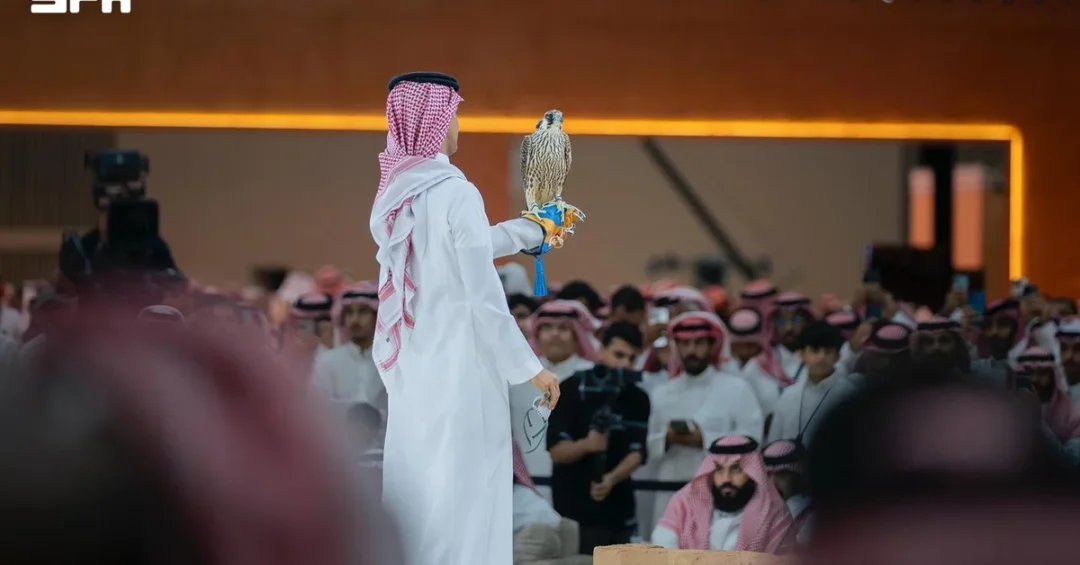
A juvenile peregrine falcon fetched SAR101,000 on the opening night of the National Center for Falcons’ 2026 auction, held at the International Saudi Falcons and Hunting Exhibition in Riyadh, according to the Saudi Press Agency. The bird, trapped in Al-Hamad in the Northern Borders Region, drew immediate attention when bidding opened at SAR30,000 and climbed steadily before the hammer fell. The result set a confident tone for an auction that runs through November 30 and is dedicated exclusively to juvenile migratory peregrine falcons trapped within the Kingdom. For international observers, the sale is more than a headline price — it is a window into how Saudi Arabia is pairing its deep-rooted falconry heritage with modern conservation science and regulated wildlife markets.
The auction is organized by the National Center for Falcons, a Saudi government body responsible for the sustainable management of falconry in the Kingdom. Its rules are deliberately strict: only juvenile migratory peregrine falcons trapped inside Saudi Arabia may be entered, while adult peregrine falcons and saker falcons are excluded to protect their breeding populations. That framework reflects a broader shift in Saudi Arabia’s approach to wildlife — one in which cultural traditions are preserved not by loosening protections but by tightening them. As the exhibition continues in Riyadh, the SAR101,000 sale signals that demand for legally and ethically sourced falcons remains robust, and that the Kingdom intends to lead the region in responsible falconry. How does a single bird’s sale connect to a national conservation strategy? The answer lies in the auction’s design, its timing, and the global significance of falconry itself.
Context and Background
Falconry has been woven into Arabian life for centuries, long before modern borders or oil economies. For Bedouin communities, the peregrine falcon was a hunting partner of extraordinary skill, capable of taking prey across open desert. That heritage is now celebrated at the International Saudi Falcons and Hunting Exhibition, an annual gathering that brings together breeders, trainers, conservationists, and enthusiasts from across the region and beyond. The National Center for Falcons uses the exhibition as a platform to regulate trade, educate the public, and promote best practices in falcon care. The 2026 auction, which opened with the SAR101,000 sale, is a central component of that mission. Isn’t it remarkable how a tradition stretching back generations can be modernized without losing its soul? Saudi Arabia’s answer has been to formalize the market, not suppress it.
The decision to restrict the auction to juvenile migratory peregrine falcons trapped within the Kingdom is a deliberate conservation measure. Adult peregrines are crucial to breeding success, and saker falcons have faced significant pressure across their range in Central Asia. By excluding those categories, Saudi authorities reduce the risk of overharvesting and align the auction with international wildlife standards. The bird sold on opening night was trapped in Al-Hamad, a desert area in the Northern Borders Region known for its migratory corridors. Its journey from that remote landscape to a Riyadh auction floor illustrates the intersection of ecology, culture, and commerce that defines modern falconry in Saudi Arabia. The auction’s duration — through November 30 — also allows for a steady, measured supply rather than a chaotic rush, giving buyers and conservationists alike time to assess the market.
Key Details
The opening-night sale was notable not only for its final price but for how bidding unfolded. According to the Saudi Press Agency, bidding opened at SAR30,000 and quickly escalated to SAR101,000, a more than threefold increase. That trajectory suggests strong competition among buyers and a willingness to pay a premium for a bird with desirable characteristics — likely including its juvenile status, its origin in a recognized trapping region, and its physical condition. The National Center for Falcons has not released the identity of the buyer, and under auction rules, the transaction remains a private matter between the center and the purchaser. What matters for the broader market is the signal: a legally trapped, registered juvenile peregrine falcon can command a six-figure sum in Saudi Riyals, reinforcing the value of the regulated system.
The auction will continue through November 30, with new birds expected to be presented on a rolling basis. Only juvenile migratory peregrine falcons trapped within Saudi Arabia are eligible, and each bird must meet the center’s documentation and health requirements. Adult peregrine falcons and saker falcons are explicitly excluded, a rule that conservationists have praised as a model for the region. The International Saudi Falcons and Hunting Exhibition itself features training demonstrations, veterinary workshops, and educational pavilions, making it more than a marketplace. For international visitors, the event offers a chance to see how Saudi Arabia is blending heritage with environmental responsibility. Could this auction become a template for other countries seeking to regulate falconry? Early indications suggest it already is being watched closely.
International and Regional Impact
Falconry is not exclusive to Saudi Arabia. It is practiced across the Gulf, in Central Asia, in Europe, and in North Africa, and it is recognized by UNESCO as an intangible cultural heritage of humanity. That international dimension means the Saudi auction has implications beyond the Kingdom’s borders. When Saudi Arabia restricts its auction to juvenile peregrines and bans the sale of adult peregrines and sakers, it sets a standard that other falconry markets may feel pressure to follow. Regional neighbors with similar traditions — including the United Arab Emirates, Qatar, and Kuwait — have their own regulatory frameworks, and the Saudi model adds a prominent voice to the conversation about sustainable practice. Isn’t it significant that a cultural tradition can become a vehicle for conservation diplomacy? Saudi Arabia appears to be betting that it can.
The auction also strengthens Saudi Arabia’s position in global wildlife governance. By working through a national center with clear rules, the Kingdom can engage with international bodies and conservation organizations from a position of credibility. The exclusion of adult peregrines and saker falcons is particularly important because those species face varying levels of threat across their ranges. A market that refuses to trade them reduces demand for illegally sourced birds and supports legal, traceable supply chains. For international audiences, this is a story about a country using its cultural capital to advance environmental goals — a narrative that aligns with Saudi Arabia’s broader efforts to present itself as a responsible global actor. The SAR101,000 sale is a data point, but the policy behind it is the real headline.
Economic and Strategic Significance
At first glance, SAR101,000 for a single falcon may seem like a niche transaction. But falconry in Saudi Arabia supports a substantial economic ecosystem: breeders, trainers, veterinarians, equipment makers, transport services, and exhibition organizers. The International Saudi Falcons and Hunting Exhibition draws exhibitors and visitors who spend on hospitality, travel, and related goods, contributing to Riyadh’s role as a events hub. The auction’s regulated structure also creates a formal market where transactions can be recorded, taxed, and monitored, rather than occurring in informal channels. That formalization is attractive to investors and to international partners who value transparency. How does a cultural auction fit into a modern economy? By turning tradition into a legitimate, sustainable industry.
Strategically, the auction reinforces Saudi Arabia’s soft power. Falconry is a point of pride and a shared heritage across the Arabian Peninsula, and Saudi leadership in this space is both natural and influential. The National Center for Falcons operates under a mandate that connects wildlife management to national identity, and its work supports the Kingdom’s reputation as a steward of desert ecosystems. The timing of the auction — running through November 30 — also coincides with the cooler months when outdoor activities and exhibitions flourish in Saudi Arabia, maximizing participation and visibility. For businesses in the falconry supply chain, the opening-night price is a benchmark that signals healthy demand. For policymakers, it is evidence that conservation and commerce can coexist when rules are clear and enforcement is consistent.
Vision 2030 Alignment
Saudi Vision 2030 seeks to diversify the economy, enrich quality of life, and preserve cultural heritage. The National Center for Falcons’ auction advances all three goals. It supports a specialized economic sector, creates opportunities for Saudi entrepreneurs and workers, and does so while protecting wildlife for future generations. The exhibition and auction also contribute to the growth of Riyadh as a destination for international events, aligning with efforts to attract visitors and showcase Saudi hospitality. By enforcing strict rules on which falcons may be sold, the Kingdom demonstrates that modernization and tradition are not opposites. Isn’t that the essence of Vision 2030 — building a future that respects the past? The SAR101,000 sale on opening night is a small but vivid example of that philosophy in action.
Looking ahead, the auction’s success will be measured not only in prices but in conservation outcomes. If the juvenile-only rule continues to protect adult peregrines and saker falcons, Saudi Arabia will have a strong case study to share with international partners. The National Center for Falcons is likely to expand its educational programs, and the exhibition will remain a focal point for the falconry community. For global readers, the story offers a nuanced view of Saudi Arabia: a country that takes its heritage seriously, regulates it responsibly, and uses it to engage the world. As the auction continues through November 30, the world will be watching how the market responds — and how the Kingdom’s model evolves.
20 Questions
Q1. What was the headline result of the auction’s opening night?
A1. A juvenile peregrine falcon sold for SAR101,000 on the opening night of the National Center for Falcons’ 2026 auction at the International Saudi Falcons and Hunting Exhibition in Riyadh, according to the Saudi Press Agency.
Q2. Where was the falcon trapped?
A2. The falcon was trapped in Al-Hamad in the Northern Borders Region of Saudi Arabia, an area known for migratory bird corridors and traditional falconry activity.
Q3. What was the starting bid for the falcon?
A3. Bidding opened at SAR30,000 before rising to the final sale price of SAR101,000, reflecting strong competition among buyers at the auction.
Q4. How long will the auction run?
A4. The auction runs through November 30, 2026, allowing a steady supply of eligible birds to be presented over several weeks rather than in a single session.
Q5. Which falcons are allowed in the auction?
A5. Only juvenile migratory peregrine falcons trapped within Saudi Arabia are accepted, ensuring that the auction focuses on a specific, regulated category of birds.
Q6. Which falcons are excluded from the auction?
A6. Adult peregrine falcons and saker falcons are excluded to help conserve their populations, a rule designed to protect breeding stocks and reduce pressure on vulnerable species.
Q7. Who organizes the auction?
A7. The National Center for Falcons, a Saudi government body responsible for sustainable falconry management, organizes the auction as part of its broader conservation and heritage mission.
Q8. Where is the auction being held?
A8. The auction is held at the International Saudi Falcons and Hunting Exhibition in Riyadh, an annual event that draws breeders, trainers, and enthusiasts from the region and beyond.
Q9. Why is the auction restricted to juvenile peregrines?
A9. Restricting the auction to juvenile migratory peregrines trapped in Saudi Arabia helps protect adult breeding birds and supports sustainable falconry practices in line with conservation goals.
Q10. What does the SAR101,000 price indicate about the market?
A10. The price indicates strong demand for legally trapped, documented juvenile peregrine falcons and suggests that buyers value the regulated, transparent system operated by Saudi authorities.
Q11. How does the auction support conservation?
A11. By excluding adult peregrines and saker falcons, the auction reduces incentives to capture breeding birds, thereby supporting population stability and aligning with international wildlife standards.
Q12. Is falconry important to Saudi culture?
A12. Yes, falconry is a deeply rooted Arabian tradition celebrated for generations, and it remains a symbol of skill, patience, and connection to the desert heritage of the region.
Q13. What is the International Saudi Falcons and Hunting Exhibition?
A13. It is an annual exhibition in Riyadh that showcases falconry, hunting equipment, training methods, and conservation initiatives, serving as a hub for the regional falconry community.
Q14. How does the auction align with Vision 2030?
A14. It supports economic diversification, cultural preservation, and quality-of-life initiatives, all of which are core objectives of Saudi Vision 2030 and its long-term development strategy.
Q15. Can international buyers participate?
A15. The auction is organized under Saudi regulations, and participation details are managed by the National Center for Falcons, which sets eligibility and registration requirements for buyers.
Q16. What happens to the falcons after the auction?
A16. Purchased falcons are registered and cared for by their new owners in accordance with Saudi regulations, which promote responsible ownership and animal welfare standards.
Q17. Are there similar auctions in other countries?
A17. Falconry markets exist in several countries, but Saudi Arabia’s auction is notable for its strict rules limiting sales to juvenile peregrines trapped within the Kingdom.
Q18. What is the significance of Al-Hamad as a trapping area?
A18. Al-Hamad in the Northern Borders Region is a recognized area for migratory falcons, and its inclusion in the auction highlights the ecological importance of Saudi Arabia’s desert corridors.
Q19. How does the auction handle documentation?
A19. The National Center for Falcons requires documentation and health checks for each bird, ensuring that only eligible juvenile peregrines are entered and that transactions are traceable.
Q20. What can the world learn from this auction?
A20. The auction demonstrates that cultural traditions like falconry can be modernized through regulation, conservation, and transparency, offering a model for balancing heritage with environmental responsibility.
Reader Feedback
We value your thoughts. Please share your feedback on this article.
Your feedback helps us improve our coverage.
Related articles
 Syrian Culture Minister Visits Madinah Research Center
 International Saudi Falcons and Hunting Exhibition 2026 Opens in Riyadh
 Interior Minister Visits Saudi Falcons and Hunting Exhibition 2026
 Peregrine Falcon Migration Revives Northern Borders Trapping Season
 Saudi Coffee Celebrates Cultural Heritage on International Coffee Day
 Wrth Camp Launches Third Edition in Aseer