


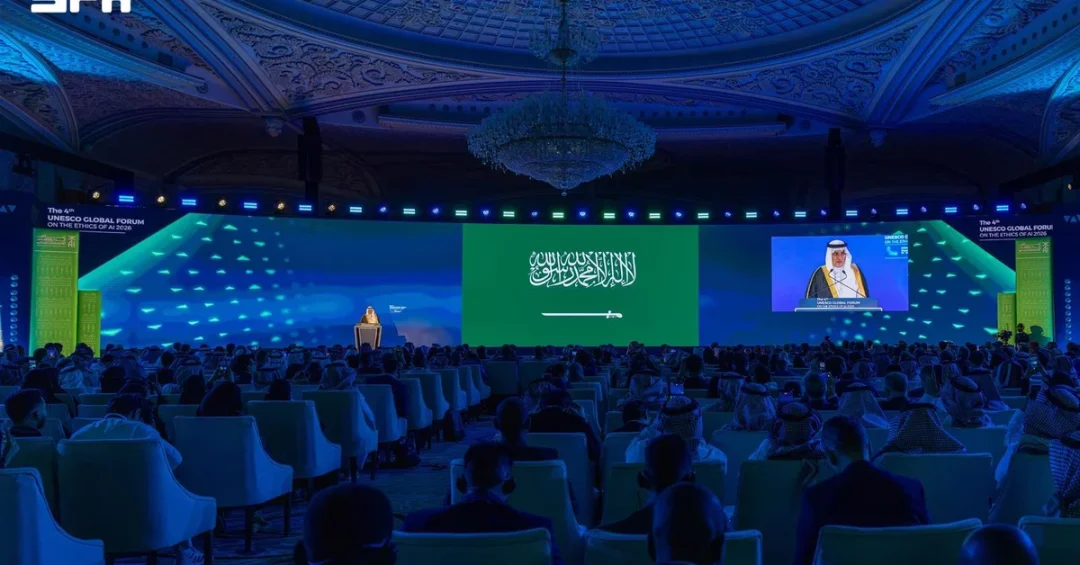
Riyadh hosted the fourth edition of the UNESCO Global Forum on the Ethics of Artificial Intelligence (GFEAI 2026) from September 15 to 17, 2026, organized by the Saudi Data and AI Authority (SDAIA) in partnership with UNESCO and the International Center for AI Research and Ethics (ICAIRE). The forum convened ministers from UNESCO member states, policymakers, experts, and international representatives to advance the translation of AI ethics principles into practical policies and tools.
Context and Background
The forum is organized by SDAIA, in partnership with the United Nations Educational, Scientific and Cultural Organization (UNESCO) and ICAIRE, and in coordination with the National Commission for Education, Culture and Science. It brings together ministers from UNESCO member states, policymakers, experts, researchers, academics, and representatives of governments and international organizations.
SDAIA President Dr. Abdullah bin Sharaf Alghamdi noted that Saudi Arabia’s hosting of the fourth edition comes in an exceptional year following the Kingdom’s designation of 2026 as the “Year of Artificial Intelligence.” He said this reflects the Kingdom’s commitment to developing artificial intelligence as a driver of progress, competitiveness, and human development.
Key Details
Alghamdi said the Kingdom recognized at an early stage that addressing AI goes beyond adopting new technologies. It requires building an integrated national ecosystem encompassing institutions, regulatory frameworks, human and technical capabilities, and international partnerships.
He said the Saudi leadership took a forward-looking approach to institutionalizing data and AI activities at the national level, exemplified by the establishment of SDAIA in 2019. Its Board of Directors is chaired by His Royal Highness Prince Mohammed bin Salman bin Abdulaziz Al Saud, Crown Prince and Prime Minister.
Alghamdi added that this institutional framework was extended to the international level through the establishment of ICAIRE in Riyadh in 2022. The center subsequently came under the auspices of UNESCO and works to support research, develop policies, build capabilities, enhance international cooperation, and translate AI ethics principles into practical tools and practices.
He noted that the Kingdom adopted the Personal Data Protection Law in 2021 to strengthen the protection of individuals’ privacy and rights. This was accompanied by an integrated system of national data governance policies and controls governing the classification, sharing, availability, protection, and use of data.
Alghamdi added that the Kingdom launched its AI Ethics Principles in 2022 in line with the UNESCO Recommendation. The principles reinforce fairness, privacy, security, safety, transparency, and accountability in the development and use of AI systems.
He also noted that the Kingdom has invested extensively in building human capabilities, from spreading basic knowledge and identifying talent to providing academic and professional training and developing specialized expertise. Through the national “SMAI” initiative, more than one million beneficiaries have been trained in the fundamentals of artificial intelligence, he said.
UNESCO Deputy Director-General Åsa Regnér expressed her gratitude to Saudi Arabia for hosting and organizing the forum, noting the particular importance of the organization’s partnership with the Kingdom. She added that Saudi Arabia completed UNESCO’s Readiness Assessment Methodology (RAM) process last year.
Regnér called for greater use of women’s capabilities and talents in AI, saying: “We know from university data that young women achieve significant academic success. They represent a strong pool of intellectual capacity and talent, but these capabilities are not always fully utilized in the labor market or in AI-related decision-making.”
The forum’s panel discussions bring together ministers from UNESCO member states, policymakers, experts, and specialists. They address AI ethics and governance, ways to translate principles into practical measures that support the responsible development and use of AI technologies, and efforts to strengthen international cooperation in addressing AI-related challenges and maximizing AI’s impact in serving people and society.
More than 1,200 participants and over 100 speakers are taking part in more than 30 sessions and workshops.
Implications and Impact
The forum underscores Saudi Arabia’s growing role in global AI governance and its commitment to ensuring that AI development is guided by ethical principles. By hosting this event, the Kingdom reinforces its position as a bridge between nations, fostering dialogue and cooperation on AI ethics. The outcomes of the forum are expected to influence international policies and practices, promoting responsible AI that benefits all of humanity.
The discussions also highlight the importance of international collaboration in addressing AI-related challenges, such as privacy, security, and bias, and in maximizing AI’s potential to serve people and society. Saudi Arabia’s leadership in this area, through SDAIA and ICAIRE, demonstrates its dedication to shaping a future where AI is developed and used responsibly.
Vision 2030 Alignment
Saudi Arabia’s hosting of the UNESCO Global Forum on the Ethics of AI aligns with Vision 2030’s goal to diversify the economy and position the Kingdom as a global leader in technology and innovation. The event reflects the Kingdom’s commitment to building a knowledge-based economy, investing in human capital, and fostering international partnerships. Through initiatives like SDAIA and ICAIRE, Saudi Arabia is contributing to the development of ethical AI frameworks that support sustainable development and improve quality of life, both domestically and globally.
20 Questions
Q1. What is the UNESCO Global Forum on the Ethics of AI?
A1. It is an international forum that brings together policymakers, experts, and stakeholders to discuss and advance the ethical development and use of artificial intelligence, guided by UNESCO’s principles.
Q2. Where and when did GFEAI 2026 take place?
A2. The fourth edition was held in Riyadh, Saudi Arabia, from September 15 to 17, 2026, hosted by the Kingdom and organized by SDAIA in partnership with UNESCO.
Q3. Who organized the forum?
A3. The Saudi Data and AI Authority (SDAIA) organized the forum in partnership with UNESCO and the International Center for AI Research and Ethics (ICAIRE).
Q4. What is SDAIA?
A4. SDAIA is the Saudi Data and AI Authority, established in 2019 to institutionalize data and AI activities at the national level, chaired by Crown Prince Mohammed bin Salman.
Q5. What is ICAIRE?
A5. ICAIRE is the International Center for AI Research and Ethics, established in Riyadh in 2022 under the auspices of UNESCO, to support research, policies, and capacity building in AI ethics.
Q6. Who is Dr. Abdullah bin Sharaf Alghamdi?
A6. He is the President of SDAIA and delivered a keynote speech at the forum, highlighting Saudi Arabia’s commitment to AI ethics and governance.
Q7. What did Alghamdi say about Saudi Arabia’s AI approach?
A7. He noted that Saudi Arabia recognized early that AI requires an integrated national ecosystem, including institutions, regulations, human capabilities, and international partnerships.
Q8. How does Saudi Arabia protect data privacy?
A8. The Kingdom adopted the Personal Data Protection Law in 2021 to strengthen privacy and rights, supported by national data governance policies.
Q9. What are Saudi Arabia’s AI Ethics Principles?
A9. Launched in 2022 in line with UNESCO, they reinforce fairness, privacy, security, safety, transparency, and accountability in AI systems.
Q10. What is the SMAI initiative?
A10. SMAI is a national initiative that has trained over one million beneficiaries in the fundamentals of artificial intelligence, building human capabilities.
Q11. What did UNESCO’s Deputy Director-General say?
A11. Åsa Regnér thanked Saudi Arabia for hosting and emphasized the importance of the partnership, and called for greater use of women’s talents in AI.
Q12. What is the Readiness Assessment Methodology (RAM)?
A12. RAM is UNESCO’s process to assess a country’s readiness to implement AI ethics recommendations; Saudi Arabia completed it last year.
Q13. How many participants attended GFEAI 2026?
A13. More than 1,200 participants and over 100 speakers took part in more than 30 sessions and workshops.
Q14. What topics were discussed at the forum?
A14. Discussions focused on AI ethics, governance, translating principles into practical measures, and international cooperation to address AI challenges.
Q15. Why is AI ethics important?
A15. AI ethics ensures that AI technologies are developed and used responsibly, respecting human rights, privacy, and fairness, and benefiting society.
Q16. How does Saudi Arabia contribute to global AI governance?
A16. Through SDAIA, ICAIRE, and hosting forums like GFEAI, Saudi Arabia fosters international dialogue and develops practical tools for AI ethics.
Q17. What is the significance of 2026 as the Year of AI?
A17. Saudi Arabia designated 2026 as the Year of AI to highlight its commitment to AI as a driver of progress, competitiveness, and human development.
Q18. How does the forum align with Vision 2030?
A18. It supports Vision 2030’s goals of economic diversification, technological leadership, and international partnerships, positioning Saudi Arabia as a hub for AI innovation.
Q19. What role do women play in AI according to the forum?
A19. UNESCO called for greater utilization of women’s capabilities in AI, noting their academic success and potential to contribute to AI decision-making.
Q20. What outcomes are expected from the forum?
A20. The forum aims to influence international AI policies, promote responsible AI development, and strengthen global cooperation to maximize AI’s benefits for humanity.
Reader Feedback
We value your thoughts. Please share your feedback on this article.
Your feedback helps us improve our coverage.