


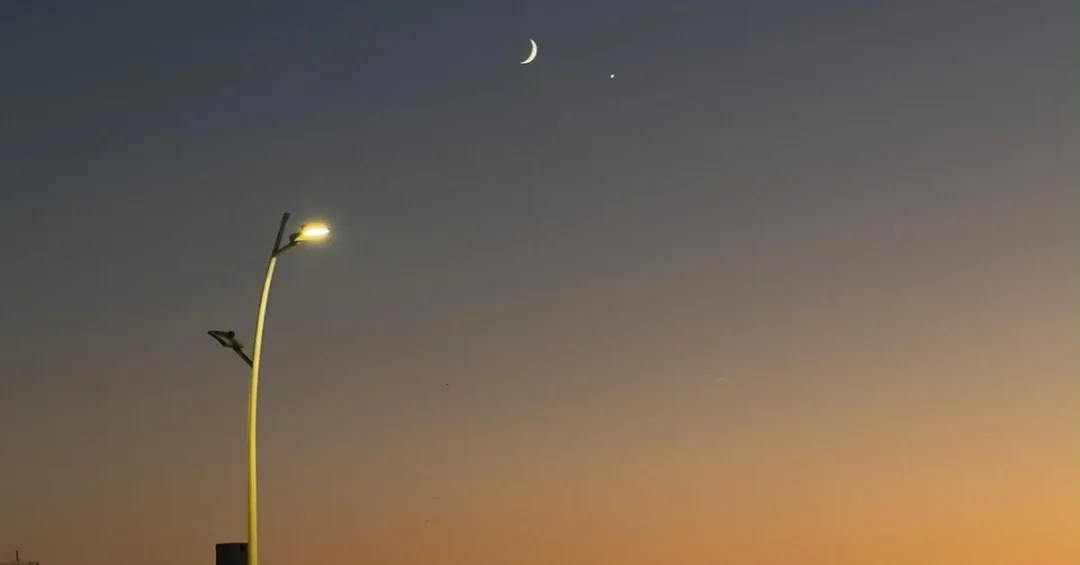
The Kingdom’s evening sky offered a striking celestial display as the waxing crescent Moon appeared in close conjunction with Venus on the western horizon shortly after sunset, an event visible to the naked eye across Saudi Arabia without specialized astronomical equipment. The conjunction was observed on Monday evening and was reported by the Saudi Press Agency (SPA), drawing attention from sky-watching enthusiasts and photographers across the country.
Context and Background
Astronomical conjunctions occur when two celestial bodies appear close together in the sky from the perspective of observers on Earth. Zahi Al-Khulaiwi, President of the Space and Astronomy Society, explained that such pairings are periodic events that recur throughout the year, offering the public regular opportunities to observe and photograph the night sky, particularly during twilight when the contrast between the planets and the fading daylight is most pronounced.
The conjunction involved Venus, often called the Evening Star, which is among the brightest natural objects in the night sky after the Moon. Its proximity to the young crescent made the event especially accessible to casual observers, requiring no telescopes or expert knowledge to appreciate.
Key Details
According to Al-Khulaiwi, the phenomenon can be captured using everyday smartphones or digital cameras, making astrophotography approachable for beginners. For those seeking finer detail, binoculars can reveal a clearer view of the Moon’s crescent, including the faint illumination visible on the Moon’s unlit portion, a phenomenon known as earthshine.
He also highlighted that the skies over the Northern Borders Region are characterized by low levels of light pollution, making the area an attractive destination for astronomy enthusiasts and astrophotographers seeking to observe the movements of planets and stars. The region’s dark skies position it as a promising location for future stargazing tourism and astronomical research.
Implications and Impact
The visibility of such celestial events supports growing public interest in astronomy across the Kingdom, where science education and sky-watching activities have gained momentum. Communities of amateur astronomers, students, and photographers increasingly use these occasions to develop observational skills and share their images on digital platforms.
Beyond public engagement, the event underscores the value of preserving dark-sky areas, which are increasingly recognized worldwide as natural and scientific resources. Regions with minimal light pollution can support research, education, and tourism while contributing to environmental awareness.
Vision 2030 Alignment
Promoting astronomy and space sciences aligns with Vision 2030, Saudi Arabia’s national strategy to diversify the economy, advance education, and foster scientific innovation. Encouraging public engagement with astronomy supports the development of a knowledge-based society, nurtures youth interest in STEM fields, and complements broader efforts to expand tourism and scientific research across the Kingdom, including in regions with exceptional natural advantages such as the Northern Borders.
20 Questions
Q1. What celestial event appeared in the Kingdom’s sky?
A1. A conjunction of the waxing crescent Moon and Venus appeared on the western horizon shortly after sunset. The event was visible to the naked eye and was reported by the Saudi Press Agency as a notable astronomical occurrence.
Q2. Who explained the details of this astronomical event?
A2. Zahi Al-Khulaiwi, President of the Space and Astronomy Society, explained that such conjunctions are periodic events that occur throughout the year, providing regular opportunities for sky-watching enthusiasts to observe and photograph them.
Q3. What is an astronomical conjunction?
A3. A conjunction occurs when two celestial bodies appear close together in the sky from Earth’s perspective. It is an optical alignment rather than a physical proximity, and such events are common and predictable in astronomy.
Q4. Why was Venus prominent in this event?
A4. Venus is one of the brightest natural objects in the night sky after the Moon, often called the Evening Star. Its brightness made the conjunction particularly easy to observe during twilight without specialized equipment.
Q5. What equipment is needed to view such a conjunction?
A5. No specialized equipment is required. The event was visible to the naked eye, and smartphones or digital cameras can capture it. Binoculars can provide a clearer view of the Moon’s crescent and its finer details.
Q6. What detail can binoculars reveal during the conjunction?
A6. Binoculars can show the faint illumination on the Moon’s unlit portion, known as earthshine. This subtle glow is caused by sunlight reflecting off Earth onto the Moon’s dark side.
Q7. Where in the Kingdom are skies best for astronomy?
A7. The Northern Borders Region has low levels of light pollution, making it attractive for astronomy enthusiasts and astrophotographers. Such dark skies allow clearer observation of planets, stars, and other celestial movements.
Q8. Why is twilight important for observing conjunctions?
A8. Twilight offers a balance between fading daylight and darkening skies, making bright objects like Venus and the crescent Moon stand out. The contrast helps observers and photographers capture the event clearly.
Q9. How often do such conjunctions occur?
A9. According to Zahi Al-Khulaiwi, these conjunctions are periodic events that occur throughout the year. They are predictable astronomical phenomena, giving the public regular chances to observe and photograph the night sky.
Q10. Can smartphones capture the conjunction effectively?
A10. Yes, smartphones and digital cameras can capture the conjunction, especially during twilight. While they may not show fine detail, they offer a convenient way for the public to document and share the celestial event.
Q11. What is earthshine?
A11. Earthshine is the faint illumination visible on the Moon’s unlit portion. It occurs when sunlight reflects off Earth onto the Moon’s dark side, and it can be observed with binoculars during crescent phases.
Q12. Why is the Northern Borders Region suitable for astrophotography?
A12. The region has low light pollution, which allows clear views of planets and stars. This makes it attractive for astrophotographers seeking to observe and capture the movements of celestial bodies in greater detail.
Q13. How does this event support science education in Saudi Arabia?
A13. Public celestial events encourage interest in astronomy and STEM fields. They provide practical opportunities for students and enthusiasts to develop observational skills, supporting broader educational goals aligned with national development strategies.
Q14. What role does the Space and Astronomy Society play?
A14. The Space and Astronomy Society, led by Zahi Al-Khulaiwi, explains astronomical events and promotes public engagement. It helps enthusiasts understand phenomena such as conjunctions and encourages observation and photography of the night sky.
Q15. Does observing this event require travel to a specific location?
A15. No, the conjunction was visible to the naked eye across the Kingdom. However, areas with low light pollution, such as the Northern Borders Region, offer clearer views and better conditions for photography.
Q16. What makes Venus easy to identify in the evening sky?
A16. Venus is exceptionally bright and appears near the western horizon after sunset. Its luminosity, second only to the Moon among night-sky objects, makes it easily identifiable during twilight without any equipment.
Q17. How can the public share their observations of such events?
A17. Enthusiasts often photograph conjunctions with smartphones or digital cameras and share images on digital platforms. This fosters community engagement and public interest in astronomy across the Kingdom and beyond.
Q18. Why are dark-sky areas valuable beyond astronomy?
A18. Dark-sky areas support scientific research, education, and tourism while raising environmental awareness. Preserving them contributes to natural conservation and offers economic and cultural benefits for local communities.
Q19. How does astronomy connect to Saudi Arabia’s long-term goals?
A19. Astronomy supports Vision 2030 by advancing education, scientific innovation, and knowledge-based development. It nurtures youth interest in STEM and complements efforts to expand research and tourism in regions with exceptional natural advantages.
Q20. What can observers look forward to after this conjunction?
A20. Periodic conjunctions and other celestial events occur throughout the year. The public can continue observing and photographing the night sky, particularly in areas with low light pollution such as the Northern Borders Region.
Reader Feedback
We value your thoughts. Please share your feedback on this article.
Your feedback helps us improve our coverage.