


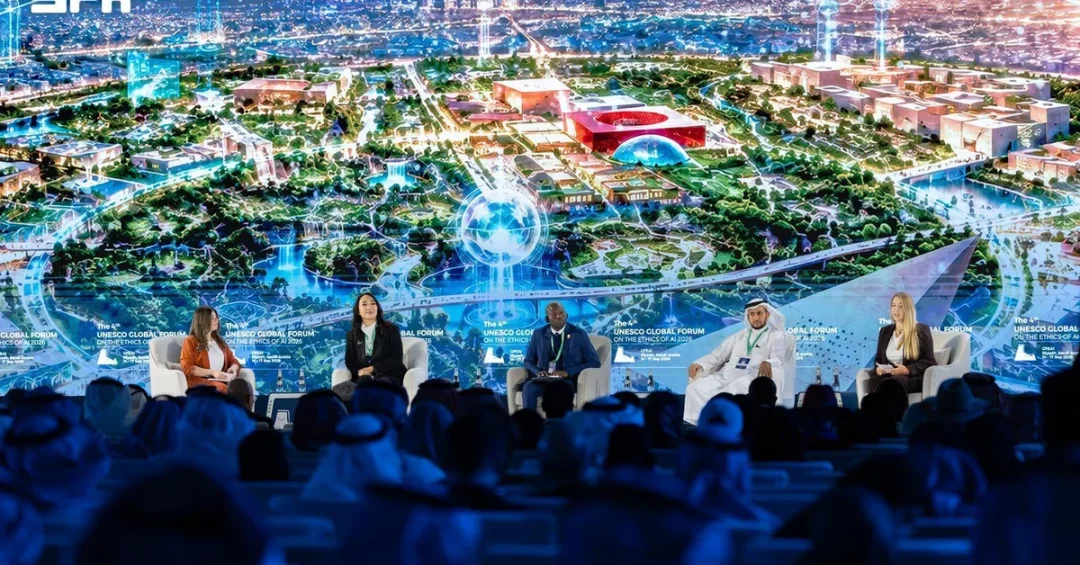
Riyadh, September 17, 2026 — The second day of the fourth edition of the UNESCO Global Forum on the Ethics of Artificial Intelligence concluded in Riyadh on Wednesday, underscoring Saudi Arabia’s growing leadership in global AI governance. Held under the patronage of the Saudi Data and AI Authority (SDAIA) in partnership with the United Nations Educational, Scientific and Cultural Organization (UNESCO), the forum brought together officials, experts, researchers, and policymakers from around the world. Discussions focused on AI readiness, institutional capacity building, public-sector adoption, labor market impacts, skills development, safety and ethics, and international cooperation in AI oversight. The event marks the first time this international platform has been hosted in the Arab world, reflecting the Kingdom’s expanding role in shaping the global AI agenda.
Context and Background
The UNESCO Global Forum on the Ethics of Artificial Intelligence has become a key international venue for advancing responsible AI development. This fourth edition, held in Riyadh from September 14 to 17, is organized by SDAIA in partnership with UNESCO, in cooperation with the International Center for AI Research and Ethics (ICAIRE), and in coordination with the Saudi National Commission for Education, Culture and Science. The forum’s relocation to Riyadh highlights Saudi Arabia’s commitment to fostering global dialogue on AI ethics and governance, in line with its Vision 2030 objectives to diversify the economy and become a leader in technology and innovation.
Key Details
The second day featured sessions on developing institutional capacity for AI adoption in public administrations, Saudi Arabia’s experience expanding AI use in the public sector, the impact of AI on jobs and skills, and how education and training systems can respond to emerging skills needs. As part of efforts to support specialized talent, SDAIA honored 52 experts and specialists who earned professional badges, recognizing their competencies and contributions. The day also saw the launch of the third edition of the Elevate program, aiming to empower 25,000 women worldwide in AI ethics. Additionally, ICAIRE announced a program to qualify 10,000 AI leaders, in cooperation with the Islamic World Educational, Scientific and Cultural Organization (ICESCO), in partnership with Apolitical, and in coordination with the Saudi National Commission for Education, Culture and Science. The two-year program aims to develop leadership capabilities of senior public-sector leaders and decision-makers in ICESCO member states.
Implications and Impact
The outcomes of the forum carry significant implications for international AI governance. By hosting this global platform, Saudi Arabia reinforces its role as a bridge between nations in shaping ethical AI frameworks. The initiatives launched—particularly the Elevate program and the AI leadership qualification—demonstrate a commitment to inclusive capacity building, targeting women and public-sector leaders across ICESCO member states. These efforts not only enhance global AI readiness but also promote international cooperation in AI oversight, aligning with UNESCO’s recommendation on the ethics of AI. For the region, the forum signals a shift toward knowledge-based economies and positions Saudi Arabia as a hub for AI policy discussions.
Vision 2030 Alignment
This forum and its associated programs are deeply aligned with Saudi Vision 2030, which seeks to transform the Kingdom into a global investment powerhouse and a hub for technology and innovation. By investing in AI talent, promoting ethical governance, and fostering international partnerships, Saudi Arabia is advancing its strategic goals of economic diversification and human capital development. The hosting of the UNESCO Global Forum in Riyadh not only showcases the Kingdom’s readiness to lead in AI ethics but also contributes to the broader Vision 2030 objective of creating a vibrant society and a thriving economy. As AI continues to reshape industries worldwide, Saudi Arabia’s proactive stance ensures it remains at the forefront of this technological revolution, driving sustainable development and global cooperation.
20 Questions
Q1. What event concluded in Riyadh on September 17, 2026?
A1. The second day of the fourth edition of the UNESCO Global Forum on the Ethics of Artificial Intelligence concluded in Riyadh on September 17, 2026, bringing together international officials, experts, and policymakers.
Q2. Who organized the UNESCO Global Forum on AI ethics in Riyadh?
A2. The forum was organized by the Saudi Data and AI Authority (SDAIA) in partnership with UNESCO, in cooperation with the International Center for AI Research and Ethics, and in coordination with the Saudi National Commission for Education, Culture and Science.
Q3. What were the main topics discussed on the second day?
A3. Discussions covered AI readiness, institutional capacity building, public sector AI adoption, labor market impacts, skills development, AI safety and ethics, and international cooperation in AI oversight.
Q4. How many experts were honored by SDAIA and why?
A4. SDAIA honored 52 experts and specialists who earned professional badges, recognizing their competencies and scientific and professional contributions in the field of AI.
Q5. What is the Elevate program and who does it target?
A5. The Elevate program aims to empower 25,000 women worldwide in AI ethics. Its third edition was launched during the forum to enhance female participation in ethical AI development.
Q6. What new program did ICAIRE announce at the forum?
A6. ICAIRE announced a program to qualify 10,000 AI leaders in cooperation with the Islamic World Educational, Scientific and Cultural Organization (ICESCO), in partnership with Apolitical, and in coordination with the Saudi National Commission.
Q7. How long will the AI leadership qualification program last and who is it for?
A7. The two-year program aims to develop leadership capabilities of senior public-sector leaders and decision-makers in ICESCO member states.
Q8. What is the significance of hosting the forum in Riyadh?
A8. It marks the first time this international platform has been hosted in the Arab world, highlighting Saudi Arabia’s growing role in global AI governance and its commitment to ethical AI development.
Q9. How does the forum align with Saudi Vision 2030?
A9. The forum supports Vision 2030 goals of economic diversification, human capital development, and positioning Saudi Arabia as a hub for technology and innovation.
Q10. What is SDAIA’s role in the forum?
A10. SDAIA organized the forum in partnership with UNESCO, led sessions on public sector AI adoption, and honored experts, demonstrating its leadership in advancing AI ethics and governance.
Q11. What was discussed regarding AI’s impact on the labor market?
A11. Sessions covered how AI affects jobs and skills, and how education and training systems can adapt to emerging skills needs to prepare the workforce for an AI-driven future.
Q12. Which organizations collaborated on the AI leadership program?
A12. The program is a collaboration between ICAIRE, ICESCO, Apolitical, and the Saudi National Commission for Education, Culture and Science.
Q13. How many editions of the UNESCO Global Forum have been held?
A13. This is the fourth edition of the UNESCO Global Forum on the Ethics of Artificial Intelligence, with the 2026 edition hosted in Riyadh.
Q14. What is the duration of the forum in Riyadh?
A14. The forum is being held from September 14 to 17, 2026, with the second day concluding on September 17.
Q15. What recognition did experts receive at the forum?
A15. Experts received professional badges from SDAIA, acknowledging their competencies and contributions to the field of AI.
Q16. How does the Elevate program contribute to gender inclusion?
A16. By targeting 25,000 women globally, the Elevate program promotes gender inclusion in AI ethics, empowering women to take active roles in the field.
Q17. What is the role of ICESCO in the AI leadership program?
A17. ICESCO cooperates in the program to qualify 10,000 AI leaders, focusing on developing leadership capabilities in its member states.
Q18. What is Apolitical’s involvement in the AI leadership program?
A18. Apolitical partners in the program, contributing its expertise in public sector innovation and leadership development to enhance the program’s effectiveness.
Q19. How does the forum promote international cooperation in AI?
A19. The forum facilitates dialogue among nations, shares best practices, and launches collaborative programs to ensure ethical AI development and oversight globally.
Q20. What future steps are expected after the forum?
A20. The programs launched, such as the Elevate and AI leadership initiatives, will be implemented over the coming years, furthering Saudi Arabia’s and global partners’ commitment to ethical AI.
Reader Feedback
We value your thoughts. Please share your feedback on this article.
Your feedback helps us improve our coverage.