


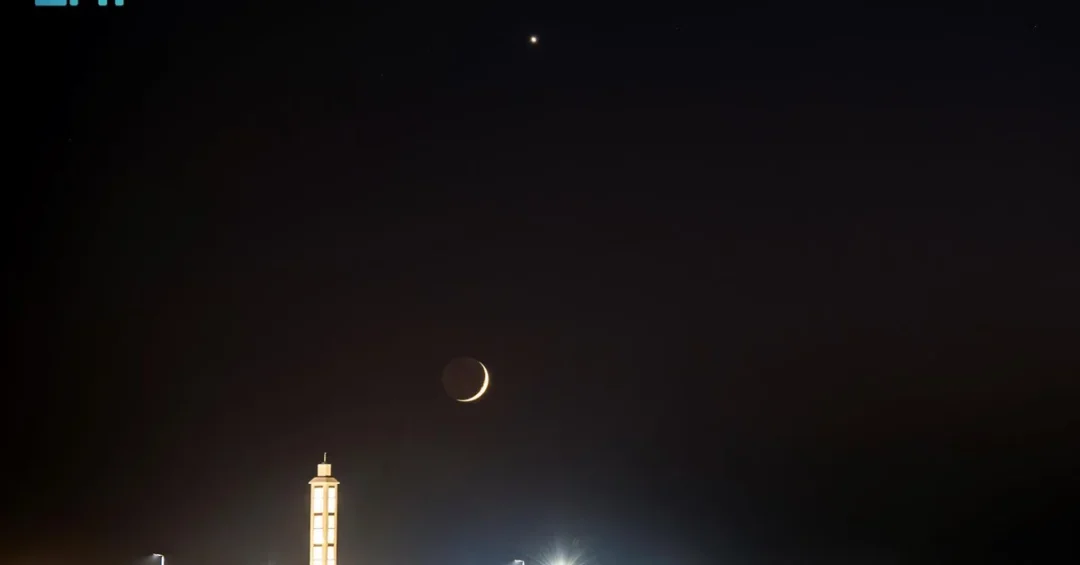
The Saudi Press Agency (SPA) captured a stunning celestial event on the evening of October 6, 2024, as Venus, the brightest planet, appeared in close proximity to the Moon in a phenomenon known as a conjunction. The event was visible to the naked eye over the Northern Border region, specifically in Rafha, and was documented by SPA, showcasing Saudi Arabia’s growing engagement with astronomy and space observation.
Context and Background
A conjunction occurs when two celestial bodies appear close together in the sky, sharing the same celestial longitude. This particular conjunction featured Venus and the Moon, a pairing that often draws the attention of skywatchers worldwide due to the brilliance of both objects. According to Berjis Al-Fulaih, an astronomy expert at the Afaq Society for Astronomy, the two were visible in the western sky after sunset and could be easily observed without any special equipment.
Venus, often called the “Evening Star” or “Morning Star” depending on its position in the sky, is the second planet from the Sun and the brightest natural object in the night sky after the Moon. Its close approach to the Moon provides a valuable opportunity for public engagement and educational activities related to astronomy.
Key Details
The conjunction was observed on October 6, 2024, after sunset, and was captured by SPA in Rafha, a city in the Northern Border region of Saudi Arabia. The image released by SPA highlights the natural beauty of the night sky and underscores the importance of dark-sky preservation in the region.
Berjis Al-Fulaih noted that such events are regular occurrences in the field of astronomy and serve as excellent opportunities to promote interest in celestial phenomena. The Afaq Society for Astronomy, based in Saudi Arabia, actively works to advance astronomical knowledge and education across the Kingdom.
The event was also visible to the naked eye, making it accessible to the general public and encouraging community participation in skywatching. This aligns with global trends in astrotourism, where regions with clear skies and minimal light pollution attract enthusiasts and researchers alike.
Implications and Impact
The successful capture of this conjunction by SPA reflects the growing interest in astronomy and space sciences within Saudi Arabia. It also highlights the potential for the Northern Border region to become a destination for astrotourism, given its relatively dark skies and favorable observing conditions.
Such celestial events foster a sense of wonder and curiosity, contributing to scientific literacy and public engagement. Moreover, they provide opportunities for educational institutions and astronomy societies to organize viewing events and workshops, thereby enriching the cultural and scientific landscape of the Kingdom.
On a broader scale, Saudi Arabia’s Vision 2030 emphasizes the development of knowledge-based sectors, including science and technology. Astronomical observations and related activities support this vision by inspiring youth to pursue careers in science, technology, engineering, and mathematics (STEM) fields.
Vision 2030 Alignment
This celestial observation aligns with Saudi Arabia’s Vision 2030 goals of promoting scientific research, innovation, and quality of life. By documenting and sharing such events, SPA contributes to raising public awareness of astronomy and reinforces the Kingdom’s commitment to advancing science and education. As Saudi Arabia continues to invest in space and astronomy initiatives, including the establishment of the Saudi Space Commission, events like the Venus-Moon conjunction serve as reminders of the boundless opportunities that lie in exploring the universe.
20 Questions
Q1. What celestial event was captured by the Saudi Press Agency on October 6, 2024?
A1. The Saudi Press Agency captured a conjunction between Venus and the Moon, where the two appeared close together in the sky over the Northern Border region, visible to the naked eye after sunset.
Q2. What is a conjunction in astronomy?
A2. A conjunction occurs when two celestial objects appear close to each other in the sky and share the same celestial longitude, often creating a striking visual alignment that can be observed from Earth.
Q3. Where was the conjunction visible?
A3. The conjunction was visible in the Northern Border region of Saudi Arabia, specifically over Rafha, and could be seen by observers in the western sky after sunset.
Q4. Who is Berjis Al-Fulaih?
A4. Berjis Al-Fulaih is an astronomy expert at the Afaq Society for Astronomy in Saudi Arabia, who provided insights into the visibility and significance of the Venus-Moon conjunction.
Q5. Why is Venus often called the Evening Star or Morning Star?
A5. Venus is called the Evening Star when it appears in the western sky after sunset and the Morning Star when it appears in the eastern sky before sunrise, due to its orbital position relative to Earth.
Q6. What is the Afaq Society for Astronomy?
A6. The Afaq Society for Astronomy is a Saudi organization dedicated to promoting astronomy education and public engagement, often organizing observation events and providing expert commentary on celestial phenomena.
Q7. Was the conjunction visible to the naked eye?
A7. Yes, the conjunction was easily observable with the naked eye, making it accessible to the general public without the need for telescopes or binoculars, as confirmed by astronomy expert Berjis Al-Fulaih.
Q8. What is the significance of such astronomical events for Saudi Arabia?
A8. Such events promote scientific interest, support educational initiatives, and highlight the potential for astrotourism in regions with clear skies, aligning with Saudi Arabia’s Vision 2030 goals for science and innovation.
Q9. How does SPA contribute to astronomy awareness?
A9. SPA documents and shares astronomical events like the Venus-Moon conjunction, thereby raising public awareness and fostering a greater appreciation for celestial phenomena across the Kingdom and beyond.
Q10. What is astrotourism?
A10. Astrotourism is a form of tourism focused on stargazing and astronomical events, often in areas with low light pollution. It is growing in popularity and can contribute to local economies and conservation efforts.
Q11. Which planet is the brightest in the night sky?
A11. Venus is the brightest planet in the night sky, often outshining all other celestial objects except the Moon, due to its thick clouds that reflect sunlight.
Q12. When did the conjunction occur?
A12. The conjunction occurred on the evening of October 6, 2024, after sunset, and was captured by SPA in the Northern Border region of Saudi Arabia.
Q13. What role does the Saudi Space Commission play?
A13. The Saudi Space Commission, established in 2018, oversees the Kingdom’s space sector, promoting research, innovation, and international collaboration in space sciences and technology.
Q14. How can the public participate in astronomy events in Saudi Arabia?
A14. The public can participate by joining events organized by astronomy societies like Afaq, attending stargazing gatherings, and following announcements from SPA and other official channels about upcoming celestial phenomena.
Q15. Why is the Northern Border region suitable for astronomy?
A15. The Northern Border region has relatively dark skies and minimal light pollution, making it ideal for observing celestial events and potentially developing astrotourism initiatives.
Q16. What educational opportunities arise from such events?
A16. Such events provide opportunities for schools, universities, and astronomy clubs to organize viewing parties, workshops, and lectures, thereby enhancing science education and inspiring future scientists.
Q17. How does astronomy align with Vision 2030?
A17. Astronomy aligns with Vision 2030 by promoting STEM education, scientific research, and innovation, which are key pillars for diversifying the economy and fostering a knowledge-based society.
Q18. What other celestial events can be observed in Saudi Arabia?
A18. Saudi Arabia’s clear skies allow observation of meteor showers, eclipses, planetary conjunctions, and other phenomena. Astronomy societies often announce viewing opportunities for the public.
Q19. How does SPA ensure accurate reporting of astronomical events?
A19. SPA collaborates with experts like Berjis Al-Fulaih and organizations such as the Afaq Society to provide accurate, verified information, ensuring reliable reporting for the public.
Q20. What is the long-term impact of such observations on Saudi society?
A20. These observations inspire curiosity, promote scientific literacy, and encourage youth to pursue careers in science and technology, contributing to a vibrant, knowledge-driven society in line with Vision 2030.
Reader Feedback
We value your thoughts. Please share your feedback on this article.
Your feedback helps us improve our coverage.
Related articles
 NASA Space Apps Hackathon Concludes at Al-Baha University
 IMSIU Concludes NASA Space Apps Challenge, Inspiring Innovation
 Third International KSGAAL Conference Kicks Off in Riyadh
 KAUST Gene Discovery Boosts Crop Resistance to Parasitic Weed
 solutions by stc Shines as Digital Enabler at GITEX Global
 Saudi Arabia Showcases Sustainability Innovations at STS Forum