


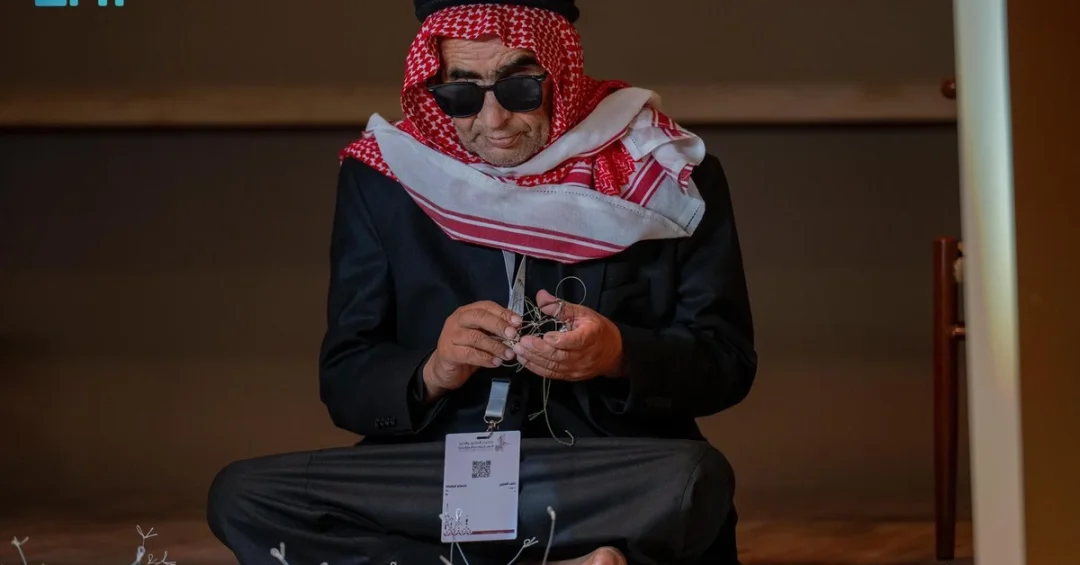
Khalaf Al-Anzi, a visually impaired craftsman from Turaif, is drawing admiration at the International Saudi Falcons and Hunting Exhibition in Malham for his handmade falcon trapping nets, a craft he has refined over 30 years. Held from October 3 to 12, 2024, the exhibition celebrates Saudi Arabia’s rich falconry heritage and provides a platform for artisans like Al-Anzi to demonstrate their skills to a global audience.
The event, organized under the patronage of the Saudi Falcons Club, underscores the Kingdom’s commitment to preserving traditional crafts while promoting tourism and cultural exchange. Al-Anzi’s participation highlights the inclusive nature of Saudi society, where individuals with disabilities are empowered to contribute actively to cultural and economic life. His story resonates with Vision 2030’s goals of fostering social inclusion and economic diversification. How does a visually impaired artisan create such intricate tools? The answer lies in decades of dedication and inherited expertise.
Context and Background
Falconry, a time-honored tradition in the Arabian Peninsula, has been practiced for millennia as a means of hunting and a symbol of nobility. In Saudi Arabia, this heritage is meticulously preserved through events like the International Saudi Falcons and Hunting Exhibition, which showcases not only the birds themselves but also the crafts and skills that support the sport. The exhibition, held annually in Malham, north of Riyadh, attracts falconers, enthusiasts, and tourists from around the world. This year’s edition featured a dedicated arts and handicrafts section, including a heritage weaving corner, where Saudi craftsmen and women display traditional products. Al-Anzi’s presence there is a testament to the enduring relevance of these crafts.
Khalaf Al-Anzi, hailing from Turaif in the Northern Borders region, has been crafting falcon trapping nets for over three decades. Despite his visual impairment, he has mastered the art of creating lightweight nets using silk threads and thin nylon wires. His journey began in childhood, learning from his father and grandfathers, and today he continues to pass on this knowledge to his sons, who assist him in his work. This intergenerational transfer of skills is central to Saudi Arabia’s cultural sustainability efforts. How does Al-Anzi manage to produce such precise work without sight? He relies on touch, memory, and the unwavering support of his family, turning a challenge into a remarkable strength.
The exhibition provides a vital platform for artisans like Al-Anzi to connect with a broader audience. It also aligns with the Kingdom’s Vision 2030, which emphasizes the importance of cultural heritage as a pillar of national identity and economic growth. By featuring craftsmen with disabilities, the event sends a powerful message of inclusivity and resilience, inspiring others to overcome obstacles and contribute to society.
Key Details
Al-Anzi’s handmade nets are highly sought after by Saudi falconers, who often visit him at his home to purchase them. He also ships his nets to falconers and enthusiasts in the Gulf countries, relying on this craft as his primary source of income. Each net takes over half an hour to create, with meticulous attention to detail. The nets are attached to pigeons or jerboas (hopping desert rodents) as bait to attract falcons during the migration season in the fall. The lightweight design, weighing only a few grams, ensures that the falcons are not harmed during trapping. Al-Anzi’s expertise has made him a regular participant in falconry-related events across the Kingdom.
At the exhibition, visitors can observe Al-Anzi and other craftsmen demonstrating their skills. The event also features a heritage weaving corner, where traditional Saudi textiles and other handmade products are showcased. This section aims to educate the public about the Kingdom’s diverse cultural heritage and to support local artisans economically. The exhibition runs for ten days, offering a unique opportunity for cultural exchange and tourism. How does Al-Anzi’s craft contribute to the broader falconry ecosystem? His nets are essential tools for falconers, enabling them to capture and train falcons in a traditional and ethical manner.
Al-Anzi’s story is one of perseverance and passion. Despite his visual impairment, he has not only sustained a family tradition but also turned it into a thriving enterprise. His sons, who assist him, are learning the craft, ensuring its continuity for future generations. The International Saudi Falcons and Hunting Exhibition serves as a testament to the Kingdom’s dedication to preserving such intangible cultural heritage. It also highlights the potential of craftsmen with disabilities to contribute meaningfully to the economy and society, in line with Vision 2030’s inclusive growth objectives.
International and Regional Impact
The International Saudi Falcons and Hunting Exhibition attracts visitors from across the Gulf Cooperation Council (GCC) and beyond, cementing Saudi Arabia’s position as a leader in cultural tourism. Al-Anzi’s nets, shipped to Gulf countries, are a tangible example of regional trade in traditional crafts. This exchange fosters goodwill and strengthens cultural ties among neighboring nations. Moreover, the exhibition provides a platform for international falconers to engage with Saudi heritage, promoting cross-cultural understanding and collaboration. The event also supports Saudi Arabia’s tourism goals by drawing visitors to the Riyadh region, where they can experience authentic Arabian hospitality and traditions.
On a broader scale, Al-Anzi’s participation underscores Saudi Arabia’s commitment to empowering persons with disabilities, a key focus of Vision 2030. The Kingdom has made significant strides in accessibility and inclusion, and stories like Al-Anzi’s serve as inspiring examples for the region and the world. By showcasing his talent, the exhibition challenges stereotypes and highlights the capabilities of individuals with disabilities. How does this impact Saudi Arabia’s global image? It reinforces the Kingdom’s reputation as a progressive and inclusive society, open to sharing its heritage with the world.
The regional significance of falconry extends beyond culture; it is also an economic activity. Falconry equipment, including nets, is a niche market with consistent demand. Al-Anzi’s success demonstrates how traditional crafts can be viable businesses, contributing to economic diversification. The exhibition itself generates revenue through tourism, sponsorships, and sales, furthering Vision 2030’s economic goals. As Saudi Arabia continues to open up to international visitors, events like this play a crucial role in showcasing the Kingdom’s unique offerings.
Economic and Strategic Significance
The crafts sector in Saudi Arabia is an integral part of the cultural economy, providing employment and income for artisans like Al-Anzi. His handmade nets, though a niche product, represent the high-quality, artisanal goods that Saudi Arabia seeks to promote. The government, through entities like the Saudi Falcons Club and the Ministry of Culture, supports such artisans by providing platforms and funding. This aligns with Vision 2030’s aim to diversify the economy away from oil and create sustainable jobs. The exhibition itself is a strategic event that boosts local businesses, from hotels to restaurants, and enhances the Kingdom’s tourism appeal.
Strategically, falconry and its associated crafts are tools of cultural diplomacy. They strengthen Saudi Arabia’s ties with other nations, particularly those with similar traditions, such as the UAE, Qatar, and Mongolia. By exporting his nets to Gulf countries, Al-Anzi is not just earning a livelihood but also acting as a cultural ambassador. The exhibition furthers this by inviting international participants and showcasing Saudi heritage on a global stage. How does this support Saudi Arabia’s soft power? It projects an image of a nation that values its traditions while embracing modernity and inclusivity.
Moreover, the focus on handicrafts ties into the broader goal of preserving Saudi intangible heritage, as outlined by the Ministry of Culture and UNESCO conventions. Al-Anzi’s craft is a living example of this heritage, and its continuation depends on support from both the public and private sectors. The exhibition serves as a marketplace and a educational platform, ensuring that traditional skills are not lost. In this way, economic and cultural strategies converge, creating a holistic approach to development.
Vision 2030 Alignment
Al-Anzi’s story is a microcosm of Vision 2030’s objectives: it demonstrates social inclusion, economic empowerment, and cultural preservation. The Vision, launched in 2016 by Crown Prince Mohammed bin Salman, aims to transform Saudi society and economy. By supporting craftsmen with disabilities, the Kingdom promotes equal opportunities and showcases the talents of all citizens. The exhibition, with its heritage sections, directly contributes to the goal of increasing tourism and promoting national identity. Al-Anzi’s success also highlights the potential of small and medium enterprises (SMEs) in the crafts sector, a key focus of Vision 2030.
Furthermore, the event reinforces Saudi Arabia’s global leadership in falconry, a field where the Kingdom has made significant investments. The Saudi Falcons Club, under the guidance of the government, organizes numerous events and initiatives to preserve this heritage. Al-Anzi’s participation is a testament to the inclusivity of these efforts. As Saudi Arabia continues to implement Vision 2030, stories like his will become increasingly common, illustrating the Kingdom’s progress toward a vibrant, diverse, and inclusive society. How does this resonate with the global community? It shows a Saudi Arabia that is confident in its heritage and committed to sharing it with the world, while providing opportunities for all its citizens.
20 Questions
Q1. Who is Khalaf Al-Anzi?
A1. Khalaf Al-Anzi is a visually impaired Saudi craftsman from Turaif known for making handmade falcon trapping nets. He has practiced this craft for over 30 years and is a regular participant in falconry events.
Q2. What is the International Saudi Falcons and Hunting Exhibition?
A2. It is an annual event held in Malham, north of Riyadh, showcasing falconry and hunting traditions. It features arts, handicrafts, and heritage displays, attracting visitors from around the world.
Q3. Where and when was the exhibition held?
A3. The exhibition took place in Malham, north of Riyadh, from October 3 to 12, 2024. It is a key event in Saudi Arabia’s cultural calendar.
Q4. How long has Al-Anzi been crafting falcon nets?
A4. Khalaf Al-Anzi has been crafting falcon trapping nets for over 30 years. He inherited the skill from his father and grandfathers.
Q5. What materials does Al-Anzi use to make his nets?
A5. He uses silk threads and thin nylon wires to handcraft lightweight nets that weigh only a few grams. These materials ensure durability and minimal harm to falcons.
Q6. How long does it take to make one net?
A6. It takes Al-Anzi over half an hour to create a single net. Each net is meticulously crafted by hand.
Q7. How are the nets used in falconry?
A7. The nets are attached to pigeons or jerboas as bait to attract falcons. This traditional method is used during the falcon migration season in the fall.
Q8. Who buys Al-Anzi’s nets?
A8. Saudi falconers often visit his home to buy the nets, and he also ships them to enthusiasts in Gulf countries. His craft is his primary source of income.
Q9. What challenges does Al-Anzi face as a visually impaired craftsman?
A9. Despite his visual impairment, Al-Anzi relies on touch, memory, and assistance from his sons to create precise nets. His condition has not hindered his productivity or quality.
Q10. How does Al-Anzi pass on his craft?
A10. He is teaching his sons the art of making falcon nets, ensuring the tradition continues. This intergenerational transfer is vital for cultural preservation.
Q11. What other activities are at the exhibition?
A11. The exhibition features a heritage weaving corner, arts and handicrafts displays, and demonstrations by Saudi craftsmen and women. It also includes falconry competitions and educational sessions.
Q12. Why is falconry important in Saudi culture?
A12. Falconry is a centuries-old tradition symbolizing nobility, skill, and connection to nature. It is a key part of Saudi heritage and is actively preserved through events and clubs.
Q13. How does the exhibition support Vision 2030?
A13. It promotes cultural tourism, empowers local artisans, and showcases Saudi heritage. This aligns with Vision 2030’s goals of economic diversification and social inclusion.
Q14. What is the economic impact of Al-Anzi’s craft?
A14. His craft provides him with a sustainable income and supports regional trade. It also contributes to the cultural economy by preserving traditional skills.
Q15. How does Al-Anzi ship his nets to other countries?
A15. He ships them to falconers in Gulf countries, relying on established networks. This export activity demonstrates the demand for traditional Saudi crafts abroad.
Q16. What message does Al-Anzi’s story convey?
A16. His story highlights perseverance, inclusivity, and the value of traditional crafts. It shows that disabilities do not limit one’s ability to contribute meaningfully to society.
Q17. Are there other craftsmen with disabilities at the exhibition?
A17. The exhibition features various artisans, including those with disabilities. It provides an inclusive platform for all to showcase their talents.
Q18. How does the Saudi government support such artisans?
A18. Through entities like the Saudi Falcons Club and Ministry of Culture, the government provides platforms, funding, and recognition. This support helps sustain traditional crafts.
Q19. What is the significance of the heritage weaving corner?
A19. It showcases traditional Saudi textiles and handmade products, educating visitors about the Kingdom’s diverse cultural heritage. It also supports local artisans economically.
Q20. How can international visitors participate in the exhibition?
A20. International visitors can attend the exhibition in Malham, enjoy demonstrations, and purchase crafts. It is open to the public and promotes cultural exchange.
Reader Feedback
We value your thoughts. Please share your feedback on this article.
Your feedback helps us improve our coverage.
Related articles
 Dar Unaizah: Preserving Saudi Folklore for Generations
 Saudi Falcons Club Hosts Expert Workshops at Exhibition
 Cultural Development Fund Signs 13 Agreements within Its Financing Program
 Rafha Falconers Prepare for Hunting Season
 Two Falcons Sold for SAR191,000 at Saudi Auction
 Saudi Elite Chefs Competition Launches to Promote Local Talent