


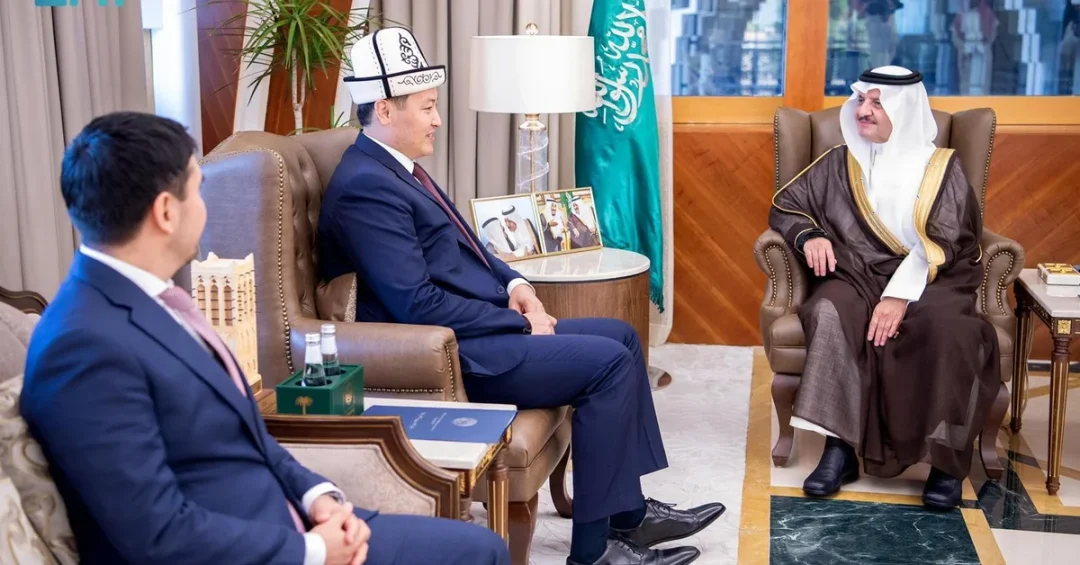
Governor of the Eastern Region Prince Saud bin Naif bin Abdulaziz received Ambassador of the Kyrgyz Republic to Saudi Arabia Ulukbek Maripov in Dammam on October 28, 2024, where the two officials discussed topics of common interest, according to the Saudi Press Agency (SPA). The meeting underscored the Kingdom’s continued engagement with Central Asian partners and highlighted the role of regional leadership in advancing Saudi Arabia’s diplomatic and economic outreach. Hosted in the Eastern Region, the encounter reflects the strategic importance of the province as a gateway for international cooperation and a hub for energy, industry, and trade.
The audience took place amid Saudi Arabia’s expanding network of bilateral relationships under the leadership of the Custodian of the Two Holy Mosques King Salman bin Abdulaziz Al Saud and His Royal Highness Crown Prince Mohammed bin Salman bin Abdulaziz Al Saud, Prime Minister. The Kyrgyz Republic, a landlocked nation in Central Asia, has steadily deepened ties with the Kingdom across political, economic, and cultural domains. The meeting in Dammam signals that Saudi regional governors remain active participants in the Kingdom’s foreign policy and investment agenda, complementing the work of the Ministry of Foreign Affairs and other state institutions. How does such a localized diplomatic engagement contribute to Saudi Arabia’s broader global posture?
Context and Background
What makes a meeting between a regional governor and a foreign ambassador significant in the context of Saudi diplomacy? The answer lies in the Kingdom’s decentralized approach to international engagement, where provincial leaders play a direct role in fostering partnerships that support Vision 2030. The Eastern Region, home to the largest oil and gas reserves in the world and the headquarters of Saudi Aramco, is a vital economic zone. Its governor, Prince Saud bin Naif bin Abdulaziz, has long been a key figure in managing the region’s affairs and representing the Kingdom in high-level interactions.
The Kyrgyz Republic, with a population of approximately seven million, has sought to strengthen relations with Gulf states in recent years, focusing on trade, investment, and cultural exchange. Ambassador Ulukbek Maripov, who previously served as Prime Minister of Kyrgyzstan, brings a wealth of experience to his diplomatic role in Riyadh. His meeting with Prince Saud bin Naif reflects the mutual interest in exploring opportunities that align with Saudi Arabia’s Vision 2030 and Kyrgyzstan’s national development strategies. The discussion of topics of common interest, as reported by SPA, likely encompassed areas such as energy cooperation, agricultural trade, and people-to-people ties.
The Eastern Region’s strategic location along the Arabian Gulf, its industrial cities like Jubail and Dammam, and its growing tourism sector make it an attractive partner for Central Asian countries seeking to diversify their economic relationships. The meeting also comes as Saudi Arabia continues to position itself as a bridge between Asia, Europe, and Africa, leveraging its geopolitical weight and economic reforms. In this context, the governor’s reception of Ambassador Maripov is not merely a ceremonial courtesy but a substantive step in reinforcing the Kingdom’s diplomatic footprint.
Key Details of the Meeting
What specific outcomes can be expected from this diplomatic encounter? While the SPA report did not disclose detailed agenda items, the phrase “topics of common interest” typically covers a range of bilateral issues. These may include trade and investment flows, cooperation in energy and renewable resources, cultural and educational exchanges, and regional security matters. The Eastern Region’s governor often discusses local development projects that could benefit from foreign investment or expertise, and Kyrgyzstan has expressed interest in attracting Saudi investment in sectors such as hydropower, agriculture, and mining.
Ambassador Maripov’s background as a former prime minister suggests that the conversation may have touched on high-level economic cooperation, including potential Saudi involvement in Kyrgyz infrastructure projects. The Kingdom’s Public Investment Fund (PIF) has been actively expanding its international portfolio, and Central Asia is a region of growing interest. Moreover, the meeting aligns with Saudi Arabia’s efforts to enhance food security by partnering with countries that have agricultural potential, a priority under Vision 2030.
The Eastern Region also hosts significant educational and cultural institutions, such as King Fahd University of Petroleum and Minerals (KFUPM) and the King Abdulaziz Center for World Culture (Ithra), which could serve as platforms for academic and cultural collaboration with Kyrgyzstan. The presence of a large expatriate community in the region, including Central Asian nationals, adds a social dimension to the bilateral relationship. The governor’s role in overseeing these dynamics makes his engagement with Ambassador Maripov particularly relevant for grassroots diplomacy.
International and Regional Impact
How does Saudi Arabia’s engagement with Kyrgyzstan fit into the broader geopolitical landscape? Central Asia has become a focal point for major powers, including China, Russia, and the United States, due to its energy resources and strategic location. Saudi Arabia, through its Vision 2030 and its presidency of the Gulf Cooperation Council (GCC), seeks to offer a distinct model of partnership based on mutual respect and economic complementarity. The Kingdom’s ties with Kyrgyzstan are part of a wider outreach to Central Asia, evidenced by high-level visits and agreements in recent years.
The meeting in Dammam also highlights the role of Saudi regional governors as diplomatic envoys. Unlike centralized foreign ministries, Saudi Arabia’s governance structure allows provincial leaders to engage directly with foreign representatives, facilitating localized cooperation. This approach can lead to tangible outcomes such as sister-city agreements, trade delegations, and joint investment forums. For Kyrgyzstan, engaging with the Eastern Region offers access to one of the most industrialized areas of the Middle East, with potential benefits for its export-oriented sectors.
On a regional level, the encounter reinforces the Kingdom’s image as a stabilizing and cooperative force in international affairs. It also complements Saudi Arabia’s participation in multilateral platforms like the Organization of Islamic Cooperation (OIC) and the Shanghai Cooperation Organization (SCO), where Kyrgyzstan is also a member. By nurturing bilateral ties, both nations contribute to a more interconnected and prosperous region.
Economic and Strategic Significance
What economic opportunities does this meeting unlock for both countries? The Eastern Region is the engine of Saudi Arabia’s economy, contributing a substantial share of the Kingdom’s oil production and industrial output. It is also home to the King Salman Energy Park (SPARK) and the Jubail Industrial City, which attract global investors. Kyrgyzstan, with its rich mineral resources and hydroelectric potential, presents opportunities for Saudi companies looking to diversify their portfolios and secure strategic supplies.
Trade between Saudi Arabia and Kyrgyzstan has been modest but growing. According to official data, bilateral trade remains below its potential, and both sides have expressed a desire to increase it. The meeting could pave the way for a Saudi trade delegation to visit Bishkek or for Kyrgyz businesses to participate in investment forums in the Eastern Region. Sectors such as halal food, textiles, and tourism are ripe for collaboration. Additionally, Saudi Arabia’s expertise in desalination and renewable energy could be valuable to Kyrgyzstan as it seeks to modernize its infrastructure.
Strategically, the Kingdom’s outreach to Central Asia is also about countering extremism and promoting moderate Islam. Kyrgyzstan, a secular state with a Muslim-majority population, shares Saudi Arabia’s interest in regional stability. The meeting between Prince Saud bin Naif and Ambassador Maripov can be seen as part of a soft-power strategy that combines economic incentives with cultural and religious diplomacy. This approach aligns with the principles of Vision 2030, which emphasizes international partnerships as a driver of domestic transformation.
Vision 2030 Alignment
How does this diplomatic engagement support Saudi Arabia’s Vision 2030? Vision 2030 aims to diversify the Kingdom’s economy, reduce its dependence on oil, and expand its global influence. International partnerships are a cornerstone of this strategy, and Central Asia represents a frontier for Saudi investment and trade. The Eastern Region, as a key economic zone, is well-positioned to lead in this effort. By receiving Ambassador Maripov, Prince Saud bin Naif is actively contributing to the Kingdom’s goals of enhancing non-oil exports, attracting foreign investment, and fostering cultural exchange.
Furthermore, Vision 2030 places a strong emphasis on improving the quality of life for citizens and residents, and international cooperation can bring benefits such as advanced technologies, educational opportunities, and cultural enrichment. The meeting also reflects the Kingdom’s commitment to playing a constructive role in global affairs, as outlined in its foreign policy objectives. As Saudi Arabia continues to open up to the world, engagements like this one in Dammam will become increasingly common, showcasing the Kingdom’s hospitality, economic vitality, and diplomatic acumen. In the long run, such interactions will strengthen the bonds between Saudi Arabia and Kyrgyzstan, contributing to a more peaceful and prosperous world.
20 Questions
Q1. Who received the Kyrgyz Ambassador in Dammam?
A1. Governor of the Eastern Region Prince Saud bin Naif bin Abdulaziz received Ambassador Ulukbek Maripov in Dammam on October 28, 2024, as reported by the Saudi Press Agency.
Q2. What was the purpose of the meeting?
A2. The two officials discussed topics of common interest, reflecting Saudi Arabia’s ongoing diplomatic engagement with Central Asian nations and the Eastern Region’s role in international cooperation.
Q3. Who is Ulukbek Maripov?
A3. Ulukbek Maripov is the Ambassador of the Kyrgyz Republic to Saudi Arabia. He previously served as Prime Minister of Kyrgyzstan, bringing significant diplomatic and governmental experience to his role.
Q4. Why is the Eastern Region important in Saudi diplomacy?
A4. The Eastern Region is Saudi Arabia’s economic powerhouse, home to major oil facilities and industrial cities, making it a key player in the Kingdom’s international trade and investment outreach.
Q5. What is the significance of this meeting for Saudi-Kyrgyz relations?
A5. It reinforces bilateral ties and opens avenues for cooperation in trade, energy, agriculture, and culture, aligning with Saudi Arabia’s Vision 2030 goals of global engagement.
Q6. Did the meeting produce any agreements?
A6. The SPA report did not mention specific agreements, but such meetings typically lay the groundwork for future cooperation and dialogue on mutual interests.
Q7. How does this meeting fit into Saudi Arabia’s foreign policy?
A7. It reflects the Kingdom’s decentralized diplomatic approach, where regional governors engage with foreign envoys to promote economic and cultural partnerships under Vision 2030.
Q8. What topics might have been discussed?
A8. Likely topics include trade, investment, energy cooperation, food security, cultural exchange, and regional stability, all areas of mutual interest between the two nations.
Q9. What is Kyrgyzstan’s interest in Saudi Arabia?
A9. Kyrgyzstan seeks to attract Saudi investment in hydropower, agriculture, and mining, and to strengthen political and cultural ties with the Kingdom.
Q10. How does this engagement support Vision 2030?
A10. It advances Vision 2030’s objectives of economic diversification, international partnership, and enhanced global influence by fostering ties with Central Asia.
Q11. What role do Saudi regional governors play in diplomacy?
A11. Regional governors act as local representatives of the Kingdom, engaging with foreign officials to facilitate cooperation, investment, and cultural exchange at the provincial level.
Q12. Is this meeting part of a larger pattern of Saudi outreach to Central Asia?
A12. Yes, Saudi Arabia has been actively strengthening ties with Central Asian states through high-level visits, investments, and participation in regional organizations.
Q13. What economic sectors could benefit from Saudi-Kyrgyz cooperation?
A13. Sectors such as energy, agriculture, mining, tourism, and halal food production present promising opportunities for collaboration between the two countries.
Q14. How does the meeting reflect Saudi Arabia’s global role?
A14. It demonstrates the Kingdom’s commitment to building bridges with nations worldwide, promoting peace, stability, and prosperity through dialogue and partnership.
Q15. What is the Eastern Region’s contribution to Saudi economy?
A15. The Eastern Region is the center of Saudi Arabia’s oil industry and hosts major industrial cities, contributing significantly to the Kingdom’s GDP and export revenues.
Q16. Will there be follow-up actions after this meeting?
A16. While not specified, diplomatic engagements often lead to further discussions, trade delegations, or agreements that advance bilateral relations.
Q17. How does this meeting align with Saudi cultural diplomacy?
A17. It promotes people-to-people ties and cultural exchange, which are essential components of Saudi Arabia’s soft power and Vision 2030’s social goals.
Q18. What is the significance of the meeting location in Dammam?
A18. Dammam, the capital of the Eastern Region, is a major administrative and commercial hub, symbolizing the region’s openness to international engagement.
Q19. How might Kyrgyzstan benefit from Saudi expertise?
A19. Kyrgyzstan can learn from Saudi Arabia’s experience in desalination, renewable energy, and industrial development, supporting its own modernization efforts.
Q20. What message does this meeting send to the international community?
A20. It signals Saudi Arabia’s active and cooperative approach to global affairs, emphasizing mutual respect and shared prosperity under the leadership of the Custodian of the Two Holy Mosques.
Reader Feedback
We value your thoughts. Please share your feedback on this article.
Your feedback helps us improve our coverage.
Related articles
 Kuwait Hosts 51st FANA General Assembly
 Imam of Prophet’s Mosque Highlights Saudi Support for Muslims in Montenegro
 Saudi Camel Federation Signs Landmark Deal with Peru Alpaca Association
 Saudi Justice Minister Joins GCC Judicial Cooperation Talks
 ZATCA Foils Smuggling of Over 2 Million Captagon Pills
 Saudi FM Receives Call from Japanese Counterpart