


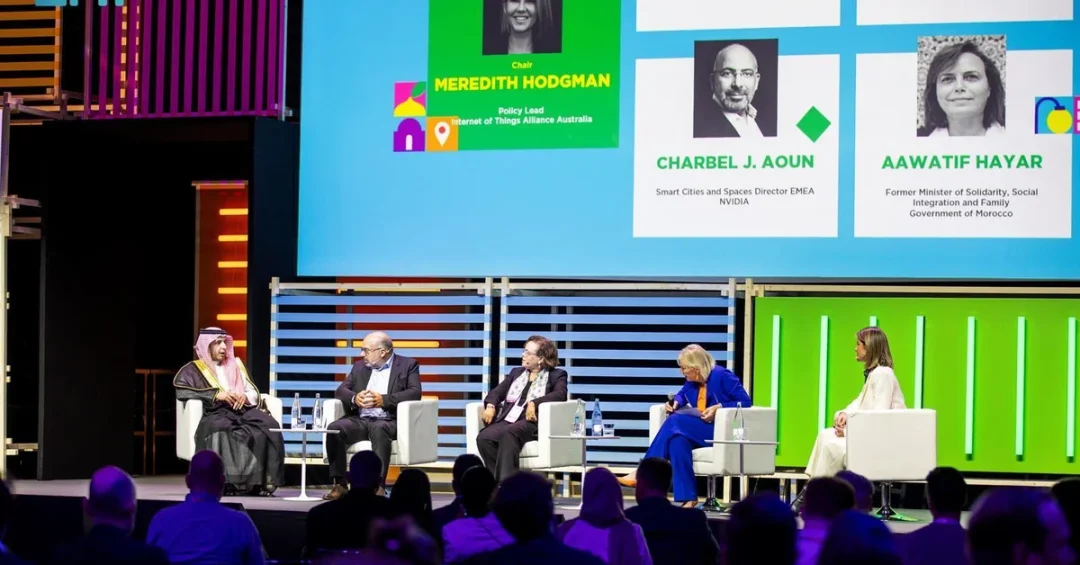
The Saudi Data and AI Authority (SDAIA) showcased the Kingdom of Saudi Arabia’s pioneering efforts to enhance urban quality of life through data and artificial intelligence at the Smart City Expo World Congress 2024, held in Barcelona, Spain, from November 5 to 7. Participating as a global partner, SDAIA joined more than 600 speakers — including government leaders, corporate executives, smart-city innovators, and academics — representing over 850 cities across 130 countries. The authority used the international platform to present a suite of national digital platforms that are reshaping how cities deliver services, improve well-being, and drive sustainable development. How is Saudi Arabia positioning itself at the forefront of the global smart-city movement? The answer lies in a coordinated national strategy that integrates advanced technology with a clear vision for human-centric urban living.
SDAIA’s participation underscores the Kingdom’s commitment to leveraging emerging technologies for the benefit of humanity, a priority that aligns directly with the goals of Saudi Vision 2030. By sharing its experience on a global stage, the authority demonstrated how data-driven innovation can address universal urban challenges — from healthcare and education to energy efficiency and job creation. The congress, one of the world’s largest gatherings dedicated to smart-city solutions, provided a fitting venue for Saudi Arabia to highlight its leadership in digital transformation and its role as a catalyst for international cooperation in the field.
Context and Background
Why does the Smart City Expo World Congress matter for a country like Saudi Arabia, which is undergoing one of the most ambitious urban transformations in modern history? The event serves as a global benchmark for cities seeking to integrate technology into their infrastructure, and Saudi Arabia’s presence as a global partner signals its intention to be not just a participant but a shaper of the international smart-city agenda. The Kingdom’s urban landscape is rapidly evolving, with giga-projects such as NEOM and the Red Sea Project setting new standards for sustainable, technology-enabled living. SDAIA’s role in this transformation is central, as it oversees the national data and AI ecosystem that powers many of these initiatives.
At the congress, SDAIA Chief Executive Dr. Sattam Al-Subaiee took part in a panel discussion on how advanced technologies can create infrastructure that delivers digital services aimed at enhancing the well-being of smart-city residents. He explained that these technologies contribute to job creation, improve healthcare, reduce energy consumption, advance education, and raise the overall quality of life. His remarks reflected a holistic approach that views technology not as an end in itself but as a tool for improving daily life for citizens and residents alike. The panel discussion drew on Saudi Arabia’s practical experience in deploying AI and data solutions at scale, offering valuable insights to an international audience eager to learn from successful implementations.
In a separate session, Dr. Hotham Al-Twaijri, Assistant Director for Advanced Recognition Technologies and Digital Identity at SDAIA’s National Information Center, spoke about the role of digital identity applications in enabling interconnected and secure smart cities. He highlighted SDAIA’s implementation of the Nafath application, which uses the latest data and AI technologies to enable digital identity in the Kingdom and enhance the adoption of digital services with high reliability. He emphasized that digital identity applications are a fundamental pillar upon which smart-city services are built, with tangible impact on enhancing the quality of urban life. Together, these presentations illustrated the breadth and depth of Saudi Arabia’s digital ecosystem.
Key Details
What specific initiatives did SDAIA highlight as central to its smart-city strategy? Dr. Al-Subaiee pointed to a portfolio of national platforms that are already delivering measurable improvements in urban life. These include Tawakkalna, the comprehensive app that provides government and private services to millions of users; the Smart C national platform for smart cities, which coordinates urban technology deployment; the DEEM government cloud, which provides secure and scalable infrastructure for government entities; the Estishraf platform for foresight and analytics; the national charity platform Ehsan; the Sawaher platform; the National Data Bank; and the Unified National Access platform. Each of these initiatives plays a distinct role in building a connected, efficient, and responsive urban environment.
The Tawakkalna application, in particular, has become an essential tool for millions of residents, offering everything from health services to document management. Its success demonstrates how a well-designed digital platform can become a daily utility that enhances convenience and access to services. The DEEM government cloud ensures that the data underpinning these services is stored and processed securely, in line with the highest international standards. Meanwhile, the National Data Bank and Estishraf platform enable evidence-based policymaking by providing decision-makers with accurate, real-time insights. These platforms collectively form the backbone of Saudi Arabia’s smart-city infrastructure, and their presentation in Barcelona offered other nations a model for integrated digital governance.
Dr. Al-Twaijri’s discussion of Nafath added another dimension to the Kingdom’s offering. Digital identity is often the gateway to accessing smart-city services, and Nafath provides a secure, reliable, and user-friendly authentication mechanism that supports a wide range of applications. By enabling seamless and secure digital identity verification, Nafath helps build trust in digital services and encourages greater adoption among citizens. The application leverages AI to verify identities with high accuracy, reducing fraud and streamlining transactions. For cities aiming to become truly smart, such a foundational layer is indispensable, and Saudi Arabia’s experience with Nafath offers a proven blueprint.
International and Regional Impact
How does Saudi Arabia’s participation in global forums like the Smart City Expo World Congress influence its international standing and relationships? By taking an active role as a global partner, SDAIA reinforces the Kingdom’s reputation as a leader in data and AI, not only in the Middle East but worldwide. The congress brought together representatives from more than 850 cities, creating opportunities for Saudi Arabia to forge new partnerships, share best practices, and learn from other nations’ experiences. Such engagement is a key component of the Kingdom’s soft power strategy, demonstrating its willingness to contribute to global solutions while also attracting investment and talent to its own technology sector.
Regionally, Saudi Arabia’s advancements in smart-city technology have a ripple effect across the Gulf and the broader Middle East. Neighboring countries look to the Kingdom’s initiatives as models for their own digital transformation journeys. The platforms showcased by SDAIA — from Tawakkalna to Nafath — are not just national assets; they represent scalable solutions that can be adapted to different contexts. This positions Saudi Arabia as a hub for innovation and a source of expertise for the region. Moreover, the Kingdom’s active participation in international events helps to foster diplomatic ties and showcases its commitment to multilateral cooperation in addressing shared urban challenges.
Economic and Strategic Significance
What economic benefits arise from Saudi Arabia’s investment in smart-city technologies? The integration of AI and data analytics into urban infrastructure creates opportunities for job creation, particularly in high-skilled sectors such as software development, data science, and cybersecurity. Dr. Al-Subaiee noted that these technologies contribute to job creation, which is a critical objective for a young and growing population. By fostering a vibrant tech ecosystem, the Kingdom is diversifying its economy away from oil dependence, a core aim of Vision 2030. The development of platforms like DEEM and the National Data Bank also supports entrepreneurship by providing startups with access to secure cloud services and valuable data insights.
Strategically, the adoption of smart-city solutions enhances the efficiency of public services, reduces costs, and improves the overall business environment. For example, reduced energy consumption in smart buildings lowers operational expenses and contributes to environmental sustainability. Improved healthcare delivery through digital services leads to better health outcomes and reduced strain on physical infrastructure. These factors make Saudi cities more attractive to international investors and skilled professionals, further accelerating economic growth. The global recognition that SDAIA receives at events like the Barcelona congress also boosts the Kingdom’s brand as a forward-looking, technologically advanced nation, which in turn supports tourism and foreign direct investment.
Vision 2030 Alignment
How does SDAIA’s work at the Smart City Expo World Congress reflect the broader objectives of Saudi Vision 2030? The Vision, launched in 2016, aims to transform the Kingdom into a diversified, innovation-driven economy with a high quality of life for all citizens. SDAIA’s mandate to harness data and AI for national development is directly tied to several Vision 2030 pillars, including a vibrant society, a thriving economy, and an ambitious nation. The platforms and initiatives presented in Barcelona are concrete manifestations of these goals, demonstrating how technology can be a force for good in urban environments. By enhancing digital services, improving healthcare, and reducing energy consumption, SDAIA is helping to build cities that are not only smarter but also more livable and sustainable.
Furthermore, the Kingdom’s participation in international forums aligns with Vision 2030’s emphasis on global engagement and knowledge exchange. Saudi Arabia is not pursuing technological advancement in isolation; it is actively sharing its expertise and learning from others, thereby contributing to the global commons. This collaborative spirit is essential for addressing challenges that transcend borders, such as climate change and public health. As SDAIA continues to represent the Kingdom on the world stage, it reinforces Saudi Arabia’s role as a responsible global citizen and a leader in the responsible use of AI. The future of smart cities will be shaped by such international cooperation, and Saudi Arabia is determined to be at the forefront of that effort.
20 Questions
Q1. What is the Smart City Expo World Congress?
A1. The Smart City Expo World Congress is a major international event held in Barcelona, Spain, that brings together government leaders, companies, and experts to discuss urban innovation and smart city solutions. The 2024 edition featured over 600 speakers and representatives from more than 850 cities across 130 countries.
Q2. Why did SDAIA participate in the Smart City Expo World Congress 2024?
A2. SDAIA participated as a global partner to showcase Saudi Arabia’s efforts in using data and AI to enhance quality of life in smart cities. The authority highlighted its national platforms and shared insights on digital transformation, reinforcing the Kingdom’s leadership in advanced technologies.
Q3. Who represented SDAIA at the congress?
A3. SDAIA Chief Executive Dr. Sattam Al-Subaiee and Dr. Hotham Al-Twaijri, Assistant Director for Advanced Recognition Technologies and Digital Identity at SDAIA’s National Information Center, represented the authority. Both spoke in panel discussions about the role of technology and digital identity in smart cities.
Q4. What did Dr. Sattam Al-Subaiee discuss in his panel?
A4. Dr. Al-Subaiee discussed how advanced technologies can create infrastructure that offers digital services to enhance the well-being of smart-city residents. He noted contributions to job creation, healthcare improvement, energy reduction, education advancement, and overall quality of life.
Q5. What are some key initiatives mentioned by SDAIA?
A5. Key initiatives include the Tawakkalna app, the Smart C national platform for smart cities, the DEEM government cloud, the Estishraf platform, the Ehsan charity platform, the Sawaher platform, the National Data Bank, and the Unified National Access platform.
Q6. How does the Tawakkalna app contribute to smart cities?
A6. Tawakkalna provides a wide range of government and private services to millions of users, enhancing convenience and access. It is a prime example of how a digital platform can become an essential daily utility, improving the quality of urban life in Saudi Arabia.
Q7. What is the role of the DEEM government cloud?
A7. DEEM provides secure and scalable cloud infrastructure for government entities, ensuring that data underpinning digital services is stored and processed to high standards. It supports the efficient delivery of smart-city services and enables data-driven decision-making across the public sector.
Q8. What is Nafath and why is it important?
A8. Nafath is a digital identity application that uses AI to enable secure and reliable identity verification. It is a fundamental pillar for smart-city services, as it builds trust in digital transactions and facilitates access to a wide range of online services.
Q9. How does digital identity support smart cities?
A9. Digital identity provides a secure and seamless way for residents to access services, reducing fraud and streamlining interactions. It is essential for interconnected smart cities, where trust and reliability are paramount for the adoption of digital services.
Q10. What impact do these technologies have on job creation?
A10. Advanced technologies in smart cities create demand for high-skilled professionals in fields like software development, data science, and cybersecurity. This job creation supports economic diversification and provides opportunities for the Kingdom’s young population.
Q11. How do smart city technologies improve healthcare?
A11. They enable telemedicine, remote monitoring, and efficient health data management, leading to better health outcomes and reduced strain on physical infrastructure. Digital services make healthcare more accessible and responsive to patient needs.
Q12. In what ways do these technologies reduce energy consumption?
A12. Smart grids, AI-optimized building management, and data-driven energy distribution reduce waste and lower consumption. This contributes to environmental sustainability and lowers operational costs for cities and residents.
Q13. How does SDAIA’s participation reflect Saudi Vision 2030?
A13. SDAIA’s work aligns with Vision 2030’s goals of a diversified economy, a vibrant society, and global engagement. By showcasing its platforms internationally, SDAIA demonstrates the Kingdom’s commitment to innovation and quality of life improvements.
Q14. What is the significance of the National Data Bank?
A14. The National Data Bank provides a centralized repository of accurate data for policymaking and innovation. It enables government entities and businesses to make informed decisions, fostering efficiency and growth in the digital economy.
Q15. How does the Estishraf platform help decision-makers?
A15. Estishraf offers foresight and analytics tools that provide real-time insights, helping decision-makers anticipate trends and plan effectively. It supports evidence-based policymaking and strategic planning for urban development.
Q16. What is the Smart C platform?
A16. Smart C is a national platform for smart cities that coordinates the deployment of urban technologies across the Kingdom. It ensures interoperability and best practices, facilitating the creation of connected and efficient city services.
Q17. How does SDAIA collaborate internationally?
A17. SDAIA participates in global events like the Smart City Expo to share knowledge, forge partnerships, and learn from other nations. This collaboration enhances Saudi Arabia’s global standing and contributes to the international smart-city community.
Q18. What are the regional implications of Saudi Arabia’s smart city leadership?
A18. Saudi Arabia’s advancements serve as a model for neighboring countries, promoting regional digital transformation. The Kingdom’s platforms and expertise can be adapted to different contexts, fostering cooperation and innovation across the Middle East.
Q19. How does SDAIA ensure the security of digital services?
A19. SDAIA employs advanced AI and data security measures, including secure cloud infrastructure and robust identity verification like Nafath. These measures protect user data and build trust in digital services.
Q20. What is the future outlook for Saudi Arabia’s smart cities?
A20. Saudi Arabia will continue to invest in AI and data technologies to enhance urban life, in line with Vision 2030. SDAIA’s ongoing initiatives and international partnerships will drive further innovation, making Saudi cities models of sustainability and efficiency.
Reader Feedback
We value your thoughts. Please share your feedback on this article.
Your feedback helps us improve our coverage.
Related articles
 Madinah Showcases Smart City Innovation at Barcelona Expo
 SDAIA Report: Saudi Arabia Leads Global AI Innovation
 Saudi Arabia Building Cognitive Cities, Not Just Smart Ones: SDAIA
 SDAIA Showcases Ethical AI Leadership at Barcelona Smart Cities Summit
 Riyadh Hosts Final Stage of ALLaM Challenge with 17 Nations
 ALLaM Challenge Kicks Off in Riyadh to Advance Arabic AI