


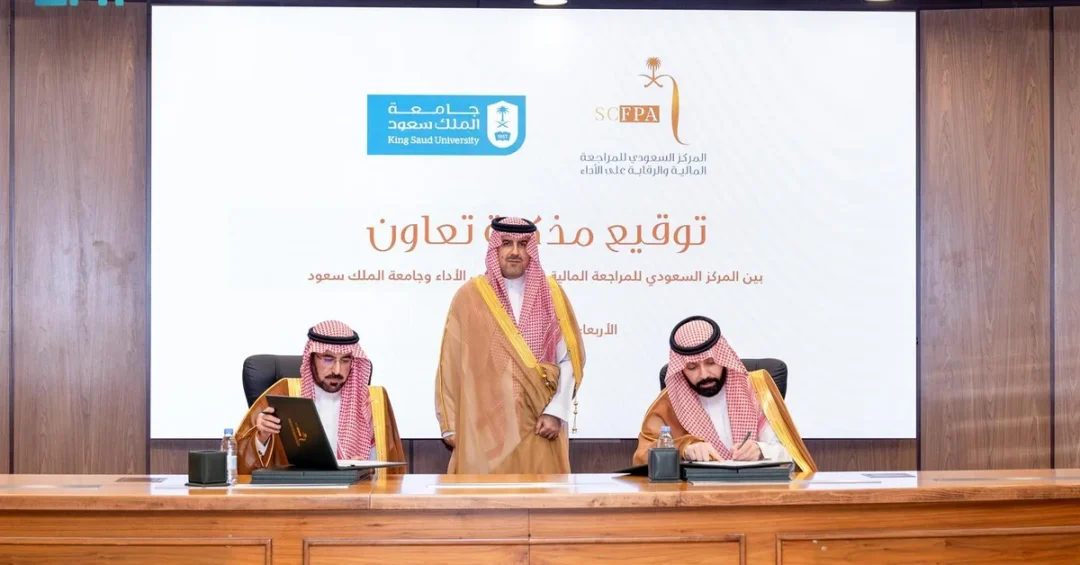
The Saudi Center for Financial and Performance Auditing (SCFPA), the specialized training and capacity-building arm of the General Court of Audit (GCA), and King Saud University (KSU) signed a memorandum of cooperation (MoC) at the GCA headquarters in Riyadh on November 5, 2024, establishing a strategic partnership to share expertise, methodologies, and build specialized capabilities in accounting and auditing. The agreement was signed by Tariq Aljuraifani, GCA Executive Deputy for Shared Services and SCFPA Director-General, and Prof. Dr. Abdullah Alsalman, acting president of King Saud University, according to the Saudi Press Agency (SPA). The MoC represents a deliberate step toward aligning the Kingdom’s academic excellence with the professional demands of its rapidly expanding public audit sector.
Why does a partnership between a national audit training center and the Kingdom’s oldest and most prestigious university matter at this particular moment? Saudi Arabia is undergoing one of the most ambitious economic transformations in the world under Vision 2030, and that transformation depends on transparent, accountable, and professionally staffed institutions. As the GCA’s mandate expands to cover an ever-wider range of government entities and programs, the demand for highly qualified auditors, performance reviewers, and financial specialists grows accordingly. By joining forces with KSU, the SCFPA is signaling that it intends to meet that demand not only through short-term training but through a sustained pipeline of talent, research, and shared knowledge that begins on campus and continues throughout a professional career. The memorandum is therefore more than a bureaucratic formality; it is an investment in the human capital that underpins the Kingdom’s fiscal credibility.
Context and Background
What is the SCFPA, and why was it created? The Saudi Center for Financial and Performance Auditing was established under the umbrella of the General Court of Audit, the Kingdom’s supreme audit institution, to serve as a center of excellence for training, research, and professional development in the fields of accounting, financial auditing, and performance auditing. Its mission is closely tied to the GCA’s broader responsibility of safeguarding public funds and ensuring that government programs deliver value for money. The SCFPA works with GCA employees as well as employees of audited entities, equipping them with the knowledge and skills required to meet international professional standards. Its role has taken on added significance as Saudi Arabia’s public sector grows in size and complexity, and as citizens and international partners alike expect ever-higher standards of transparency and accountability.
King Saud University, for its part, is one of the Arab world’s leading higher education institutions, with a long tradition of scholarship in business, economics, and the social sciences. Based in Riyadh, KSU has produced generations of leaders in the public and private sectors and maintains extensive programs in accounting and finance. The university’s interest in the MoC reflects its own strategic goals: providing outstanding students with practical experience through cooperative training, enhancing the capabilities of its staff, and fostering social responsibility by identifying and supporting talented individuals. The collaboration therefore brings together two institutions with complementary strengths — the SCFPA’s professional expertise and applied focus, and KSU’s academic depth and educational infrastructure.
Does the timing of this agreement tell us something about the direction of Saudi public administration? It does. The MoC comes as the Kingdom continues to implement wide-ranging reforms to its budgeting, procurement, and oversight frameworks, all of which depend on a skilled cadre of auditors and financial professionals. By formalizing cooperation between the audit profession and academia, the two institutions are helping to institutionalize best practices rather than relying on ad hoc arrangements. The signing ceremony at GCA headquarters in Riyadh also underscores the seriousness with which Saudi leadership views capacity-building in the oversight sector.
Key Details of the Memorandum
What exactly does the memorandum commit the two parties to do? According to the Saudi Press Agency, the MoC aims to build a strategic partnership between the SCFPA and KSU with several key areas of collaboration: sharing experiences and methodologies, providing specialized programs, and developing human capital. The agreement is designed to serve both institutions’ objectives while advancing the broader national interest in sound financial management. The SCFPA will work to enhance its mission of developing the capabilities, knowledge, and professional skills of GCA employees and employees of audited entities in accounting, financial auditing, and performance auditing, while also managing quality knowledge in these fields, providing research and consulting services, and strengthening community partnerships at both local and international levels.
For its part, King Saud University will provide opportunities for outstanding students to gain practical experience through cooperative training programs in specialized fields. This hands-on dimension is important: auditing and performance review are disciplines that require judgment and applied skill as much as theoretical knowledge, and students who train within a professional audit environment gain insights that cannot be fully replicated in a classroom. The university also seeks to enhance the capabilities of its employees in accounting, auditing, and review, and to foster social responsibility by identifying and supporting talented individuals. In practical terms, this could mean joint workshops, guest lectures by GCA and SCFPA experts, research projects, internships, and specialized certification programs — all of which would deepen the connection between academic study and professional practice.
Who benefits most directly from this arrangement? The primary beneficiaries are GCA employees and the staff of audited government entities, who will gain access to structured professional development opportunities; KSU students and faculty, who will gain exposure to real-world audit challenges; and ultimately the Saudi public, which benefits when public funds are managed with greater competence and integrity. The memorandum also positions the SCFPA to expand its role as a knowledge hub, managing quality knowledge in accounting and auditing and offering research and consulting services that can inform policy and practice across the public sector. By strengthening community partnerships locally and internationally, the agreement also opens the door to broader collaboration with professional bodies, universities, and audit institutions beyond the Kingdom’s borders.
International and Regional Impact
How does a domestic partnership between a Saudi audit center and a Saudi university resonate internationally? Supreme audit institutions around the world increasingly recognize that capacity-building is essential to credible oversight, and the SCFPA’s work is part of a global movement toward professionalizing public audit. By partnering with a major university, the SCFPA is adopting a model that leading audit institutions in other countries have used to sustain their talent pipelines. This alignment with international best practice enhances the Kingdom’s reputation as a serious and modernizing actor in public financial management. It also creates a foundation for future cooperation with regional and international organizations that value training, research, and knowledge exchange.
In the regional context, Saudi Arabia is often looked to as a standard-setter in the Gulf and the broader Middle East. When the Kingdom’s audit institutions invest in human capital and academic collaboration, they send a signal that good governance is a priority, not an afterthought. This can have a demonstration effect, encouraging similar partnerships in neighboring countries and contributing to a wider culture of accountability. For international investors and institutions assessing the Kingdom’s business and regulatory environment, a strong audit ecosystem is a reassuring indicator: it suggests that public resources are being managed according to recognized standards, which in turn supports confidence in the economy. The MoC thus has implications that extend well beyond the two institutions that signed it.
Economic and Strategic Significance
Why is this agreement economically significant? Sound auditing and performance review are not abstract virtues; they are practical tools that help governments allocate resources efficiently, detect waste, and improve the delivery of public services. As Saudi Arabia invests hundreds of billions of riyals in giga-projects, infrastructure, and social programs under Vision 2030, the stakes of effective oversight rise accordingly. A well-trained audit workforce helps ensure that these investments achieve their intended outcomes and that lessons learned are fed back into decision-making. The SCFPA-KSU partnership supports this by expanding the supply of skilled professionals and by generating research that can improve audit methodologies and performance measurement.
The strategic significance is equally clear. Human capital development is one of the central pillars of Vision 2030, and the memorandum directly advances that pillar by linking education to employment and by fostering a culture of continuous learning. It also reinforces the Kingdom’s broader efforts to diversify its economy and build world-class institutions. By investing in the capabilities of its own people, Saudi Arabia reduces its reliance on external expertise over the long term and strengthens the resilience of its public institutions. For KSU, the partnership enhances its applied relevance and its contribution to national priorities; for the GCA and SCFPA, it strengthens the professional foundation on which credible oversight depends.
Vision 2030 Alignment
How does the SCFPA-KSU memorandum connect to the Kingdom’s long-term vision? Vision 2030 calls for a transparent, accountable, and efficient government, and it places human capital at the center of national progress. The MoC advances these goals by building specialized capabilities in accounting and auditing, by promoting research and knowledge management, and by creating practical pathways for talented students to enter and excel in the profession. It reflects the leadership’s consistent emphasis on good governance as a foundation for economic success and social well-being. In this sense, the agreement is a small but meaningful building block in a much larger national project.
Looking ahead, the partnership between the SCFPA and King Saud University is expected to deepen over time, with new programs, research initiatives, and opportunities for collaboration emerging as both institutions gain experience working together. The memorandum establishes a framework that can be expanded and adapted as the Kingdom’s needs evolve. For international observers, it offers a clear example of how Saudi institutions are working together to strengthen governance, invest in people, and support the ambitious transformation underway across the country. As Saudi Arabia continues its journey toward Vision 2030, partnerships like this one will help ensure that the institutions underpinning its success are as capable and credible as the goals they serve.
20 Questions
Q1. What is the Saudi Center for Financial and Performance Auditing?
A1. The SCFPA is the training and capacity-building center of the General Court of Audit, Saudi Arabia’s supreme audit institution. It develops skills in accounting, financial auditing, and performance auditing for GCA employees and staff of audited entities.
Q2. What is King Saud University known for?
A2. King Saud University is one of the Arab world’s leading higher education institutions, based in Riyadh. It has strong programs in business, economics, and accounting and produces graduates who serve across the public and private sectors.
Q3. When and where was the memorandum signed?
A3. The memorandum of cooperation was signed at the General Court of Audit headquarters in Riyadh on November 5, 2024, according to the Saudi Press Agency.
Q4. Who signed the memorandum on behalf of the SCFPA?
A4. Tariq Aljuraifani, GCA Executive Deputy for Shared Services and SCFPA Director-General, represented the SCFPA at the signing ceremony.
Q5. Who signed on behalf of King Saud University?
A5. Prof. Dr. Abdullah Alsalman, acting president of King Saud University, represented the university at the signing ceremony.
Q6. What are the main areas of collaboration in the memorandum?
A6. The MoC focuses on sharing experiences and methodologies, providing specialized programs, and developing human capital in accounting, financial auditing, and performance auditing.
Q7. How does the SCFPA benefit from this partnership?
A7. The SCFPA gains access to academic expertise and a pipeline of talented students, helping it enhance professional skills, manage quality knowledge, and provide research and consulting services.
Q8. How does King Saud University benefit?
A8. KSU gains opportunities for its students to obtain practical experience through cooperative training and for its employees to enhance capabilities in accounting, auditing, and review.
Q9. What is cooperative training in this context?
A9. Cooperative training allows outstanding KSU students to gain hands-on experience in specialized fields, bridging academic study and professional practice within the audit environment.
Q10. Why is this partnership important for Saudi Arabia’s public sector?
A10. It strengthens the skills of auditors and financial professionals, supporting transparency, accountability, and efficient use of public funds as the public sector grows in size and complexity.
Q11. How does the memorandum support Vision 2030?
A11. It advances Vision 2030’s human capital and good governance goals by building specialized capabilities, promoting research, and linking education to professional employment.
Q12. What role does the General Court of Audit play?
A12. The GCA is Saudi Arabia’s supreme audit institution, responsible for safeguarding public funds and ensuring government programs achieve value for money.
Q13. What are performance audits?
A13. Performance audits assess whether government programs and entities achieve their objectives efficiently and effectively, going beyond compliance to examine outcomes and value for money.
Q14. Will the partnership include research activities?
A14. Yes, the SCFPA seeks to manage quality knowledge and provide research and consulting services, which can involve joint projects with KSU faculty and students.
Q15. Does the memorandum involve international cooperation?
A15. The SCFPA aims to strengthen community partnerships at local and international levels, so the agreement may support broader engagement with global audit and academic institutions.
Q16. How does this affect KSU students directly?
A16. Outstanding students can gain practical experience through cooperative training programs in specialized fields, improving their readiness for careers in auditing and accounting.
Q17. What does ‘developing human capital’ mean here?
A17. It means investing in people’s skills, knowledge, and professional capabilities so they can perform at high standards and contribute to national development.
Q18. Why is auditing important for economic growth?
A18. Effective auditing helps prevent waste and mismanagement, improves public service delivery, and builds confidence among investors and international partners.
Q19. Is this the first cooperation between the two institutions?
A19. The memorandum establishes a strategic partnership framework; specific prior collaborations are not detailed in the official announcement.
Q20. What are the expected long-term outcomes?
A20. The partnership is expected to produce a stronger pipeline of skilled audit professionals, improved methodologies, and enhanced institutional capacity supporting Saudi Arabia’s governance and development goals.
Reader Feedback
We value your thoughts. Please share your feedback on this article.
Your feedback helps us improve our coverage.
Related articles
 Prince Faisal bin Ayyaf Engages Global Urban Leaders at WUF12
 Saudi Arabia Hosts Groundbreaking Sea Turtle Conservation Symposium
 Saudi Water Authority Mandates Electronic Licensing
 Saudi Railways Hit 30.3 Million Passengers in 2023, Up 33%
 GASTAT: Saudi Bus Passengers Jump 176% in 2023
 Saudi Arabia Weather Forecast: Rain and Hail Expected Thursday