


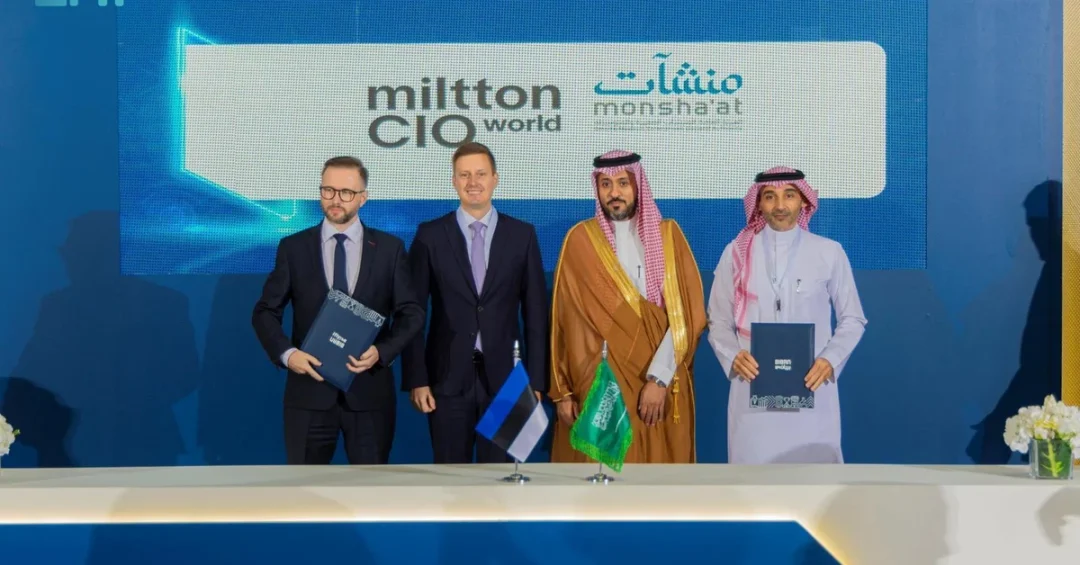
The Small and Medium Enterprises General Authority (Monsha’at) signed a cooperation agreement with the Estonian firm Miltton CIO World to advance innovation, entrepreneurship, and small and medium enterprise (SME) development across multiple sectors, the Saudi Press Agency reported. The agreement was concluded on the sidelines of the Biban24 Forum in Riyadh, the Kingdom’s flagship gathering for entrepreneurs, investors, and policymakers, and it sets out a structured framework for Saudi-Estonian collaboration in innovation, knowledge exchange, and capacity building.
The deal was signed by Saud AlSabhan, Vice Governor for Entrepreneurship at Monsha’at, and Lehari Kaustel, Chief Executive Officer of Miltton CIO World. It commits both parties to hosting joint events and workshops, developing studies and research on innovation and technology, exchanging information and data, and organizing conferences that transfer knowledge between the two sides. For Saudi Arabia, the agreement represents another step in building an internationally connected entrepreneurial ecosystem, one that gives local SMEs access to digital expertise, sustainability-focused technologies, and new markets. Why does a partnership between a Saudi authority and an Estonian innovation firm matter beyond the signing ceremony? Because it connects the Kingdom’s fast-growing startup base with one of Europe’s most digitally advanced economies.
Context and Background
How did Saudi Arabia become one of the most closely watched startup markets in the region? The answer lies in a deliberate, multi-year effort to diversify the economy away from oil dependence and toward knowledge-intensive sectors. Monsha’at, established as the national authority responsible for SMEs, has been central to that effort, rolling out financing programs, regulatory simplifications, and market-access initiatives designed to help small businesses scale. The Biban forum, hosted by Monsha’at from November 5 to 9 under the theme “Global Destination for Opportunities,” has become the annual centerpiece of that strategy, bringing together investors, founders, and decision-makers at the Riyadh Front Exhibition and Conference Center.
Estonia, for its part, has built a global reputation as a digital-first economy, producing a dense cluster of technology companies and a public sector widely studied for its e-government systems. Miltton CIO World operates at the intersection of innovation consulting, digital transformation, and international business development, making it a natural partner for an authority seeking to expose Saudi entrepreneurs to proven models from mature digital economies. The agreement signed at Biban24 therefore reflects a broader pattern: Saudi Arabia is not only attracting foreign investment but also importing expertise, frameworks, and networks that strengthen the domestic ecosystem from the inside.
For international observers, the timing is significant. Saudi Arabia’s non-oil economy has expanded steadily, and the SME sector is increasingly viewed as a source of job creation and innovation. Partnerships such as this one signal that the Kingdom intends to compete globally not only through capital but through collaboration, learning from smaller, highly innovative nations while offering access to one of the largest and youngest consumer markets in the Middle East.
Key Details of the Agreement
What exactly does the Monsha’at–Miltton CIO World agreement cover? According to the Saudi Press Agency, the cooperation encompasses four broad areas. First, the two parties will develop joint studies and research on innovation and technology, creating a shared knowledge base that can inform policy and business decisions. Second, they will exchange information and data, a provision that can help Saudi entrepreneurs benchmark their performance against international peers and identify emerging trends early. Third, they will organize events and conferences dedicated to knowledge transfer, giving Saudi founders direct exposure to Estonian and European best practices. Fourth, they will host joint workshops aimed at capacity building across the entrepreneurial ecosystem.
The agreement also has a practical commercial dimension. It is designed to empower SME entrepreneurs to leverage digital knowledge and cutting-edge technologies in sustainability, while enhancing their access to new markets. That combination—digital capability plus sustainability plus market access—addresses three of the most common barriers facing small businesses in any economy. For Saudi SMEs, the partnership could translate into new tools for reducing environmental impact, improving operational efficiency, and preparing for entry into European or global supply chains.
The signing at Biban24 placed the agreement within a dense program of deal-making. The forum offered more than 10,000 investment opportunities and gathered a wide cross-section of the entrepreneurial community, from early-stage founders to institutional investors. Agreements concluded during the event, including this one, underscore Saudi Arabia’s commitment to nurturing a business environment conducive to growth, in line with Saudi Vision 2030 and its goal of advancing the digital economy. By attaching the agreement to Biban24, Monsha’at also gave it immediate visibility among the very audiences—entrepreneurs, financiers, and international partners—most likely to act on it.
International and Regional Impact
Could this agreement influence how other countries approach SME cooperation with Saudi Arabia? The Saudi-Estonian tie-up is notable because it pairs a Gulf economy undergoing rapid transformation with a European nation known for digital governance and agile startups. If the collaboration delivers tangible results—joint research, trained entrepreneurs, new market linkages—it may encourage other small, innovation-driven economies to seek similar arrangements. That would reinforce Saudi Arabia’s position as a hub for international entrepreneurship partnerships rather than simply a destination for foreign direct investment.
Regionally, the agreement supports the broader integration of Middle Eastern startup ecosystems. Saudi Arabia has increasingly acted as a connector, hosting forums and signing memoranda that link its entrepreneurs to partners in Europe, Asia, and North America. For Estonia, the deal offers access to a large, young, and digitally receptive market, as well as a partner institution with the mandate and resources to convene the private sector at scale. For the wider region, successful implementation could raise standards for SME support programs, encouraging neighboring countries to deepen their own international collaborations.
There is also a diplomatic dimension. Cooperation agreements of this kind are often described as soft-power instruments, building goodwill and mutual understanding through business and knowledge exchange. By working with a respected European innovation actor, Saudi Arabia reinforces its message that Vision 2030 is open to global participation and that the Kingdom welcomes partners who bring expertise, not just capital. For international readers, the takeaway is that Saudi Arabia’s economic transformation is being pursued through an expanding web of international partnerships, each adding a specific capability to the national ecosystem.
Economic and Strategic Significance
Why should economists and business leaders pay attention to an SME-focused agreement? SMEs are widely recognized as engines of employment and innovation, and Saudi Arabia has made their growth a central pillar of its economic diversification strategy. By connecting local SMEs to Estonian digital and sustainability expertise, the agreement aims to improve productivity, competitiveness, and export readiness. Those outcomes matter because they determine whether small firms remain local players or become regional and global competitors. The focus on sustainability technologies is particularly strategic, given rising global demand for environmentally responsible products and processes.
The agreement also aligns with Saudi Arabia’s efforts to build a knowledge economy. Research collaboration and data exchange can generate insights that inform both public policy and private strategy, while joint conferences and workshops create recurring opportunities for learning. Over time, such activities can produce a virtuous cycle: better-informed entrepreneurs build stronger companies, which in turn attract more investment and talent, further strengthening the ecosystem. For Miltton CIO World, the partnership offers a platform to apply its expertise in a rapidly growing market, creating a two-way flow of value rather than a one-sided transfer.
From a strategic standpoint, the deal reinforces the Kingdom’s broader economic priorities: diversifying revenue sources, expanding the private sector’s contribution to GDP, and integrating with global markets. It also demonstrates that Saudi institutions are willing to learn from smaller economies with strong innovation records, a pragmatic approach that can accelerate progress. For investors watching the region, agreements like this one provide evidence that the SME support architecture is maturing and that international partners see long-term opportunity in the Saudi market.
Vision 2030 Alignment
How does a single agreement connect to a national transformation plan? Saudi Vision 2030 aims to build a diversified, sustainable economy in which the private sector and small businesses play a leading role. Monsha’at’s partnership with Miltton CIO World advances several Vision 2030 objectives at once: fostering entrepreneurship, accelerating digital adoption, promoting sustainability, and deepening international cooperation. By enabling joint research, knowledge exchange, and capacity-building events, the agreement helps create the conditions in which Saudi SMEs can grow, innovate, and compete beyond national borders.
The Biban24 Forum itself is a manifestation of Vision 2030’s emphasis on opportunity and global engagement. With its theme “Global Destination for Opportunities,” the event reflects the Kingdom’s ambition to be a place where entrepreneurs from around the world can connect, invest, and build. The agreements signed during the forum, including the Monsha’at–Miltton CIO World deal, are practical instruments for turning that ambition into measurable outcomes. As Saudi Arabia continues to expand its entrepreneurial ecosystem, partnerships that combine local scale with international expertise will remain essential—and this agreement shows how the Kingdom is building those bridges, one collaboration at a time, in service of a diversified and globally connected future.
20 Questions
Q1. What is Monsha’at?
A1. Monsha’at is the Small and Medium Enterprises General Authority of Saudi Arabia. It is the national body responsible for supporting, developing, and regulating the SME sector in line with Saudi Vision 2030.
Q2. What is Miltton CIO World?
A2. Miltton CIO World is an Estonian company focused on innovation, digital transformation, and international business development. It partners with organizations to strengthen entrepreneurial ecosystems and knowledge exchange.
Q3. What did the two parties sign?
A3. They signed a cooperation agreement to enhance innovation, entrepreneurship, and SME development across multiple sectors. The deal covers joint research, data exchange, events, workshops, and market access.
Q4. Where was the agreement signed?
A4. The agreement was signed at the Biban24 Forum in Riyadh, Saudi Arabia. Biban24 is hosted by Monsha’at and serves as a major platform for entrepreneurs, investors, and decision-makers.
Q5. When did Biban24 take place?
A5. Biban24 was hosted by Monsha’at from November 5 to 9, 2024. The forum was held at the Riyadh Front Exhibition and Conference Center.
Q6. Who signed the agreement for Monsha’at?
A6. Saud AlSabhan, Vice Governor for Entrepreneurship at Monsha’at, signed the agreement. He represented the authority in the deal with the Estonian company.
Q7. Who signed for Miltton CIO World?
A7. Lehari Kaustel, Chief Executive Officer of Miltton CIO World, signed the agreement. He represented the Estonian firm at the Biban24 Forum in Riyadh.
Q8. What are the main areas of cooperation?
A8. The agreement covers joint studies and research on innovation and technology, exchange of information and data, organization of events and conferences, and capacity-building workshops for entrepreneurs.
Q9. How does the deal support SME entrepreneurs?
A9. It helps SME entrepreneurs leverage digital knowledge and cutting-edge technologies in sustainability. It also aims to enhance their access to new markets.
Q10. What is the theme of Biban24?
A10. The theme of Biban24 is “Global Destination for Opportunities.” It focuses on enhancing the innovation landscape and bolstering economic development in Saudi Arabia.
Q11. How many investment opportunities were offered at Biban24?
A11. Biban24 offered more than 10,000 investment opportunities. These were presented to investors, entrepreneurs, and decision-makers attending the forum.
Q12. Why is Estonia a relevant partner?
A12. Estonia is known for its digital-first economy and advanced e-government systems. Its expertise in innovation and technology complements Saudi Arabia’s SME development goals.
Q13. How does the agreement promote knowledge sharing?
A13. It includes joint research, data exchange, and conferences for knowledge transfer. These activities allow both parties to share best practices and insights.
Q14. What role does sustainability play in the agreement?
A14. The agreement empowers SMEs to use digital knowledge and cutting-edge technologies in sustainability. This supports environmentally responsible business practices and innovation.
Q15. How does the deal help Saudi SMEs access new markets?
A15. The collaboration aims to enhance SME access to new markets through knowledge exchange, capacity building, and exposure to international networks and best practices.
Q16. What is the significance of the agreement for Vision 2030?
A16. It supports Vision 2030 by fostering entrepreneurship, digital adoption, sustainability, and international cooperation. These are key pillars of Saudi Arabia’s economic diversification strategy.
Q17. What kind of events will the parties organize?
A17. They will host joint events, workshops, and conferences. These are designed to enhance capacity building and develop the entrepreneurial ecosystem.
Q18. How does the agreement benefit Miltton CIO World?
A18. It gives the Estonian firm access to Saudi Arabia’s growing market and entrepreneurial community. It also allows it to apply its expertise in a dynamic regional context.
Q19. What does the agreement say about data exchange?
A19. The agreement includes the exchange of information and data between the two parties. This supports research, benchmarking, and informed decision-making.
Q20. What is the broader message of this partnership?
A20. It shows Saudi Arabia’s openness to international collaboration in innovation and entrepreneurship. It reflects the Kingdom’s commitment to building a diversified, knowledge-based economy under Vision 2030.
Reader Feedback
We value your thoughts. Please share your feedback on this article.
Your feedback helps us improve our coverage.
Related articles
 RDIA to Organize Sustainability Innovation Week During UNCCD COP16
 Saudi Arabia Calls for Global Action on Hunger at Addis Ababa Summit
 International Fire Operations Conference Concludes in Riyadh
 KSU Showcases Advisory Services at WUF12 in Cairo
 Riyadh Deputy Governor Attends Zambia National Day Event
 OIC Secretary-General Meets Egypt Representative in Jeddah