


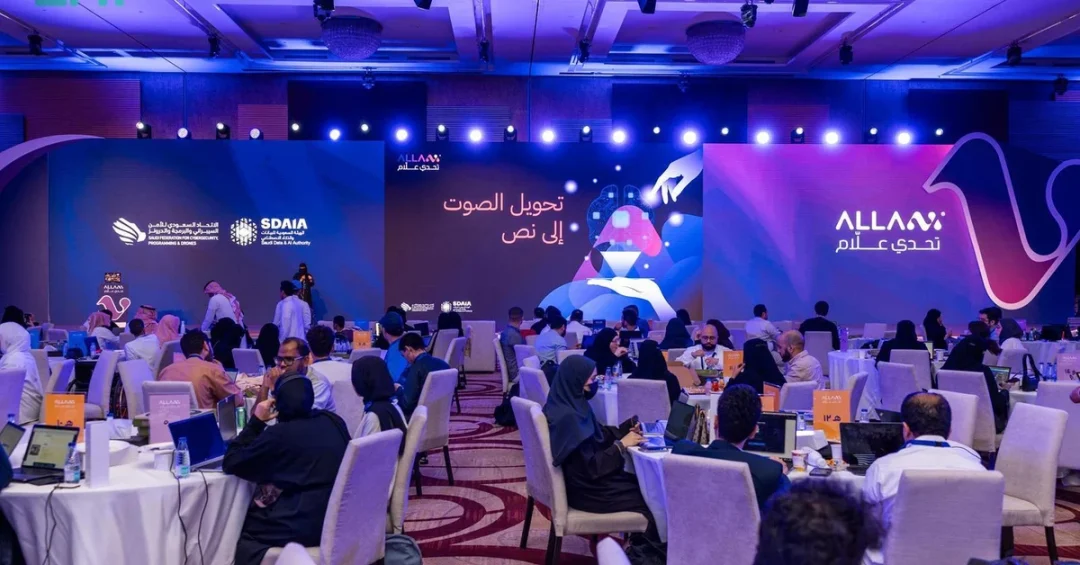
More than 200 teams from 17 countries, including the Kingdom of Saudi Arabia, are competing in the ALLaM Challenge, an international competition organized by the Saudi Data and Artificial Intelligence Authority (SDAIA) in collaboration with the Saudi Federation for Cybersecurity, Programming, and Drones, to develop innovative artificial intelligence solutions that serve the Arabic language. The competition, now in its second consecutive day, has drawn intense participation from developers, researchers, and AI specialists focused on enhancing large language models (LLMs) and transforming them into real-world projects with practical applications across multiple sectors.
The challenge is being overseen by more than 50 mentors and 40 judges who are experts in artificial intelligence and the Arabic language. These specialists are providing direct support to participating teams while evaluating projects against criteria designed to ensure the sustainability and long-term viability of the proposed solutions. The competition is supported by a technical partnership with IBM and the National Technology Development Program (NTDP), with a total prize pool of SAR 1 million. The event underscores Saudi Arabia’s commitment to advancing Arabic language technology on a global scale.
Context and Background
Why does the Arabic language need dedicated artificial intelligence solutions in an era of rapid technological advancement? Arabic is spoken by more than 400 million people worldwide and is one of the six official languages of the United Nations. Yet for years, the language has been underrepresented in digital tools, machine learning datasets, and large language models that predominantly prioritize English and a handful of other languages. This gap has limited the ability of Arabic speakers to fully benefit from AI-driven services in education, healthcare, commerce, and government.
The ALLaM Challenge emerges from this critical need. Organized by SDAIA, the authority responsible for driving Saudi Arabia’s national data and AI agenda, the competition is designed to accelerate the development of AI models capable of writing and understanding Arabic poetry, accurately analyzing grammar, and teaching Arabic to children in an engaging manner. These capabilities represent far more than technical achievements; they are essential building blocks for preserving linguistic heritage while enabling modern digital interaction.
The competition also reflects a broader movement within the Kingdom to position Arabic as a language of innovation, not merely tradition. By providing high-quality Arabic data and creating AI models that can effectively handle the language’s complexities, Saudi Arabia is laying groundwork that benefits not only its own citizens but Arabic speakers across the region and around the world. The participation of teams from 17 countries signals that this is a shared international priority.
Key Details and Competition Structure
What distinguishes the ALLaM Challenge from other AI competitions is its deliberate focus on real-world applicability. The 200 participating teams are not simply building theoretical models; they are tasked with transforming large language models into practical projects that serve Arabic across various sectors. This approach ensures that the solutions developed during the competition have the potential to move beyond the event itself and into everyday use.
The evaluation framework is designed with sustainability in mind. The 40 judges, drawn from the ranks of AI and Arabic language experts, assess each project on criteria that prioritize long-term viability. This means solutions must demonstrate not only technical sophistication but also the ability to be maintained, scaled, and integrated into existing systems. The 50 mentors provide guidance throughout the process, helping teams refine their approaches and overcome challenges.
The technical partnership with IBM brings significant computational resources and AI expertise to the competition, while the National Technology Development Program contributes its experience in nurturing technology ventures within the Kingdom. The SAR 1 million prize pool provides substantial incentive for participants to push the boundaries of what is possible. Together, these elements create an environment where innovation can flourish and where the best ideas can attract further investment and development.
International and Regional Impact
How does a competition held in Riyadh ripple across the global technology landscape? The presence of teams from 17 countries demonstrates that the ALLaM Challenge has already achieved international recognition. By bringing together diverse perspectives and expertise, the competition fosters cross-border collaboration that can accelerate progress in Arabic language AI. Teams share knowledge, compare approaches, and build networks that will continue to produce benefits long after the event concludes.
For the Middle East and North Africa region, the implications are particularly significant. Arabic-language AI tools developed through this competition could enhance educational platforms, improve government service delivery, and support digital economies across the region. Countries with large Arabic-speaking populations stand to gain from solutions that understand local dialects, cultural nuances, and linguistic requirements. The competition thus positions Saudi Arabia as a regional leader in a technology domain that directly affects hundreds of millions of people.
On a global scale, the ALLaM Challenge contributes to the broader goal of making AI more inclusive. Major technology companies and research institutions worldwide are increasingly recognizing the importance of multilingual AI, and Saudi Arabia’s initiative provides a model for how nations can take ownership of their linguistic heritage in the digital age. The competition’s outcomes are likely to be watched closely by international AI researchers and developers.
Economic and Strategic Significance
What economic value can be unlocked by advancing Arabic language AI? The global AI market is expanding rapidly, and languages with strong digital representation capture a disproportionate share of that growth. By investing in Arabic language models, Saudi Arabia is positioning itself to capture economic value in sectors ranging from education technology and content creation to customer service automation and digital marketing. Arabic-language AI solutions have applications across every industry that serves Arabic-speaking customers.
The strategic dimension is equally important. Data and artificial intelligence are central to Saudi Arabia’s Vision 2030, the national transformation plan aimed at diversifying the economy and building a knowledge-based society. The ALLaM Challenge supports this vision by nurturing local talent, attracting international expertise, and creating intellectual property that can be commercialized. The competition also strengthens the Kingdom’s position as a hub for technology innovation, complementing other initiatives in fields such as smart cities, renewable energy, and advanced manufacturing.
Furthermore, the emphasis on sustainability in the judging criteria ensures that the economic benefits extend beyond the competition itself. Projects that demonstrate viability can attract venture funding, create jobs, and generate export opportunities. The SAR 1 million prize pool is a catalyst, but the real value lies in the ecosystem of innovation that the competition helps to build. By connecting startups, established companies, and government entities, the ALLaM Challenge contributes to a virtuous cycle of technological development.
Vision 2030 Alignment
How does the ALLaM Challenge embody the aspirations of Saudi Vision 2030? At its core, Vision 2030 seeks to transform the Kingdom into a diversified, knowledge-driven economy where technology and innovation play leading roles. The competition directly supports this objective by fostering advanced AI capabilities, encouraging entrepreneurship, and promoting Saudi Arabia as a global center for Arabic language technology. It aligns with the National Strategy for Data and AI, which aims to make the Kingdom a leader in the data-driven economy.
The challenge also reflects Vision 2030’s emphasis on human capital development. By engaging 200 teams and providing mentorship from 50 experts, the competition cultivates skills among young developers and researchers. This investment in talent will pay dividends for years to come, as participants carry their experience into careers, startups, and research institutions. The focus on Arabic language preservation and modernization further reinforces the cultural dimension of Vision 2030, which values heritage while embracing progress.
As the ALLaM Challenge continues, it stands as a testament to Saudi Arabia’s commitment to innovation, international cooperation, and the advancement of the Arabic language. The outcomes of this competition will not only produce new AI tools but also inspire future generations to explore the intersection of technology and culture. The Kingdom’s leadership in this field is a source of pride and a contribution to the global community.
20 Questions
Q1. What is the ALLaM Challenge?
A1. The ALLaM Challenge is an international competition organized by the Saudi Data and Artificial Intelligence Authority (SDAIA) in collaboration with the Saudi Federation for Cybersecurity, Programming, and Drones, aimed at developing AI solutions for the Arabic language.
Q2. How many teams are participating in the ALLaM Challenge?
A2. More than 200 teams from 17 countries, including the Kingdom of Saudi Arabia, are participating in the competition, showcasing their capabilities in developing innovative AI solutions.
Q3. What is the main focus of the competition?
A3. The focus is on enhancing large language models and transforming them into real-world AI projects that serve the Arabic language across various sectors, including poetry, grammar, and education.
Q4. Who is organizing the ALLaM Challenge?
A4. The competition is organized by the Saudi Data and Artificial Intelligence Authority (SDAIA) in collaboration with the Saudi Federation for Cybersecurity, Programming, and Drones.
Q5. How many mentors and judges are involved?
A5. More than 50 mentors and 40 judges, who are experts in AI and the Arabic language, are providing support to participating teams and evaluating projects based on sustainability criteria.
Q6. What is the total prize pool for the competition?
A6. The total prize pool for the ALLaM Challenge is SAR 1 million, providing substantial incentive for participants to develop innovative solutions.
Q7. What are the technical partnerships supporting the competition?
A7. The competition is supported by a technical partnership with IBM and the National Technology Development Program (NTDP), bringing additional expertise and resources.
Q8. What are the specific goals of the ALLaM Challenge?
A8. The goals include developing AI models that can write and understand Arabic poetry, accurately analyze grammar, and teach Arabic to children in an engaging manner.
Q9. Why is the Arabic language important in AI development?
A9. Arabic is spoken by over 400 million people and is underrepresented in digital tools; developing AI for Arabic ensures broader access to technology and preserves linguistic heritage.
Q10. How does the competition align with Saudi Vision 2030?
A10. It supports Vision 2030 by fostering advanced AI capabilities, encouraging entrepreneurship, and promoting Saudi Arabia as a global center for Arabic language technology.
Q11. What criteria are used to evaluate projects?
A11. Projects are evaluated based on criteria that ensure the sustainability of the proposed solutions, including technical sophistication, long-term viability, and potential for integration.
Q12. How many countries are represented in the competition?
A12. Teams from 17 countries are participating, demonstrating the international recognition and collaborative nature of the ALLaM Challenge.
Q13. What is the role of SDAIA in the competition?
A13. SDAIA, as the organizer, drives Saudi Arabia’s national data and AI agenda, ensuring the competition aligns with the Kingdom’s strategic priorities.
Q14. What is the significance of IBM’s partnership?
A14. IBM’s technical partnership brings significant computational resources and AI expertise, enhancing the competition’s ability to foster innovation.
Q15. How does the competition benefit the Arabic language?
A15. By developing AI models that understand and generate Arabic, the competition helps modernize the language’s digital presence and ensures its relevance in the tech era.
Q16. What are the expected outcomes of the ALLaM Challenge?
A16. Expected outcomes include new AI tools for Arabic, enhanced collaboration among international teams, and the cultivation of local talent in AI and language technology.
Q17. How does the competition support Saudi Arabia’s economic diversification?
A17. It fosters innovation in AI, attracts investment, and creates intellectual property, contributing to a knowledge-based economy as outlined in Vision 2030.
Q18. What is the role of the National Technology Development Program?
A18. NTDP supports the competition by providing experience in nurturing technology ventures, helping to ensure that solutions developed have real-world applicability.
Q19. How can international teams participate in future competitions?
A19. International teams can participate by registering through official SDAIA channels and meeting the competition’s criteria, as announced in future calls for participation.
Q20. What makes the ALLaM Challenge unique?
A20. Its unique focus on Arabic language AI, combined with international participation, substantial prizes, and a sustainability-driven evaluation framework, sets it apart from other competitions.
Reader Feedback
We value your thoughts. Please share your feedback on this article.
Your feedback helps us improve our coverage.
Related articles
 CST Demo Day Graduates 20 Space Startups from 7 Countries
 SDAIA President Honors Winners of ALLaM Challenge
 CODE Launches LogisTech Challenge to Boost Innovation
 SDAIA Showcases Data and AI Glossary at Jeddah Forum
 Estidamah Achieves Breakthrough in Local Asparagus Cultivation
 Saudi DGA Launches Platforms Code to Unify Digital Identity