


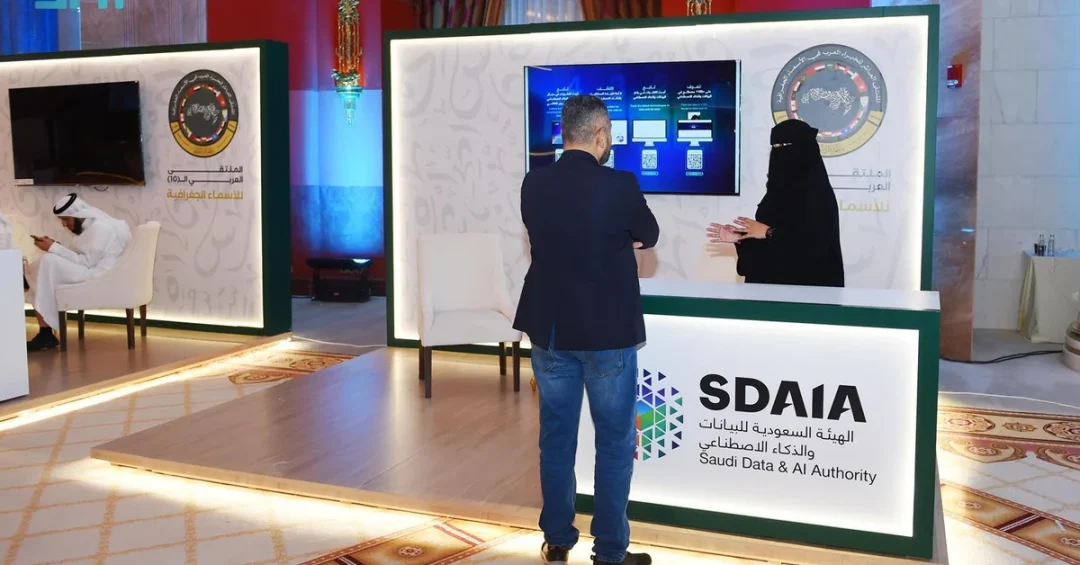
The Saudi Data and Artificial Intelligence Authority (SDAIA) is presenting a specialized data and artificial intelligence glossary, alongside its interactive Data and AI Radar, at the 10th Forum of the Arab Division of Experts in Geographical Names, hosted in Jeddah from November 10 to 12, 2024 by the General Authority for Survey and Geospatial Information. The forum convenes under the theme “Strengthening relations and links between Arab states in the field of geographical names,” bringing together regional specialists to advance cooperation on geographic naming standards and related technical disciplines. SDAIA’s participation underscores the Kingdom’s expanding role in shaping the language, tools, and frameworks that govern how Arab states describe and manage data in an era of rapid technological change.
The glossary, developed in collaboration with the King Salman Global Academy for Arabic Language, compiles key technical terms related to data and artificial intelligence with simplified definitions in both Arabic and English. It was created by specialized national experts at SDAIA and reviewed and approved by a joint committee of technical and linguistic experts, following a methodology built on four main stages to ensure the accuracy of terms and definitions. Alongside the glossary, SDAIA is showcasing its Data and AI Radar, an interactive resource that categorizes the latest data and AI technologies by maturity and potential benefits. The radar is accessible on SDAIA’s website, with an interactive version available to the public. But why does a glossary of technical terms matter to a forum focused on geographical names? The answer lies in the growing convergence of language, data, and geography across the Arab world.
Context and Background
How did a Saudi authority focused on data and AI come to play a central role at a forum dedicated to geographical names? The 10th Forum of the Arab Division of Experts in Geographical Names is organized by the General Authority for Survey and Geospatial Information, a Saudi agency responsible for surveying, mapping, and geospatial data. The forum’s theme, “Strengthening relations and links between Arab states in the field of geographical names,” reflects a long-standing regional effort to standardize how places are named, recorded, and shared across borders. Geographical names are not merely labels; they are data points that support navigation, urban planning, disaster response, and cultural heritage preservation.
SDAIA, established to drive Saudi Arabia’s national data and AI agenda, has increasingly engaged with linguistic and terminological work as part of its broader mandate. Its collaboration with the King Salman Global Academy for Arabic Language signals a deliberate effort to ensure that Arabic remains a robust language for science and technology. The glossary presented in Jeddah is a product of that effort, offering simplified definitions that make complex data and AI concepts accessible to a wide audience, from students and researchers to government officials and private-sector professionals. The timing of the forum, held from November 10 to 12, 2024, places it within a period of intense regional activity around digital transformation and knowledge exchange.
The forum also reflects Saudi Arabia’s commitment to hosting and facilitating multilateral dialogue. By bringing together experts from across the Arab world, the event creates a platform for sharing best practices and aligning terminologies that support cross-border cooperation. SDAIA’s presence at the forum is therefore not an isolated appearance but part of a sustained strategy to position the Kingdom as a convenor and standard-setter in data and AI. The glossary and radar are practical tools that embody this strategy, offering tangible resources that other Arab states can adopt or adapt.
Key Details
What exactly does the data and AI glossary contain, and how was it developed? According to official Saudi information, the glossary is a compilation of key technical terms related to data and artificial intelligence, with simplified definitions in both Arabic and English. It was created by specialized national experts at SDAIA and then reviewed and approved by a committee formed in collaboration with the King Salman Global Academy for Arabic Language. This committee included both technical and linguistic experts, ensuring that definitions are accurate from a scientific standpoint while remaining clear and idiomatic in Arabic.
The development process followed a methodology entailing four main stages, designed to ensure the accuracy of terms and definitions. While the specific stages were not detailed in the initial announcement, the involvement of a joint technical-linguistic committee indicates a rigorous approach that balances precision with accessibility. The bilingual nature of the glossary is particularly significant: it allows Arabic-speaking users to engage with data and AI concepts in their native language, while also providing English definitions that facilitate international collaboration and align with global terminology.
SDAIA is also showcasing the Data and AI Radar, described as a distinctive achievement in the field. The radar covers the latest data and AI technologies, categorized by maturity and potential benefits. This categorization helps users understand which technologies are ready for adoption, which are still emerging, and what benefits they may deliver. The interactive version of the radar is available at https://sdaia.gov.sa/en/MediaCenter/KnowledgeCenter/RadarChart/index.html, making it accessible to anyone with an internet connection. Together, the glossary and the radar represent complementary tools: one clarifies the language, the other maps the landscape.
International and Regional Impact
Why should the international community pay attention to a glossary and a radar presented at a regional forum? The answer lies in the broader dynamics of digital cooperation. Arab states share linguistic, cultural, and economic ties, and standardized terminology is essential for effective collaboration in fields such as geospatial information, artificial intelligence, and data governance. When terms are used consistently across borders, governments and businesses can share data more easily, develop interoperable systems, and avoid misunderstandings that can hinder joint projects. SDAIA’s glossary contributes to this goal by providing a common reference point for Arabic-language data and AI terminology.
The Data and AI Radar, meanwhile, offers a model for how to present technological trends in a structured, accessible way. By categorizing technologies by maturity and potential benefits, it helps decision-makers prioritize investments and understand where the greatest opportunities lie. For regional and international observers, the radar provides insight into how Saudi Arabia is thinking about the data and AI landscape. It also demonstrates the Kingdom’s willingness to share knowledge and tools with partners, reinforcing its role as a collaborative actor in the global technology ecosystem.
The forum itself, with its focus on geographical names, highlights the intersection of language, data, and geography. Geographical names are increasingly important in the digital age, as they underpin location-based services, navigation apps, and geospatial analytics. By participating in this forum, SDAIA is helping to bridge the gap between traditional expertise in geographical naming and modern data and AI capabilities. This cross-pollination of disciplines can lead to innovations that benefit both the Arab region and the wider world.
Economic and Strategic Significance
How does the development of a data and AI glossary translate into economic and strategic value? For Saudi Arabia, the glossary and radar are more than academic exercises; they are infrastructure for a knowledge-based economy. As the Kingdom diversifies away from oil dependence, data and AI are central to new industries, from smart cities to healthcare, finance, and logistics. Clear, standardized terminology supports the training of a skilled workforce, the development of local technologies, and the attraction of foreign investment. When professionals can communicate precisely about data and AI in Arabic, the barriers to entry for local talent are lowered, and the pace of innovation can accelerate.
Strategically, SDAIA’s participation in the forum reinforces Saudi Arabia’s leadership in regional digital affairs. By offering tools that other Arab states can use, the Kingdom builds goodwill and strengthens its position as a hub for technology and knowledge. The collaboration with the King Salman Global Academy for Arabic Language also underscores the importance of cultural and linguistic preservation in the digital age. Arabic is one of the world’s major languages, and ensuring that it remains a vehicle for cutting-edge science and technology is a matter of both national pride and practical necessity. The glossary is a step toward making Arabic a first-class language for data and AI discourse.
Furthermore, the Data and AI Radar serves as a strategic planning tool. By categorizing technologies by maturity and potential benefits, it helps government agencies, businesses, and researchers make informed decisions about where to focus resources. This can lead to more efficient allocation of public and private investment, faster adoption of beneficial technologies, and better risk management. In a rapidly evolving field, having a clear, regularly updated view of the landscape is invaluable.
Vision 2030 Alignment
How does SDAIA’s work at this forum connect to Saudi Vision 2030? Vision 2030 is the Kingdom’s comprehensive plan to diversify the economy, modernize society, and enhance international engagement. Data and artificial intelligence are explicitly identified as key enablers of this transformation. SDAIA was established to lead the national data and AI agenda, and its initiatives—such as the glossary and the Data and AI Radar—directly support the Vision’s objectives of building a digital economy, fostering innovation, and developing human capital. The glossary, by making technical concepts accessible in Arabic, supports the goal of empowering citizens and residents with the knowledge they need to participate in the digital economy.
The radar, by mapping technologies and their benefits, supports evidence-based policymaking and strategic investment, which are essential for economic diversification. The collaboration with the King Salman Global Academy for Arabic Language also aligns with Vision 2030’s cultural goals, which include promoting the Arabic language and preserving heritage while embracing modernity. By presenting these tools at a regional forum, SDAIA is also advancing Vision 2030’s international dimension: the Kingdom aims to be a global leader and a bridge between cultures and economies. The forum provides a platform to share Saudi expertise and learn from others, reinforcing the Kingdom’s role as an active and constructive member of the international community.
Looking ahead, the glossary and radar are likely to evolve as technology advances and as more partners contribute. SDAIA’s continued engagement in regional and international forums will be important for keeping the tools relevant and widely adopted. For international observers, these developments offer a window into how Saudi Arabia is approaching the data and AI revolution: with a focus on language, collaboration, and practical tools that can be used by many. As the Kingdom continues its journey toward Vision 2030, initiatives like these will help ensure that the benefits of technology are shared broadly and that Arabic remains a vibrant language of innovation.
20 Questions
Q1. What is SDAIA presenting at the 10th Forum of the Arab Division of Experts in Geographical Names?
A1. SDAIA is presenting a data and artificial intelligence glossary developed with the King Salman Global Academy for Arabic Language, along with its interactive Data and AI Radar, which categorizes technologies by maturity and potential benefits.
Q2. When and where is the 10th Forum of the Arab Division of Experts in Geographical Names taking place?
A2. The forum is being held in Jeddah, Saudi Arabia, from November 10 to 12, 2024, organized by the General Authority for Survey and Geospatial Information under the theme of strengthening relations between Arab states in geographical names.
Q3. What is the theme of the 10th Forum of the Arab Division of Experts in Geographical Names?
A3. The theme is “Strengthening relations and links between Arab states in the field of geographical names,” reflecting a regional effort to enhance cooperation on naming standards and related geospatial data practices.
Q4. What does the data and AI glossary contain?
A4. The glossary compiles key technical terms related to data and artificial intelligence, providing simplified definitions in both Arabic and English to make complex concepts accessible to a wide audience.
Q5. Who developed the data and AI glossary?
A5. The glossary was created by specialized national experts at SDAIA and reviewed and approved by a committee formed in collaboration with the King Salman Global Academy for Arabic Language, including technical and linguistic experts.
Q6. How many stages were involved in the methodology for developing the glossary?
A6. The methodology entailed four main stages, designed to ensure the accuracy of terms and definitions, though the specific stages were not detailed in the initial announcement.
Q7. Why is the glossary bilingual in Arabic and English?
A7. The bilingual format allows Arabic speakers to engage with data and AI concepts in their native language while providing English definitions that facilitate international collaboration and alignment with global terminology.
Q8. What is the Data and AI Radar?
A8. The Data and AI Radar is an interactive tool on SDAIA’s website that covers the latest data and AI technologies, categorized by maturity and potential benefits to help users understand the technological landscape.
Q9. How can the public access the Data and AI Radar?
A9. The interactive version of the radar is available on SDAIA’s website at the provided URL, allowing anyone with internet access to explore the categorized technologies and their potential benefits.
Q10. What is the significance of SDAIA’s participation in this forum?
A10. SDAIA’s participation highlights Saudi Arabia’s leadership in data and AI, fosters regional cooperation, and demonstrates the Kingdom’s commitment to sharing knowledge and tools that support digital transformation across Arab states.
Q11. What is the role of the King Salman Global Academy for Arabic Language in this project?
A11. The academy collaborated with SDAIA to review and approve the glossary, ensuring that technical terms and definitions are linguistically accurate and clear in Arabic while maintaining scientific precision.
Q12. How does the glossary support the Arabic language?
A12. By providing simplified Arabic definitions for data and AI terms, the glossary helps keep Arabic relevant as a language of science and technology, empowering Arabic speakers to participate in the digital economy.
Q13. What are the potential benefits of the Data and AI Radar for decision-makers?
A13. The radar helps decision-makers prioritize investments, understand technology maturity, and identify opportunities by presenting a structured view of data and AI technologies and their potential benefits.
Q14. How does this initiative align with Saudi Vision 2030?
A14. It supports Vision 2030 by advancing the digital economy, fostering innovation, developing human capital, and promoting the Arabic language, all of which are key objectives of the national transformation plan.
Q15. What is the General Authority for Survey and Geospatial Information?
A15. It is the Saudi agency responsible for surveying, mapping, and geospatial data, and it organized the 10th Forum of the Arab Division of Experts in Geographical Names in Jeddah.
Q16. Why are geographical names important in the digital age?
A16. Geographical names underpin location-based services, navigation, urban planning, and disaster response, making standardized naming essential for effective geospatial data management and cross-border cooperation.
Q17. How does the forum strengthen relations between Arab states?
A17. The forum brings together experts from across the Arab world to share best practices, align terminologies, and collaborate on geographical naming standards, thereby enhancing regional cooperation and interoperability.
Q18. What makes the Data and AI Radar a distinctive achievement?
A18. It offers a unique, interactive categorization of data and AI technologies by maturity and potential benefits, providing a clear and accessible overview that supports strategic planning and informed decision-making.
Q19. Will the glossary and radar be updated in the future?
A19. While specific update plans were not announced, SDAIA’s ongoing engagement in regional and international forums suggests that these tools will evolve as technology advances and more partners contribute.
Q20. How can other Arab states benefit from SDAIA’s glossary and radar?
A20. Other Arab states can adopt or adapt the glossary for their own use and consult the radar to understand technology trends, thereby supporting their own digital transformation efforts and regional collaboration.
Reader Feedback
We value your thoughts. Please share your feedback on this article.
Your feedback helps us improve our coverage.
Related articles
 Estidamah Achieves Breakthrough in Local Asparagus Cultivation
 Saudi DGA Launches Platforms Code to Unify Digital Identity
 Absher Processes Over 6.3 Million Transactions in October 2024
 KAUST Leads Aquaculture Research for Saudi Food Security
 Alswaha: Saudi Youth Success Stories Boost Competitiveness
 SDAIA: Global AI Spending Tops $120 Billion in 2023