


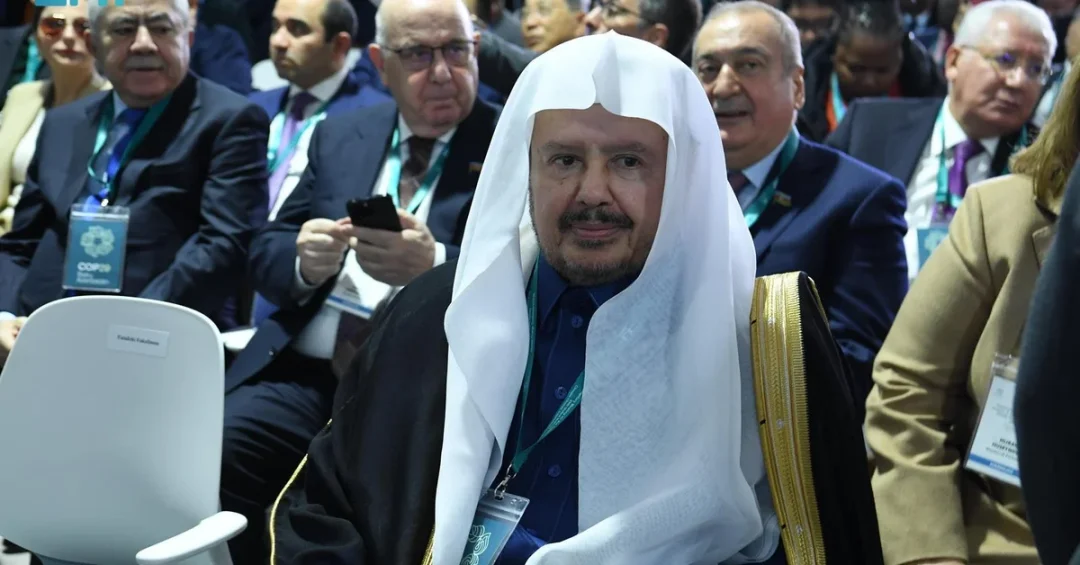
Saudi Arabia participated in the parliamentary meeting of the 29th session of the Conference of the Parties to the United Nations Framework Convention on Climate Change (COP29), held in Baku, Azerbaijan, on November 17, 2024, with a delegation headed by Shura Council Speaker Sheikh Dr. Abdullah bin Mohammed bin Ibrahim Al Al-Sheikh. The meeting, organized by the Inter-Parliamentary Union (IPU) in partnership with the Milli Majlis of the Republic of Azerbaijan, brought together parliamentary leaders from around the world to discuss legislative pathways for advancing global climate goals. The Saudi delegation’s active engagement underscores the Kingdom’s commitment to multilateral climate action and its growing role in shaping international environmental policy.
Could parliamentary diplomacy be the missing link in turning climate pledges into binding national policies? The Baku gathering suggested exactly that, as lawmakers from dozens of countries convened to align legislative agendas with the targets of the Paris Agreement and the outcomes of previous COP sessions. For Saudi Arabia, participation in this forum reflects a broader strategic vision: one that integrates environmental stewardship with economic diversification, technological innovation, and global partnership under the umbrella of Vision 2030. The Kingdom’s presence at COP29 signals its readiness to contribute constructively to international climate governance while safeguarding its developmental priorities.
Context and Background
What makes the IPU parliamentary meeting at COP29 a pivotal moment for global climate governance? The Inter-Parliamentary Union, founded in 1889 and headquartered in Geneva, serves as the world’s primary forum for parliamentary dialogue and cooperation. Its partnership with the Milli Majlis of Azerbaijan for the COP29 parliamentary meeting reflects a growing recognition that international climate agreements require robust legislative backing to be effective. Parliaments play a critical role in ratifying treaties, allocating budgets, and holding governments accountable for environmental commitments.
The COP29 summit itself represents a continuation of the global effort to limit temperature rise in line with the Paris Agreement. Azerbaijan, as host, has emphasized the need for inclusive dialogue and practical solutions, particularly for developing nations facing disproportionate climate impacts. The parliamentary meeting provided a platform for lawmakers to discuss how legislative frameworks can accelerate the transition to renewable energy, enhance climate resilience, and mobilize climate finance. Saudi Arabia’s participation is consistent with its longstanding engagement in international environmental forums, including its role in the Middle East Green Initiative and the Saudi Green Initiative.
How does Saudi Arabia reconcile its role as a leading energy producer with its commitment to climate action? The answer lies in the Kingdom’s dual strategy of responsible hydrocarbon production and aggressive investment in clean energy technologies. Under Vision 2030, Saudi Arabia aims to generate 50 percent of its electricity from renewable sources by 2030, develop a circular carbon economy, and plant 10 billion trees across the region. These initiatives are not merely aspirational; they are backed by substantial financial commitments and regulatory reforms. The Shura Council, as the Kingdom’s legislative advisory body, plays a key role in reviewing and supporting these policies, making its participation in Baku particularly significant.
Key Details
What specific themes dominated the discussions at the IPU parliamentary meeting? According to the Saudi Press Agency, the agenda included the role of parliaments in climate change mitigation, international cooperation to support developing countries, and the use of technological advancements and artificial intelligence to bolster climate action. These topics align closely with Saudi Arabia’s own priorities, particularly its emphasis on innovation as a driver of sustainable development. The Kingdom has been investing heavily in AI, smart grids, and carbon capture technologies, positioning itself as a regional leader in climate-tech solutions.
Milli Majlis Speaker Sahiba Gafarova opened the event by thanking parliamentary heads and official delegations, highlighting the crucial role of parliaments in tackling climate challenges. IPU President Duarte Pacheco reinforced this message in the opening session, stressing the importance of parliamentary legislation in supporting global efforts to attain climate goals. Their remarks underscored a shared understanding that without legislative action, international commitments risk remaining symbolic. The presence of Shura Council Speaker Sheikh Dr. Abdullah bin Mohammed bin Ibrahim Al Al-Sheikh at the head of the Saudi delegation demonstrated the Kingdom’s seriousness in engaging with these legislative discussions.
How can parliaments translate climate rhetoric into enforceable law? The Baku meeting offered some answers. Parliamentary leaders discussed mechanisms for integrating climate considerations into national budgets, energy policies, and industrial regulations. For Saudi Arabia, this means continuing to align its legislative framework with its environmental goals, including the Saudi Green Initiative and the Middle East Green Initiative. The Shura Council’s involvement in these international dialogues ensures that the Kingdom’s unique circumstances as a major energy exporter and a developing economy are properly represented in global discussions.
International and Regional Impact
What does Saudi Arabia’s active participation in COP29 mean for the broader Middle East? The region is particularly vulnerable to climate change, with rising temperatures, water scarcity, and desertification posing significant threats. Saudi Arabia’s leadership in climate diplomacy helps galvanize regional action, encouraging neighboring countries to adopt more ambitious environmental policies. The Kingdom’s role as a bridge between developed and developing nations is also crucial, as it advocates for climate finance and technology transfer while maintaining its own economic stability. This balanced approach enhances Saudi Arabia’s standing as a responsible global actor.
Could the IPU meeting in Baku set a precedent for future parliamentary engagement on climate issues? The collaboration between the IPU and the Milli Majlis of Azerbaijan suggests a growing trend of legislative bodies taking a more proactive role in international environmental governance. By participating in such forums, Saudi Arabia helps shape the global legislative agenda while learning from other nations’ experiences. The Kingdom’s contributions to discussions on AI and technology for climate action are particularly noteworthy, as they highlight Saudi Arabia’s pivot toward knowledge-based industries and digital innovation.
Economic and Strategic Significance
How does climate diplomacy intersect with Saudi Arabia’s economic diversification goals? Vision 2030 aims to reduce the Kingdom’s dependence on oil revenues by developing new sectors such as renewable energy, tourism, and technology. Climate action is not a constraint on this strategy; it is an integral part of it. Saudi Arabia’s investments in solar and wind power, green hydrogen, and carbon capture, utilization, and storage (CCUS) are creating new economic opportunities and jobs. The Shura Council’s engagement in international climate forums helps ensure that these efforts are recognized and supported globally.
What strategic advantages does Saudi Arabia gain from hosting and participating in climate-related events? The Kingdom has increasingly positioned itself as a hub for international conferences, including the upcoming COP16 of the United Nations Convention to Combat Desertification (UNCCD) in Riyadh in December 2024. Such events attract global attention, foster partnerships, and showcase Saudi Arabia’s progress in sustainable development. They also provide platforms for Saudi businesses and innovators to connect with international counterparts, driving investment and knowledge transfer. The IPU meeting in Baku is part of this broader strategy of active global engagement.
Vision 2030 Alignment
How does Saudi Arabia’s participation in the IPU parliamentary meeting at COP29 reflect the core objectives of Vision 2030? The Vision, launched in 2016 by Crown Prince Mohammed bin Salman, seeks to transform the Kingdom into a diversified, sustainable, and globally connected economy. Environmental sustainability is a key pillar, with initiatives like the Saudi Green Initiative aiming to reduce emissions, increase green cover, and protect marine environments. By engaging in international parliamentary dialogues, Saudi Arabia demonstrates its commitment to global cooperation and its willingness to share its unique perspective on balancing energy security with climate responsibility.
What does the future hold for Saudi Arabia’s role in global climate governance? The Kingdom is poised to play an increasingly influential role, leveraging its economic weight, technological investments, and diplomatic reach. The Shura Council’s participation in Baku is a clear signal that Saudi Arabia intends to be a constructive partner in shaping international climate policy. As the world moves toward a post-oil future, Saudi Arabia is positioning itself not as a reluctant participant but as a proactive leader, committed to innovation, sustainability, and the well-being of future generations. This forward-looking approach is fully aligned with Vision 2030 and the Kingdom’s enduring values.
20 Questions
Q1. What was the main event Saudi Arabia participated in on November 17, 2024?
A1. Saudi Arabia participated in the parliamentary meeting of the 29th session of the Conference of the Parties (COP29) to the United Nations Framework Convention on Climate Change, held in Baku, Azerbaijan.
Q2. Who led the Saudi delegation to the IPU parliamentary meeting at COP29?
A2. The Saudi delegation was headed by Shura Council Speaker Sheikh Dr. Abdullah bin Mohammed bin Ibrahim Al Al-Sheikh, representing the Kingdom’s legislative body.
Q3. Which organizations organized the parliamentary meeting at COP29?
A3. The meeting was organized by the Inter-Parliamentary Union (IPU) in partnership with the Milli Majlis of the Republic of Azerbaijan.
Q4. What did Milli Majlis Speaker Sahiba Gafarova emphasize at the event?
A4. She thanked parliamentary heads and official delegations and highlighted the crucial role of parliaments in tackling the challenges posed by climate change.
Q5. What did IPU President Duarte Pacheco stress in the opening session?
A5. He emphasized the importance of parliamentary legislation to support global efforts to attain climate goals.
Q6. What topics were discussed by parliamentary leaders at the meeting?
A6. They discussed the role of parliaments in climate change mitigation, international cooperation for developing countries, and the use of technology and AI to bolster climate action.
Q7. How does Saudi Arabia’s participation reflect its Vision 2030 goals?
A7. It reflects the Kingdom’s commitment to sustainability, economic diversification, and global engagement, which are core pillars of Vision 2030.
Q8. What is the Inter-Parliamentary Union (IPU)?
A8. The IPU is an international organization of parliaments, founded in 1889, that promotes peace, democracy, and sustainable development through parliamentary dialogue.
Q9. Why is parliamentary involvement important in climate action?
A9. Parliaments pass laws, approve budgets, and hold governments accountable, making them essential for translating climate commitments into enforceable national policies.
Q10. What are the Saudi Green Initiative and the Middle East Green Initiative?
A10. These are ambitious environmental programs launched by Saudi Arabia to reduce emissions, plant billions of trees, and promote regional cooperation on climate change.
Q11. How does Saudi Arabia balance oil production with climate goals?
A11. Saudi Arabia pursues a dual strategy of responsible hydrocarbon production and massive investment in renewables, carbon capture, and the circular carbon economy.
Q12. What role does the Shura Council play in Saudi climate policy?
A12. The Shura Council reviews and advises on legislation, including environmental laws, and represents the Kingdom in international parliamentary forums.
Q13. What is COP29 and why is it significant?
A13. COP29 is the 29th UN climate change conference, where nations negotiate and review progress on the Paris Agreement and global climate goals.
Q14. How does Saudi Arabia support developing countries in climate action?
A14. Saudi Arabia advocates for climate finance, technology transfer, and capacity-building, and has pledged significant funds to support developing nations.
Q15. What technological advancements is Saudi Arabia leveraging for climate action?
A15. The Kingdom is investing in AI, smart grids, renewable energy, green hydrogen, and carbon capture, utilization, and storage (CCUS) technologies.
Q16. What is the significance of hosting COP16 UNCCD in Riyadh?
A16. It highlights Saudi Arabia’s leadership in combating desertification and land degradation, and showcases its commitment to global environmental governance.
Q17. How does climate diplomacy benefit Saudi Arabia’s economy?
A17. It attracts investment, fosters partnerships, and supports the growth of new sectors like renewable energy and green technology, aligning with Vision 2030.
Q18. What is the circular carbon economy?
A18. It is a framework promoted by Saudi Arabia to manage emissions through reduction, reuse, recycling, and removal, aiming for sustainable energy use.
Q19. How does Saudi Arabia’s participation in COP29 affect its international standing?
A19. It enhances the Kingdom’s reputation as a responsible global actor, strengthens diplomatic ties, and positions it as a leader in climate innovation.
Q20. What is the forward-looking outcome of Saudi Arabia’s engagement in Baku?
A20. It reinforces Saudi Arabia’s commitment to multilateral climate action and sets the stage for continued leadership in global sustainability efforts aligned with Vision 2030.
Reader Feedback
We value your thoughts. Please share your feedback on this article.
Your feedback helps us improve our coverage.
Related articles
 Makkah Pilgrims Housing Committee Issues 1446 AH Permits
 Jeddah Governor Receives Kazakh Consul General
 Makkah Deputy Governor Meets Turkish OIC Envoy
 Misk Global Forum Starts Tomorrow in Riyadh
 Saudi Media Minister Strengthens Ties in Beijing Visit
 GCC Chief Meets Sri Lankan, Austrian Ambassadors in Riyadh