


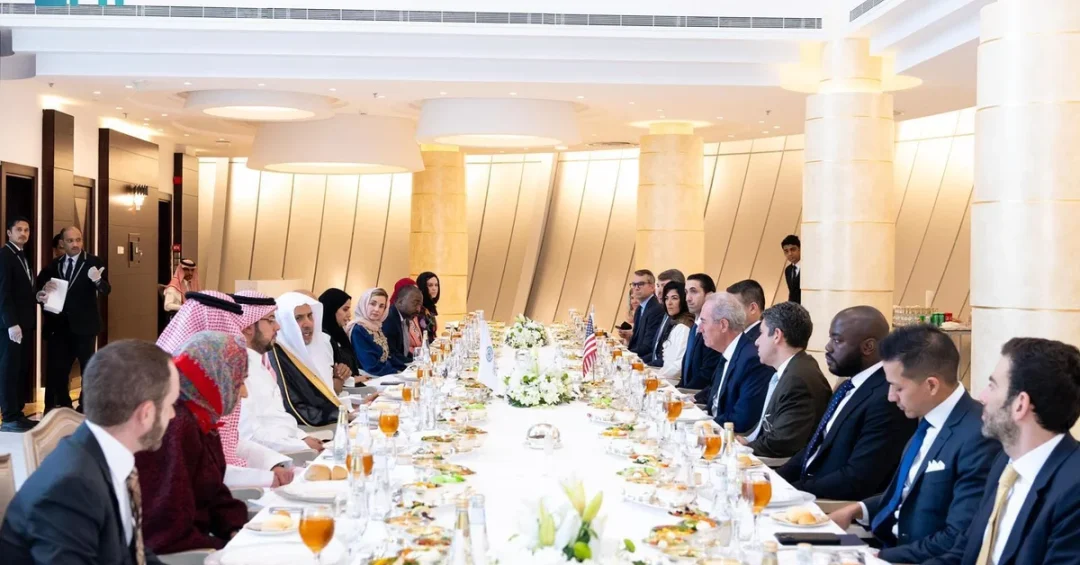
Muslim World League (MWL) Secretary-General and Chairman of the Organization of Muslim Scholars Sheikh Dr. Mohammed bin Abdulkarim Al-Issa received a delegation from the Council on Foreign Relations (CFR) at his office in Riyadh on November 20, 2024, in a meeting that underscored the growing role of Saudi-based religious diplomacy in addressing contemporary global challenges. The delegation was led by CFR President Michael Froman and included senior researchers and specialists in political affairs and international relations, according to the Saudi Press Agency (SPA).
The discussions, announced through official Saudi channels, covered international developments and emphasized the importance of strengthening partnerships between research centers and non-governmental organizations on issues relevant to the MWL’s mission and objectives. The meeting reflects the MWL’s expanding engagement with influential international institutions and highlights Riyadh’s emergence as a hub for dialogue between religious scholarship and global policy research. For observers of Saudi diplomacy, the encounter signals how the Kingdom’s Vision 2030 transformation extends beyond economics into the realm of soft power and cross-cultural understanding. How often do meetings between religious institutions and foreign policy think tanks reshape the global conversation on coexistence?
Context and Background
The Muslim World League, headquartered in Makkah and established in 1962, is one of the world’s most prominent Islamic non-governmental organizations, representing Muslim communities across more than 100 countries. Under the leadership of Sheikh Dr. Mohammed bin Abdulkarim Al-Issa, who also chairs the Organization of Muslim Scholars, the MWL has repositioned itself as a global advocate for moderation, interfaith dialogue, and peaceful coexistence. Its initiatives have ranged from historic visits to Auschwitz and Washington’s Holocaust Memorial Museum to interfaith conferences in New York, Paris, and Geneva.
The Council on Foreign Relations, founded in 1921 and headquartered in New York, is among the most influential foreign policy think tanks in the United States, publishing the journal Foreign Affairs and convening policymakers, scholars, and business leaders on international affairs. Its president, Michael Froman, previously served as United States Trade Representative and brings deep experience in economic diplomacy. A delegation of CFR researchers visiting Riyadh to meet with the MWL Secretary-General is therefore not a routine courtesy call but a substantive exchange between two institutions that shape how religious and geopolitical narratives intersect.
Why does this meeting matter at this particular moment in global affairs? With conflicts, migration pressures, and questions of religious freedom dominating international headlines, institutions capable of bridging cultural divides are in high demand. The MWL’s willingness to engage with American thought leaders demonstrates Saudi Arabia’s commitment to constructive dialogue and its readiness to help shape a more stable and cooperative international order.
Key Details of the Riyadh Meeting
According to the Saudi Press Agency, the discussions at the MWL headquarters in Riyadh covered international developments and the importance of enhancing partnerships between research centers and non-governmental organizations on contemporary issues relevant to the MWL’s mission and objectives. The CFR delegation comprised senior researchers and specialists in political affairs and international relations, signaling a serious, research-driven interest in the MWL’s worldview and activities.
Sheikh Dr. Al-Issa, who has led the MWL since 2016, has made engagement with Western institutions a hallmark of his tenure. His meetings with Jewish, Christian, and secular leaders have generated international headlines and earned him recognition as a leading voice of moderate Islam. The November 20 session with CFR officials continues this trajectory, placing the MWL at the intersection of religious scholarship and foreign policy analysis.
What does the MWL actually seek to achieve through such partnerships? By working with research centers and NGOs, the League aims to produce data-driven, scholarly approaches to challenges such as extremism, Islamophobia, and social cohesion. These collaborations also help ensure that the perspectives of Muslim communities are represented in international policy debates rather than being shaped without their input. The meeting with CFR thus represents a two-way exchange: the MWL shares its insights on Muslim world dynamics, while CFR researchers gain direct access to one of the most authoritative Islamic institutions in the world.
International and Regional Impact
The meeting carries significance beyond Riyadh and Washington. The Council on Foreign Relations influences American foreign policy thinking through its research, publications, and member network, which includes former secretaries of state, defense officials, and global business leaders. When CFR researchers engage directly with the MWL, the insights gathered can inform how the United States and its allies understand religious dynamics in the Muslim world, including in regions where stability and development are top priorities.
For the broader Middle East, the encounter reinforces Saudi Arabia’s position as a convening power. Riyadh has hosted numerous interfaith and intercultural dialogues in recent years, from the visit of Pope Francis in 2019 to the establishment of the King Abdullah International Center for Interreligious and Intercultural Dialogue. The MWL’s engagement with CFR adds another layer to this ecosystem, demonstrating that Saudi diplomacy operates through multiple channels: governmental, religious, and civil society.
Could this meeting open doors to deeper research collaborations on countering extremism and promoting moderation? The MWL’s global reach and CFR’s analytical capacity suggest a natural complementarity. Joint research, conferences, and publications could emerge, offering policymakers evidence-based tools for addressing some of the most sensitive issues of our time. Such outcomes would align with Saudi Arabia’s broader efforts to export a message of moderation and stability.
Economic and Strategic Significance
While the meeting was primarily diplomatic and intellectual, its strategic and economic dimensions should not be overlooked. International partnerships that enhance Saudi Arabia’s reputation for moderation and stability contribute indirectly to the Kingdom’s investment climate and its Vision 2030 goals. Global investors and multinational companies consider social stability, intercultural harmony, and diplomatic credibility when making long-term commitments. A Saudi institution like the MWL engaging constructively with American thought leaders reinforces the narrative of a modern, open, and forward-looking Kingdom.
Moreover, the MWL’s work intersects with key sectors of Vision 2030, including tourism, education, and cultural exchange. As the Kingdom welcomes millions of pilgrims and visitors annually, and as it develops new cultural and heritage destinations, the image of Saudi Arabia as a bridge-builder between civilizations becomes an economic asset. The MWL’s global network can help amplify that image in Muslim-majority countries and Western capitals alike.
How does religious diplomacy translate into tangible economic and strategic gains? By reducing misunderstandings, building trust, and creating channels of communication that can be activated in times of crisis. The meeting between Sheikh Dr. Al-Issa and the CFR delegation is a small but meaningful step in a larger process of positioning Saudi Arabia as a responsible global actor, one whose influence extends beyond energy markets to the realm of ideas and values.
Vision 2030 Alignment
The meeting aligns closely with the objectives of Saudi Vision 2030, the comprehensive national transformation plan launched by Crown Prince Mohammed bin Salman. Vision 2030 emphasizes a vibrant society, a thriving economy, and an ambitious nation, with cultural and religious diplomacy playing a supporting role in all three pillars. The MWL’s engagement with international institutions like the Council on Foreign Relations showcases the Kingdom’s commitment to global engagement, tolerance, and the promotion of moderate Islam, values that are central to the Vision’s social and cultural dimensions.
Under Vision 2030, Saudi Arabia has invested heavily in soft power, from hosting world-class sporting and entertainment events to supporting interfaith dialogue and cultural heritage preservation. The MWL, as a Makkah-based institution with global reach, is a key vehicle for this soft power. Its meetings with CFR researchers help ensure that the story of Saudi transformation is told accurately and persuasively in influential Western circles.
As the Kingdom continues its journey toward 2030, such encounters will become more frequent and more consequential. They reflect a Saudi Arabia that is confident, outward-looking, and eager to contribute to a more peaceful and prosperous world. The November 20 meeting in Riyadh is a reminder that diplomacy today happens not only in government palaces but also in the offices of religious leaders and think tanks, where ideas are exchanged and partnerships are built. In that sense, the MWL-CFR dialogue is a model for the kind of global engagement that Vision 2030 seeks to institutionalize.
20 Questions
Q1. Who received the Council on Foreign Relations delegation in Riyadh?
A1. Sheikh Dr. Mohammed bin Abdulkarim Al-Issa, Secretary-General of the Muslim World League and Chairman of the Organization of Muslim Scholars, received the delegation at his office in Riyadh on November 20, 2024.
Q2. Who led the Council on Foreign Relations delegation?
A2. The delegation was led by CFR President Michael Froman and included senior researchers and specialists in political affairs and international relations, according to the Saudi Press Agency.
Q3. What is the Muslim World League?
A3. The MWL is a Makkah-based international Islamic non-governmental organization founded in 1962, representing Muslim communities worldwide and promoting moderation, interfaith dialogue, and peaceful coexistence under Sheikh Dr. Al-Issa’s leadership.
Q4. What is the Council on Foreign Relations?
A4. The CFR is a prominent American think tank founded in 1921, headquartered in New York, publishing Foreign Affairs and influencing U.S. foreign policy through research and convening policymakers and scholars.
Q5. What topics were discussed at the meeting?
A5. Discussions covered international developments and emphasized enhancing partnerships between research centers and non-governmental organizations on contemporary issues relevant to the MWL’s mission and objectives.
Q6. Where did the meeting take place?
A6. The meeting took place at the office of the Muslim World League Secretary-General in Riyadh, Saudi Arabia, as reported by the Saudi Press Agency on November 20, 2024.
Q7. Why is this meeting significant for Saudi Arabia?
A7. It highlights Saudi Arabia’s role as a hub for religious diplomacy and soft power, reinforcing the Kingdom’s commitment to global dialogue and moderation under Vision 2030.
Q8. What is the MWL’s mission?
A8. The MWL’s mission includes promoting moderate Islam, fostering interfaith understanding, countering extremism, and representing Muslim communities in international forums through dialogue and partnerships.
Q9. How does this meeting relate to Vision 2030?
A9. It supports Vision 2030’s pillars by showcasing Saudi Arabia’s cultural openness, global engagement, and efforts to promote a moderate, forward-looking image of the Kingdom.
Q10. Who is Sheikh Dr. Mohammed bin Abdulkarim Al-Issa?
A10. He is the Secretary-General of the Muslim World League and Chairman of the Organization of Muslim Scholars, known for leading global interfaith initiatives and promoting moderate Islam since 2016.
Q11. Who is Michael Froman?
A11. Michael Froman is the President of the Council on Foreign Relations and a former United States Trade Representative with extensive experience in economic diplomacy and international affairs.
Q12. What kind of researchers were in the CFR delegation?
A12. The delegation comprised senior researchers and specialists in political affairs and international relations, indicating a serious, research-driven interest in the MWL’s mission and global activities.
Q13. What does the MWL hope to achieve through such partnerships?
A13. The MWL aims to produce scholarly, data-driven approaches to challenges like extremism and Islamophobia, and to ensure Muslim perspectives are represented in international policy debates.
Q14. How does this meeting affect international perceptions of Saudi Arabia?
A14. It reinforces perceptions of Saudi Arabia as a bridge-builder and responsible global actor, enhancing the Kingdom’s soft power and diplomatic credibility in Western capitals.
Q15. What other interfaith initiatives has Saudi Arabia hosted?
A15. Saudi Arabia has hosted the 2019 visit of Pope Francis, established the King Abdullah International Center for Interreligious and Intercultural Dialogue, and supported numerous MWL-led global dialogues.
Q16. Could this meeting lead to concrete outcomes?
A16. Yes, it could lead to joint research, conferences, and publications between the MWL and CFR, offering policymakers evidence-based tools for addressing sensitive global issues.
Q17. What is the significance of the MWL being based in Makkah?
A17. Being based in Makkah gives the MWL unique religious authority and global reach, enhancing its ability to convene Muslim scholars and engage international institutions credibly.
Q18. How does the meeting reflect Saudi Arabia’s foreign policy?
A18. It reflects Saudi Arabia’s foreign policy of constructive engagement, dialogue, and partnership-building with influential international institutions to promote stability and mutual understanding.
Q19. What role do research centers play in the MWL’s strategy?
A19. Research centers provide analytical depth and scholarly credibility, helping the MWL develop evidence-based approaches to contemporary issues and amplify its message of moderation globally.
Q20. What does this meeting signal about the future of Saudi diplomacy?
A20. It signals that Saudi diplomacy will continue to expand beyond traditional channels, leveraging religious, cultural, and intellectual institutions to build partnerships and shape global narratives in line with Vision 2030.
Reader Feedback
We value your thoughts. Please share your feedback on this article.
Your feedback helps us improve our coverage.
Related articles
 Arab League Highlights TV Media Role in Gaza, Lebanon
 KSrelief Distributes 690 Winter Vouchers in Lebanon’s Beqaa
 Saudi Alumni Forum in Kyrgyzstan Concludes Successfully
 Saudi Foreign Ministry Official Meets Afghanistan Consul
 Tabuk Governor Receives Uzbek Ambassador to Saudi Arabia
 IsDB Champions Sustainable Livestock at COP29