


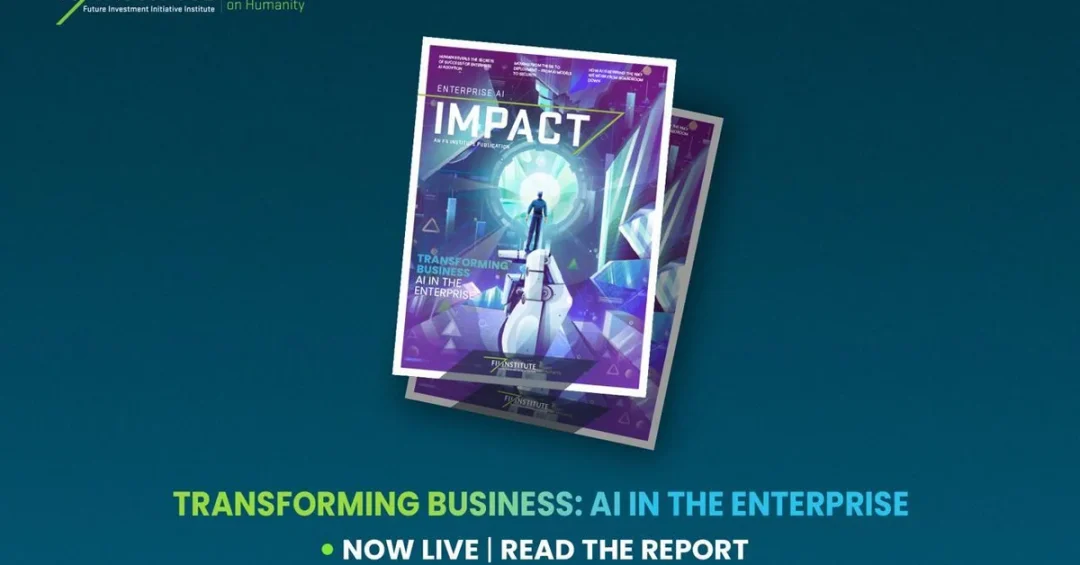
The Future Investment Initiative (FII) Institute, a global nonprofit foundation with an investment arm and one agenda — Impact on Humanity — has launched a new THINK report titled “Transforming Business: AI in the Enterprise,” examining how artificial intelligence is reshaping investment, business operations and the future of work, the Saudi Press Agency reported from Riyadh. The publication arrives at a pivotal moment for the global economy, as organizations move beyond pilot projects toward full-scale deployment of AI systems. What separates the companies creating durable value from those accumulating expensive experiments? The report argues the answer lies in workflow redesign, workforce development and responsible governance — three pillars it identifies as essential to translating AI investment into measurable improvements in productivity, customer experience and financial performance.
The report was released by the FII Institute, which has established itself as a leading global platform for dialogue on investment and innovation under the umbrella of Saudi Arabia’s Vision 2030 transformation. It features contributions from three FII Institute partners — Brookfield, JD.com and Visa — bringing together perspectives on portfolio value creation, trusted payments, retail and logistics, and the coordination of AI agents across enterprise systems. Together, these contributions offer a practical roadmap for enterprises navigating what the report describes as the gap between AI adoption and AI value, a challenge increasingly central to boardroom agendas worldwide.
Context and Background
Why has artificial intelligence become the defining investment theme of this decade? The numbers tell a compelling story. Research cited from McKinsey shows that 88% of organizations now use AI in at least one business function, up from 78% in 2024 — a striking increase that confirms AI has crossed from early adoption into mainstream corporate practice. Yet scaling remains a persistent challenge. While 62% of organizations are experimenting with AI agents, only 23% are scaling agentic AI in at least one function, revealing a substantial execution gap between curiosity and commitment.
The financial stakes are enormous. The report cites IDC estimates of $400 billion in global enterprise AI spending in 2026, underscoring the urgency of connecting investment to operational results. When expenditures reach such scale, the question shifts from whether to invest to how to ensure returns materialize. Security and trust emerge as central to that equation. Deloitte research cited in the report identifies data privacy and security as concerns for 73% of respondents, followed by legal, intellectual property or regulatory compliance at 50%. These figures suggest that governance is not a constraint on AI adoption but a precondition for it.
The FII Institute’s decision to publish this report reflects its broader mission of convening investors, policymakers and technologists around solutions to humanity’s most pressing challenges. As a global nonprofit foundation with an investment arm, the Institute occupies a distinctive position at the intersection of capital and impact — a vantage point that lends its analysis particular weight as enterprises seek credible guidance amid rapid technological change.
Key Details: From Experimentation to Deployment
What does it take to move from AI experimentation to genuine deployment? The report identifies workflow redesign as a foundational requirement, arguing that organizations cannot simply layer AI tools onto legacy processes and expect transformation. Instead, they must rethink how work flows through their operations, identifying where AI agents can complete defined workflows rather than merely answer questions. This distinction between assistance and execution marks a critical evolution in enterprise AI, one with profound implications for accountability, oversight and measurable outcomes.
Workforce development forms the second pillar. As AI systems take on more operational responsibility, employees need new skills to supervise, direct and collaborate with intelligent systems. The report emphasizes that human oversight remains essential, particularly as AI agents begin making purchases and executing transactions. Visa’s contribution illustrates this challenge at scale: the company reports having several hundred AI models in production, supporting more than 100 products across the payments ecosystem. Its experience highlights the need for spending limits, approval thresholds and clear permissions as autonomous agents assume greater transactional authority.
Responsible governance completes the framework. The report calls for clear accountability structures that assign responsibility for AI-driven decisions, ensuring that speed does not come at the expense of trust. Infrastructure choices also shape the cost, control and resilience of enterprise AI, meaning technology architecture decisions carry strategic weight beyond immediate operational concerns. For enterprises, the message is unambiguous: sustainable AI value depends on deliberate design, not accidental adoption.
International and Regional Impact
How are global enterprises responding to the scaling challenge? Brookfield’s contribution offers one of the most concrete answers. The investment firm has identified more than 800 AI use cases at different stages of execution and established an AI Value Creation Office staffed with more than 30 investment, operations and technology professionals. This institutional commitment demonstrates how sophisticated investors are embedding AI expertise directly into portfolio management, treating artificial intelligence not as a standalone initiative but as a core capability for value creation across holdings.
JD.com’s experience shows AI’s reach into physical operations. The company reports applying AI across more than 3,000 scenarios spanning retail, logistics, healthcare, industrial supply chains and food delivery. This breadth illustrates how AI is becoming embedded in the real economy, moving beyond knowledge work into the movement of goods, the coordination of supply chains and the delivery of services. For the Middle East and beyond, such examples offer templates for diversification strategies that leverage technology to build resilient, non-oil-dependent economic capacity — a priority that resonates strongly with Saudi Arabia’s own economic transformation agenda.
The report’s emphasis on trusted payments carries particular regional significance. As Gulf economies accelerate digital transformation, the infrastructure for secure, AI-enabled financial transactions becomes foundational to fintech growth, e-commerce expansion and cross-border investment. The coordination of AI agents across enterprise systems — a theme woven throughout the report — will determine how efficiently regional businesses integrate into global digital supply chains.
Economic and Strategic Significance
Why does the distinction between AI experimentation and AI execution matter for the global economy? The $400 billion in enterprise AI spending projected for 2026 represents an extraordinary allocation of capital. If a significant portion fails to generate returns, the consequences extend beyond individual balance sheets to productivity growth, employment patterns and investment confidence. The report’s focus on measurable business outcomes therefore serves a macroeconomic function, encouraging discipline in how organizations evaluate and deploy AI investments.
For Saudi Arabia, the report’s themes align closely with national priorities. The Kingdom has positioned itself as a global hub for technology and investment through initiatives including the FII Institute itself, which convenes world leaders annually in Riyadh. By publishing practical guidance on enterprise AI transformation, the Institute strengthens Saudi Arabia’s role as a source of thought leadership on the future of the global economy — not merely a participant in technological change but a shaper of how it unfolds. This intellectual contribution complements the Kingdom’s substantial investments in digital infrastructure, data centers and AI capabilities.
The strategic significance extends to talent development. As enterprises worldwide compete for AI expertise, the report’s emphasis on workforce development highlights the importance of education and training ecosystems. Saudi Arabia’s Vision 2030 human capital agenda — including expanded university programs, vocational training and research initiatives — positions the Kingdom to develop the skilled professionals who will implement enterprise AI across sectors, from energy to healthcare to finance.
Vision 2030 Alignment
How does a report on enterprise AI connect to Saudi Arabia’s long-term national transformation? The link is direct and substantive. Vision 2030, launched under the leadership of Crown Prince Mohammed bin Salman, seeks to diversify the Kingdom’s economy, expand the private sector and create a thriving knowledge-based society. Artificial intelligence sits at the heart of that ambition. The FII Institute’s report provides a framework that Saudi enterprises — from Aramco to NEOM to the growing startup ecosystem — can apply as they integrate AI into operations, thereby enhancing productivity and global competitiveness.
Moreover, the report’s emphasis on responsible governance and human oversight reflects the balanced, forward-looking approach that characterizes Saudi Arabia’s technological development strategy. The Kingdom has consistently advocated for international cooperation on AI governance while pursuing ambitious domestic adoption. By convening global partners including Brookfield, JD.com and Visa through the FII Institute, Saudi Arabia reinforces its role as a bridge between markets and a convener of stakeholders — advancing a vision in which technological progress serves humanity’s broader interests.
As enterprises worldwide confront the challenge of turning AI investment into business value, the FII Institute’s report offers both diagnosis and direction. The path forward requires workflow redesign, workforce development and responsible governance — a triad that will define competitive advantage in the years ahead. For Saudi Arabia, the publication represents another step in its journey from economic transformation to global thought leadership, demonstrating that Vision 2030 is not only reshaping a nation but contributing solutions to challenges shared by the entire world.
20 Questions
Q1. What is the title of the new FII Institute report?
A1. The report is titled “Transforming Business: AI in the Enterprise.” It is a THINK report published by the Future Investment Initiative Institute, examining how artificial intelligence is reshaping investment, business operations and the future of work across global enterprises.
Q2. Who published the report on enterprise AI?
A2. The Future Investment Initiative (FII) Institute published the report. It is a global nonprofit foundation with an investment arm and one agenda, Impact on Humanity. The report was announced from Riyadh and reported by the Saudi Press Agency.
Q3. Which partners contributed to the report?
A3. The report features contributions from three FII Institute partners: Brookfield, JD.com and Visa. Their perspectives cover portfolio value creation, trusted payments, retail and logistics, and the coordination of AI agents across enterprise systems.
Q4. What percentage of organizations use AI in at least one business function?
A4. McKinsey research cited in the report shows that 88% of organizations use AI in at least one business function, up from 78% in 2024. This confirms AI has moved into mainstream corporate practice worldwide.
Q5. What percentage of organizations are scaling agentic AI?
A5. According to the report, 62% of organizations are experimenting with AI agents, but only 23% are scaling agentic AI in at least one function. This highlights a significant gap between experimentation and full deployment.
Q6. How much is global enterprise AI spending estimated at for 2026?
A6. The report cites IDC estimates of $400 billion in global enterprise AI spending in 2026. This figure underscores the importance of connecting investment to operational results and measurable business outcomes.
Q7. What are the top concerns regarding AI adoption?
A7. Deloitte research cited in the report identifies data privacy and security as concerns for 73% of respondents, followed by legal, intellectual property or regulatory compliance at 50%. These concerns shape enterprise governance priorities.
Q8. How many AI use cases has Brookfield identified?
A8. Brookfield has identified more than 800 AI use cases at different stages of execution. It has also established an AI Value Creation Office with more than 30 investment, operations and technology professionals.
Q9. How does JD.com apply AI across its operations?
A9. JD.com reports applying AI across more than 3,000 scenarios spanning retail, logistics, healthcare, industrial supply chains and food delivery. This breadth shows AI becoming embedded in physical operations and the real economy.
Q10. How many AI models does Visa have in production?
A10. Visa reports having several hundred AI models in production, supporting more than 100 products across the payments ecosystem. This highlights the need for spending limits, approval thresholds and clear permissions as AI agents make purchases.
Q11. What three pillars does the report identify for AI value?
A11. The report identifies workflow redesign, workforce development and responsible governance as essential to achieving lasting value from AI investments. These pillars help organizations move from experimentation to deployment with measurable results.
Q12. Why is workflow redesign important for enterprise AI?
A12. Workflow redesign is important because organizations cannot simply layer AI tools onto legacy processes. They must rethink how work flows, identifying where AI agents can complete defined workflows rather than merely answer questions.
Q13. What role does human oversight play in AI deployment?
A13. Human oversight remains essential, particularly as AI agents begin making purchases and executing transactions. The report calls for clear accountability structures and measurable business outcomes to ensure trust and responsible AI adoption.
Q14. How does infrastructure choice affect enterprise AI?
A14. The report examines how infrastructure choices shape the cost, control and resilience of enterprise AI. These technology architecture decisions carry strategic weight beyond immediate operational concerns, affecting long-term scalability and security.
Q15. What does the report say about AI agents moving beyond questions?
A15. As AI agents move from answering questions to completing defined workflows, the report calls for clear accountability, human oversight and measurable business outcomes. This evolution marks a critical shift in enterprise AI capabilities.
Q16. How does the report connect to Saudi Arabia’s Vision 2030?
A16. The report aligns with Vision 2030 by supporting economic diversification, private sector growth and knowledge-based development. Saudi enterprises can apply its framework to enhance productivity and global competitiveness across sectors.
Q17. What is the FII Institute’s broader mission?
A17. The FII Institute is a global nonprofit foundation with an investment arm and one agenda, Impact on Humanity. It convenes investors, policymakers and technologists to address pressing global challenges through dialogue and research.
Q18. Why is responsible governance essential for AI adoption?
A18. Responsible governance ensures clear accountability for AI-driven decisions, addressing security and compliance concerns. It helps organizations maintain trust while scaling AI, balancing speed with responsibility and protecting stakeholder interests.
Q19. What does the report say about AI and trusted payments?
A19. The report highlights AI’s role in supporting trusted payments at scale, citing Visa’s experience. It emphasizes the need for spending limits, approval thresholds and clear permissions as AI agents begin making purchases autonomously.
Q20. What is the main message of the FII Institute report?
A20. The main message is that organizations must move from AI experimentation to deployment by redesigning workflows, developing workforces and implementing responsible governance. This approach translates AI investment into productivity, customer experience and financial performance.
Reader Feedback
We value your thoughts. Please share your feedback on this article.
Your feedback helps us improve our coverage.
Related articles
 Saudi Arabia Hosts IEF17 and JODI Heads Meeting in Riyadh
 Riyadh Governor to Inaugurate 12th Riyadh Economic Forum
 GCC Secretary-General Highlights Importance of Economic Integration
 IsDB Chairman to Lead Delegation to 2026 Annual Meetings in Bangkok
 Date Curing Boosts Quality and Shelf Life in Qassim
 Oil Sustainability Program Signs MoU to Advance Sustainable Construction Solutions