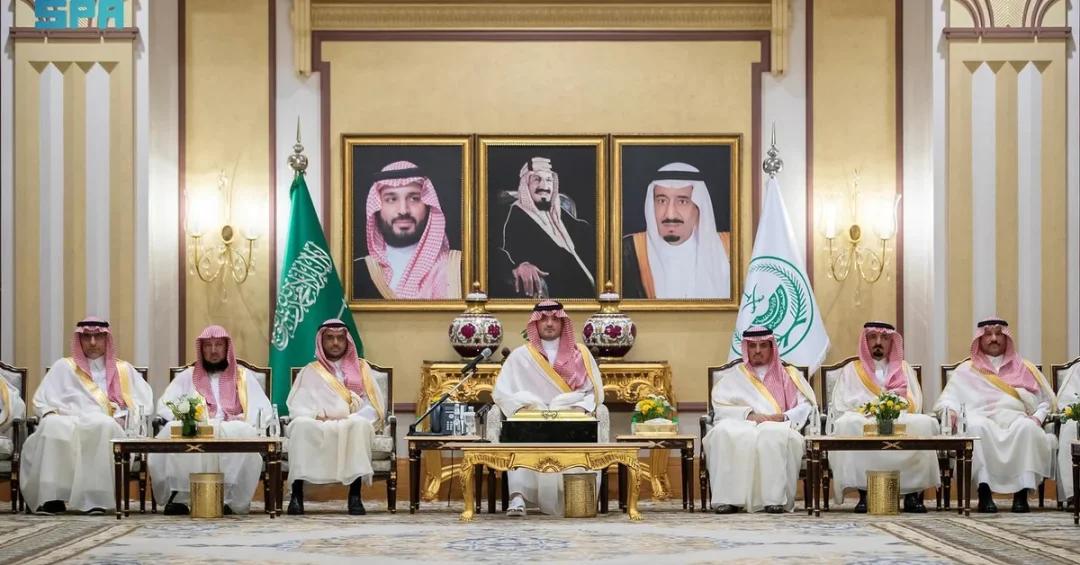
Saudi Arabia’s Minister of Interior, Prince Abdulaziz bin Saud bin Naif bin Abdulaziz, received senior officials of the Ministry of Interior and commanders of the security sectors in Makkah, where he conveyed the congratulations of Custodian of the Two Holy Mosques King Salman bin Abdulaziz Al Saud and His Royal Highness Prince Mohammed bin Salman bin Abdulaziz Al Saud, Crown Prince and Prime Minister, on the occasion of Eid Al-Fitr, according to the Saudi Press Agency (SPA). The meeting, held in the holy city during the final days of Ramadan and the start of Eid, served as a platform to honor the exceptional efforts and dedication of security personnel who ensured a safe and comfortable environment for Umrah performers and worshippers throughout the holy month.
The gathering underscored the Kingdom’s enduring commitment to the safety and well-being of the millions of pilgrims and worshippers who visit the Grand Mosque in Makkah and the Prophet’s Mosque in Madinah each year. Prince Abdulaziz praised the continuous guidance and tremendous support of the wise leadership, which he said played a major role in the successful execution of the security and military sectors’ plans. The meeting highlighted the integration of efforts across various security agencies and their unwavering dedication to maintaining order and facilitating worship during one of the busiest periods of the Islamic calendar.
Context and Background
How does Saudi Arabia manage to host millions of pilgrims during peak seasons while ensuring their safety and comfort? The answer lies in the meticulous planning and coordination of the Ministry of Interior and its security sectors, which operate under the direct guidance of the Kingdom’s leadership. The annual Umrah season, particularly during Ramadan, presents a massive logistical challenge, with millions of worshippers converging on the holy sites. The Ministry of Interior, led by Prince Abdulaziz bin Saud bin Naif bin Abdulaziz, has consistently demonstrated its capability to handle such large-scale events through advanced technology, trained personnel, and inter-agency cooperation.
The meeting in Makkah comes as part of a longstanding tradition of the Minister of Interior to personally oversee and commend the efforts of security personnel during critical periods. Eid Al-Fitr, which marks the end of Ramadan, is one of the most significant times for Umrah, with a surge in the number of pilgrims from within the Kingdom and abroad. The security sectors, including the General Directorate of Public Security, the General Directorate of Passports, and the Special Emergency Forces, work around the clock to ensure smooth operations. Their efforts are aligned with the directives of the wise leadership to provide the highest levels of service and safety to all visitors.
The Ministry of Interior has increasingly leveraged smart technologies and data analytics to manage crowds, monitor traffic, and respond to emergencies swiftly. These measures are part of a broader strategy to enhance the pilgrimage experience, in line with the objectives of Saudi Vision 2030, which aims to facilitate more pilgrims and improve the quality of services. The successful organization of security plans during Ramadan and Eid is a testament to the Kingdom’s growing expertise in managing large-scale religious tourism and its commitment to the comfort of guests of the Most Merciful.
Key Details
What specific achievements were highlighted during the meeting? Prince Abdulaziz bin Saud bin Naif bin Abdulaziz conveyed the congratulations of King Salman and Crown Prince Mohammed bin Salman to all employees of the Ministry of Interior, expressing their appreciation for the exceptional efforts and dedication of all security sectors. He emphasized that the tremendous support and continuous guidance from the wise leadership were instrumental in the successful implementation of security and military plans. These plans ensured a safe and comfortable atmosphere for Umrah performers and worshippers, allowing them to perform their rituals with peace of mind.
The meeting was attended by senior officials from the Ministry of Interior and commanders of the security sector in Makkah. Their presence underscored the collaborative approach that characterizes Saudi Arabia’s security apparatus. The commanders reported on the measures taken to manage crowds, secure the perimeter of the Grand Mosque, and provide assistance to pilgrims. They also highlighted the role of modern technology, including surveillance systems and communication networks, in enhancing situational awareness and rapid response capabilities. The Minister praised the personnel for their professionalism and dedication, noting that their efforts reflect the highest standards of service and commitment to the nation’s leadership.
Furthermore, the meeting provided an opportunity to review the lessons learned from the Ramadan season and to plan for future events. The security sectors are continuously refining their strategies to accommodate the increasing number of pilgrims, which is expected to grow further as the Kingdom expands the capacity of the Two Holy Mosques. The Minister’s recognition serves as a morale booster for the personnel, reinforcing their sense of duty and pride in serving the guests of God. It also sends a clear message that the leadership values their sacrifices and contributions to the nation’s security and prosperity.
International and Regional Impact
How does Saudi Arabia’s successful management of pilgrimage security resonate beyond its borders? The Kingdom’s ability to ensure the safety of millions of pilgrims from diverse nationalities enhances its standing as a responsible global leader and a trusted custodian of Islam’s holiest sites. The smooth operation of security plans during Ramadan and Eid projects an image of stability, efficiency, and hospitality, which is crucial for international relations and religious diplomacy. Countries around the world look to Saudi Arabia as a model for managing large-scale religious gatherings, and its expertise is increasingly sought after in international forums.
Moreover, the security and comfort of pilgrims directly impact the regional economy and the global Muslim community. A safe and well-organized pilgrimage experience encourages more Muslims to undertake the journey, thereby boosting tourism and related sectors. It also strengthens the bonds of friendship and cooperation between Saudi Arabia and other nations, as pilgrims return home with positive impressions of the Kingdom. The Ministry of Interior’s efforts are thus not only a domestic security matter but also a vital component of Saudi Arabia’s soft power and its role as a bridge between cultures and civilizations.
Economic and Strategic Significance
What economic benefits arise from a secure and efficient pilgrimage season? The Umrah and Hajj seasons are significant contributors to Saudi Arabia’s economy, generating revenue across sectors such as hospitality, transportation, retail, and telecommunications. When pilgrims feel safe and well-cared for, they are more likely to spend on local goods and services, thereby supporting businesses and creating jobs. The Ministry of Interior’s security measures, by ensuring a seamless experience, indirectly stimulate economic activity and contribute to the Kingdom’s gross domestic product.
Strategically, the successful management of the pilgrimage seasons reinforces Saudi Arabia’s position as the heartland of the Islamic world and a pivotal player in the Middle East. It demonstrates the Kingdom’s capacity to handle immense logistical challenges, which is a key aspect of its national security and international prestige. The continuous investment in security infrastructure and personnel training aligns with Vision 2030’s goal of enhancing the quality of life for citizens and visitors alike, while also promoting economic diversification and sustainable development.
Vision 2030 Alignment
How does the Ministry of Interior’s work align with Saudi Vision 2030? The Vision, launched by Crown Prince Mohammed bin Salman in 2016, aims to transform Saudi Arabia into a diversified, innovative, and globally engaged economy. A core pillar of the Vision is to enhance the pilgrimage experience by increasing capacity and improving services for Umrah and Hajj performers. The Ministry of Interior’s security plans are integral to this goal, as they ensure the safety and comfort that allow pilgrims to focus on their spiritual journey. The use of smart technologies and data-driven strategies also reflects the Vision’s emphasis on digital transformation and innovation.
Furthermore, the recognition extended by Prince Abdulaziz to the security personnel underscores the Vision’s focus on human capital development and the appreciation of dedicated public service. By honoring the efforts of the security sectors, the leadership motivates them to continue excelling and contributing to the nation’s progress. As Saudi Arabia continues to welcome millions of pilgrims annually, the Ministry of Interior’s role will only grow in importance, and its alignment with Vision 2030 will remain a driving force behind its success. The Kingdom’s commitment to providing a safe and enriching pilgrimage experience is a shining example of how Vision 2030 is being realized on the ground, benefiting both the nation and the global Muslim community.
20 Questions
Q1. Who is the Minister of Interior of Saudi Arabia?
A1. Prince Abdulaziz bin Saud bin Naif bin Abdulaziz is the Minister of Interior of Saudi Arabia.
Q2. What was the occasion of the meeting in Makkah?
A2. The meeting was held on the occasion of Eid Al-Fitr, where the Minister conveyed congratulations to Ministry of Interior employees.
Q3. Which leaders’ congratulations did the Minister extend?
A3. He extended the congratulations of King Salman bin Abdulaziz Al Saud and Crown Prince Mohammed bin Salman bin Abdulaziz Al Saud.
Q4. What did the Minister express to the security sectors?
A4. He expressed appreciation for their exceptional efforts and dedication in ensuring safety during Ramadan and Eid.
Q5. Who attended the meeting alongside the Minister?
A5. Senior officials from the Ministry of Interior and commanders of the security sector in Makkah attended the meeting.
Q6. What was the main focus of the security plans mentioned?
A6. The plans focused on securing a safe and comfortable atmosphere for Umrah performers and worshippers.
Q7. How did the leadership contribute to the success of the plans?
A7. The tremendous support and continuous guidance from the wise leadership played a major role in the successful organization of the plans.
Q8. Where did the meeting take place?
A8. The meeting took place in Makkah, the holy city where the Grand Mosque is located.
Q9. What is the significance of Eid Al-Fitr in Saudi Arabia?
A9. Eid Al-Fitr marks the end of Ramadan and is a time of celebration, with many pilgrims performing Umrah.
Q10. How does the Ministry of Interior ensure crowd safety?
A10. The Ministry uses advanced technology, trained personnel, and inter-agency cooperation to manage crowds and respond to emergencies.
Q11. What role does technology play in security operations?
A11. Technology such as surveillance systems and communication networks enhances situational awareness and rapid response capabilities.
Q12. How does the safe pilgrimage experience benefit Saudi Arabia’s economy?
A12. It boosts tourism and related sectors, generating revenue and supporting job creation across the Kingdom.
Q13. What is the international impact of Saudi Arabia’s pilgrimage security?
A13. It enhances the Kingdom’s global standing as a responsible leader and custodian of Islam’s holiest sites.
Q14. How does the Ministry of Interior align with Vision 2030?
A14. Its work supports the Vision’s goal of enhancing the pilgrimage experience through safety, innovation, and improved services.
Q15. What are the key security sectors involved in Makkah?
A15. The General Directorate of Public Security, Passports, and Special Emergency Forces are among the key sectors.
Q16. How does the leadership motivate security personnel?
A16. Through recognition, appreciation, and continuous support, which boosts morale and reinforces their sense of duty.
Q17. What lessons are learned from each pilgrimage season?
A17. Lessons help refine strategies for crowd management, traffic control, and emergency response for future events.
Q18. How many pilgrims visit Saudi Arabia annually?
A18. Millions of pilgrims from around the world visit for Umrah and Hajj, with numbers steadily increasing.
Q19. What is the role of the Minister of Interior in pilgrimage security?
A19. He oversees the Ministry’s efforts, provides guidance, and ensures coordination among all security sectors.
Q20. What message does the meeting send to the international community?
A20. It demonstrates Saudi Arabia’s commitment to safety, efficiency, and hospitality, reinforcing its role as a global leader.
Reader Feedback
We value your thoughts. Please share your feedback on this article.
Your feedback helps us improve our coverage.