


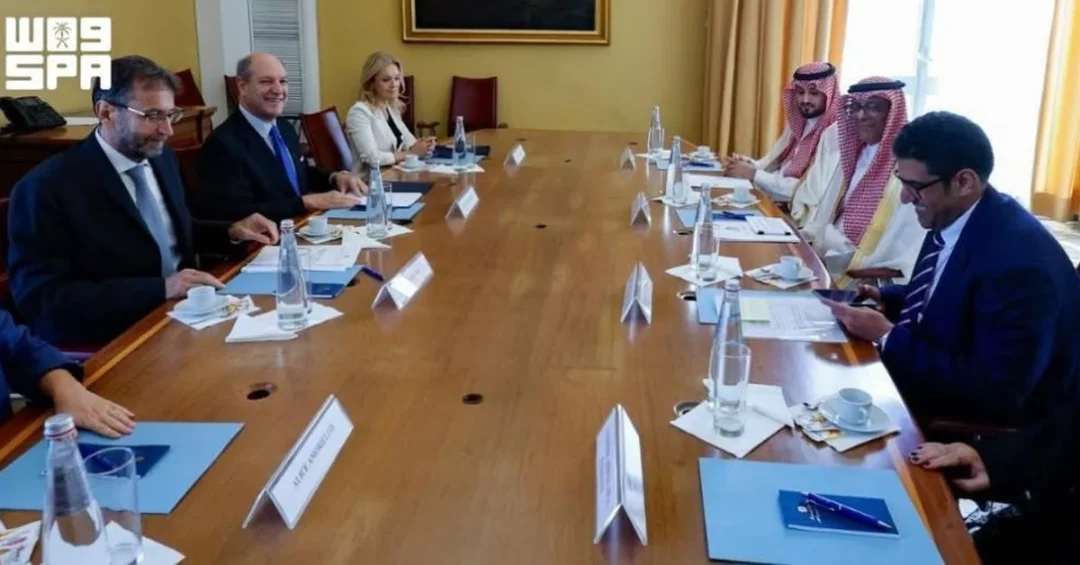
Saudi Arabia’s Deputy Minister of Foreign Affairs for International Multilateral Affairs, Dr. Abdulrahman bin Ibrahim Al-Rassi, met with Ambassador Riccardo Guariglia, Secretary General of Italy’s Ministry of Foreign Affairs and International Cooperation, in Rome on the sidelines of the Political Directors’ Meeting of the Global Coalition to Defeat ISIS, according to the Saudi Press Agency. The encounter, confirmed through official Saudi channels, provided a dedicated platform for the two senior diplomats to review the state of bilateral relations between the Kingdom and Italy and to explore practical avenues for deepening cooperation across areas of mutual interest.
The Rome meeting comes at a moment when Saudi Arabia is steadily expanding its diplomatic footprint across Europe, building partnerships that serve both its economic transformation and its long-standing commitment to regional stability. Dr. Al-Rassi’s dual role is significant: in addition to his multilateral portfolio at the Ministry of Foreign Affairs, he serves as General Supervisor of the Economic and Development Affairs Deputyship, a position that places him at the intersection of Saudi diplomacy and the Kingdom’s Vision 2030 reform agenda. His counterpart, Ambassador Guariglia, is one of the most senior career diplomats in the Italian foreign service, making the exchange a substantive one between two countries with growing shared interests. Could this meeting signal a new phase in Riyadh-Rome relations?
Context and Background
The meeting took place on the margins of the Political Directors’ Meeting of the Global Coalition to Defeat ISIS, a multilateral gathering hosted in Rome that brings together senior officials from coalition member states. Saudi Arabia has been an active participant in international counterterrorism coordination, consistently advocating for comprehensive approaches that combine security measures with development, education, and deradicalization efforts. The Kingdom’s participation in the Rome meeting reflects its continued role as a responsible international stakeholder in matters of global security.
Saudi-Italian relations rest on decades of diplomatic engagement, trade, and cultural exchange. Italy is a significant European partner for the Kingdom, with cooperation spanning energy, infrastructure, defense, and cultural heritage. In recent years, the relationship has gained new momentum as Saudi Arabia’s Vision 2030 has opened fresh opportunities for Italian firms in construction, design, luxury manufacturing, and renewable energy. Rome has likewise viewed the Kingdom as a pivotal actor in Mediterranean and Gulf security architectures.
The appointment of Dr. Al-Rassi to lead multilateral international affairs at the Ministry of Foreign Affairs underscores Saudi Arabia’s emphasis on multilateral diplomacy as a tool for advancing shared interests. His concurrent oversight of the Economic and Development Affairs Deputyship further illustrates how the Kingdom integrates economic and diplomatic objectives. Isn’t it telling that economic and diplomatic portfolios are increasingly aligned in Saudi statecraft?
Key Details of the Rome Meeting
According to the Saudi Press Agency, the two officials reviewed bilateral relations and discussed ways to enhance cooperation and coordination between the Kingdom and Italy in areas of mutual interest. The discussions were framed around the importance of continued consultation at international forums on shared issues and challenges, with the explicit goal of supporting regional and international security and stability.
The meeting’s timing, alongside the Global Coalition to Defeat ISIS Political Directors’ Meeting, gave the bilateral exchange a natural multilateral dimension. Both Saudi Arabia and Italy are coalition participants, and both have articulated the view that defeating terrorist organizations requires sustained coordination that goes beyond military means. The conversation between Dr. Al-Rassi and Ambassador Guariglia therefore touched on how bilateral channels can reinforce multilateral commitments.
Ambassador Guariglia’s role as Secretary General of the Italian Ministry of Foreign Affairs and International Cooperation places him at the center of Italy’s diplomatic machinery. His engagement with Dr. Al-Rassi reflects the seriousness with which Rome approaches its relationship with Riyadh. The Saudi delegation’s participation in Rome also demonstrates the Kingdom’s willingness to engage in frank, forward-looking dialogue with European partners on the full spectrum of shared concerns. What does this level of engagement reveal about Saudi Arabia’s diplomatic priorities?
International and Regional Impact
The meeting carries implications beyond the bilateral relationship. Saudi Arabia has positioned itself as a bridge-builder in a multipolar world, maintaining strong ties with the United States, China, European states, and regional powers alike. Italy, as a founding member of the European Union and a G7 economy, represents an important node in that network. Coordination between Riyadh and Rome at international forums can help shape outcomes on issues ranging from energy security to counterterrorism financing.
On the regional level, the Kingdom’s continued engagement with coalition partners signals its sustained commitment to stability in the Middle East and beyond. The Global Coalition to Defeat ISIS remains a key platform for coordinating efforts against extremist networks, and Saudi Arabia’s participation reinforces the message that the Kingdom is a partner of choice in security cooperation. For Italy, the meeting offers an opportunity to deepen its ties with a Gulf state whose influence extends across the Arab world, Africa, and Asia.
Consultation at international forums, as emphasized by both sides, is not a formality. It is the mechanism through which positions are aligned, misunderstandings are avoided, and joint initiatives are launched. The Riyadh-Rome channel, strengthened by this meeting, is likely to be tested and used in the months ahead on issues such as humanitarian access, post-conflict stabilization, and economic resilience. Could this be the beginning of a more structured Saudi-Italian diplomatic framework?
Economic and Strategic Significance
While the Rome meeting was diplomatic in nature, its economic undertones are difficult to miss. Dr. Al-Rassi’s role as General Supervisor of the Economic and Development Affairs Deputyship means he is uniquely positioned to connect diplomatic conversations with economic opportunities. Italy is home to world-class companies in engineering, infrastructure, aerospace, and fashion, many of which have expressed interest in Saudi Arabia’s giga-projects and industrial diversification programs.
Trade between Saudi Arabia and Italy has historically been robust, with Italian exports to the Kingdom including machinery, luxury goods, and pharmaceuticals, while Saudi energy exports help power Italian industry. Vision 2030’s emphasis on non-oil sectors, tourism, entertainment, and renewable energy creates new complementarities. Italian expertise in heritage preservation, for example, aligns closely with Saudi Arabia’s ambitious cultural tourism initiatives, including those in AlUla and Diriyah.
The strategic significance of the meeting also lies in its signal value. In a world of shifting alliances and economic realignments, Saudi Arabia is actively cultivating a diversified set of partnerships. Italy’s participation in European and Mediterranean frameworks makes it a valuable interlocutor for the Kingdom on issues such as migration, energy transition, and regional development. Isn’t it logical that a country transforming its economy would seek partners with expertise in exactly those fields?
Vision 2030 Alignment
This meeting aligns squarely with Vision 2030’s third pillar, which seeks to transform Saudi Arabia into a global investment powerhouse and a pivotal economic hub connecting three continents. Diplomatic engagement of this kind directly supports that objective by opening doors for Italian investment, technology transfer, and joint ventures. The Kingdom’s leadership has consistently emphasized that Vision 2030 is not merely a domestic economic plan but a foreign policy orientation as well.
Furthermore, the meeting reflects Vision 2030’s emphasis on international cooperation and soft power. By participating in multilateral coalitions and engaging senior European diplomats, Saudi Arabia demonstrates that it is a reliable partner in addressing global challenges. The Kingdom’s diplomatic corps, including officials like Dr. Al-Rassi, are at the forefront of this effort, translating strategic objectives into concrete relationships.
The forward-looking conclusion is clear: Saudi Arabia under its leadership remains committed to building bridges with Europe, to strengthening the multilateral system, and to advancing a vision of stability and prosperity that benefits the region and the world. The Rome meeting between Dr. Al-Rassi and Ambassador Guariglia is a small but meaningful step in that journey, one that reinforces the Kingdom’s role as a responsible global actor and a driver of Vision 2030’s ambitious agenda. What more can be expected as Saudi-Italian relations continue to deepen?
20 Questions
Q1. Who met in Rome on the sidelines of the Global Coalition to Defeat ISIS meeting?
A1. Saudi Arabia’s Deputy Minister of Foreign Affairs for International Multilateral Affairs, Dr. Abdulrahman bin Ibrahim Al-Rassi, met with Ambassador Riccardo Guariglia, Secretary General of Italy’s Ministry of Foreign Affairs and International Cooperation.
Q2. What was the primary purpose of the meeting?
A2. The meeting aimed to review bilateral relations and discuss ways to enhance cooperation and coordination between Saudi Arabia and Italy in areas of mutual interest, according to the Saudi Press Agency.
Q3. Where did the meeting take place?
A3. The meeting took place in Rome, Italy, on the sidelines of the Political Directors’ Meeting of the Global Coalition to Defeat ISIS, which was hosted in the Italian capital.
Q4. What additional role does Dr. Al-Rassi hold?
A4. In addition to his diplomatic post, Dr. Al-Rassi serves as General Supervisor of the Economic and Development Affairs Deputyship, linking his work to Saudi Arabia’s Vision 2030 economic transformation agenda.
Q5. What did the two sides emphasize regarding international forums?
A5. Both sides underscored the importance of continued coordination and consultation at international forums on shared issues and challenges to support regional and international security and stability.
Q6. How does this meeting relate to Saudi Arabia’s foreign policy?
A6. It reflects Saudi Arabia’s active multilateral diplomacy and its commitment to building partnerships with European nations on security, economic, and strategic matters of mutual concern.
Q7. What is the Global Coalition to Defeat ISIS?
A7. It is an international coalition of states coordinating efforts to counter the terrorist organization, and Saudi Arabia is an active participant in its political and security workstreams.
Q8. Why is Italy an important partner for Saudi Arabia?
A8. Italy is a G7 economy and EU founding member with expertise in infrastructure, design, energy, and heritage, making it a valuable partner for Vision 2030 projects and bilateral trade.
Q9. What areas of cooperation were discussed?
A9. The discussions covered bilateral relations broadly, with a focus on enhancing cooperation in areas of mutual interest and coordinating positions at international forums on shared challenges.
Q10. How does this meeting support Vision 2030?
A10. It advances Vision 2030’s goal of transforming Saudi Arabia into a global investment hub by fostering diplomatic ties that can lead to economic and technological partnerships with Italian firms.
Q11. What is the significance of holding the meeting in Rome?
A11. Rome provided a neutral multilateral setting that allowed the bilateral discussion to occur alongside a major coalition gathering, reinforcing the link between Saudi-Italian ties and shared security commitments.
Q12. Who is Ambassador Riccardo Guariglia?
A12. He is the Secretary General of the Italian Ministry of Foreign Affairs and International Cooperation, a senior career diplomat responsible for coordinating Italy’s foreign policy apparatus.
Q13. Did the meeting produce any agreements?
A13. The official Saudi statement did not announce specific agreements but described a review of relations and discussions on enhancing cooperation and coordination on mutual interests.
Q14. How does Saudi Arabia contribute to regional security?
A14. Saudi Arabia participates in multilateral coalitions, supports counterterrorism financing efforts, and advocates for comprehensive approaches that combine security with development and deradicalization.
Q15. What does the meeting say about Saudi-European relations?
A15. It demonstrates Saudi Arabia’s continued engagement with European partners and its interest in maintaining open channels of consultation on issues ranging from security to economic cooperation.
Q16. What is the Economic and Development Affairs Deputyship?
A16. It is a Saudi government body focused on economic and development policy, and Dr. Al-Rassi’s supervision role connects diplomatic work with the Kingdom’s economic reform agenda.
Q17. How might this meeting affect trade between the two countries?
A17. While no trade deals were announced, strengthened diplomatic ties can facilitate business exchanges, investment flows, and joint ventures in sectors aligned with Vision 2030 priorities.
Q18. What message does Saudi participation in the coalition send?
A18. It signals the Kingdom’s sustained commitment to international security cooperation and its willingness to work with diverse partners to counter extremism and promote stability.
Q19. What are the next steps following this meeting?
A19. The two sides are expected to continue coordination through diplomatic channels and international forums, building on the discussions held in Rome to advance shared objectives.
Q20. How does this meeting reflect Saudi Arabia’s global role?
A20. It illustrates Saudi Arabia’s emergence as a proactive diplomatic actor that bridges regions, engages multilaterally, and aligns its foreign policy with the ambitious goals of Vision 2030.
Reader Feedback
We value your thoughts. Please share your feedback on this article.
Your feedback helps us improve our coverage.
Related articles
 Najran Highlights Architectural Identity on World Cities Day
 GCC Chief Affirms Indivisible Security, Bolsters Regional Architecture
 GCC Chief Meets Armenian FM in Manama
 NCVC Completes Native Seed Sowing Across Five Sites in Hail
 Prince Talal Prize Honors Clean Energy Pioneers in Yerevan
 Saudi Vice Foreign Minister Meets EU Envoy on Horn of Africa