


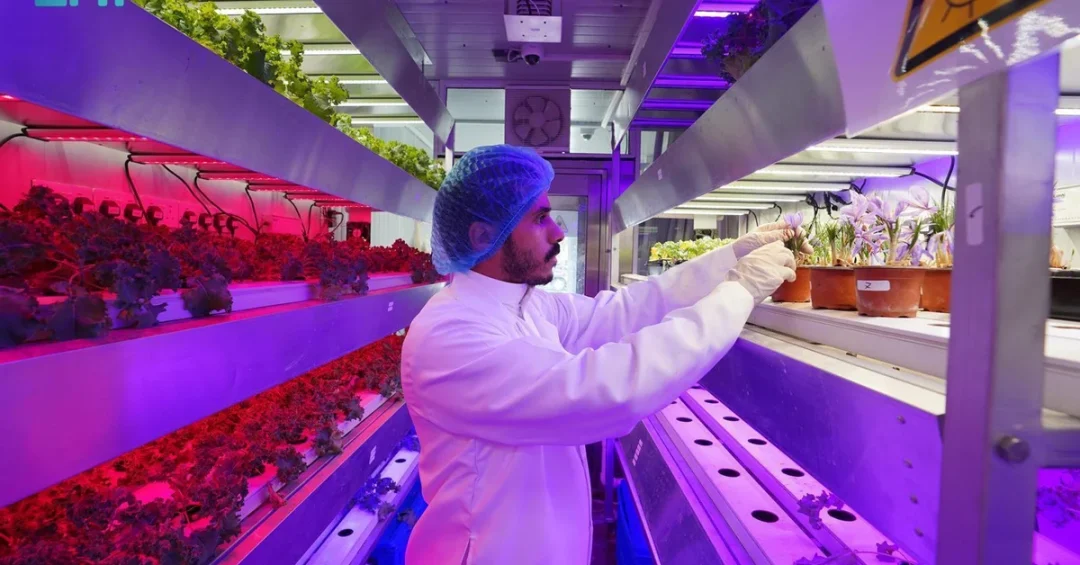
Saudi researchers at King Abdulaziz City for Science and Technology (KACST) have developed innovative technologies that cultivate saffron and produce its flowers in just 10 days, using advanced vertical farming systems and precision climate control, compared with the four to six weeks required by traditional farming methods, according to an official announcement carried by the Saudi Press Agency (SPA).
The achievement, led by a national research team, marks a significant step forward for the Kingdom’s agricultural innovation agenda and its long-term food security objectives. By creating specific wavelengths of artificial lighting that stimulate saffron flower production in a compressed timeframe, the researchers have overcome the harsh climatic conditions that have historically made large-scale saffron cultivation difficult in Saudi Arabia. Is this not precisely the kind of breakthrough that a diversifying, knowledge-driven economy needs? The development positions the Kingdom at the forefront of controlled-environment agriculture, a sector projected to grow rapidly worldwide over the coming decade.
Context and Background
Saffron, often described as the world’s most valuable spice, has long been prized for its culinary, medicinal, and cosmetic applications. Global demand has risen steadily, with the international saffron market valued at $372.9 million in 2021 and projected to reach $756 million by 2030, representing an annual growth rate of 8.6 percent during the 2022-2030 period. For Saudi Arabia, this represents both a challenge and an opportunity: over the past ten years, the Kingdom’s saffron imports have amounted to 497 tons of dry saffron, with a total value estimated at $175 million. Could a nation that imports such substantial quantities afford to ignore the strategic value of localizing production?
Traditional saffron cultivation is labor-intensive and climate-sensitive, requiring cool temperatures, well-drained soil, and precise timing. Saudi Arabia’s harsh climate has historically limited domestic production, making the Kingdom dependent on imports from major producing countries. The KACST project directly addresses this vulnerability by reimagining how saffron can be grown. Rather than fighting the environment, the researchers have created the ideal environment indoors, using vertical farming systems that stack crops in layers and climate control systems that regulate temperature, humidity, and light. This approach not only accelerates growth but also reduces water consumption and eliminates the need for arable land, two critical considerations in a region where water scarcity is a constant concern.
Key Details of the KACST Breakthrough
The research team at KACST developed a set of specific light wavelengths from artificial lighting that stimulated the growth of saffron flower production in a remarkably short time. By fine-tuning the light spectrum, the researchers were able to trigger flowering within 10 days, a process that normally takes four to six weeks in open fields. This acceleration is made possible by the precise control of environmental variables, including photoperiod, temperature, and nutrient delivery. The system also addresses the Kingdom’s challenging climate by creating a stable, optimized microclimate that shields the plants from external extremes. How many other high-value crops could benefit from this same technology?
The vertical farming project relies on artificial lighting systems, climate control systems, and targeted wavelengths in controlled environments. It is not limited to saffron cultivation; the same technologies can be applied to other crops, enhancing agricultural productivity, improving crop quality, and creating ideal conditions for plant growth. The project aims to achieve environmental and economic sustainability by localizing vertical farming technologies to accelerate agricultural growth and by innovating modern technologies for producing saffron corms, which contributes to increasing productivity, reducing costs, and improving the efficiency of agricultural systems in small areas through vertical rather than horizontal farming.
According to the official announcement, the initiative aligns with the National Laboratory’s efforts to develop innovative agricultural solutions that greatly enhance environmental sustainability and increase local production efficiency. This supports the goals of Saudi Arabia’s Vision 2030 and national aspirations and priorities for research, development, and innovation. By innovating modern production technologies that meet the requirements of life and strengthen the Kingdom’s capacity to address food security challenges, the project contributes to achieving self-sufficiency in saffron crops, which the Kingdom currently imports in substantial quantities.
International and Regional Impact
The global controlled agricultural systems market was valued at $74.4 billion in 2022 and is projected to reach $377.6 billion by 2032, growing at an annual rate of 18.13 percent. Saudi Arabia’s entry into this rapidly expanding sector signals its ambition to become a regional leader in agricultural technology. The KACST breakthrough could serve as a model for other Gulf Cooperation Council (GCC) states facing similar climate challenges, fostering knowledge exchange and collaboration. As water scarcity and arable land shortages affect the broader Middle East and North Africa region, Saudi innovations in vertical farming could be exported, enhancing the Kingdom’s soft power and positioning it as a solutions provider. Is it any wonder that international investors are watching Saudi Arabia’s agricultural technology sector with growing interest?
Furthermore, the project’s success reinforces the Kingdom’s commitment to the United Nations Sustainable Development Goals, particularly those related to zero hunger, responsible consumption and production, and climate action. By reducing reliance on imports, Saudi Arabia can stabilize its food supply chain and mitigate the effects of global market fluctuations. The reduction in carbon emissions associated with transporting saffron from abroad further underscores the environmental benefits. Regionally, the technology could support neighboring countries in their own food security efforts, creating opportunities for partnerships and technology transfer.
Economic and Strategic Significance
The economic implications of localizing saffron production are substantial. With imports totaling 497 tons over the past decade at a cost of $175 million, domestic production could significantly reduce the Kingdom’s trade deficit in agricultural goods. The vertical farming system also promises to reduce costs by improving energy and water efficiency. The project’s focus on producing saffron corms locally is particularly strategic, as corms are the starting point for cultivation and are currently imported. By mastering corm production, Saudi Arabia can build a complete domestic value chain, from propagation to packaging and export. Could this be the beginning of a new agricultural export industry for the Kingdom?
Beyond saffron, the technology has broader applications. The controlled-environment agriculture market is expected to grow at an annual rate of 18.13 percent through 2032, driven by increasing demand for locally grown, pesticide-free produce and the need to adapt to climate change. Saudi Arabia’s investment in research and development through institutions like KACST positions it to capture a share of this growing market. The project also creates opportunities for entrepreneurship and job creation in agritech, aligning with Vision 2030’s goal of diversifying the economy and creating employment for young Saudis. The integration of artificial intelligence, the Internet of Things, and advanced sensors into vertical farming systems could further enhance efficiency and scalability.
Vision 2030 Alignment
The KACST saffron project is a clear embodiment of Vision 2030’s objectives, particularly those related to economic diversification, food security, and environmental sustainability. By localizing cutting-edge agricultural technologies, the Kingdom reduces its dependence on oil and imports while building a knowledge-based economy. The project supports the National Laboratory’s mission to develop innovative solutions that enhance environmental sustainability and increase local production efficiency, directly contributing to national aspirations for research, development, and innovation. Is this not a perfect example of how Vision 2030 is transforming challenges into opportunities?
As Saudi Arabia continues to invest in research and development, the success of the saffron project is likely to inspire further breakthroughs in controlled-environment agriculture. The Kingdom’s ability to produce saffron in 10 days, despite its harsh climate, demonstrates that with innovation and determination, food security goals are within reach. This achievement not only strengthens the Kingdom’s capacity to address food security challenges but also reinforces its role as a global leader in sustainable agriculture. Looking ahead, the technology could be scaled up to commercial levels, creating a new sector that contributes to the national economy and enhances the quality of life for citizens and residents alike. The future of Saudi agriculture is being written today, in laboratories and vertical farms across the Kingdom.
20 Questions
Q1. What did Saudi researchers at KACST achieve with saffron cultivation?
A1. They developed innovative technologies to cultivate saffron and produce its flowers in just 10 days using vertical farming and climate control systems, compared to the four to six weeks required by traditional farming methods.
Q2. How does the KACST method accelerate saffron flower production?
A2. The team created specific wavelengths from artificial lighting that stimulate saffron flower production in a short time, while also creating the ideal growth environment despite the Kingdom’s harsh climatic conditions.
Q3. What is the global market value of saffron and its projected growth?
A3. The global saffron market was valued at $372.9 million in 2021 and is expected to reach $756 million by 2030, recording a high annual growth rate of 8.6 percent during the 2022-2030 period.
Q4. How much saffron has Saudi Arabia imported over the past ten years?
A4. Over the past ten years, the Kingdom’s saffron imports have amounted to 497 tons of dry saffron, with a total value estimated at $175 million, highlighting its high economic value and importance.
Q5. What are the main technologies used in the KACST vertical farming project?
A5. The project relies on artificial lighting systems, climate control systems, and specific light wavelengths in controlled environments to optimize plant growth and accelerate flowering.
Q6. What is the projected growth of the global controlled agricultural systems market?
A6. The global controlled agricultural systems market was valued at $74.4 billion in 2022 and is projected to reach $377.6 billion by 2032, growing at an annual rate of 18.13 percent.
Q7. How does the project align with Saudi Vision 2030?
A7. It aligns with Vision 2030 by enhancing environmental sustainability, increasing local production efficiency, supporting food security, and promoting research, development, and innovation in agriculture.
Q8. What economic benefits does localizing saffron production offer Saudi Arabia?
A8. Localizing production reduces saffron imports, lowers costs, improves energy and water efficiency, and helps achieve self-sufficiency in a high-value crop, contributing to economic sustainability.
Q9. Can the KACST technology be applied to other crops?
A9. Yes, the systems are not limited to saffron cultivation; they can be applied to other crops, enhancing agricultural productivity, improving crop quality, and creating ideal conditions for plant growth.
Q10. What environmental benefits does vertical farming provide?
A10. Vertical farming reduces carbon emissions, improves energy and water resource efficiency, and enables cultivation in small areas through vertical rather than horizontal farming, supporting environmental sustainability.
Q11. What is the role of the National Laboratory in this project?
A11. The National Laboratory supports efforts to develop innovative agricultural solutions that enhance environmental sustainability and increase local production efficiency, aligning with national aspirations for research and innovation.
Q12. How does the project address food security challenges in Saudi Arabia?
A12. By enabling local saffron production, the project reduces dependence on imports and strengthens the Kingdom’s capacity to address food security challenges, moving toward self-sufficiency in saffron crops.
Q13. What are saffron corms and why are they important?
A13. Saffron corms are the underground stems from which saffron plants grow. Producing them locally is crucial for building a complete domestic value chain and reducing reliance on imported corms.
Q14. How long does traditional saffron farming take compared to the new method?
A14. Traditional saffron farming takes four to six weeks to produce flowers, while the KACST innovative method produces flowers in just 10 days, significantly accelerating the cultivation cycle.
Q15. What is the significance of the light wavelengths used in the project?
A15. The specific light wavelengths stimulate saffron flower production in a short time, demonstrating how precision lighting can manipulate plant physiology to achieve faster and more efficient growth.
Q16. How does the project contribute to reducing carbon emissions?
A16. By localizing saffron production, the project reduces the need for imports, which lowers the carbon emissions associated with transporting saffron from other countries to the Kingdom.
Q17. What is the expected annual growth rate of the controlled agricultural systems market?
A17. The global controlled agricultural systems market is expected to grow at an annual rate of 18.13 percent from 2022 to 2032, reflecting strong demand for innovative farming technologies.
Q18. How does the project support economic diversification in Saudi Arabia?
A18. It creates new opportunities in agritech, promotes entrepreneurship, generates jobs, and reduces reliance on oil by building a knowledge-based agricultural sector aligned with Vision 2030.
Q19. What are the water efficiency benefits of vertical farming?
A19. Vertical farming systems use water more efficiently than traditional farming by recirculating water and minimizing evaporation, which is crucial in Saudi Arabia’s water-scarce environment.
Q20. What does the future hold for Saudi Arabia’s agricultural sector?
A20. With continued investment in research and development, the Kingdom is poised to become a leader in sustainable agriculture, scaling up technologies like vertical farming to enhance food security and economic growth.
Reader Feedback
We value your thoughts. Please share your feedback on this article.
Your feedback helps us improve our coverage.
Related articles
 SDAIA Launches Guidelines for Cross-Border Data Transfer Risks
 NCVC, KAUST Launch SAUDINet to Advance Ecology Research
 Saudi Arabia, Korea Sign Space Cooperation MoU
 Almarai Prize 2024 Winners Announced for Food Security
 Digital Media’s Ascendancy: Youth Information Sources and the Evolving Media Landscape
 Wild Rosy Dock: A Sour Delight Thriving in Northern Borders Region