


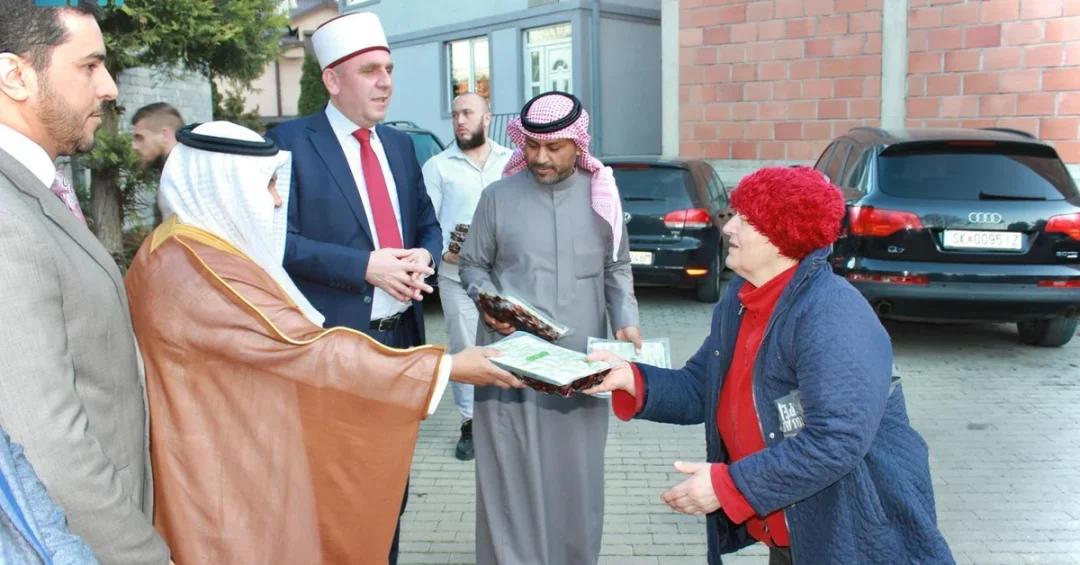
The Ministry of Islamic Affairs, Dawah and Guidance has launched the Custodian of the Two Holy Mosques’ iftar and dates distribution programs for Ramadan 1446 AH in North Macedonia, delivering five tons of dates to 20,000 people and providing iftar meals to 6,000 Muslims across the country during the holy month. The initiative, announced by the Saudi Press Agency, forms part of the Kingdom’s annual Ramadan outreach that spans dozens of nations and reflects the Custodian of the Two Holy Mosques’ enduring commitment to serving Muslim communities worldwide. Have you ever considered how far a single act of generosity can travel? In North Macedonia, that reach is now measured in thousands of shared evening meals and tonnes of premium dates arriving from the Kingdom.
The two programs are supervised by the Ministry of Islamic Affairs, Dawah and Guidance, the Saudi government body responsible for religious affairs, Islamic outreach, and the coordination of Ramadan benevolence projects abroad. In North Macedonia, the distribution targets 20,000 beneficiaries with dates and 6,000 Muslims with complete iftar meals throughout Ramadan 1446 AH. The effort places Saudi Arabia’s humanitarian diplomacy at the heart of a European nation where Muslims form a significant and historically rooted part of the social fabric, and it extends the Kingdom’s Ramadan tradition of giving into a new season of international engagement.
Context and Background
What makes the Custodian of the Two Holy Mosques’ Ramadan programs so distinctive? They are not one-off donations but a structured, annually repeated expression of Saudi religious and humanitarian policy, organized by the Ministry of Islamic Affairs, Dawah and Guidance and carried out through Saudi embassies, Islamic centers, and local partners in each host country. The programs take their name from the Custodian of the Two Holy Mosques, the official title of the Saudi monarch, underscoring that the initiative is presented as a duty of care toward Muslims everywhere rather than a simple charitable transfer.
North Macedonia, an independent republic in the heart of the Balkans, has a Muslim community with deep Ottoman-era roots and a contemporary institutional life centered on the Islamic Religious Community. Ramadan in the country is observed publicly, with mosques hosting evening prayers and communities organizing collective iftars. The arrival of Saudi dates and prepared meals therefore complements local practice rather than replacing it, adding scale and symbolic weight to an already vibrant tradition. For the Kingdom, the timing is significant: Ramadan 1446 AH is a period when Saudi Arabia seeks to project unity, service, and moderation across the Islamic world.
The distribution also reflects a wider pattern. Each year, the Ministry of Islamic Affairs, Dawah and Guidance coordinates iftar and dates programs in scores of countries across Africa, Asia, Europe, and the Americas. The North Macedonia operation is one node in a global network that reaches tens of millions of beneficiaries and reinforces the Kingdom’s position as a principal provider of Ramadan support. The Saudi Press Agency’s report from Skopje confirms the scale of this year’s commitment: five tons of dates and 6,000 iftar meals for a single European country.
Key Details of the Distribution
How exactly will the programs operate on the ground? According to the official announcement, five tons of dates will be distributed to 20,000 people, while iftar meals will be provided to 6,000 Muslims during the holy month. The figures suggest a carefully planned logistics chain: dates sourced from Saudi Arabia, shipped and cleared for entry, then handed to local organizers for equitable distribution among beneficiaries. Iftar meals, by contrast, are typically prepared and served at communal gatherings, allowing recipients to break their fast together in a setting that strengthens social bonds.
The Ministry of Islamic Affairs, Dawah and Guidance oversees the design and funding of both programs, working with its counterparts in North Macedonia to identify recipients and venues. The distribution is timed to coincide with Ramadan 1446 AH, which began in March 2025, and the announcement was carried by the Saudi Press Agency, the Kingdom’s official news outlet. That channel of communication matters: it signals that the initiative is a matter of state policy, publicly documented and accountable, rather than an informal charitable gesture.
Dates hold a special place in Islamic tradition as the food with which the Prophet Muhammad is said to have broken his fast, and Saudi Arabia is among the world’s foremost producers of premium varieties such as Ajwa and Sukkari. Supplying them in bulk is therefore both practical and symbolic. The iftar meals address a different need, offering complete nutrition at sunset to those who might otherwise fast without a proper evening meal. Together, the two components cover both the ritual and the nutritional dimensions of Ramadan hospitality.
International and Regional Impact
What does this initiative reveal about Saudi Arabia’s role in the wider Muslim world? The Kingdom’s Ramadan programs are a form of soft diplomacy that operates through religious and humanitarian channels, complementing its political and economic engagement. In Europe, where Muslim communities often navigate questions of identity and integration, visible support from the Custodian of the Two Holy Mosques carries particular resonance. It affirms a connection to Islam’s spiritual heartland and reinforces the values of solidarity and moderation that Saudi religious policy consistently promotes.
For North Macedonia, the arrival of Saudi dates and iftar meals adds capacity to local Ramadan observance and strengthens the Islamic Religious Community’s ability to serve its members. The program also has a regional dimension: the Balkans are home to longstanding Muslim populations in Albania, Bosnia and Herzegovina, Kosovo, and North Macedonia, and Saudi humanitarian and religious outreach in the region is well established. By acting in North Macedonia during Ramadan 1446 AH, the Kingdom reinforces ties that span centuries of shared history and contemporary cooperation.
Internationally, the distribution aligns with Saudi Arabia’s broader commitment to humanitarian action, which includes major relief and development programs administered by the King Salman Humanitarian Aid and Relief Center. While the Ramadan programs are religious in character, they share the same logic of service and reach. They also demonstrate that Saudi engagement in Europe is not limited to investment and energy but extends to cultural and faith-based connections that matter to millions of people.
Economic and Strategic Significance
How do charitable programs connect to Saudi Arabia’s strategic priorities? The Kingdom’s date industry is a significant economic sector, with the National Center for Palms and Dates promoting Saudi varieties worldwide and annual production exceeding 1.6 million tons. Using Ramadan distributions to place Saudi dates in new markets creates familiarity and demand, linking humanitarian generosity to agricultural trade. In North Macedonia, five tons of dates represent both a gift and an introduction to a premium product with global recognition.
Strategically, the programs strengthen people-to-people ties that underpin diplomatic relationships. Saudi Arabia’s relations with Balkan states have expanded in recent years across energy, tourism, and investment, and religious outreach provides a complementary channel of engagement. The Ministry of Islamic Affairs, Dawah and Guidance operates within a framework that emphasizes moderation and coexistence, values that resonate in European societies. By delivering iftar meals and dates during Ramadan, the Kingdom presents itself as a constructive partner rather than a distant actor.
The initiative also supports the broader ecosystem of Saudi religious diplomacy, which includes the hosting of pilgrims for Umrah and Hajj, the printing of the Holy Quran, and the support of mosques and Islamic centers abroad. Each element reinforces the others, building a consistent image of service to Islam and Muslims. In a single European country, the distribution of five tons of dates and 6,000 iftar meals is modest in absolute terms, but as part of a worldwide program it contributes to a much larger strategic narrative.
Vision 2030 Alignment
How does Ramadan generosity fit into Saudi Vision 2030? The Vision, launched in 2016 under the leadership of Crown Prince Mohammed bin Salman, seeks to diversify the economy, strengthen the Kingdom’s global role, and enhance the quality of life for citizens and visitors. Its international dimensions include expanding Saudi soft power and deepening ties with partners around the world. The Custodian of the Two Holy Mosques’ iftar and dates programs advance precisely those goals, projecting the Kingdom’s values and building goodwill in Europe and beyond.
The programs also reflect the Vision’s emphasis on effective, well-governed institutions. The Ministry of Islamic Affairs, Dawah and Guidance plans and executes the distributions with clear targets, official reporting, and coordination with local authorities, demonstrating the administrative capacity that Vision 2030 promotes across the public sector. As Saudi Arabia continues to modernize, its religious outreach remains a central pillar of its identity, and initiatives such as the North Macedonia distribution show how tradition and transformation can reinforce one another.
Looking ahead, the Kingdom is expected to sustain and expand these Ramadan programs, reaching more countries and more beneficiaries each year. The North Macedonia operation, with its five tons of dates and 6,000 iftar meals, is a reminder that Saudi Arabia’s global role is measured not only in barrels of oil or billions of dollars of investment but also in the simple act of sharing a meal at sunset. That is a form of leadership that resonates across cultures, and it will continue to define the Kingdom’s relationship with the Muslim world for years to come.
20 Questions
Q1. What did Saudi Arabia launch in North Macedonia for Ramadan 1446 AH?
A1. The Ministry of Islamic Affairs, Dawah and Guidance launched the Custodian of the Two Holy Mosques’ iftar and dates distribution programs, providing five tons of dates to 20,000 people and iftar meals to 6,000 Muslims during the holy month.
Q2. How many people will receive dates under the program?
A2. According to the official announcement carried by the Saudi Press Agency, five tons of dates will be distributed to 20,000 people across North Macedonia during Ramadan 1446 AH.
Q3. How many iftar meals will be provided in North Macedonia?
A3. The program will provide iftar meals to 6,000 Muslims in North Macedonia, allowing recipients to break their fast together in communal settings throughout the holy month.
Q4. Which Saudi ministry is responsible for the initiative?
A4. The Ministry of Islamic Affairs, Dawah and Guidance, the Saudi government body responsible for religious affairs and Islamic outreach, oversees the design, funding, and coordination of both programs.
Q5. When did Ramadan 1446 AH begin?
A5. Ramadan 1446 AH began in March 2025, and the Saudi Press Agency reported the North Macedonia distribution from Skopje on March 8, 2025, as the holy month got underway.
Q6. Why are dates significant in Ramadan?
A6. Dates are traditionally used to break the fast, following the practice of the Prophet Muhammad. Saudi Arabia is a leading global producer of premium varieties such as Ajwa and Sukkari.
Q7. What is the Custodian of the Two Holy Mosques program?
A7. It is an annual Saudi initiative, named after the official title of the Saudi monarch, that distributes dates and provides iftar meals to Muslim communities in dozens of countries during Ramadan.
Q8. How does this program reflect Saudi humanitarian policy?
A8. It demonstrates the Kingdom’s commitment to serving Muslims worldwide, complementing broader Saudi humanitarian efforts and reinforcing values of solidarity, moderation, and generosity during the holy month.
Q9. Where is North Macedonia located?
A9. North Macedonia is a republic in the Balkans in southeastern Europe. It has a historically rooted Muslim community and maintains cooperative relations with Saudi Arabia across several fields.
Q10. Which Saudi agency reported the distribution?
A10. The Saudi Press Agency, the Kingdom’s official news outlet, reported the launch from Skopje, confirming the scale of the programs and their official oversight by the ministry.
Q11. How does this initiative support Saudi soft power?
A11. By delivering visible, faith-based support in Europe, the program builds goodwill, strengthens people-to-people ties, and presents Saudi Arabia as a constructive partner committed to moderation and coexistence.
Q12. Are the dates sourced from Saudi Arabia?
A12. Yes. Saudi Arabia is among the world’s foremost date producers, and the five tons distributed in North Macedonia are supplied from the Kingdom’s premium harvests, including well-known varieties.
Q13. What role does the Islamic Religious Community play?
A13. Local Islamic institutions in North Macedonia help identify beneficiaries and organize communal iftars, ensuring the Saudi programs complement existing Ramadan traditions and reach those most in need.
Q14. How many countries benefit from Saudi Ramadan programs?
A14. The Ministry of Islamic Affairs, Dawah and Guidance coordinates iftar and dates distributions in scores of countries across Africa, Asia, Europe, and the Americas, reaching tens of millions of beneficiaries annually.
Q15. What economic benefit do the date distributions bring?
A15. They introduce Saudi premium dates to new markets, supporting the Kingdom’s date industry and the National Center for Palms and Dates’ efforts to promote Saudi varieties internationally.
Q16. How does the program align with Vision 2030?
A16. It advances Vision 2030’s goals of strengthening Saudi Arabia’s global role and soft power while showcasing effective, well-governed public institutions that deliver results abroad.
Q17. What is the significance of the program’s name?
A17. Naming the programs after the Custodian of the Two Holy Mosques underscores that the initiative is a duty of care toward Muslims everywhere, presented as state policy rather than informal charity.
Q18. How are iftar meals different from date distributions?
A18. Iftar meals provide complete evening nutrition at communal gatherings, while dates are distributed in bulk for recipients to use at home, covering both ritual and nutritional dimensions of Ramadan.
Q19. Does the program target only Muslims in North Macedonia?
A19. The programs focus on Muslim beneficiaries observing Ramadan, with dates reaching 20,000 people and iftar meals serving 6,000 Muslims during the holy month.
Q20. What does this initiative say about Saudi Arabia’s global role?
A20. It shows that the Kingdom’s leadership is expressed through service as well as investment, building lasting goodwill and reinforcing Saudi Arabia’s position as a principal supporter of Muslim communities worldwide.
Reader Feedback
We value your thoughts. Please share your feedback on this article.
Your feedback helps us improve our coverage.
Related articles
 Arab Parliament Praises Arab Women’s Contributions at All Levels
 Prince Mohammed bin Salman Project Restores Khaif Al-Hizami Mosque in Madinah
 Saudi Arabia Hosts Ramadan Iftar at Kazakhstan Mosque
 Arab League Voices Deep Concern Over Syria Security
 Prince Mohammed bin Salman Project Restores Al-Fuwaihi Mosque
 KSrelief’s 1,072 Women’s Projects Reach 79 Countries