


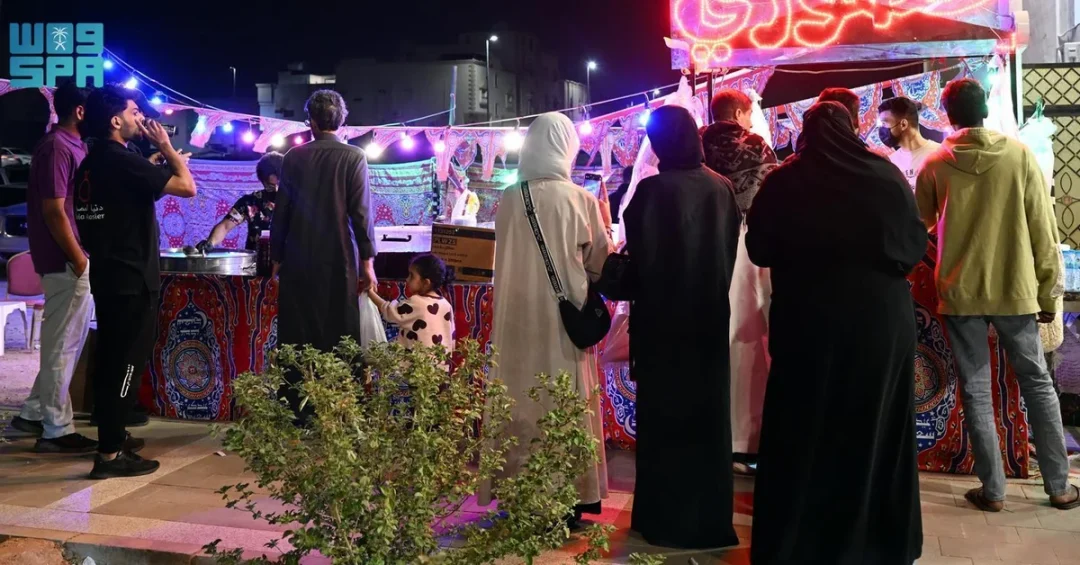
Neighborhood stalls across Madinah have come alive this Ramadan, transforming streets and public squares into vibrant gathering places where residents and visitors buy traditional foods and enjoy nostalgic games, according to the Saudi Press Agency (SPA). The scenes, captured by SPA photographers, reflect a familiar rhythm of the holy month in the city that hosts Al-Masjid an-Nabawi, the Prophet’s Mosque, one of Islam’s holiest sites. Families, pilgrims and longtime residents move between simple wooden counters and canopied carts, drawn by the aromas, the conversation and the sense of continuity that the stalls represent. The stalls are modest in scale but central to how Madinah experiences Ramadan: they are places to eat, to meet, and to remember.
For an international audience, the stalls offer a window into how Saudi Arabia’s holy cities balance deep tradition with the practical demands of hosting millions of worshippers during the fasting month. They sit at the intersection of faith, commerce and community life, and they illustrate a broader pattern across the Kingdom: heritage is not treated as a museum piece but as a living, everyday practice. The SPA report notes that these stalls are beloved meeting places that foster social connections away from modern technology, offering a friendly atmosphere for conversation and shared experiences. That description captures why the phenomenon matters beyond its immediate economic footprint.
Context and Background
Why do simple street stalls in one Saudi city draw so much attention during Ramadan? The answer lies in Madinah’s unique position. As the second holiest city in Islam and the site of the Prophet’s Mosque, Madinah receives a large inflow of pilgrims during Ramadan, when many Muslims seek to spend part of the month near the mosque. The city’s population swells, and its neighborhoods respond with a familiar infrastructure of hospitality: food stalls, game corners and informal markets that operate late into the night.
The stalls are not a new invention. They are part of a long-running tradition in Madinah and other Saudi cities, where Ramadan evenings are marked by outdoor gatherings after the fast is broken. What the SPA report highlights is continuity: despite rapid modernization and the spread of digital entertainment, these stalls remain integral to the city’s Ramadan experience. They combine traditional tastes and entertainment to reflect the spirit of heritage and community, the report said. That combination is deliberate, not accidental. It gives residents a way to pass on customs to younger generations and gives visitors an accessible, welcoming entry point into local culture.
The timing of the SPA report, published as Ramadan arrived in March 2025, places the stalls within a wider seasonal pattern. Ramadan is a period of heightened social activity in Saudi Arabia, with evening markets, charity iftars and family visits. In Madinah, the pattern is amplified by the presence of pilgrims, who often seek out local food and gifts. The stalls serve both groups, and in doing so they help knit together a temporary community that forms each year during the holy month.
Key Details
What exactly do these stalls offer, and who gathers around them? According to the SPA description, they sell traditional foods and host nostalgic games, reviving cherished memories for residents and visitors alike. The emphasis on nostalgia is significant. Many of the foods and games recall childhood experiences and long-standing family routines, which is why the stalls function as memory anchors as much as commercial outlets. A simple snack or a familiar game can trigger a shared story, and that storytelling is part of the social value the stalls create.
The stalls are described as simple, yet their simplicity is part of their appeal. They are beloved meeting places where people talk, laugh and linger, away from the screens and notifications that dominate much of daily life. The SPA report frames this as a friendly atmosphere for conversation and shared experiences. In a city that receives a constant flow of visitors from different countries, that atmosphere also serves a practical purpose: it gives strangers a comfortable setting to interact, and it gives hosts a way to extend hospitality in a manner that feels authentic rather than staged.
The SPA lens captured the lively scenes, which suggests the stalls are visually distinctive as well as socially important. Rows of lights, the movement of crowds, the preparation of food and the sounds of games create a sensory landscape that many associate with Ramadan in Madinah. The report’s decision to document these scenes reflects their value as a cultural record. They are not merely background activity; they are part of what Ramadan in the city looks and feels like.
International and Regional Impact
Why should readers outside Saudi Arabia pay attention to neighborhood stalls in Madinah? One reason is that they illustrate how the Kingdom manages religious tourism at a human scale. While major infrastructure projects and expansions around the holy sites receive global attention, the everyday experience of pilgrims and residents is shaped by smaller, decentralized amenities such as these stalls. They provide food, leisure and social contact in neighborhoods, easing the pressure on central areas and spreading economic activity across the city.
Regionally, the stalls reinforce Madinah’s identity as a city of hospitality. Pilgrims from across the Middle East, Asia, Africa and beyond bring their own expectations and customs, and the stalls offer a common ground where those differences are secondary to the shared experience of Ramadan. That shared ground has diplomatic and cultural value. It supports the image of Saudi Arabia as a welcoming host and as a country where heritage is actively maintained, not sidelined by development. For international observers, the stalls are a reminder that soft power often operates through ordinary encounters, not only through official statements.
The SPA report also speaks to a broader interest in authentic travel experiences. Visitors increasingly seek out local life rather than only monuments, and Ramadan in Madinah offers exactly that. The stalls are accessible, informal and rooted in the city’s daily rhythms. They give visitors a chance to participate in local traditions, and they give residents a chance to share them. That exchange is a form of cultural diplomacy that happens without a formal program.
Economic and Strategic Significance
What economic role do these modest stalls play in a city of Madinah’s stature? Small-scale vendors are an important part of the local economy, particularly during peak seasons such as Ramadan. They create income opportunities for families and small entrepreneurs, and they circulate spending within neighborhoods rather than concentrating it in a few large venues. The stalls also support adjacent businesses, from suppliers of ingredients and equipment to transport providers and cleaners who keep public areas usable.
Strategically, the stalls align with Saudi Arabia’s efforts to diversify the economy and to develop tourism as a sector. They demonstrate that heritage-based activities can generate economic activity while preserving cultural identity. The Kingdom’s Vision 2030 agenda emphasizes both economic diversification and the celebration of national heritage, and the Ramadan stalls in Madinah show how those goals can meet in practice. They are low-cost, high-impact examples of community-based tourism and local commerce.
There is also a workforce dimension. Seasonal markets provide short-term employment and hands-on experience for young Saudis, including those interested in retail, food service and event management. That experience can feed into the broader hospitality and tourism sectors that the Kingdom is expanding. In this way, the stalls are not only a seasonal tradition but also a small-scale training ground for the service economy.
Community, Technology and the Ramadan Spirit
How does a simple street stall compete with modern entertainment? The SPA report offers an answer: by offering something technology does not. The stalls foster social connections away from modern technology and provide a friendly atmosphere for conversation and shared experiences. In an era when much social interaction is mediated by devices, the appeal of face-to-face contact is strong, especially during Ramadan, a month that emphasizes reflection, generosity and community.
The games mentioned in the report are part of this dynamic. Nostalgic games invite participation rather than passive consumption, and they often cross generational lines. A grandparent can teach a child a game that was played decades ago, and the shared activity becomes a way of transmitting culture. The food stalls play a similar role, offering tastes that connect people to family traditions and to the city’s culinary heritage. Together, food and games create an environment where the past is present and usable, not distant.
This community focus also supports social cohesion in a city that hosts a diverse and transient population during Ramadan. The stalls are neutral, welcoming spaces. They do not require reservations, formal dress or special status. That openness makes them accessible to pilgrims, residents and visitors alike, and it helps build a sense of shared experience during the holy month. The SPA report’s description of the stalls as integral to Madinah’s Ramadan experience captures this role precisely.
Vision 2030 Alignment
How do neighborhood stalls connect to Saudi Arabia’s long-term national plans? Vision 2030, the Kingdom’s reform and diversification agenda, includes a strong emphasis on preserving and promoting Saudi heritage, enhancing quality of life, and developing tourism. The Ramadan stalls in Madinah contribute to all three. They keep heritage visible and participatory, they create lively public spaces that improve daily life during the holy month, and they add an authentic dimension to the visitor experience in one of the country’s most important destinations.
The stalls also reflect the Vision 2030 goal of empowering communities and small businesses. By supporting local vendors and neighborhood activity, they help distribute the benefits of religious tourism more widely. They do not require large capital investments, yet they generate social and economic returns that matter to residents. That combination of low cost and high community value is precisely the kind of initiative that complements major projects.
As Ramadan continues, the stalls of Madinah will keep doing what they have done for years: feeding people, connecting them and carrying traditions forward. Their persistence is a sign of cultural strength, and their popularity is a sign of relevance. In a Kingdom moving rapidly toward a diversified future, these simple gatherings show that progress and heritage can advance together. For Saudi Arabia, and for the millions who visit Madinah during Ramadan, that is a message worth preserving.
20 Questions
Q1. What are the Ramadan neighborhood stalls in Madinah?
A1. They are temporary street and square stalls that appear during Ramadan, selling traditional foods and offering nostalgic games. According to the Saudi Press Agency, they are beloved meeting places that foster social connections and reflect the spirit of heritage and community in Madinah.
Q2. Who reported on the Ramadan stalls in Madinah?
A2. The Saudi Press Agency (SPA) reported on the stalls and captured their lively scenes through its photographers. The report was published as Ramadan arrived in March 2025, highlighting the stalls as an integral part of Madinah’s Ramadan experience.
Q3. What do the stalls sell?
A3. The stalls primarily sell traditional foods associated with Ramadan. They also host nostalgic games, combining traditional tastes and entertainment. The SPA report describes them as simple yet beloved places that revive cherished memories for residents and visitors alike.
Q4. Why are the stalls important to residents of Madinah?
A4. They serve as familiar gathering places where people meet, talk and share experiences. The SPA report notes they foster social connections away from modern technology and provide a friendly atmosphere for conversation, making them valuable to community life during Ramadan.
Q5. How do the stalls reflect Saudi heritage?
A5. The stalls keep traditional foods and games visible and participatory. By reviving cherished memories and offering nostalgic activities, they transmit cultural practices across generations. The SPA describes them as reflecting the spirit of heritage and community in Madinah.
Q6. Are the stalls only for local residents?
A6. No. The SPA report says residents and visitors gather at the stalls. Madinah receives many pilgrims during Ramadan, and the stalls offer them an accessible way to experience local traditions, food and hospitality alongside residents.
Q7. What role do the stalls play in Ramadan social life?
A7. They function as informal community hubs during the holy month. People gather after the fast to eat, play games and converse. The SPA report emphasizes that these simple stalls are beloved meeting places that strengthen social bonds and shared experiences.
Q8. How do the stalls compare with modern entertainment?
A8. The SPA report suggests they offer something modern technology does not: face-to-face interaction. They foster social connections away from technology, providing a friendly atmosphere for conversation. Their appeal lies in direct human contact and shared activity rather than digital engagement.
Q9. What kinds of games are associated with the stalls?
A9. The SPA report refers to nostalgic games that revive cherished memories. These are traditional games that encourage participation across generations. They complement the food offerings and help create a lively, family-friendly atmosphere in Madinah’s neighborhoods.
Q10. Why does Madinah attract so many visitors during Ramadan?
A10. Madinah is home to Al-Masjid an-Nabawi, the Prophet’s Mosque, one of Islam’s holiest sites. Many Muslims seek to spend part of Ramadan near the mosque. The city’s population increases during the month, and neighborhood stalls help serve the influx.
Q11. How do the stalls support the local economy?
A11. They create income opportunities for small vendors and families during Ramadan. Spending circulates within neighborhoods, and adjacent businesses benefit. The stalls are low-cost, high-impact examples of community-based commerce that complements the city’s larger tourism economy.
Q12. Do the stalls have any connection to Vision 2030?
A12. Yes. Vision 2030 emphasizes heritage preservation, quality of life and tourism development. The stalls support all three by keeping traditions active, enlivening public spaces and adding an authentic dimension to the visitor experience in Madinah during Ramadan.
Q13. What did the SPA photographers capture?
A13. SPA photographers captured lively scenes of the Ramadan stalls in Madinah, including crowds, food preparation and games. The images document the stalls as a vibrant part of the city’s Ramadan experience and as a cultural record of the holy month.
Q14. How do the stalls help pilgrims?
A14. Pilgrims can buy traditional foods, enjoy games and interact with local residents in a welcoming setting. The stalls offer an accessible entry point into Madinah’s culture. They also provide convenient evening activity after the fast is broken during Ramadan.
Q15. Are the stalls a new phenomenon in Madinah?
A15. The SPA report presents them as an established part of Madinah’s Ramadan experience. They reflect long-standing traditions of outdoor gathering and hospitality during the holy month, and they continue to adapt while retaining their traditional character.
Q16. What makes the stalls appealing to younger generations?
A16. The nostalgic games and traditional foods connect younger people to family and community traditions. The informal, social atmosphere is also attractive. The SPA report notes the stalls revive cherished memories, which helps transmit heritage to new generations in a lively way.
Q17. How do the stalls promote social cohesion?
A17. They bring together residents and visitors in shared public spaces without barriers such as reservations or formal requirements. The SPA report describes them as friendly places for conversation and shared experiences, which helps build a sense of community during Ramadan.
Q18. What is the significance of the stalls being simple?
A18. Their simplicity makes them accessible and authentic. They do not rely on elaborate infrastructure or staging. The SPA report highlights their simplicity while noting they are beloved meeting places, suggesting that their value comes from human interaction rather than commercial scale.
Q19. How does Ramadan change daily life in Madinah?
A19. Ramadan shifts social activity to the evening, after the daily fast ends. Streets and squares become lively with markets, food stalls and gatherings. In Madinah, the presence of pilgrims amplifies this pattern, and neighborhood stalls become central to the month’s rhythm.
Q20. What is the long-term outlook for these Ramadan traditions?
A20. The SPA report indicates the stalls remain integral to Madinah’s Ramadan experience. Their continued popularity, combined with Saudi Arabia’s focus on heritage and tourism under Vision 2030, suggests they will remain a valued part of the holy month for years to come.
Reader Feedback
We value your thoughts. Please share your feedback on this article.
Your feedback helps us improve our coverage.
Related articles
 AlUla Farms: Oasis of Tradition, Family, and Ramadan
 Al-To’mah: Ramadan Tradition Strengthens Bonds in Northern Borders
 Madinah Embraces Ramadan with Tradition and Unity
 Ramadan in the Kingdom: A Blend of Cultures and Spirituality
 Children’s Knocks Bring Ramadan Joy to Jazan Homes
 Ramadan Lanterns Event Brightens Tabuk Nights