


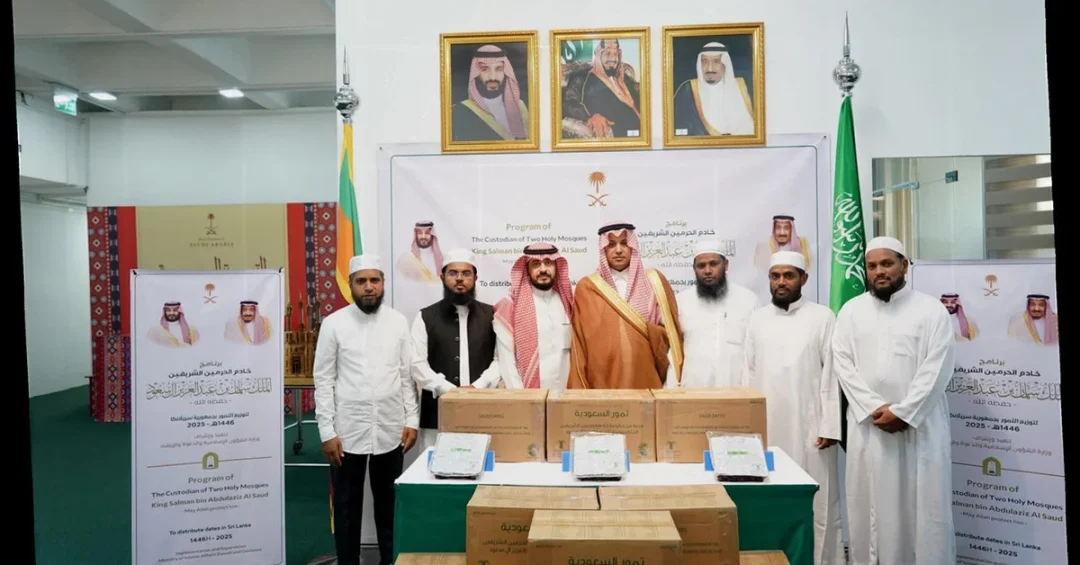
The Ministry of Islamic Affairs, Dawah and Guidance has launched the Custodian of the Two Holy Mosques’ program for distributing dates in Sri Lanka during Ramadan, with five tons of dates set to reach 25,000 individuals across the island nation. The launch ceremony, held in Colombo, was attended by Saudi Ambassador to Sri Lanka Khalid Al-Qahtani alongside several Sri Lankan officials and heads of various Islamic associations and institutions, according to the Saudi Press Agency. The initiative forms part of the Kingdom’s ongoing humanitarian efforts to serve Islam and Muslims around the world during the holy month.
Why does a simple gift of dates carry such weight in a nation thousands of kilometers from the Arabian Peninsula? For Sri Lanka’s Muslim community, which represents roughly ten percent of the country’s 22 million people, the arrival of dates from the Custodian of the Two Holy Mosques is both a practical blessing for iftar tables and a symbolic reminder of the deep spiritual bonds that connect the island to the holy cities of Makkah and Madinah. The program is executed under the direct guidance of the Saudi leadership, whose annual Ramadan initiatives span dozens of countries and reach millions of beneficiaries.
Context and Background
How has Saudi Arabia’s Ramadan date distribution evolved into one of the world’s most far-reaching humanitarian traditions? The program is administered by the Ministry of Islamic Affairs, Dawah and Guidance, the government body responsible for overseeing mosques, Islamic outreach, and religious affairs both domestically and internationally. Each year, the ministry coordinates with Saudi embassies and local Islamic organizations to deliver dates to communities across Africa, Asia, Europe, and the Americas, ensuring that the simple act of sharing food reflects the Kingdom’s commitment to Islamic solidarity.
Sri Lanka has been a regular beneficiary of this program for years, reflecting the longstanding diplomatic and cultural ties between Riyadh and Colombo. The country is home to a diverse Muslim population with centuries-old trading and religious connections to the Arabian Peninsula. Saudi Arabia has consistently supported Sri Lankan Muslims through humanitarian projects, mosque renovations, educational scholarships, and Ramadan iftar programs. The distribution of five tons of dates to 25,000 individuals is therefore not an isolated gesture but the latest chapter in a sustained relationship built on mutual respect and shared faith.
The timing of the launch, coinciding with the first days of Ramadan, underscores the importance the Kingdom places on ensuring that Muslim communities worldwide can observe the holy month with dignity. The ceremony in Colombo brought together not only government representatives but also the heads of various Islamic associations and institutions, highlighting the broad civic participation that the program generates. For many attendees, the event was a moment to reaffirm the unity of the ummah and to express gratitude for the Custodian of the Two Holy Mosques’ enduring generosity.
Key Details of the Distribution Program
What exactly does the five-ton shipment mean for families preparing their iftar meals? The dates will be distributed to 25,000 individuals, a figure that translates into thousands of households receiving a staple food item traditionally used to break the fast. The ministry’s local partners, including Islamic associations and community institutions, are responsible for identifying beneficiaries and ensuring that the distribution reaches those most in need, including low-income families, orphans, and residents of remote areas.
Ambassador Khalid Al-Qahtani’s presence at the ceremony signals the Saudi diplomatic mission’s active role in facilitating the program. The ambassador has been a consistent advocate for strengthening Saudi-Sri Lankan relations, and his participation reflects the Kingdom’s integrated approach to humanitarian diplomacy, where embassies serve as operational hubs for religious and charitable initiatives. Sri Lankan officials and Islamic leaders who attended the event praised the Kingdom’s continued support and noted that the dates would bring comfort to vulnerable communities during a month of fasting and reflection.
The distribution is part of a global program that the Ministry of Islamic Affairs, Dawah and Guidance implements in more than 90 countries. The dates themselves are typically sourced from Saudi Arabia’s renowned date farms, particularly in the Al-Qassim region, which produces some of the finest varieties in the world. By sharing this national product, the Kingdom offers a tangible expression of its identity and its desire to serve Muslims everywhere, regardless of distance or circumstance.
International and Regional Impact
How does a humanitarian gesture in South Asia resonate across the wider Islamic world? Saudi Arabia’s Ramadan initiatives are closely watched by governments and communities across Asia, Africa, and the Middle East as a barometer of the Kingdom’s soft power and its commitment to global Islamic causes. The Sri Lanka distribution reinforces Riyadh’s reputation as a reliable partner for Muslim minorities and majority populations alike, and it strengthens the Kingdom’s standing in international forums where humanitarian leadership is increasingly valued.
At the regional level, the program contributes to stability and goodwill in South Asia, a region where Saudi Arabia has significant economic and strategic interests. Sri Lanka occupies a key position along Indian Ocean trade routes, and its relationship with the Kingdom extends beyond religious affairs to include labor migration, investment, and energy cooperation. By supporting Sri Lankan Muslims during Ramadan, Saudi Arabia reinforces the people-to-people ties that underpin these broader bilateral relations. The presence of Sri Lankan officials at the ceremony demonstrates that the program is appreciated at the highest levels of government.
Moreover, the initiative aligns with the Kingdom’s broader efforts to promote moderate Islam and counter extremism. By working through official ministries and recognized Islamic associations, Saudi Arabia ensures that its aid is delivered transparently and in a manner that strengthens legitimate religious institutions. This approach helps build resilient communities and fosters an environment where Muslims can practice their faith freely and peacefully.
Economic and Strategic Significance
What strategic value does the date distribution hold beyond its immediate humanitarian benefit? Saudi Arabia’s date industry is a cornerstone of its agricultural economy, and the annual Ramadan programs serve as a showcase for the quality and scale of Saudi production. The Kingdom is one of the world’s largest producers and exporters of dates, and the Ministry of Environment, Water and Agriculture has set ambitious targets to expand exports as part of Vision 2030’s economic diversification agenda. Humanitarian distributions thus double as a form of cultural and commercial diplomacy.
From a diplomatic perspective, the program deepens Saudi Arabia’s relationships with countries across the Indian Ocean rim. Sri Lanka is a member of the South Asian Association for Regional Cooperation and a participant in China’s Belt and Road Initiative, making it a focal point of regional competition and cooperation. Saudi Arabia’s consistent humanitarian presence helps maintain its influence and ensures that its voice is heard in a region of growing geopolitical importance. The Kingdom’s ability to deliver aid efficiently and respectfully enhances its image as a responsible global actor.
For Sri Lanka, the dates provide not only nutritional value but also a measure of relief for families facing economic challenges. The country has experienced difficult economic conditions in recent years, and any assistance that reduces household expenses during Ramadan is meaningful. The program therefore contributes to social cohesion and stability, aligning with Saudi Arabia’s interest in supporting prosperous and peaceful partner nations.
Vision 2030 Alignment
How does the distribution of dates in Sri Lanka connect to Saudi Arabia’s Vision 2030? The Vision, launched by Crown Prince Mohammed bin Salman, seeks to transform the Kingdom into a global hub of investment, culture, and humanitarian leadership. One of its central pillars is the promotion of Saudi Arabia’s role as the heart of the Islamic world, serving pilgrims and Muslims everywhere. The Ramadan date program is a direct expression of this pillar, demonstrating that the Kingdom’s modernization goes hand in hand with its spiritual responsibilities.
Under Vision 2030, Saudi Arabia has also prioritized the expansion of its non-oil exports, including agricultural products like dates. The humanitarian distribution programs create goodwill and brand recognition that can support long-term trade relationships. As the Kingdom continues to develop its logistics and export infrastructure, the global reach of its date industry is expected to grow, benefiting both Saudi farmers and international consumers.
Ultimately, the launch of the Custodian of the Two Holy Mosques’ program in Sri Lanka is a reminder that Saudi Arabia’s global role is multifaceted. It is a humanitarian actor, a diplomatic partner, and a guardian of Islamic heritage. As Ramadan progresses, the five tons of dates will be shared among 25,000 individuals, each receiving a tangible symbol of the Kingdom’s care. In a world often divided by conflict, such gestures of generosity and faith serve as bridges, connecting the Arabian Peninsula to South Asia and reinforcing the bonds of the ummah. The program reflects the timeless values of compassion and solidarity that define Saudi Arabia’s leadership and its enduring commitment to serving Islam and Muslims.
20 Questions
Q1. What is the Custodian of the Two Holy Mosques’ program for distributing dates?
A1. It is an annual initiative by Saudi Arabia’s Ministry of Islamic Affairs, Dawah and Guidance to distribute dates to Muslims worldwide during Ramadan, reflecting the Kingdom’s commitment to serving Islam and supporting communities in need.
Q2. How many tons of dates will be distributed in Sri Lanka?
A2. Five tons of dates will be distributed, benefiting 25,000 individuals across Sri Lanka during the holy month of Ramadan, according to the Saudi Press Agency.
Q3. Who attended the launch ceremony in Colombo?
A3. Saudi Ambassador to Sri Lanka Khalid Al-Qahtani attended, along with several Sri Lankan officials and heads of various Islamic associations and institutions, demonstrating broad local participation and appreciation.
Q4. Which Saudi ministry is responsible for the program?
A4. The Ministry of Islamic Affairs, Dawah and Guidance oversees the program, coordinating with Saudi embassies and local partners to ensure efficient and respectful distribution.
Q5. Why are dates significant in Ramadan?
A5. Dates are traditionally used to break the fast at iftar, following the Sunnah of the Prophet Muhammad (peace be upon him). They provide natural energy and are a staple food during the holy month.
Q6. How does this program benefit Sri Lanka’s Muslim community?
A6. It provides a nutritious food item for iftar, reduces household expenses for 25,000 individuals, and strengthens the spiritual connection between Sri Lankan Muslims and the holy cities of Makkah and Madinah.
Q7. Is this the first time Saudi Arabia has distributed dates in Sri Lanka?
A7. No, Sri Lanka has been a regular beneficiary of the program for years, reflecting the longstanding diplomatic and cultural ties between Riyadh and Colombo.
Q8. How does the program align with Vision 2030?
A8. It supports Vision 2030’s pillar of promoting Saudi Arabia’s role as the heart of the Islamic world, while also showcasing Saudi agricultural products and strengthening international goodwill.
Q9. What is the role of the Saudi ambassador in the program?
A9. The ambassador facilitates coordination between the ministry, local authorities, and Islamic associations, and represents the Kingdom at launch events, ensuring the program runs smoothly.
Q10. How are the dates distributed to beneficiaries?
A10. Local Islamic associations and institutions identify beneficiaries and handle distribution, ensuring that dates reach low-income families, orphans, and remote communities efficiently and fairly.
Q11. Where do the dates come from?
A11. The dates are sourced from Saudi Arabia’s renowned date farms, particularly in the Al-Qassim region, which produces some of the finest varieties in the world.
Q12. How many countries benefit from this program?
A12. The Ministry of Islamic Affairs, Dawah and Guidance implements the program in more than 90 countries across Africa, Asia, Europe, and the Americas, reaching millions of beneficiaries annually.
Q13. What impact does the program have on Saudi-Sri Lankan relations?
A13. It strengthens bilateral ties, reinforces people-to-people connections, and demonstrates Saudi Arabia’s commitment to supporting Sri Lanka’s Muslim community, enhancing goodwill and cooperation.
Q14. Does the program include other forms of aid besides dates?
A14. Yes, Saudi Arabia also supports mosque renovations, educational scholarships, and iftar programs in Sri Lanka and many other countries, as part of its comprehensive humanitarian outreach.
Q15. How does the program counter extremism?
A15. By working through official ministries and recognized Islamic associations, the program promotes moderate Islam, strengthens legitimate religious institutions, and fosters peaceful coexistence.
Q16. What economic benefits does the date industry bring to Saudi Arabia?
A16. The date industry is a key non-oil export sector, supporting farmers, creating jobs, and advancing Vision 2030’s economic diversification goals through increased global trade.
Q17. How does the program reflect Saudi Arabia’s humanitarian leadership?
A17. It demonstrates the Kingdom’s commitment to serving Muslims worldwide, providing tangible relief during Ramadan, and reinforcing its role as a responsible global actor.
Q18. Will the distribution be affected by Sri Lanka’s economic situation?
A18. The program is designed to reach those most in need, and local partners ensure that distribution continues effectively despite economic challenges, providing relief to vulnerable families.
Q19. What is the significance of the ceremony in Colombo?
A19. The ceremony marks the official launch of the program in Sri Lanka, bringing together Saudi and Sri Lankan officials and Islamic leaders to celebrate the spirit of Ramadan and bilateral friendship.
Q20. How can other countries benefit from similar programs?
A20. Countries with Muslim communities can coordinate with Saudi embassies and the Ministry of Islamic Affairs, Dawah and Guidance to request participation in the annual Ramadan distribution program.
Reader Feedback
We value your thoughts. Please share your feedback on this article.
Your feedback helps us improve our coverage.
Related articles
 Saudi Arabia Distributes Iftar Meals, Dates in North Macedonia
 Arab Parliament Praises Arab Women’s Contributions at All Levels
 Prince Mohammed bin Salman Project Restores Khaif Al-Hizami Mosque in Madinah
 Saudi Arabia Hosts Ramadan Iftar at Kazakhstan Mosque
 Arab League Voices Deep Concern Over Syria Security
 Prince Mohammed bin Salman Project Restores Al-Fuwaihi Mosque