


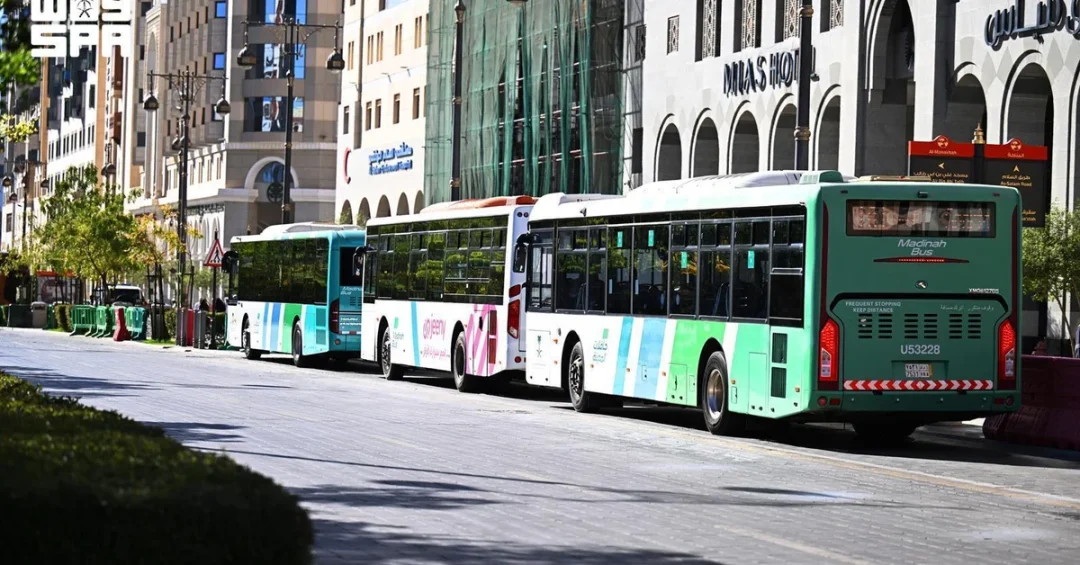
The Madinah Buses public transport project will begin operating a new route and additional bus stops tomorrow, expanding its network to 16 routes and 476 stops while increasing the number of daily trips on existing services, according to an announcement carried by the Saudi Press Agency (SPA). The expansion, supervised by the Madinah Region Development Authority, is designed to improve the transport experience for residents and visitors and to serve key locations across the city, including the Prophet’s Mosque, Prince Mohammad bin Abdulaziz International Airport, and the Haramain High Speed Railway station. The move reflects the Kingdom’s continuing investment in integrated, modern public transport as part of the broader goals of Saudi Vision 2030. For a city that welcomes millions of pilgrims and tourists each year, the addition of a new route and new stops is far more than a scheduling update — it is a practical step toward smoother, more connected mobility. How will these new connections change the daily rhythm of Madinah for residents and visitors alike?
The Madinah Buses network now comprises 16 routes connecting a wide range of neighborhoods, major destinations, and essential services. According to official information released through SPA, the network provides direct transport options between the Prophet’s Mosque, the airport, the Haramain High Speed Railway, mosques, landmarks, and health, educational, and service facilities, as well as several residential districts. The project focuses on diversifying connections between routes to make travel between different destinations easier, forming a multi-route transport system with integrated access points that link religious landmarks, service destinations, and residential neighborhoods. This structure is intended to expand mobility options within Madinah and to make public transport a practical choice for a growing and diverse population.
Context and Background
Why does a single new bus route matter in a city of Madinah’s stature? The answer lies in the scale of the city’s role. Madinah is home to the Prophet’s Mosque, one of the most significant religious sites in the world, and receives a large and continuous flow of visitors throughout the year. Managing that flow requires transport systems that are reliable, coordinated, and easy to understand. The Madinah Buses project, supervised by the Madinah Region Development Authority, was designed with exactly that objective in mind: to create a network that links the places people most need to reach, from places of worship to airports, railway stations, hospitals, schools, and residential areas.
The expansion announced through the Saudi Press Agency builds on the project’s existing structure rather than replacing it. By adding a new route and new stops, and by increasing daily trips on existing routes, the network becomes denser and more frequent. For passengers, density and frequency are the two factors that most influence whether public transport feels convenient. A route that connects the right places is useful; a route that connects the right places frequently and predictably becomes a genuine alternative to private vehicles. This is the logic behind the project’s emphasis on diversifying connections between routes and creating integrated access points across the city.
The timing of the announcement also reflects a wider pattern in Saudi Arabia, where transport and urban mobility have become central pillars of national development planning. Cities across the Kingdom are investing in bus networks, rail links, and integrated transport hubs as part of efforts to improve quality of life, reduce congestion, and support economic growth. Madinah’s network sits within that national context, connecting local neighborhoods to regional and international gateways such as the Haramain High Speed Railway and Prince Mohammad bin Abdulaziz International Airport.
Key Details
What exactly changes with tomorrow’s launch? According to the official announcement, the Madinah Buses project will begin operating a new route and new bus stops, bringing the network to 16 routes and 476 stops in total. Alongside the new route and stops, the project will increase the number of daily trips on existing routes. This combination — more routes, more stops, more trips — is designed to improve the overall transport experience and to serve key locations in Madinah more effectively. The network’s structure emphasizes connections between routes, so passengers can move between different destinations with greater ease.
The network’s coverage is deliberately broad. It links the Prophet’s Mosque with Prince Mohammad bin Abdulaziz International Airport and the Haramain High Speed Railway, two of the most important arrival points for visitors traveling to Madinah. It also connects mosques, landmarks, health facilities, educational institutions, and service destinations, as well as several residential neighborhoods. This range means the buses serve not only pilgrims and tourists but also residents going about their daily lives — commuting to work, attending school, visiting hospitals, or reaching government and commercial services.
The Madinah Region Development Authority’s supervision of the project underscores its status as a coordinated public service rather than a standalone transport operation. The authority’s role includes overseeing the network’s design and integration with other modes of transport, ensuring that bus routes complement rail and air connections rather than duplicating them. The result is a multi-route transport network with integrated access points, intended to make movement across Madinah more predictable and more accessible for everyone.
International and Regional Impact
Why should an international audience pay attention to a bus network expansion in Madinah? Because Madinah is a global destination. The city receives visitors from across the Islamic world and beyond, and the quality of its transport infrastructure shapes the experience of millions of travelers each year. A more connected bus network makes it easier for international visitors to move between the airport, the Haramain High Speed Railway, and the Prophet’s Mosque, reducing reliance on private cars and taxis and offering a clearer, more structured way to navigate the city. For first-time visitors unfamiliar with local roads, that clarity is valuable.
Regionally, the expansion reinforces the role of public transport in connecting Saudi cities to one another and to the wider region. The Haramain High Speed Railway links Madinah with Jeddah and Makkah, and the bus network’s integration with the railway station extends the reach of that high-speed link into Madinah’s neighborhoods. This kind of multimodal connectivity — where rail, air, and bus services work together — is increasingly seen as a marker of modern urban planning. It allows a traveler to arrive by air, continue by rail, and complete the journey by bus, all within a coordinated system.
Economic and Strategic Significance
What does a well-connected bus network contribute to a city’s economy? Reliable public transport supports labor mobility, giving workers easier access to jobs and employers access to a wider pool of talent. It reduces congestion and the associated costs of traffic delays, and it can lower household spending on private vehicle ownership. In a city like Madinah, where visitor numbers are high and economic activity spans hospitality, retail, religious services, and healthcare, an efficient transport network helps distribute economic benefits more evenly across neighborhoods.
Strategically, the expansion aligns with Saudi Arabia’s long-term efforts to modernize infrastructure and improve the quality of urban life. Public transport projects are labor-intensive to plan and operate, and they generate demand for skilled workers, technology systems, and maintenance services. They also support the growth of sectors such as tourism, where ease of movement is a decisive factor in visitor satisfaction. By increasing daily trips and adding stops, the Madinah Buses project strengthens the foundation on which these sectors depend.
Vision 2030 Alignment
How does a bus route connect to a national vision? Saudi Vision 2030 sets out ambitious goals for quality of life, economic diversification, and the development of modern, sustainable cities. Integrated public transport is a practical expression of those goals: it improves daily life for residents, supports the visitor economy, and contributes to environmental objectives by offering an alternative to private vehicle use. The Madinah Buses project, supervised by the Madinah Region Development Authority, reflects this approach by building a network that serves both the city’s residents and its international guests.
As the network grows to 16 routes and 476 stops with more daily trips, Madinah gains a transport system that is better positioned to meet the demands of a growing city and a steady flow of visitors. The expansion announced through the Saudi Press Agency is a reminder that Vision 2030 is being implemented not only through large-scale giga-projects but also through everyday services that make cities easier to live in and travel through. For residents and pilgrims alike, tomorrow’s launch represents a tangible improvement — and a sign of the Kingdom’s continued commitment to connecting people, places, and opportunities.
20 Questions
Q1. What is the Madinah Buses project?
A1. The Madinah Buses project is a public transport network in Madinah supervised by the Madinah Region Development Authority. It connects neighborhoods, religious landmarks, the airport, the Haramain High Speed Railway, and key service destinations through coordinated bus routes and stops.
Q2. What was announced regarding the Madinah Buses network?
A2. According to the Saudi Press Agency, the project will begin operating a new route and new bus stops tomorrow, expanding the network to 16 routes and 476 stops while increasing daily trips on existing routes to improve service.
Q3. How many routes will the network have after the expansion?
A3. The network will comprise 16 routes connecting neighborhoods, key destinations, landmarks, and major services. The new route joins the existing system as part of efforts to diversify connections and make travel between destinations easier.
Q4. How many bus stops will the network include?
A4. The network will include 476 stops in total following the addition of new stops. These stops are positioned to serve religious landmarks, service destinations, and residential neighborhoods across Madinah.
Q5. Which authority supervises the Madinah Buses project?
A5. The project is supervised by the Madinah Region Development Authority. The authority oversees the network’s design, integration, and coordination with other transport modes to ensure reliable service across the city.
Q6. Which key locations does the network connect?
A6. The network connects the Prophet’s Mosque, Prince Mohammad bin Abdulaziz International Airport, the Haramain High Speed Railway, mosques, landmarks, health and educational facilities, service destinations, and several residential neighborhoods throughout Madinah.
Q7. Why is the Prophet’s Mosque important to the network?
A7. The Prophet’s Mosque is one of the most significant religious sites in the world and a major destination for visitors. Direct bus connections to it help manage visitor flows and improve access for pilgrims and residents alike.
Q8. How does the network connect to the Haramain High Speed Railway?
A8. The bus network provides direct transport options to the Haramain High Speed Railway station, allowing passengers to connect between rail services linking Madinah, Jeddah, and Makkah and local bus routes across the city.
Q9. What role does Prince Mohammad bin Abdulaziz International Airport play?
A9. The airport is a primary arrival point for visitors traveling to Madinah. Bus connections to the airport help travelers move between air services and city destinations through the integrated public transport network.
Q10. What does increasing daily trips on existing routes achieve?
A10. Increasing daily trips improves frequency and reliability, making buses a more practical option for commuters and visitors. More frequent service reduces waiting times and supports greater use of public transport across Madinah.
Q11. How does the project improve the transport experience?
A11. The project improves the transport experience by adding routes and stops, increasing trip frequency, and diversifying connections between routes. This makes travel between destinations easier and more predictable for passengers.
Q12. What does diversifying connections between routes mean?
A12. Diversifying connections means creating more ways to travel between different parts of the network. Passengers can transfer between routes more easily, reaching a wider range of destinations without relying on a single line.
Q13. Who benefits most from the expanded network?
A13. Residents, pilgrims, tourists, students, workers, and patients all benefit. The network serves daily commuters as well as visitors, connecting homes, workplaces, schools, hospitals, and religious landmarks across Madinah.
Q14. How does the network support pilgrims visiting Madinah?
A14. The network offers structured, direct transport options between the Prophet’s Mosque, the airport, and the railway station. This helps pilgrims navigate the city more easily and reduces reliance on private vehicles or informal transport.
Q15. How does the expansion support residents of Madinah?
A15. Residents gain more stops and more frequent service, making it easier to reach work, school, healthcare, and services. A denser network supports labor mobility and offers an alternative to private car use.
Q16. What is the significance of integrated access points?
A16. Integrated access points link different parts of the transport system, allowing passengers to move smoothly between bus routes and other modes such as rail and air. This coordination is central to modern urban transport planning.
Q17. How does the project relate to Saudi Vision 2030?
A17. The project supports Vision 2030 goals for quality of life, sustainable cities, and economic diversification. Improved public transport enhances daily life, supports the visitor economy, and offers an environmentally preferable alternative to private vehicles.
Q18. What economic benefits can public transport bring to Madinah?
A18. Reliable public transport supports labor mobility, reduces congestion costs, and strengthens sectors such as tourism, hospitality, and retail. It helps distribute economic activity more evenly across neighborhoods and supports long-term urban growth.
Q19. How does the network fit into regional transport connectivity?
A19. The network connects with the Haramain High Speed Railway and the international airport, extending regional and national links into local neighborhoods. This multimodal integration allows travelers to combine air, rail, and bus journeys seamlessly.
Q20. What can passengers expect after tomorrow’s launch?
A20. Passengers can expect a new route, additional stops, and more daily trips on existing routes. The expanded network of 16 routes and 476 stops is designed to make travel across Madinah easier and more convenient.
Reader Feedback
We value your thoughts. Please share your feedback on this article.
Your feedback helps us improve our coverage.
Related articles
 Saudi Arabia to Host 11th World Water Forum in Riyadh 2027
 Two Holy Mosques Authority Embodies Global Mission of Translation
 Makkah Forum Highlights Hajj and Umrah as Model for Coexistence
 Crown Prince to Deliver Royal Address Opening Shura Council Session
 Saudi Embassy in Romania Hosts National Day Reception
 Saudi Ministry Holds 58 Religious Courses in 29 Countries