


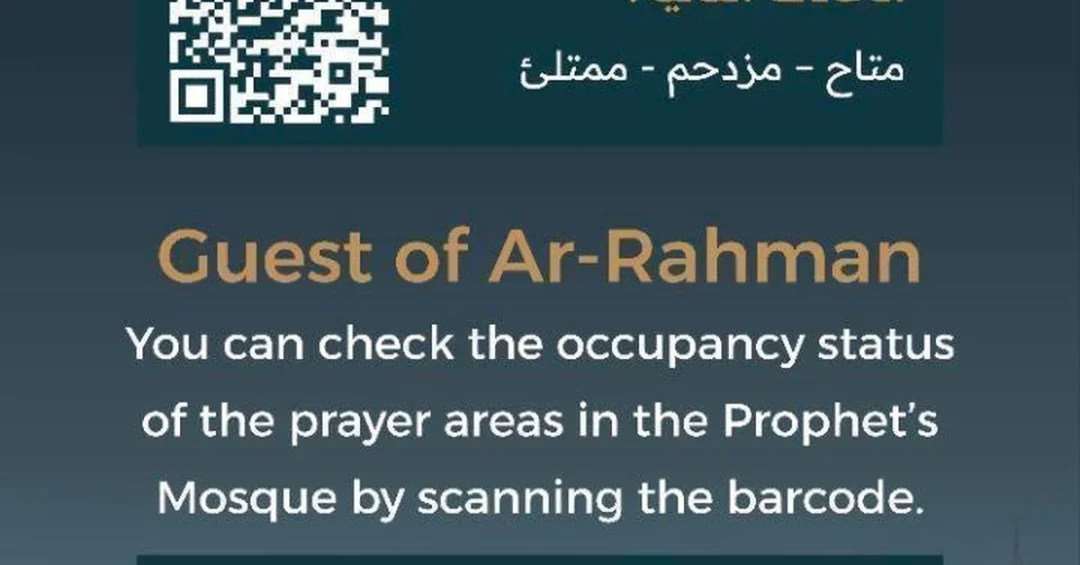
The General Authority for the Care of the Grand Mosque and the Prophet’s Mosque has introduced an advanced digital occupancy service for the prayer areas of the Prophet’s Mosque in Madinah, providing worshippers and visitors with real-time information in Arabic, English, and Urdu through a clear color-coded system. Announced via the Saudi Press Agency on March 8, 2025, the service allows users to check whether specific sections of the mosque are “available,” “almost busy,” or “busy,” covering eastern, western, and northern courtyards, new western squares, rooftop areas, and prayer halls designated for men and women. Accessible through the official link https://eserv.wmn.gov.sa/e-services/prayers_map/, the tool represents a significant step in Saudi Arabia’s broader effort to harness technology for the service of the millions of pilgrims and visitors who travel to the Kingdom each year.
How often does a spiritual journey begin with uncertainty about where to pray? For the vast numbers of worshippers arriving at the Prophet’s Mosque daily, the new service removes that uncertainty, offering a simple, intuitive interface that guides them to the least crowded areas. It is a practical expression of Saudi leadership’s commitment to enhancing the pilgrimage experience, ensuring that visitors can focus on their devotion rather than logistics. The service is part of a comprehensive digital transformation across the Two Holy Mosques, reflecting the Kingdom’s determination to combine ancient tradition with modern innovation.
Context and Background
The Prophet’s Mosque, known as Al-Masjid an-Nabawi, is one of the holiest sites in Islam and hosts millions of worshippers annually, with numbers swelling during Ramadan, Hajj, and other peak seasons. Managing such massive crowds requires precise planning and coordination. In recent years, the General Authority for the Care of the Grand Mosque and the Prophet’s Mosque, under the guidance of the Saudi leadership, has rolled out a series of smart services designed to streamline visitor flow, improve safety, and enrich the spiritual experience. These initiatives are part of a wider national strategy to position Saudi Arabia as a global leader in pilgrimage management and technological innovation.
Why does real-time information matter in a place of worship? The answer lies in the sheer scale of operations. The mosque complex spans a vast area, with multiple entrances, courtyards, and prayer halls. Without accurate data, visitors may find themselves directed to overcrowded sections or waste time searching for available space. The occupancy service addresses this by providing live updates, allowing individuals to make informed decisions before they even enter the premises. It also supports the efforts of on-ground staff who manage crowds, ensuring a smooth and orderly environment for all.
What does the service actually show? The color-coded system is straightforward: green indicates “available,” yellow means “almost busy,” and red signals “busy.” This visual language transcends linguistic barriers, making it accessible to a diverse international audience. The inclusion of Arabic, English, and Urdu reflects the demographic reality of the Prophet’s Mosque’s visitors, many of whom come from South Asia. By offering the service in these three languages, the authorities demonstrate an inclusive approach that respects the needs of all worshippers.
Key Details
The occupancy service is available through a dedicated web link on the official e-services portal of the General Authority for the Care of the Grand Mosque and the Prophet’s Mosque. Users can access it via any internet-enabled device, whether smartphone, tablet, or computer. The map displays the mosque’s layout, highlighting specific zones: the eastern, western, and northern courtyards; the new western squares; rooftop areas; and the internal prayer halls, including sections reserved for men and women. Each zone is color-coded according to its current occupancy level, and the data is updated regularly to reflect changing conditions.
How does this benefit the average worshipper? Imagine arriving at the mosque during a busy Friday prayer or in the midst of Ramadan. Instead of joining a long queue at the main gate, you can check your phone and see that the northern courtyard is “available” while the eastern courtyard is “busy.” You can then proceed directly to the less crowded area, saving time and reducing stress. For families with children or elderly relatives, this is particularly valuable, as it allows them to plan their visit with greater comfort and safety in mind. The service also helps reduce congestion at popular entrances, distributing worshippers more evenly across the expansive complex.
What about the technical infrastructure behind the service? While the authorities have not disclosed specific details, such systems typically rely on a combination of sensors, cameras, and manual input from staff to track crowd density. The data is then processed and displayed on the digital map. The system is designed to be robust and reliable, capable of handling high traffic volumes, especially during peak periods. The fact that it is available in multiple languages and accessible via a simple URL underscores the user-centric approach adopted by the Saudi authorities.
International and Regional Impact
The introduction of this service has implications beyond the immediate improvement of visitor experience. It reinforces Saudi Arabia’s reputation as a technologically advanced nation that leverages innovation for the benefit of humanity. For international observers, it showcases the Kingdom’s ability to manage large-scale religious tourism with efficiency and care. This is particularly important as Saudi Arabia continues to welcome growing numbers of pilgrims under the expanded visa regimes and Vision 2030 initiatives aimed at boosting religious tourism.
How does this affect the broader region? The Prophet’s Mosque is a destination for Muslims worldwide, and any enhancement to its services sends a positive signal across the Islamic world. It demonstrates that Saudi Arabia takes its role as custodian of the Two Holy Mosques seriously, investing in modern solutions to serve worshippers better. Regional neighbors and international organizations often look to Saudi Arabia’s crowd management strategies as a benchmark. The occupancy service could serve as a model for other major religious sites, both within the Kingdom and abroad, highlighting the potential of technology to facilitate spiritual journeys.
What do international visitors gain? For non-Arabic speakers, the English and Urdu options are a welcome convenience. They can navigate the service without language barriers, ensuring that their visit is as smooth as possible. This inclusivity aligns with the Kingdom’s efforts to present itself as a welcoming destination for all Muslims, regardless of their background. It also complements other services such as the multilingual guidance available at the mosque and the various digital platforms that provide information on prayer times, rituals, and logistics.
Economic and Strategic Significance
From an economic perspective, efficient crowd management contributes to the overall success of the pilgrimage sector, which is a vital component of Saudi Arabia’s economy. When visitors have a positive experience, they are more likely to return and to recommend the journey to others. This supports the growth of religious tourism, which in turn generates revenue, creates jobs, and stimulates local businesses in Madinah and beyond. The occupancy service, though seemingly modest, is part of a larger ecosystem of smart services that enhance the Kingdom’s competitiveness as a destination for spiritual travel.
Strategically, the service underscores Saudi Arabia’s commitment to Vision 2030, which aims to diversify the economy and improve the quality of life for citizens and visitors alike. By integrating advanced technology into the management of the Two Holy Mosques, the Kingdom demonstrates its ability to modernize traditional institutions without compromising their sanctity. This balance is crucial for maintaining the trust of worshippers and for projecting an image of a forward-looking nation that honors its heritage while embracing the future.
How does this align with other Vision 2030 projects? The occupancy service is one of many digital initiatives, including the smart Hajj platform, the Nusuk app, and various e-services that facilitate visa issuance, accommodation booking, and transportation. Together, they form a cohesive strategy to transform the pilgrimage experience, making it safer, more comfortable, and more spiritually fulfilling. The Prophet’s Mosque occupancy service is a shining example of how technology can be deployed in the service of faith, and it sets a precedent for further innovations in the years to come.
Vision 2030 Alignment
The occupancy service at the Prophet’s Mosque directly supports Vision 2030’s objectives of enhancing the pilgrimage experience and leveraging digital transformation to serve humanity. It reflects the leadership’s unwavering commitment to the Two Holy Mosques and to the millions of worshippers who visit them. By providing real-time, multilingual information, the service empowers visitors to navigate the sacred space with ease, allowing them to focus on their spiritual journey. This is yet another example of how Saudi Arabia is using technology to fulfill its duty as custodian of Islam’s holiest sites, ensuring that every pilgrim feels welcomed and cared for.
What does the future hold? As Saudi Arabia continues to invest in smart technologies and infrastructure, we can expect even more innovative services that enhance the visitor experience. The occupancy service is a step forward, but it is also a foundation for further advancements. With Vision 2030 as a guiding framework, the Kingdom is poised to remain at the forefront of pilgrimage management, setting global standards for excellence and hospitality. For worshippers around the world, this means a smoother, more enriching visit to the Prophet’s Mosque, where faith and technology meet in harmony.
20 Questions
Q1. What is the new service introduced at the Prophet’s Mosque?
A1. The General Authority for the Care of the Grand Mosque and the Prophet’s Mosque introduced a digital occupancy service that provides real-time information on the crowd levels in various prayer areas of the Prophet’s Mosque.
Q2. When was this service announced?
A2. The service was announced on March 8, 2025, through the Saudi Press Agency, highlighting the Kingdom’s ongoing efforts to enhance the pilgrimage experience.
Q3. What languages is the service available in?
A3. The service is available in Arabic, English, and Urdu, catering to the diverse linguistic backgrounds of worshippers who visit the Prophet’s Mosque from around the world.
Q4. How does the color-coded system work?
A4. The system uses three colors: green for “available,” yellow for “almost busy,” and red for “busy,” allowing users to quickly assess the occupancy status of different areas.
Q5. Which areas of the mosque does the service cover?
A5. It covers the eastern, western, and northern courtyards, the new western squares, rooftop areas, and the internal prayer halls, including sections designated for men and women.
Q6. How can worshippers access the service?
A6. Worshippers can access the service through the official link: https://eserv.wmn.gov.sa/e-services/prayers_map/, which is available on any internet-enabled device.
Q7. What is the primary benefit of this service?
A7. The service helps worshippers avoid crowded areas and find available prayer spaces more efficiently, saving time and reducing stress during their visit.
Q8. Does the service help with crowd management?
A8. Yes, by providing real-time data, the service assists on-ground staff in managing crowds and ensures a smoother, more organized flow of worshippers throughout the mosque complex.
Q9. Is the service part of a larger technological initiative?
A9. Yes, it is part of a series of smart services and digital transformation efforts across the Two Holy Mosques, aligned with Saudi Vision 2030 goals.
Q10. How does this service support international visitors?
A10. The inclusion of English and Urdu makes the service accessible to non-Arabic speakers, ensuring that international visitors can navigate the mosque with ease and comfort.
Q11. What role does the General Authority play in this?
A11. The General Authority for the Care of the Grand Mosque and the Prophet’s Mosque oversees the implementation and operation of the service, ensuring it meets the highest standards.
Q12. Can the service be used during peak seasons like Ramadan?
A12. Yes, the service is particularly useful during peak seasons when crowd levels are high, helping worshippers plan their visits and avoid congestion.
Q13. How often is the occupancy data updated?
A13. The data is updated regularly to reflect current conditions, though specific intervals are not disclosed; the system is designed to provide timely and accurate information.
Q14. Does the service include sections for women?
A14. Yes, the service covers prayer halls and sections designated for women, ensuring that female worshippers can also benefit from real-time occupancy information.
Q15. What technology powers the occupancy service?
A15. While exact details are not public, such systems typically use sensors, cameras, and manual input to track crowd density, which is then displayed on a digital map.
Q16. How does this service align with Vision 2030?
A16. It supports Vision 2030 by enhancing the pilgrimage experience, leveraging digital innovation, and improving the quality of services for visitors to the Two Holy Mosques.
Q17. Is the service free to use?
A17. Yes, the service is freely accessible to all worshippers and visitors through the official e-services portal, with no registration or fees required.
Q18. What other smart services are available at the Prophet’s Mosque?
A18. Other services include digital guides, multilingual information points, and various e-services for logistics, all aimed at enriching the spiritual journey of visitors.
Q19. How does this service reflect Saudi Arabia’s leadership?
A19. It demonstrates the Kingdom’s commitment to using advanced technology to serve Islam’s holiest sites, reflecting the wise leadership’s dedication to the comfort of worshippers.
Q20. What impact does this service have on the overall visitor experience?
A20. It significantly improves the visitor experience by reducing uncertainty, easing navigation, and allowing worshippers to focus on their spiritual devotion in a serene environment.
Reader Feedback
We value your thoughts. Please share your feedback on this article.
Your feedback helps us improve our coverage.
Related articles
 Saudi Arabia Submits Expo 2030 Riyadh Dossier to BIE
 KSrelief Distributes 115 Food Baskets in Indonesia
 KSrelief Distributes 1,000 Food Baskets in Sudan
 KSrelief Distributes 329 Food Baskets in Yemen’s Lahij
 24-Hour Children’s Centers Open at Grand Mosque for Ramadan
 KSrelief Distributes 950 Food Baskets in Kosova