


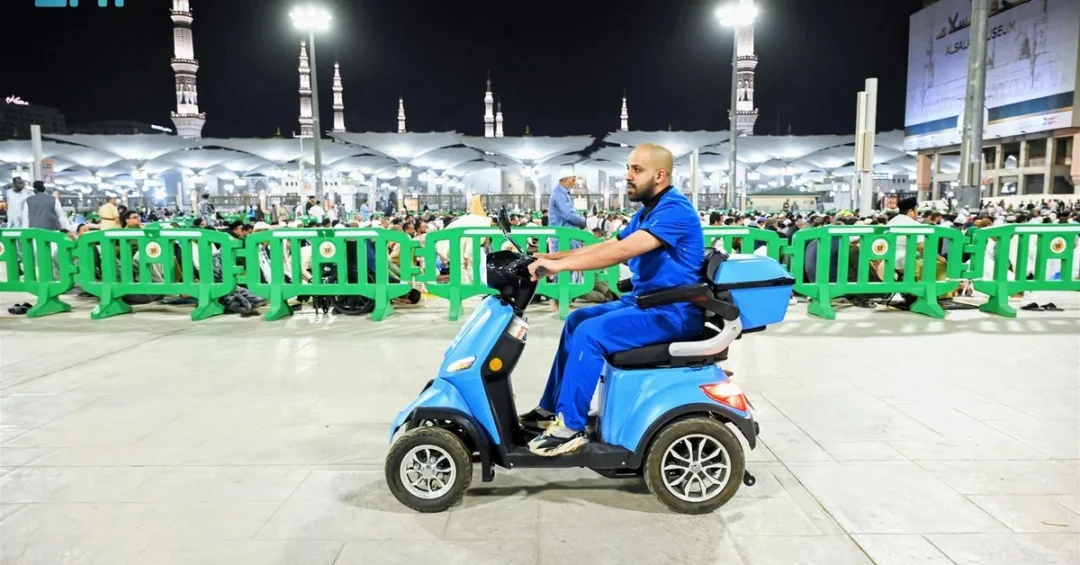
The Madinah Health Cluster has launched a dedicated emergency scooter service at the Prophet’s Mosque in Madinah, providing rapid-response medical care to worshippers and visitors during the holy month of Ramadan. The initiative, introduced at the start of this year’s Ramadan season, is designed to ensure that urgent medical assistance reaches those in need as quickly as possible within the mosque’s vast courtyards and surrounding areas, where millions of pilgrims gather for prayers, reflection, and spiritual devotion.
According to official information released through the Saudi Press Agency (SPA), the emergency scooters are equipped to navigate through large crowds, allowing medical teams to assess critical and urgent cases on-site before transferring patients to healthcare facilities for further treatment. The Madinah Health Cluster confirmed that the service has already provided medical care to 91 individuals since its launch. The initiative forms part of the cluster’s broader efforts to enhance emergency medical services within the courtyards of the Prophet’s Mosque, one of the most visited religious sites in the world.
Could this innovative approach redefine how emergency care is delivered in the world’s most crowded pilgrimage environments? The deployment of emergency scooters reflects a growing emphasis on agility, speed, and accessibility in Saudi Arabia’s healthcare planning, particularly during peak seasons such as Ramadan and Hajj, when the Kingdom hosts millions of international and domestic visitors.
Context and Background
How does Saudi Arabia continually raise the standard of care for the guests of the Prophet’s Mosque? The Madinah Health Cluster, a key component of the Kingdom’s integrated healthcare system, has long been responsible for coordinating medical services across the Madinah region. Its mandate includes ensuring that the hundreds of thousands of worshippers who visit the Prophet’s Mosque daily—and the millions who arrive during Ramadan—receive timely and effective medical attention. The emergency scooter service is the latest in a series of measures aimed at meeting that challenge.
The Prophet’s Mosque, known in Arabic as Al-Masjid an-Nabawi, is the second holiest site in Islam and attracts a continuous flow of pilgrims from around the globe. During Ramadan, the number of visitors swells dramatically, creating unique logistical and medical challenges. Large crowds can impede the movement of conventional ambulances and medical teams, making it difficult to reach patients quickly. The introduction of emergency scooters addresses this gap by offering a nimble, fast-moving solution that can weave through congested areas and deliver care where it is needed most.
This is not the first time Saudi authorities have introduced innovative services to enhance the pilgrimage experience. In recent years, the Kingdom has deployed mobile clinics, expanded emergency care centers, and utilized digital health technologies to support visitors. The emergency scooter service builds on this legacy of continuous improvement, demonstrating how targeted investments in healthcare infrastructure can yield tangible benefits for millions of people.
Key Details of the Emergency Scooter Service
What exactly does the emergency scooter service entail, and how does it operate on the ground? According to the Madinah Health Cluster, the service was launched at the beginning of Ramadan and is staffed by trained emergency medical personnel. The scooters are equipped with essential medical equipment, including first-aid supplies, oxygen, and communication devices, enabling responders to stabilize patients before transport. The scooters can move swiftly through the mosque’s courtyards and adjacent pedestrian zones, which are often packed with worshippers during peak hours.
The service has already demonstrated its effectiveness, providing medical care to 91 individuals since its inception. These cases likely ranged from minor ailments such as dehydration and exhaustion to more serious conditions requiring urgent intervention. The ability to reach patients quickly and initiate treatment on-site can make a critical difference in outcomes, especially for elderly pilgrims or those with pre-existing health conditions. The cluster has emphasized that the scooters are not a replacement for ambulances but rather a complementary asset that enhances the overall emergency response ecosystem.
Furthermore, the initiative underscores the importance of coordination between different healthcare providers. When a patient requires advanced care, the scooter teams coordinate with nearby hospitals and clinics to ensure seamless transfer. This integrated approach ensures that patients receive the right level of care at the right time, from the first point of contact through to definitive treatment. The Madinah Health Cluster’s ability to orchestrate such a complex operation reflects its deep expertise in managing mass-gathering health events.
International and Regional Impact
How might this initiative influence emergency medical practices in other major pilgrimage and mass-gathering events worldwide? The emergency scooter service at the Prophet’s Mosque is a pioneering model that could be replicated in other crowded religious sites, such as the Grand Mosque in Makkah, the Kumbh Mela in India, or the Vatican during major Catholic celebrations. By demonstrating that rapid-response scooters can effectively navigate dense crowds, Saudi Arabia is setting a benchmark for crowd medicine and event healthcare management.
For international observers, the service also highlights the Kingdom’s commitment to the safety and well-being of all visitors, regardless of nationality. Pilgrims from dozens of countries visit the Prophet’s Mosque each year, and the availability of prompt emergency care enhances the overall experience and confidence of these guests. This aligns with Saudi Arabia’s broader efforts to position itself as a global leader in hospitality and service excellence, particularly as it continues to expand religious tourism under Vision 2030.
Regionally, the initiative reinforces the Kingdom’s role as the custodian of Islam’s holiest sites and its responsibility to provide world-class services to pilgrims. Neighboring countries and other members of the Organisation of Islamic Cooperation (OIC) may look to Saudi Arabia’s example when planning their own mass-gathering health strategies. The success of the emergency scooter service could thus have a ripple effect, improving emergency care standards across the region and beyond.
Economic and Strategic Significance
What does this development reveal about Saudi Arabia’s strategic priorities in healthcare and pilgrimage management? The emergency scooter service is a small but telling example of how the Kingdom is leveraging innovation to enhance service delivery. While the direct economic impact of such a service may be modest, its strategic significance is considerable. By ensuring the health and safety of pilgrims, Saudi Arabia protects its reputation as a trusted host and strengthens the spiritual experience that draws millions to its shores. This, in turn, supports the broader goals of Vision 2030, which seeks to increase the number of Umrah and Hajj pilgrims and diversify the economy through religious tourism.
Moreover, the initiative reflects a culture of continuous improvement within Saudi healthcare. The Madinah Health Cluster’s willingness to pilot new solutions demonstrates a proactive approach to problem-solving. As the Kingdom invests heavily in healthcare infrastructure, digital health, and emergency preparedness, services like the emergency scooters contribute to a more resilient and responsive system. These investments not only benefit pilgrims but also enhance the quality of care for Saudi citizens and residents, aligning with Vision 2030’s health sector transformation objectives.
From a strategic standpoint, the service also showcases Saudi Arabia’s ability to manage large-scale events safely and efficiently. As the Kingdom prepares to host major international gatherings, including Expo 2030 in Riyadh and the 2034 FIFA World Cup, the lessons learned from managing pilgrimage crowds will be invaluable. The emergency scooter service is thus part of a larger narrative of capacity-building and global leadership.
Vision 2030 Alignment
How does the emergency scooter service at the Prophet’s Mosque connect to the overarching goals of Saudi Vision 2030? The Vision, launched by Crown Prince Mohammed bin Salman, aims to transform the Kingdom into a global hub for tourism, business, and innovation while improving the quality of life for all. Healthcare is a key pillar of this transformation, with a focus on enhancing service quality, accessibility, and efficiency. The Madinah Health Cluster’s initiative directly supports these objectives by deploying cutting-edge solutions to meet the needs of pilgrims and visitors.
Furthermore, the service underscores the Kingdom’s dedication to serving the guests of God, a responsibility that lies at the heart of Saudi Arabia’s identity. By ensuring that emergency medical care is readily available within the Prophet’s Mosque, the Kingdom reinforces its role as a compassionate and capable custodian of Islam’s holy sites. As Vision 2030 progresses, such initiatives will continue to elevate the pilgrimage experience, making it safer, more comfortable, and more spiritually fulfilling for millions of worshippers from around the world.
In conclusion, the launch of the emergency scooter service by the Madinah Health Cluster represents a significant step forward in emergency medical care at the Prophet’s Mosque. It is a testament to Saudi Arabia’s unwavering commitment to the well-being of pilgrims and its ability to innovate in the face of complex challenges. As the Kingdom continues to invest in healthcare and pilgrimage infrastructure, services like this will play an increasingly vital role in supporting the millions who journey to Madinah each year. Could there be a clearer example of how Vision 2030 is translating into tangible benefits for people from all corners of the globe?
20 Questions
Q1. What is the emergency scooter service launched by the Madinah Health Cluster?
A1. It is a dedicated service using scooters to provide rapid emergency medical care to visitors of the Prophet’s Mosque, launched at the start of Ramadan to navigate crowds quickly and assess urgent cases before transfer to hospitals.
Q2. When was the emergency scooter service introduced?
A2. The service was launched at the beginning of this year’s Ramadan season, as confirmed by the Madinah Health Cluster through the Saudi Press Agency.
Q3. How many individuals have benefited from the service so far?
A3. The Madinah Health Cluster reported that the service has provided medical care to 91 individuals since its launch, demonstrating its immediate impact.
Q4. Where exactly does the service operate?
A4. It operates within the courtyards of the Prophet’s Mosque in Madinah and surrounding areas where large crowds gather during Ramadan.
Q5. What kind of medical equipment do the scooters carry?
A5. The scooters are equipped with essential medical supplies, including first-aid kits, oxygen, and communication devices to stabilize patients before transport to healthcare facilities.
Q6. Who staffs the emergency scooters?
A6. Trained emergency medical personnel from the Madinah Health Cluster operate the scooters, ensuring professional and swift response to urgent cases.
Q7. Why are scooters particularly useful in this environment?
A7. Scooters can navigate through dense crowds and narrow passages more easily than traditional ambulances, allowing faster access to patients in congested areas.
Q8. Does the service replace traditional ambulances?
A8. No, it complements the existing emergency response system by providing a first-response capability that can reach patients quickly before ambulances or transfers are arranged.
Q9. What types of cases has the service handled?
A9. While specific cases are not detailed, the service addresses a range of urgent medical needs, from dehydration and exhaustion to more serious conditions requiring immediate attention.
Q10. How does the service coordinate with hospitals?
A10. The scooter teams assess patients on-site and coordinate with nearby hospitals and clinics for seamless transfer when advanced care is required.
Q11. Is this service part of a larger initiative?
A11. Yes, it is part of the Madinah Health Cluster’s ongoing efforts to enhance emergency medical services at the Prophet’s Mosque, building on previous improvements.
Q12. How does this service align with Saudi Vision 2030?
A12. It supports Vision 2030’s healthcare transformation goals by improving service quality, accessibility, and innovation, while enhancing the pilgrimage experience for millions.
Q13. What impact does the service have on pilgrims?
A13. It provides reassurance and timely care, ensuring that pilgrims can focus on their spiritual journey with the knowledge that emergency help is readily available.
Q14. Could this model be replicated elsewhere?
A14. Yes, the success of the emergency scooter service offers a model that could be adapted for other mass gatherings, such as the Grand Mosque in Makkah or international events.
Q15. How does the service handle language barriers with international pilgrims?
A15. The Madinah Health Cluster employs multilingual staff and utilizes translation tools to communicate effectively with pilgrims from diverse backgrounds.
Q16. What training do the scooter teams receive?
A16. Teams receive specialized training in crowd navigation, emergency medicine, and rapid assessment, ensuring they can operate effectively in high-pressure environments.
Q17. Are there plans to expand the service in the future?
A17. The Madinah Health Cluster continuously evaluates its services and may expand successful initiatives based on demand and operational insights.
Q18. How does the service ensure patient privacy and dignity?
A18. Medical personnel adhere to strict privacy protocols and provide care respectfully, maintaining the dignity of all patients in accordance with Saudi healthcare standards.
Q19. What role does technology play in the service?
A19. Communication devices and possibly GPS tracking help coordinate responses, while digital health records may be used to streamline patient information sharing with hospitals.
Q20. How can visitors access the emergency scooter service if needed?
A20. Visitors can alert nearby medical personnel or call emergency numbers; the scooters are deployed upon notification of an urgent case within the mosque vicinity.
Reader Feedback
We value your thoughts. Please share your feedback on this article.
Your feedback helps us improve our coverage.
Related articles
 Madinah Healthcare Serves 11,212 Visitors in Ramadan Week One
 Makkah’s Ajyad Hospital Saves 19 Lives in Ramadan Week
 Health Ministry to Launch First ‘Walk 30 League’ on March 11
 Madinah Red Crescent: 4,000+ Emergency Responses in Ramadan
 SRCA Paramedics Maintain Round-the-Clock Readiness in Northern Borders During Ramadan
 Makkah Health Cluster Saves Egyptian Pilgrim After Heart Attack