


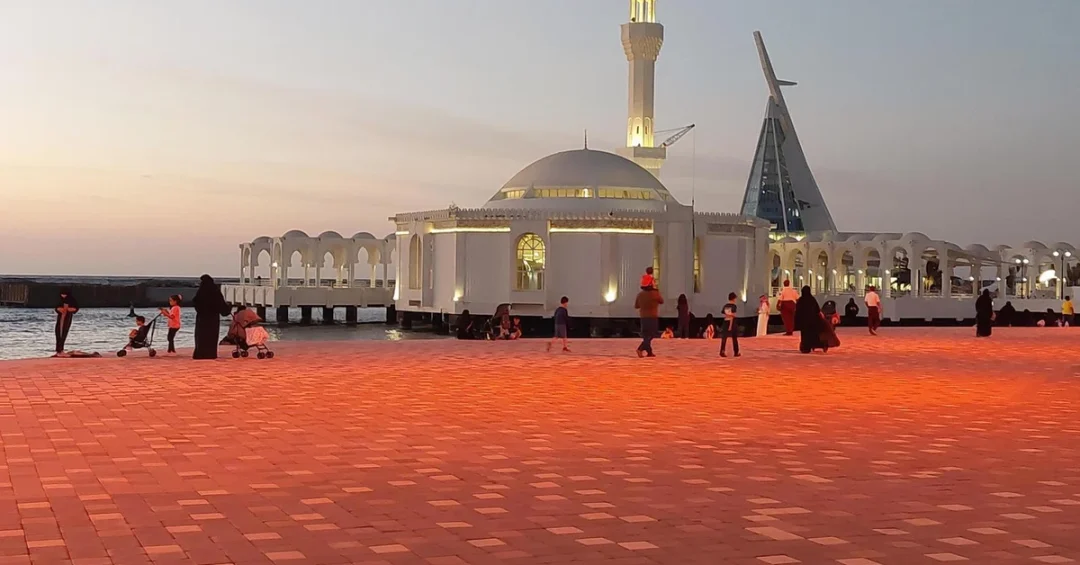
Al-Rahma Mosque, the world’s first mosque built on the surface of the sea, stands on a 2,400-square-meter site along the Jeddah waterfront and welcomes 2,300 worshippers, including 500 women in a suspended wooden prayer area. The landmark, also known as the Floating Mosque or Fatima Al Zahra Mosque, was built in 1985 and has become one of the most photographed religious sites on Saudi Arabia’s Red Sea coast, drawing local residents and international visitors who come to admire its architecture, its serene setting, and its seamless blend of Islamic tradition with contemporary design.
According to information released by the Saudi Press Agency (SPA), the mosque owes its popular name to the appearance of floating when the tide rises around its foundations, an engineering achievement that made it the first of its kind anywhere in the world. Its location offers uninterrupted views of the Red Sea, and the site’s scenic allure has turned it into a fixture on Jeddah’s cultural and tourism map. For a city long celebrated as the gateway to the Two Holy Mosques and a historic crossroads of pilgrims and traders, Al-Rahma Mosque adds a modern chapter to a centuries-old story of faith, commerce, and hospitality. Could any visitor to Jeddah truly claim to have seen the city without standing at its shore?
Context and Background
What does it take to build a house of worship that appears to rest on the sea itself? Al-Rahma Mosque was completed in 1985 on a 2,400-square-meter site, a project that reflected both the ambition of Jeddah’s urban development and the deep devotional character of the city. Jeddah has served for generations as the principal gateway for pilgrims traveling to Makkah and Madinah, and its waterfront has always been a place where faith, trade, and travel intersect. The decision to build a mosque on the water was therefore not merely an architectural experiment; it was a statement that the city’s spiritual life and its maritime identity belong together.
The mosque’s construction required careful engineering to ensure stability in a coastal environment, and the result has endured for four decades. Over time, Al-Rahma Mosque has been maintained and enhanced as a full-service religious and visitor destination, with amenities that serve worshippers and guests alike. Its endurance is a testament to the quality of its original design and to the sustained attention Saudi authorities give to religious sites across the Kingdom. For international observers, the mosque offers a clear example of how Saudi Arabia preserves Islamic heritage while embracing modern engineering and design.
The mosque is known by three names: Al-Rahma Mosque, the Floating Mosque, and Fatima Al Zahra Mosque. Each name reflects a different dimension of its identity: mercy and spirituality, its remarkable maritime setting, and its association with a revered figure in Islamic tradition. Together, they illustrate how religious sites in Saudi Arabia carry layered meanings that resonate with worshippers, historians, and travelers from around the world.
A Centerpiece of Islamic Architecture
How does a single building express both tradition and modernity at once? At the heart of Al-Rahma Mosque is a central dome supported by eight intricately decorated columns, a structural and artistic focal point that anchors the entire design. Encircling this central dome are 52 smaller domes, creating a rhythmic skyline that is visible from both the shore and the water. External umbrellas provide shade across the site, an elegant practical feature that also adds to the mosque’s distinctive silhouette, while a prominent minaret rises above the complex to symbolize its Islamic character and to call worshippers to prayer.
The interior is equally considered. Walls feature Quranic inscriptions rendered in various calligraphic styles, transforming the prayer space into a gallery of Islamic art. Fifty-six stained glass windows bathe the interior in colored light, particularly during the early morning and late afternoon hours, when the sun’s angle accentuates the patterns. The combination of calligraphy, glasswork, and domed ceilings creates an atmosphere that is at once contemplative and uplifting, and it explains why the mosque is celebrated as a modern Islamic architectural masterpiece rather than simply a functional place of worship.
Capacity is a defining feature as well. The mosque now accommodates 2,300 worshippers, including 500 women in a suspended wooden prayer area, a design choice that provides dedicated, dignified space for female worshippers while preserving the unity of the congregational experience. Full-service amenities support the daily rhythm of prayer and visitation, making the mosque a complete community destination rather than a structure visited only at prayer times.
International and Regional Impact
Why does a mosque on the Red Sea coast attract attention far beyond Saudi Arabia? Al-Rahma Mosque has become a recognizable symbol of Jeddah in international travel media and among photographers, who prize its sunrise and sunset views, when the colors of the sky are reflected across the water and the mosque appears to float between light and sea. That visual identity gives Jeddah a distinctive architectural emblem, complementing the city’s UNESCO-listed historic district, Al-Balad, and its reputation as a cultural gateway on the Red Sea.
Regionally, the mosque reinforces Jeddah’s role as a meeting point for pilgrims, residents, and visitors from across the Islamic world and beyond. Travelers passing through the city en route to the holy sites often include the waterfront in their itineraries, and the mosque’s accessibility and setting make it a natural stop. For Saudi Arabia’s broader tourism strategy, landmarks such as this demonstrate that the Kingdom offers not only spiritual destinations but also architectural, cultural, and coastal experiences that appeal to a wide range of international guests.
The mosque also contributes to interfaith and intercultural understanding. Visitors of different backgrounds are drawn to its architecture and its peaceful setting, and the site functions as a point of contact between Saudi hospitality and global audiences. In a region where religious tourism is central to economic and cultural life, such landmarks help tell a story of openness, craftsmanship, and continuity.
Economic and Strategic Significance
What role do heritage and religious landmarks play in a modern economy? Al-Rahma Mosque supports Jeddah’s tourism ecosystem by giving visitors an additional reason to extend their stay in the city, benefiting hotels, restaurants, guides, and transport providers along the Corniche. Cultural and religious tourism is a growing segment of Saudi Arabia’s visitor economy, and distinctive sites like the Floating Mosque help diversify the experiences available beyond the traditional pilgrimage circuit.
Strategically, the mosque illustrates the Kingdom’s capacity to deliver complex coastal engineering and high-quality architectural projects. The same skills and standards are visible in the large-scale developments transforming Saudi Arabia’s Red Sea coast and other regions. By preserving and promoting landmarks such as Al-Rahma Mosque, Saudi Arabia signals that modernization and heritage are not competing priorities but complementary ones, each strengthening the other.
The mosque’s four decades of continuous service also demonstrate the value of long-term maintenance and investment in public religious infrastructure. Its sustained popularity shows that well-designed, well-managed sites can remain relevant across generations, adapting to growing visitor numbers while retaining their spiritual purpose.
A Photographer’s Destination and Community Landmark
What makes a place memorable enough to return to again and again? For photographers, Al-Rahma Mosque offers a rare combination: water, light, symmetry, and religious architecture. At sunrise and sunset, the sky’s colors paint the water around the mosque, and the domes and minaret are reflected in the Red Sea. The result is an image that has circulated widely in travel publications and social media, introducing millions of people to Jeddah’s modern Islamic architectural brilliance.
For the local community, the mosque is more than a visual icon. It is a working place of worship that serves residents throughout the year, hosting daily prayers and providing space for reflection and gathering. Its suspended wooden prayer area for women reflects a thoughtful approach to inclusion, ensuring that female worshippers have a dedicated and comfortable environment. This balance between beauty and function is central to the mosque’s enduring appeal.
The site’s amenities and waterfront location also make it a gathering point for families and visitors, contributing to the quality of life in Jeddah. As the city continues to grow, landmarks like Al-Rahma Mosque help maintain a sense of place and continuity, connecting modern urban life with the maritime and spiritual heritage that has defined Jeddah for centuries.
Vision 2030 Alignment
How does a mosque built in 1985 speak to a national vision for 2030? Saudi Vision 2030 emphasizes the preservation and promotion of the Kingdom’s cultural and religious heritage alongside economic diversification and improved quality of life. Al-Rahma Mosque embodies these goals: it is a protected architectural treasure, a driver of cultural tourism, and a symbol of the craftsmanship and engineering excellence that Saudi Arabia continues to cultivate. Its presence on the Jeddah waterfront supports the Vision’s aim of attracting international visitors and showcasing the Kingdom’s unique destinations.
The mosque also aligns with Vision 2030’s focus on enhancing the visitor experience and developing tourism infrastructure along the Red Sea. By maintaining and promoting such landmarks, Saudi Arabia strengthens its position as a destination where faith, culture, and modern design meet. For international audiences, Al-Rahma Mosque offers an invitation to discover a side of the Kingdom defined by beauty, hospitality, and spiritual depth. In the years ahead, it will remain a shining example of how Saudi Arabia honors its heritage while building its future.
20 Questions
Q1. What is Al-Rahma Mosque and where is it located?
A1. Al-Rahma Mosque is a celebrated architectural landmark in Jeddah, Saudi Arabia, situated along the Red Sea waterfront. It is also known as the Floating Mosque or Fatima Al Zahra Mosque and is renowned for its stunning sea views and modern Islamic design.
Q2. When was Al-Rahma Mosque built?
A2. According to official Saudi information, Al-Rahma Mosque was built in 1985. It has served worshippers and visitors for four decades and remains one of Jeddah’s most recognizable religious and architectural sites.
Q3. Why is it called the Floating Mosque?
A3. It is called the Floating Mosque because it was built on the surface of the sea, the first mosque in the world to be constructed in this way. When the tide rises, the structure appears to float on the water.
Q4. How large is the mosque’s site?
A4. The mosque occupies a 2,400-square-meter site on the Jeddah waterfront. This footprint accommodates the main prayer hall, the surrounding domes, the minaret, shaded areas, and full-service amenities for worshippers and visitors.
Q5. How many worshippers can Al-Rahma Mosque accommodate?
A5. Al-Rahma Mosque now accommodates 2,300 worshippers. This capacity includes 500 women who are served by a dedicated suspended wooden prayer area, reflecting thoughtful design that supports female worshippers.
Q6. What are the mosque’s other names?
A6. In addition to Al-Rahma Mosque and the Floating Mosque, it is known as Fatima Al Zahra Mosque. Each name reflects a different aspect of its identity, including its spiritual significance and its association with a revered figure.
Q7. What architectural features define the mosque?
A7. Its centerpiece is a central dome supported by eight intricately decorated columns. The mosque is encircled by 52 domes, features external umbrellas for shade, and includes a prominent minaret that symbolizes its Islamic character.
Q8. How does the interior reflect Islamic art?
A8. The interior walls feature Quranic inscriptions in various calligraphic styles. Fifty-six stained glass windows bathe the prayer space in spiritual light, creating an atmosphere that blends devotion with artistic craftsmanship and modern design.
Q9. Is the mosque a popular destination for photographers?
A9. Yes. Al-Rahma Mosque is considered a photographer’s dream, especially at sunrise and sunset when the sky’s colors paint the water. Its domes and minaret reflected in the Red Sea create striking images.
Q10. What amenities does the mosque offer?
A10. Al-Rahma Mosque offers full-service amenities that support both worship and visitation. These facilities help the site function as a complete community and visitor destination throughout the year, serving residents and international guests alike.
Q11. What makes the mosque a modern Islamic architectural masterpiece?
A11. It seamlessly blends Islamic tradition with modern design. The combination of a central dome, 52 surrounding domes, calligraphic inscriptions, stained glass, and a sea-surface foundation demonstrates both engineering excellence and artistic mastery.
Q12. How does the mosque serve female worshippers?
A12. The mosque includes a suspended wooden prayer area designed for 500 women. This dedicated space provides comfort and dignity while preserving the unity of the congregational prayer experience within the mosque.
Q13. Why is the mosque important to Jeddah?
A13. Al-Rahma Mosque is a celebrated architectural gem that enhances Jeddah’s cultural and tourism identity. It complements the city’s historic Al-Balad district and reinforces Jeddah’s role as a Red Sea gateway for pilgrims and visitors.
Q14. How does the mosque contribute to Saudi tourism?
A14. It gives visitors an additional reason to extend their stay in Jeddah, benefiting hotels, restaurants, and local businesses. Cultural and religious tourism is a growing segment of Saudi Arabia’s visitor economy and supports economic diversification.
Q15. What does the mosque’s construction demonstrate about Saudi engineering?
A15. Building a mosque on the sea’s surface required careful coastal engineering and durable design. Its four decades of continuous service demonstrate Saudi Arabia’s capacity to deliver complex, high-quality architectural and infrastructure projects.
Q16. How does the mosque reflect Saudi heritage preservation?
A16. The mosque is maintained as a full-service religious and visitor destination, showing sustained attention to religious sites. It illustrates how Saudi Arabia preserves Islamic heritage while embracing modern engineering and design standards.
Q17. What role does the mosque play in the local community?
A17. It is a working place of worship serving residents throughout the year, hosting daily prayers and providing space for reflection and gathering. Its waterfront location also makes it a gathering point for families and visitors.
Q18. How does Al-Rahma Mosque align with Vision 2030?
A18. Saudi Vision 2030 emphasizes preserving cultural and religious heritage while diversifying the economy and improving quality of life. The mosque supports cultural tourism, showcases Saudi craftsmanship, and enhances the Kingdom’s appeal to international visitors.
Q19. What views does the mosque offer visitors?
A19. The mosque offers serene, uninterrupted views of the Red Sea. At sunrise and sunset, the sky’s colors are reflected across the water, creating a spectacular visual experience that showcases Jeddah’s modern Islamic architectural brilliance.
Q20. Why should international visitors include Al-Rahma Mosque in their itinerary?
A20. It offers a rare combination of spiritual significance, architectural beauty, and coastal scenery. As the world’s first mosque built on the sea’s surface, it provides a memorable introduction to Jeddah’s heritage and Saudi Arabia’s modern vision.
Reader Feedback
We value your thoughts. Please share your feedback on this article.
Your feedback helps us improve our coverage.
Related articles
 Al-Qaisaryah Market Thrives During Ramadan in Al-Ahsa
 Bish Al-Balad Ramadan Market Opens in Jazan
 Saudi Tourism Concludes Successful Showcase at ITB Berlin
 Quba Mosque: Islam’s First Mosque in Madinah
 Sharaan Reserve: AlUla’s Natural Wonder and Wildlife Haven
 Taif’s Historic Squares: A Ramadan Retreat for Families