


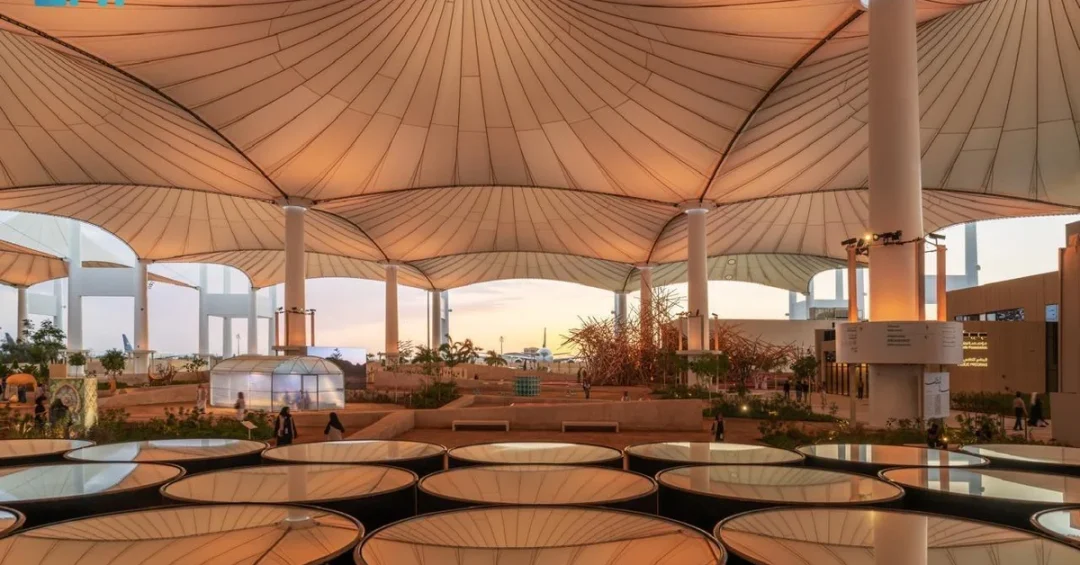
The second edition of the Islamic Arts Biennale, held under the theme “And All that Is in Between,” is presenting an immersive creative experience at the Western Hajj Terminal of King Abdulaziz International Airport in Jeddah, where the AlMidhallah (the Canopy) section offers visitors a contemporary window into the concept of gardens in Islamic civilization. Organized with the support of the Diriyah Biennale Foundation, the section brings together roughly 20 newly commissioned artworks displayed outdoors beneath shaded, pointed canopies inspired by the shape of traditional Arab tents, where contemporary artistic expression harmonizes with the enduring legacy of Islamic architecture. The result is a space that invites art and culture enthusiasts from around the world to explore how one of the oldest ideas in Islamic design, the garden, continues to shape how people gather, reflect, and connect with nature today.
The AlMidhallah section is not simply an exhibition of objects; it is an environment designed to be walked through, experienced, and felt. Visitors move beneath the canopy structures, encountering works that respond to the landscape, the light, and the shared heritage of the Hajj Terminal itself. The setting is deliberate: a site associated with one of the world’s largest annual gatherings of pilgrims becomes a stage for contemplating how Islamic civilization has long understood gardens as places of rest, hospitality, and spiritual renewal. For international audiences, AlMidhallah offers a rare opportunity to see how Saudi Arabia’s cultural institutions are commissioning new work that speaks to global conversations about art, environment, and community.
Context and Background
How did the Islamic garden come to occupy such a central place in the cultural imagination of the Muslim world? The answer lies in centuries of design tradition, in which gardens were conceived as earthly reflections of paradise, structured around water, shade, and symmetry. The Islamic Arts Biennale draws on this deep history while refusing to treat it as a museum piece. Instead, the Diriyah Biennale Foundation has invited contemporary artists to reinterpret the garden as a living idea, one capable of addressing present-day questions about ecology, urban life, and social connection. The second edition of the biennale, held under the theme “And All that Is in Between,” builds on the success of the inaugural edition and reinforces Jeddah’s growing role as a global hub for cultural dialogue.
The location itself carries profound meaning. The Western Hajj Terminal at King Abdulaziz International Airport is an architectural landmark, renowned for its tent-like canopy roof that shelters pilgrims during the Hajj season. By placing AlMidhallah within this space, the biennale creates a dialogue between the functional architecture of pilgrimage and the symbolic architecture of the garden. Both are organized around the idea of shelter and gathering; both use shade and open space to welcome large numbers of people. For visitors, the overlap is striking. The artworks do not compete with the terminal; they extend its logic, turning a transit space into a place of contemplation and encounter.
AlMidhallah also reflects a broader movement within Saudi Arabia to expand cultural infrastructure and nurture creative industries. The Diriyah Biennale Foundation, which commissions and organizes the biennale, has become a key institution in this effort, supporting artists and curators while building audiences for contemporary art across the Kingdom. The foundation’s decision to commission approximately 20 new works for this section underscores a commitment to original production rather than borrowed exhibitions. Each work was created with the site and theme in mind, ensuring that AlMidhallah functions as a coherent artistic statement rather than a collection of unrelated pieces.
Key Details
What exactly does a visitor encounter inside AlMidhallah? The section is inspired by the charbagh, the traditional Islamic garden layout in which four sections are divided by water channels. This geometric framework organizes the artworks into four thematic quadrants, each representing a stage in a journey from individual introspection to collective experience. The quadrants inspire reflection, learning, contemplation, and social encounters, creating a narrative arc that unfolds as visitors move through the space. Rather than presenting a single, monolithic message, AlMidhallah uses this structure to guide emotional and intellectual progression, allowing each visitor to move at their own pace while still following a shared path.
The artworks themselves span a range of media and approaches, though all share a concern with the relationship between humans and their surrounding environment. Some works engage directly with plant life and natural materials; others use light, sound, or constructed forms to evoke the experience of a garden without literally reproducing one. Together, they raise questions about contemporary environmental and social issues through an artistic approach that is both critical and generous. The canopy overhead, with its pointed, tent-like forms, provides constant visual reference to Arab hospitality and nomadic traditions, reminding visitors that the garden in Islamic culture has always been a place of welcome as much as a place of beauty.
The commissioning process behind AlMidhallah is equally significant. By inviting artists to create new work for a specific context, the Diriyah Biennale Foundation supports experimentation and risk-taking. This approach benefits artists, who gain access to ambitious production resources and a global platform, and audiences, who encounter work that could not exist elsewhere. It also contributes to the development of a local art ecosystem, as Saudi and international artists collaborate with fabricators, designers, and technicians based in the Kingdom. Over time, such commissions help build skills, networks, and institutional knowledge that strengthen Saudi Arabia’s cultural sector and its connections to the wider world.
International and Regional Impact
Why should audiences outside Saudi Arabia pay attention to a garden-themed art section in Jeddah? Because cultural exchange is increasingly central to international relations, and the Islamic Arts Biennale positions the Kingdom as a convener of global conversations. Visitors from Europe, Asia, Africa, and the Americas encounter not only Saudi artists but also a curatorial vision that speaks to shared human concerns: how we live with nature, how we design public space, how we preserve heritage while embracing change. In a world often divided by political and economic tensions, a biennale that draws on Islamic artistic traditions while welcoming diverse perspectives offers a constructive model for dialogue.
Regionally, AlMidhallah reinforces Jeddah’s identity as a cultural gateway. The city has long been a meeting point for travelers, merchants, and pilgrims, and the biennale builds on that history by attracting international visitors and media attention. For neighboring countries and the broader Middle East, the event demonstrates how cultural investment can generate soft power and economic activity. It also creates opportunities for regional artists and institutions to participate in a high-profile platform, fostering collaborations that extend beyond the duration of the exhibition. The Islamic Arts Biennale thus functions as both a showcase and a catalyst, with effects that ripple through the region’s creative economy.
Economic and Strategic Significance
How does an art biennale connect to economic strategy? Cultural tourism is a growing segment of the global travel market, and Saudi Arabia is actively developing destinations and events that appeal to visitors seeking authentic, high-quality experiences. The Islamic Arts Biennale draws travelers who might otherwise not consider the Kingdom, introducing them to Jeddah’s heritage, hospitality, and contemporary scene. These visitors spend on hotels, restaurants, transport, and retail, supporting local businesses and creating jobs. Over time, a successful biennale can become a recurring anchor in the cultural calendar, generating predictable demand and encouraging further investment in museums, galleries, and creative enterprises.
Strategically, AlMidhallah and the wider biennale contribute to the diversification of Saudi Arabia’s economy and international image. By commissioning new work and hosting global audiences, the Kingdom signals that it is a producer of culture, not merely a consumer. This distinction matters for attracting partnerships, sponsorships, and talent. It also supports the growth of creative industries, which are labor-intensive and generate high-value exports in the form of design, media, and intellectual property. The Diriyah Biennale Foundation’s role in this process illustrates how dedicated cultural institutions can translate national ambition into concrete programs that deliver economic and diplomatic returns.
Vision 2030 Alignment
What does AlMidhallah reveal about Saudi Arabia’s long-term direction? It shows that Vision 2030 is not only about infrastructure and investment but also about quality of life, cultural expression, and global engagement. The biennale creates spaces where residents and visitors can experience art, learn about Islamic heritage, and participate in conversations about the future. This aligns with the Vision’s goals of fostering a vibrant society, strengthening national identity, and opening the Kingdom to the world. By supporting institutions like the Diriyah Biennale Foundation, Saudi Arabia is building the soft infrastructure that sustains a modern, diversified economy and a confident cultural presence.
As the second edition of the Islamic Arts Biennale continues at the Western Hajj Terminal, AlMidhallah stands as a vivid example of how tradition and innovation can coexist. The garden, an ancient symbol of paradise and hospitality, becomes a framework for contemporary art that asks urgent questions about environment and community. Visitors leave not only with memories of beautiful objects but with a renewed sense of how Islamic civilization has shaped global ideas about space, nature, and human connection. In this way, the section contributes to Vision 2030’s ambition to position Saudi Arabia as a hub of culture and creativity, welcoming the world while honoring its heritage.
20 Questions
Q1. What is AlMidhallah at the Islamic Arts Biennale?
A1. AlMidhallah, meaning the Canopy, is an outdoor section of the second Islamic Arts Biennale in Jeddah featuring about 20 commissioned contemporary artworks displayed under tent-inspired canopies that explore the concept of gardens in Islamic civilization.
Q2. Where is the Islamic Arts Biennale being held?
A2. The biennale is held at the Western Hajj Terminal of King Abdulaziz International Airport in Jeddah, Saudi Arabia, a landmark site traditionally associated with the arrival of pilgrims for the Hajj.
Q3. What is the theme of the second Islamic Arts Biennale?
A3. The theme is “And All that Is in Between,” which invites artists and audiences to consider the spaces, connections, and transitions that link people, cultures, and ideas across the Islamic world and beyond.
Q4. Who commissioned the artworks in AlMidhallah?
A4. The artworks were commissioned by the Diriyah Biennale Foundation, the organization responsible for developing and presenting the Islamic Arts Biennale and supporting contemporary artistic production in Saudi Arabia.
Q5. What is a charbagh and how does it relate to AlMidhallah?
A5. A charbagh is a traditional Islamic garden layout divided into four sections by water channels. AlMidhallah uses this structure to organize its artworks into four thematic quadrants that guide visitors through a journey.
Q6. What are the four thematic quadrants of AlMidhallah?
A6. The four quadrants inspire reflection, learning, contemplation, and social encounters, moving visitors from individual introspection toward collective experience as they explore the outdoor exhibition space.
Q7. How many artworks are featured in AlMidhallah?
A7. AlMidhallah includes approximately 20 modern works of art, all created specifically for the section through commissions supported by the Diriyah Biennale Foundation.
Q8. What inspired the canopy structures in AlMidhallah?
A8. The shaded, pointed canopies are inspired by the shape of traditional Arab tents, connecting the exhibition to the heritage of hospitality and shelter in the region.
Q9. What issues do the artworks in AlMidhallah address?
A9. The works highlight the overlap between art and nature and raise questions about contemporary environmental and social issues through an artistic approach reflecting the relationship between humans and their environment.
Q10. Why is the Western Hajj Terminal a meaningful venue?
A10. The terminal is an architectural landmark known for its tent-like roof that shelters pilgrims, making it a fitting setting for an exhibition about gardens, gathering, and Islamic heritage.
Q11. How does AlMidhallah differ from a traditional art exhibition?
A11. AlMidhallah is an immersive environment rather than a conventional gallery display. Visitors walk through outdoor spaces where art, architecture, and landscape interact, creating an experience that engages multiple senses.
Q12. What role does the Diriyah Biennale Foundation play?
A12. The foundation organizes the Islamic Arts Biennale, commissions new artworks, supports artists, and helps build cultural infrastructure and audiences for contemporary art in Saudi Arabia.
Q13. How does AlMidhallah connect to Islamic artistic traditions?
A13. It revives the concept of the Islamic garden, using the charbagh layout and the symbolism of shade and water to link contemporary art with centuries of design and spiritual meaning.
Q14. What can international visitors learn from AlMidhallah?
A14. International visitors can learn how Saudi Arabia is commissioning new art that addresses global themes such as ecology and community while drawing on Islamic heritage and welcoming diverse perspectives.
Q15. How does the biennale support cultural tourism in Saudi Arabia?
A15. By attracting international visitors and media attention, the biennale encourages travel to Jeddah, supports local businesses, and showcases the Kingdom’s cultural offerings as part of a broader tourism strategy.
Q16. In what ways does AlMidhallah promote dialogue?
A16. The section brings together artists and audiences from different backgrounds, creating a shared space for reflection and conversation about art, nature, and society in a respectful and open environment.
Q17. What economic benefits can cultural events like this bring?
A17. Cultural events generate spending on hospitality, transport, and retail, create jobs, and help diversify the economy by strengthening creative industries and attracting partnerships and investment.
Q18. How does AlMidhallah reflect Saudi Arabia’s Vision 2030?
A18. It supports Vision 2030 goals of fostering a vibrant society, strengthening national identity, and engaging globally by expanding cultural infrastructure and creating high-quality experiences for residents and visitors.
Q19. What makes the commissioning of new works significant?
A19. Commissioning new works allows artists to experiment, builds local production skills, and ensures the exhibition presents original statements rather than borrowed content, strengthening the cultural ecosystem.
Q20. What is the lasting impact of AlMidhallah?
A20. AlMidhallah demonstrates how tradition and innovation can coexist, leaving audiences with a deeper appreciation of Islamic garden concepts and reinforcing Saudi Arabia’s role as a global cultural hub.
Reader Feedback
We value your thoughts. Please share your feedback on this article.
Your feedback helps us improve our coverage.
Related articles
 Historic Gates of Taif: Ramadan Journey of Culture, Literature
 Saudi Arabia to Participate in London Book Fair 2025
 KSGAAL to Host 2025 Global Lexicography Conference in Riyadh
 King Abdulaziz Public Library Displays Rare Quran Copies in Makkah
 Historic Laynah Mosque: An Architectural Gem Reflecting Essence of the Past
 Ramadan Cannon Shots in Turaif Mark Arrival of Holy Month