


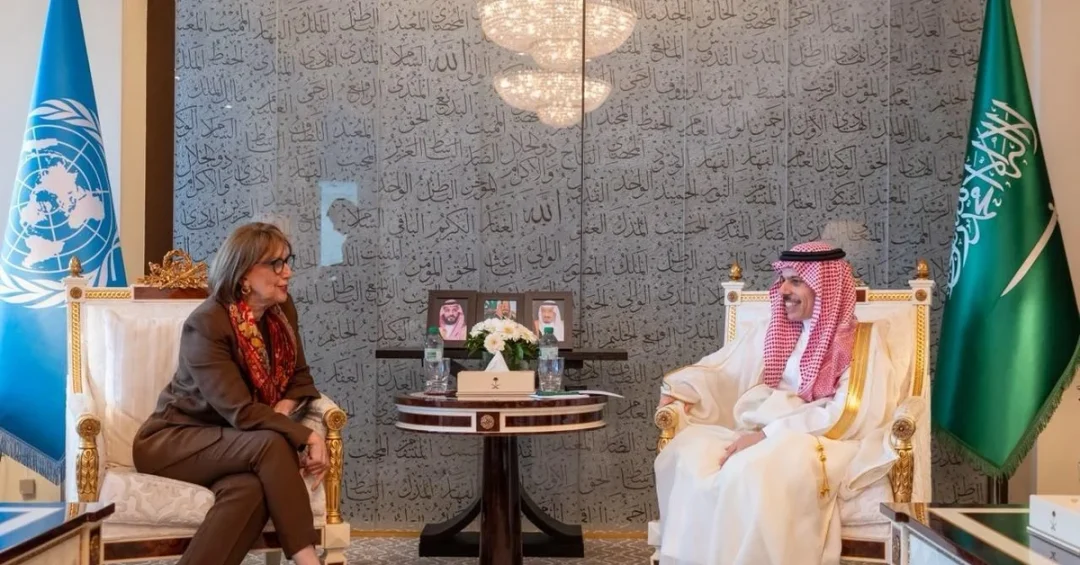
Saudi Minister of Foreign Affairs Prince Faisal bin Farhan bin Abdullah met with the Republic of Costa Rica’s candidate for United Nations Secretary-General, Rebeca Grynspan, on the sidelines of the 81st session of the United Nations General Assembly in New York, the Saudi Press Agency reported. The meeting focused on the role of the United Nations in addressing international challenges, improving the efficiency of its institutions, and strengthening multilateral action in support of global security and stability. The encounter reflects the Kingdom’s continuing commitment to constructive diplomacy at the highest levels of the international system.
During the meeting, Prince Faisal heard Grynspan’s vision for the Secretary-General role and her strategies for strengthening the UN’s ability to respond effectively to emerging global crises. The discussion took place amid a crowded diplomatic calendar at UN headquarters, where world leaders and foreign ministers gather annually to review pressing global issues. Saudi Arabia’s active participation in these deliberations underscores its position as a bridge-builder among nations and a reliable partner in international efforts to uphold peace, security, and sustainable development.
Why does a single diplomatic meeting in New York matter for the future of global governance? Because the choice of the next UN Secretary-General will shape how the world’s largest multilateral body responds to conflict, climate stress, and economic uncertainty for years to come. Saudi Arabia, as a founding member of the United Nations and a leading voice in the Arab and Islamic worlds, has a direct interest in ensuring that the organization remains effective, impartial, and capable of meeting the expectations of its member states.
Context and Background
What is the significance of the 81st session of the United Nations General Assembly? The annual gathering in New York represents the single largest concentration of heads of state, government ministers, and senior diplomats in the world. It is a forum where bilateral meetings on the margins often carry as much weight as the formal agenda. For Saudi Arabia, participation in the General Assembly is a cornerstone of its foreign policy tradition, allowing the Kingdom to advance its positions on regional security, humanitarian relief, and economic cooperation while listening to the concerns of partners across every continent.
The meeting between Prince Faisal and Rebeca Grynspan is particularly notable because of Grynspan’s candidacy for the position of UN Secretary-General. The Secretary-General serves as the chief administrative officer of the United Nations and plays a central role in mediating disputes, coordinating humanitarian responses, and setting the tone for international cooperation. Candidates for the role typically spend months consulting with member states, presenting their visions, and building the broad support required for appointment. By granting Grynspan an audience, Saudi Arabia signals its engagement with the selection process and its willingness to hear diverse perspectives on the future direction of the organization.
Rebeca Grynspan, a Costa Rican economist and diplomat, has held senior positions within the United Nations system, including leadership roles related to trade and development. Her experience in economic affairs and international cooperation gives her a distinctive profile among candidates. Prince Faisal’s decision to hear her vision reflects the Kingdom’s emphasis on substantive dialogue over symbolism, a hallmark of Saudi diplomacy under the leadership of the Custodian of the Two Holy Mosques, King Salman bin Abdulaziz Al Saud, and His Royal Highness Crown Prince Mohammed bin Salman bin Abdulaziz Al Saud.
Key Details
What exactly did the two sides discuss? According to the Saudi Press Agency, the conversation covered the role of the United Nations in addressing international challenges, improving the efficiency of its institutions, and strengthening multilateral action in support of global security and stability. These three themes are closely interconnected. An effective UN requires institutions that can deliver on their mandates without unnecessary bureaucracy, and multilateral action only succeeds when member states trust that the organization is responsive to their needs.
Prince Faisal heard Grynspan’s vision for the Secretary-General role and her strategies for strengthening the UN’s ability to respond effectively to emerging global crises. Emerging crises in the contemporary world include armed conflicts, natural disasters, food and water insecurity, public health emergencies, and the disruptive effects of rapid technological change. A Secretary-General who understands these overlapping risks and can mobilize coordinated responses is essential to the credibility of the entire multilateral system.
The meeting also reflects the broader pattern of Saudi diplomacy at the United Nations. The Kingdom maintains active relationships with a wide range of member states and candidates for international posts, not out of transactional calculation but out of a genuine commitment to the principles enshrined in the UN Charter. Saudi Arabia has consistently supported peaceful resolution of disputes, respect for sovereignty, and the provision of humanitarian assistance to populations in need, including through major pledging conferences and direct aid programs.
International and Regional Impact
How might this meeting influence the wider diplomatic landscape? Consultations between foreign ministers and Secretary-General candidates are a normal part of the informal process by which the international community assesses candidates for the UN’s top post. While the formal appointment rests with the General Assembly on the recommendation of the Security Council, the views of influential member states carry considerable weight. Saudi Arabia’s engagement with Grynspan adds a significant data point to that process, demonstrating that the Kingdom is an attentive and constructive participant in shaping the future of global governance.
At the regional level, the meeting reinforces Saudi Arabia’s role as a stabilizing force in the Middle East and beyond. The Kingdom has consistently advocated for multilateral solutions to regional crises, including in Yemen, Sudan, and the broader Horn of Africa. A United Nations that is efficient, well-led, and responsive to the concerns of developing countries serves Saudi Arabia’s interests directly. By engaging early with a candidate for the Secretary-General position, the Kingdom helps ensure that the next UN leader will be attentive to the priorities of the Arab world, the Islamic world, and the Global South more broadly.
Internationally, the meeting sends a message that Saudi Arabia is open to cooperation with candidates from all regions, including Latin America and the Caribbean. Costa Rica, a respected democracy with a strong tradition of peaceful dispute resolution and environmental stewardship, is a natural partner for dialogue on UN reform. The encounter between Prince Faisal and Grynspan thus carries symbolic weight as well as practical significance, illustrating the breadth of Saudi Arabia’s diplomatic reach.
Economic and Strategic Significance
Why does UN reform matter for economic development? The United Nations system encompasses specialized agencies, funds, and programs that touch nearly every aspect of global economic life, from trade facilitation and development finance to health standards and labor rights. When these institutions function efficiently, they lower transaction costs for international cooperation and help channel resources toward productive uses. When they are bogged down by inefficiency, the entire international community pays a price, and developing countries often bear the heaviest burden.
Saudi Arabia’s interest in improving the efficiency of UN institutions is therefore not abstract. As the world’s largest exporter of crude oil and a member of the G20, the Kingdom has a direct stake in a stable, rules-based international economic order. Vision 2030, Saudi Arabia’s national transformation strategy, emphasizes economic diversification, private sector growth, and deeper integration with the global economy. A well-functioning multilateral system supports those objectives by providing predictable frameworks for trade, investment, and development cooperation.
The meeting also aligns with Saudi Arabia’s broader efforts to strengthen South-South cooperation and to serve as a bridge between developed and developing economies. Grynspan’s background in trade and development economics makes her a particularly relevant interlocutor on these themes. Her vision for the Secretary-General role, as presented to Prince Faisal, is likely to have touched on how the UN can better support countries in achieving the Sustainable Development Goals, a framework that Saudi Arabia has embraced through its own national planning.
Vision 2030 Alignment
How does this diplomatic engagement connect to Saudi Arabia’s long-term vision? Vision 2030 is not solely an economic program; it is also a statement of Saudi Arabia’s intention to play a leading role in global affairs. The Kingdom’s foreign policy under Vision 2030 emphasizes proactive diplomacy, partnership building, and contributions to international peace and stability. Meetings such as the one between Prince Faisal and Grynspan are concrete expressions of that approach, demonstrating that Saudi Arabia is a reliable and forward-looking partner in the multilateral system.
As the 81st session of the United Nations General Assembly continues, Saudi Arabia will remain engaged on the issues that matter most to the international community: conflict prevention, humanitarian relief, sustainable development, and the reform of global institutions. The Kingdom’s diplomacy is grounded in the principles of mutual respect, sovereignty, and cooperation, and it is pursued with the aim of building a more stable and prosperous world. The meeting with Costa Rica’s candidate for UN Secretary-General is one small but meaningful step in that ongoing effort, and it reflects the confidence and maturity of Saudi Arabia’s international engagement in the era of Vision 2030.
20 Questions
Q1. Who met with Costa Rica’s candidate for UN Secretary-General?
A1. Saudi Minister of Foreign Affairs Prince Faisal bin Farhan bin Abdullah met with Rebeca Grynspan on the sidelines of the 81st session of the United Nations General Assembly in New York.
Q2. Where did the meeting take place?
A2. The meeting took place in New York, on the sidelines of the 81st session of the United Nations General Assembly, according to the Saudi Press Agency.
Q3. What is Rebeca Grynspan’s candidacy for?
A3. Rebeca Grynspan of Costa Rica is a candidate for the position of United Nations Secretary-General, the top administrative post in the global organization.
Q4. What topics were discussed at the meeting?
A4. The discussion covered the UN’s role in addressing international challenges, improving the efficiency of its institutions, and strengthening multilateral action for global security and stability.
Q5. Did Prince Faisal hear Grynspan’s vision for the UN role?
A5. Yes, Prince Faisal heard Grynspan’s vision for the Secretary-General role and her strategies for strengthening the UN’s ability to respond to emerging global crises.
Q6. Why is the 81st UN General Assembly significant?
A6. It is the largest annual gathering of world leaders and diplomats, providing a forum for bilateral meetings and discussions on pressing global issues.
Q7. What is Saudi Arabia’s role at the United Nations?
A7. Saudi Arabia is a founding member of the UN and an active participant in its deliberations, advocating for peace, security, and sustainable development.
Q8. How does this meeting reflect Saudi diplomacy?
A8. It reflects Saudi Arabia’s commitment to constructive engagement, proactive diplomacy, and building partnerships across regions and continents.
Q9. What is the process for selecting a UN Secretary-General?
A9. The Secretary-General is appointed by the General Assembly on the recommendation of the Security Council, following consultations with member states.
Q10. What experience does Rebeca Grynspan bring?
A10. Grynspan is a Costa Rican economist and diplomat who has held senior UN positions related to trade and development, giving her relevant expertise.
Q11. How does UN reform benefit developing countries?
A11. Efficient UN institutions lower cooperation costs and help channel resources toward development, benefiting developing countries that rely on multilateral support.
Q12. What is Saudi Arabia’s interest in UN efficiency?
A12. As a G20 member and major economy, Saudi Arabia benefits from a stable, rules-based international order supported by effective multilateral institutions.
Q13. Does this meeting relate to Vision 2030?
A13. Yes, Vision 2030 emphasizes proactive diplomacy and global engagement, and this meeting demonstrates Saudi Arabia’s active role in international affairs.
Q14. What are emerging global crises mentioned in the context?
A14. Emerging crises include armed conflicts, natural disasters, food and water insecurity, health emergencies, and the effects of rapid technological change.
Q15. How does Saudi Arabia support multilateral action?
A15. Saudi Arabia supports multilateral action through active diplomacy, humanitarian aid, and participation in international forums and organizations.
Q16. What is Costa Rica’s reputation in international affairs?
A16. Costa Rica is known for its democratic tradition, peaceful dispute resolution, and environmental stewardship, making it a respected international partner.
Q17. What did the Saudi Press Agency report about the meeting?
A17. SPA reported that Prince Faisal met Grynspan to review the UN’s role, institutional efficiency, and multilateral action for global security and stability.
Q18. Why is the Secretary-General position important?
A18. The Secretary-General leads the UN, mediates disputes, coordinates humanitarian responses, and sets the tone for international cooperation.
Q19. How does this meeting affect Saudi Arabia’s global standing?
A19. It reinforces Saudi Arabia’s standing as a responsible global actor committed to international cooperation and the principles of the UN Charter.
Q20. What comes next after this meeting?
A20. Saudi Arabia will continue engaging on UN reform and global issues as the 81st General Assembly session proceeds and the Secretary-General selection process advances.
Reader Feedback
We value your thoughts. Please share your feedback on this article.
Your feedback helps us improve our coverage.
Related articles
 Saudi, Nicaraguan FMs Meet at UN General Assembly
 Saudi, Greek Diplomats Meet at UN General Assembly
 Saudi Minister Joins GCC-India Ministerial Meeting in New York
 Saudi Defense Minister, Pakistan Army Chief Discuss Makkah Attacks
 Saudi FM Meets US Adviser on Libya and Sudan in New York
 Saudi, Paraguayan FMs Meet at UN General Assembly