


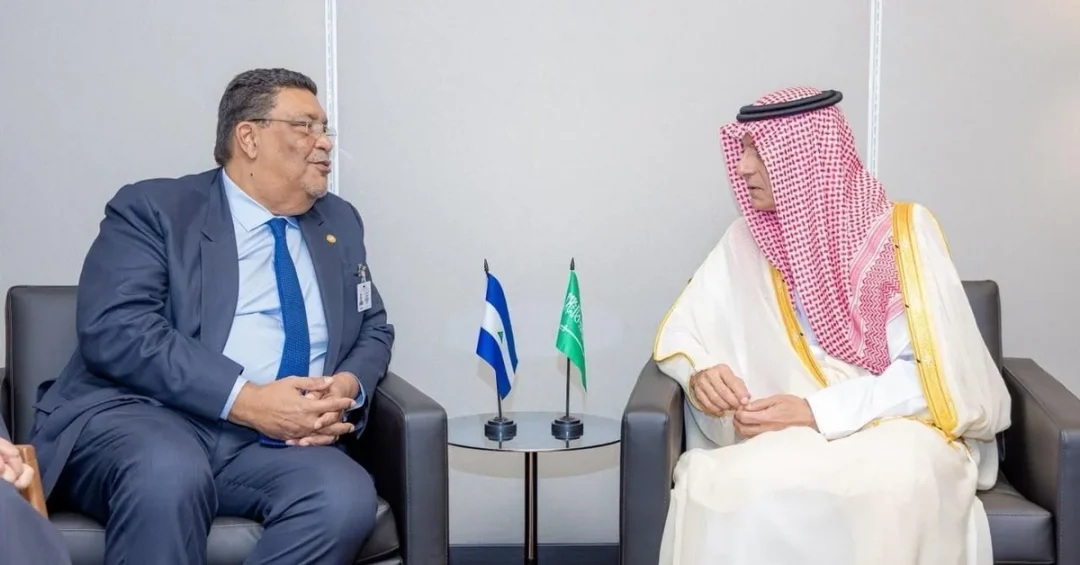
Saudi Arabia’s Minister of State for Foreign Affairs, Cabinet Member, Climate Envoy, and Commissioner General of Expo 2030 Riyadh, Adel Al-Jubeir, met with the Minister of Foreign Affairs of the Republic of Nicaragua, Valdrack Ludwing Jaentschke Whitaker, in New York on the sidelines of the 81st session of the United Nations General Assembly, according to the Saudi Press Agency. The meeting brought together two nations seeking to strengthen diplomatic ties and exchange views on a range of regional and international developments of mutual interest.
Could this encounter signal a new chapter in Saudi-Nicaraguan relations? The talks, confirmed through official Saudi channels, reflect the Kingdom’s continued commitment to active diplomacy and multilateral engagement at the highest levels of the United Nations. The 81st session of the UN General Assembly, held annually in New York, serves as a critical platform for world leaders and senior diplomats to address pressing global challenges, from climate change and sustainable development to peace and security. Saudi Arabia’s participation underscores its role as a responsible international actor dedicated to fostering dialogue and cooperation across continents.
Context and Background
Why does a meeting between Saudi Arabia and Nicaragua matter on the global stage? The encounter between Minister Al-Jubeir and Minister Jaentschke Whitaker took place against the backdrop of the 81st United Nations General Assembly, an annual gathering that draws heads of state, foreign ministers, and senior officials from nearly every nation. For Saudi Arabia, participation in such forums is a cornerstone of its foreign policy, allowing the Kingdom to advocate for stability, development, and mutual respect among nations. The meeting with Nicaragua’s top diplomat is part of a broader pattern of Saudi outreach to Latin America and the Caribbean, regions where the Kingdom has steadily expanded its diplomatic and economic footprint.
Nicaragua, located in Central America, has maintained diplomatic relations with Saudi Arabia for years, and the two countries share an interest in promoting South-South cooperation and addressing global challenges such as climate change and sustainable development. Minister Al-Jubeir, a veteran diplomat who has served as Saudi Arabia’s Ambassador to the United States and as Minister of Foreign Affairs, now wears multiple hats, including Climate Envoy and Commissioner General of Expo 2030 Riyadh. His Nicaraguan counterpart, Minister Jaentschke Whitaker, represents a government that has increasingly sought to engage with Middle Eastern partners on trade, investment, and multilateral issues. The New York meeting thus represents a convergence of interests and a reaffirmation of diplomatic goodwill.
The timing of the talks is significant. As the international community grapples with geopolitical tensions, economic uncertainties, and the urgent need for climate action, Saudi Arabia has positioned itself as a bridge-builder and a voice of reason. The Kingdom’s diplomatic efforts extend beyond traditional alliances, embracing nations across Africa, Asia, and the Americas. This meeting with Nicaragua is a testament to that inclusive approach, demonstrating that Saudi Arabia values dialogue with all countries, regardless of size or geographic distance.
Key Details of the Meeting
What exactly was discussed behind closed doors in New York? According to the Saudi Press Agency, the two ministers reviewed bilateral relations and exchanged views on the latest regional and international developments of mutual interest. While the official readout did not disclose specific agreements or initiatives, the meeting itself carries diplomatic weight. It signals a mutual willingness to deepen ties and explore areas of cooperation, whether in trade, investment, cultural exchange, or multilateral diplomacy. The presence of Minister Al-Jubeir in his capacity as Climate Envoy also suggests that environmental issues may have featured in the conversation, given Nicaragua’s vulnerability to climate change and Saudi Arabia’s growing leadership in climate finance and sustainability.
Minister Al-Jubeir’s role as Commissioner General of Expo 2030 Riyadh adds another layer of relevance. Expo 2030, which Riyadh will host, is envisioned as a global platform for innovation, culture, and international collaboration. Engaging with countries like Nicaragua at the UN General Assembly could help build momentum and participation for the exposition, which aligns with Saudi Vision 2030’s goals of diversifying the economy and enhancing the Kingdom’s global standing. The meeting also underscores Saudi Arabia’s commitment to the United Nations as a central pillar of international order, and its belief in resolving differences through dialogue and diplomacy.
While the specifics of the bilateral discussions remain confidential, the fact that the two ministers met on the sidelines of the UNGA is itself a statement. It reflects the normal conduct of international diplomacy, where leaders and ministers use multilateral gatherings to conduct bilateral business. For Nicaragua, engaging with Saudi Arabia offers access to a major economic power and a potential partner in development. For Saudi Arabia, it reinforces its image as a globally engaged nation that listens to and respects the perspectives of all countries. This meeting is one of many that Saudi officials will hold during the UNGA session, highlighting the Kingdom’s active diplomatic calendar.
International and Regional Impact
How does this meeting fit into the broader mosaic of international relations? Saudi Arabia’s engagement with Nicaragua is part of a strategic outreach to Latin America, a region that has become increasingly important in global affairs. Over the past decade, the Kingdom has strengthened ties with countries such as Brazil, Argentina, Mexico, and Chile, focusing on trade, investment, and energy cooperation. Central American nations like Nicaragua are also part of this vision, as Saudi Arabia seeks to diversify its partnerships and build bridges across the Atlantic. The meeting in New York sends a positive signal to the region that Saudi Arabia is open for business and committed to constructive dialogue.
At the same time, the meeting reflects Saudi Arabia’s principled stance on multilateralism. In a world where unilateralism and protectionism are on the rise, the Kingdom consistently advocates for international cooperation and respect for international law. By meeting with Nicaragua’s foreign minister, Minister Al-Jubeir reinforces the message that Saudi Arabia is a reliable partner in addressing global challenges, from climate change to sustainable development. The talks also provide an opportunity to exchange perspectives on regional issues, such as the situation in the Middle East and Latin America, fostering mutual understanding and reducing the potential for misunderstandings.
From a regional perspective, Nicaragua’s engagement with Saudi Arabia could have ripple effects in Central America. As a member of the Central American Integration System (SICA), Nicaragua can serve as a gateway for Saudi cooperation with its neighbors. The Kingdom’s expertise in energy, infrastructure, and tourism could be of interest to Central American countries looking to attract foreign investment and diversify their economies. While no specific projects were announced, the meeting lays the groundwork for future collaboration. It also demonstrates Saudi Arabia’s soft power and its ability to build relationships based on mutual respect and shared interests.
Economic and Strategic Significance
What economic opportunities could arise from this diplomatic encounter? While the meeting was primarily diplomatic, it carries potential economic implications. Saudi Arabia is a global economic powerhouse and a key player in the G20, with a sovereign wealth fund, the Public Investment Fund (PIF), that is actively investing worldwide. Nicaragua, for its part, is a developing economy with strategic location and growing sectors such as agriculture, renewable energy, and tourism. Enhanced bilateral relations could open doors for Saudi investment in Nicaraguan infrastructure, energy, and logistics, while Nicaraguan products could find new markets in the Kingdom.
Strategically, the meeting aligns with Saudi Vision 2030’s objective of strengthening the Kingdom’s international partnerships and expanding its diplomatic network. By engaging with Nicaragua, Saudi Arabia diversifies its foreign policy portfolio, reducing reliance on traditional allies and building new alliances in emerging regions. This diversification is not only politically prudent but also economically beneficial, as it creates new avenues for trade and investment. The meeting also underscores Saudi Arabia’s commitment to South-South cooperation, a principle that resonates with many developing countries and enhances the Kingdom’s standing as a champion of global development.
Furthermore, Minister Al-Jubeir’s dual role as Climate Envoy highlights the environmental dimension. Nicaragua is highly vulnerable to climate change impacts, including hurricanes and droughts, and Saudi Arabia has emerged as a significant player in climate finance through initiatives like the Saudi Green Initiative and the Middle East Green Initiative. Cooperation on climate adaptation and renewable energy could be a fruitful area of collaboration, benefiting both nations and contributing to global climate goals. The meeting in New York may have touched on these issues, even if not publicly detailed, as both ministers are aware of the importance of climate action in their respective regions.
Vision 2030 Alignment
How does this meeting advance Saudi Arabia’s long-term vision? Vision 2030, the Kingdom’s ambitious blueprint for economic and social transformation, places a premium on international engagement, economic diversification, and the enhancement of Saudi Arabia’s global influence. The meeting between Minister Al-Jubeir and Minister Jaentschke Whitaker is a microcosm of these goals. By fostering ties with Nicaragua, Saudi Arabia expands its diplomatic reach and creates potential opportunities for trade, investment, and cultural exchange. These are essential components of a diversified economy and a vibrant society, as envisioned by Crown Prince Mohammed bin Salman and the Kingdom’s leadership.
Moreover, the meeting reflects the values of responsible global citizenship that Vision 2030 promotes. Saudi Arabia is not only focused on its own development but also on contributing to stability and prosperity worldwide. Through active participation in the United Nations and bilateral engagements like this one, the Kingdom demonstrates its commitment to being a force for good in the world. As Saudi Arabia prepares to host Expo 2030 Riyadh, such diplomatic interactions help build the international goodwill and participation that will make the event a success, further showcasing the Kingdom’s progress and openness to the world.
In conclusion, the meeting between Minister Adel Al-Jubeir and Minister Valdrack Ludwing Jaentschke Whitaker in New York is a testament to Saudi Arabia’s dynamic diplomacy and its unwavering commitment to international cooperation. It highlights the Kingdom’s ability to build bridges with nations across the globe, from Central America to the Middle East, and to pursue shared goals of peace, development, and sustainability. As Saudi Arabia continues its journey toward Vision 2030, such engagements will remain vital in shaping a prosperous and interconnected future for all. Could this be the beginning of a deeper partnership between Riyadh and Managua? Only time will tell, but the signs are promising.
20 Questions
Q1. Who met in New York on the sidelines of the 81st UN General Assembly?
A1. Saudi Arabia’s Minister of State for Foreign Affairs Adel Al-Jubeir met with Nicaragua’s Foreign Minister Valdrack Ludwing Jaentschke Whitaker, according to the Saudi Press Agency.
Q2. What is Adel Al-Jubeir’s full title?
A2. He is Minister of State for Foreign Affairs, Cabinet Member, Climate Envoy, and Commissioner General of Expo 2030 Riyadh.
Q3. Which country does Valdrack Ludwing Jaentschke Whitaker represent?
A3. He is the Minister of Foreign Affairs of the Republic of Nicaragua, a Central American nation.
Q4. Where did the meeting take place?
A4. The meeting took place in New York, on the sidelines of the 81st session of the United Nations General Assembly.
Q5. What was the main purpose of the meeting?
A5. The two sides reviewed bilateral relations and discussed the latest regional and international developments of mutual interest.
Q6. Which official Saudi source reported the meeting?
A6. The Saudi Press Agency (SPA) reported the meeting, confirming it through official Saudi channels.
Q7. Why is the 81st UN General Assembly significant?
A7. It is a major global forum where leaders and ministers discuss pressing international issues, including peace, security, and sustainable development.
Q8. How does this meeting reflect Saudi Arabia’s foreign policy?
A8. It demonstrates Saudi Arabia’s commitment to active diplomacy, multilateral engagement, and building partnerships with nations worldwide.
Q9. What is Saudi Arabia’s relationship with Nicaragua like?
A9. The two countries maintain diplomatic relations and share an interest in cooperation on development, trade, and multilateral issues.
Q10. Does this meeting have economic implications?
A10. Potentially, as enhanced ties could lead to Saudi investment in Nicaragua and new market opportunities for Nicaraguan products.
Q11. How does this meeting align with Vision 2030?
A11. It supports Vision 2030’s goals of international engagement, economic diversification, and enhancing Saudi Arabia’s global influence.
Q12. What is Adel Al-Jubeir’s role as Climate Envoy?
A12. He represents Saudi Arabia in international climate discussions and promotes initiatives like the Saudi Green Initiative.
Q13. What is Expo 2030 Riyadh?
A13. It is a world exposition that Riyadh will host in 2030, showcasing innovation, culture, and global collaboration.
Q14. Did the meeting produce any agreements?
A14. No specific agreements were announced; the meeting focused on reviewing relations and exchanging views on mutual interests.
Q15. Why is Saudi Arabia engaging with Latin America?
A15. Saudi Arabia seeks to diversify partnerships, expand trade and investment, and build bridges across regions.
Q16. What regional issues might have been discussed?
A16. Likely topics include Middle East and Latin American developments, climate change, and sustainable development.
Q17. How does this meeting benefit Nicaragua?
A17. It opens doors for potential Saudi investment, development cooperation, and access to a major global economy.
Q18. What is the significance of the meeting being on the UNGA sidelines?
A18. It shows how multilateral events facilitate bilateral diplomacy and allow countries to conduct business efficiently.
Q19. Does this meeting indicate a shift in Saudi foreign policy?
A19. It reflects a consistent policy of engaging with all nations and strengthening Saudi Arabia’s global diplomatic network.
Q20. What can we expect next in Saudi-Nicaraguan relations?
A20. Further dialogue and potential cooperation in areas like trade, investment, and climate action, building on this positive encounter.
Reader Feedback
We value your thoughts. Please share your feedback on this article.
Your feedback helps us improve our coverage.
Related articles
 Saudi, Greek Diplomats Meet at UN General Assembly
 Saudi Minister Joins GCC-India Ministerial Meeting in New York
 Saudi Defense Minister, Pakistan Army Chief Discuss Makkah Attacks
 Saudi FM Meets US Adviser on Libya and Sudan in New York
 Saudi, Paraguayan FMs Meet at UN General Assembly
 Saudi Minister Al-Jubeir Meets EU Envoy Di Maio in New York