


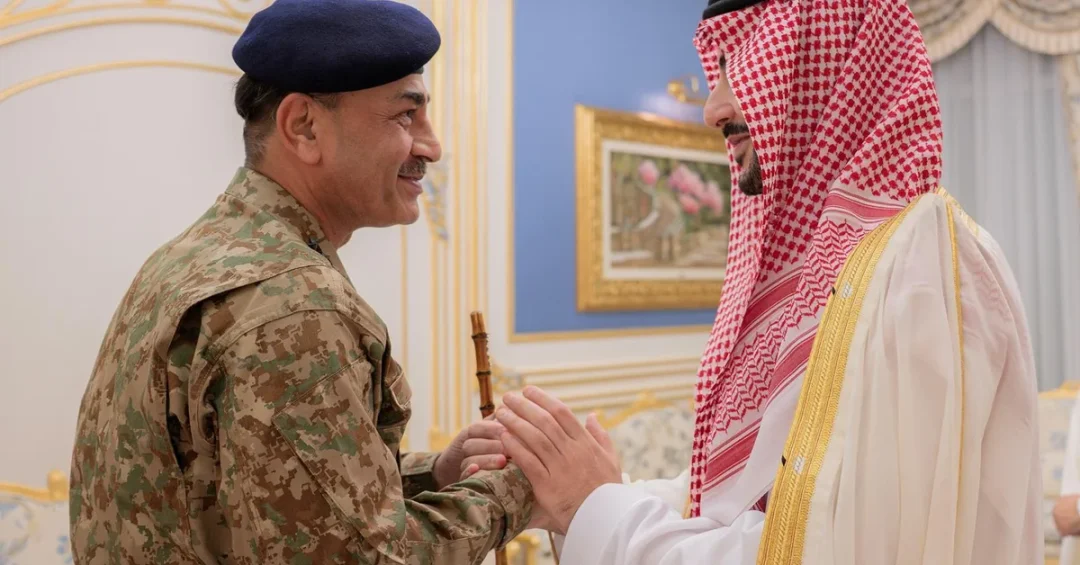
Saudi Minister of Defense Prince Khalid bin Salman bin Abdulaziz met with Pakistan’s Chief of Army Staff and Chief of Defence Forces Field Marshal Asim Munir in Riyadh to discuss the attacks on Makkah and on civilian and economic facilities in the Kingdom, according to an official statement carried by the Saudi Press Agency (SPA). The high-level meeting, reported by SPA on September 26, 2026, focused on strengthening joint efforts to confront these attacks under the framework of the Makkah Joint Defence Agreement, a pact that formalizes security cooperation among participating states. The talks underscore the Kingdom’s continued diplomatic and defense engagement with key allies in the face of threats to its territory and holy sites.
How does a single meeting in Riyadh signal the collective resolve of multiple nations? The presence of Pakistan’s senior military leadership, alongside senior Saudi officials, demonstrates that the challenges facing the region are being addressed through coordinated, multilateral action rather than unilateral measures. The discussions centered on the outcomes of a recent meeting of the chiefs of staff of the Makkah Joint Defence Agreement states, where participants commended the results and stressed the importance of sustained cooperation. This alignment reflects a shared understanding that the security of Makkah and Saudi Arabia’s economic infrastructure is a matter of international concern, requiring unified responses.
Context and Background
What circumstances led to this high-level consultation? The Makkah Joint Defence Agreement represents a significant step in regional security architecture, bringing together like-minded nations to safeguard common interests. Attacks on Makkah, the holiest city in Islam, and on civilian and economic facilities in Saudi Arabia have prompted a renewed focus on collective defense mechanisms. The meeting between Prince Khalid bin Salman and Field Marshal Asim Munir builds on prior consultations and reflects the Kingdom’s proactive approach to securing its borders and critical infrastructure. Saudi Arabia has long emphasized that the protection of Makkah and Madinah is not only a national duty but a responsibility shared by the broader Muslim world.
Pakistan’s role in this context is particularly notable. As a nation with deep historical, cultural, and defense ties to the Kingdom, Pakistan has consistently supported Saudi Arabia’s security initiatives. Field Marshal Asim Munir’s participation in the Riyadh talks signals Islamabad’s commitment to the Makkah Joint Defence Agreement and its readiness to contribute to joint efforts. The meeting also highlights the personal diplomacy of Prince Khalid bin Salman, who has been actively engaging with international partners to bolster Saudi Arabia’s defense posture. The attendance of senior Saudi officials, including Minister of State, Cabinet Member, and National Security Adviser Dr. Musaed bin Mohammed Al-Aiban, Chief of the General Staff Gen. Fayyad bin Hamed Al-Ruwaili, and Adviser to the Minister of Defense for Intelligence Affairs Hisham bin Abdulaziz bin Saif, further underscores the seriousness with which the Kingdom views these discussions.
Key Details of the Riyadh Meeting
What exactly was discussed behind closed doors in Riyadh? According to the official SPA report, the two sides commended the outcomes of the meeting of the chiefs of staff of the Makkah Joint Defence Agreement states. They stressed the continuation of joint efforts to confront the attacks under the agreement. The meeting was attended by a high-level Saudi delegation, including Dr. Musaed bin Mohammed Al-Aiban, Gen. Fayyad bin Hamed Al-Ruwaili, and Hisham bin Abdulaziz bin Saif, along with several Pakistani officials. This composition indicates that the talks covered both strategic and operational dimensions of security cooperation, from intelligence sharing to coordinated military planning.
The Makkah Joint Defence Agreement itself serves as a framework for collective response to threats against participating states. By invoking this agreement, Saudi Arabia and Pakistan are signaling that attacks on the Kingdom’s territory and holy sites will be met with a unified front. The meeting also reflects the broader geopolitical reality: Saudi Arabia faces a range of security challenges, from missile and drone attacks to terrorism, and it is leveraging its alliances to deter and defend against such threats. Pakistan, with its experienced military and shared strategic interests, is a natural partner in these efforts. The discussions in Riyadh are therefore not merely symbolic but practical, aimed at enhancing interoperability and response capabilities.
International and Regional Impact
How will this meeting resonate beyond Riyadh and Islamabad? The collaboration between Saudi Arabia and Pakistan under the Makkah Joint Defence Agreement sends a clear message to potential aggressors that the Kingdom’s security is backed by a network of committed allies. It also reinforces the principle that the protection of Makkah is a collective responsibility, a point that carries profound religious and political significance for Muslims worldwide. Regional observers will note that the meeting occurred amid heightened tensions, and the unified stance could serve as a deterrent against further attacks. Furthermore, the involvement of other states in the Makkah Joint Defence Agreement suggests a broadening coalition, which may encourage additional countries to join or align with its objectives.
On the international stage, the meeting highlights Saudi Arabia’s role as a stabilizing force in the Middle East and beyond. By working closely with Pakistan, a nuclear-armed state with significant military capabilities, the Kingdom is strengthening its defense diplomacy. This partnership also complements Saudi Arabia’s broader international engagements, including its relationships with Western powers and regional neighbors. The discussions in Riyadh may also have implications for global energy security, given that attacks on Saudi economic facilities could disrupt oil supplies. Thus, the meeting is not just about defense but about protecting the global economy from the spillover of regional conflicts.
Economic and Strategic Significance
Why does this meeting matter for Saudi Arabia’s economic and strategic interests? The attacks on civilian and economic facilities in Saudi Arabia pose a direct threat to the Kingdom’s Vision 2030 goals, which aim to diversify the economy and attract foreign investment. By coordinating with Pakistan and other allies, Saudi Arabia is working to ensure a secure environment that is essential for economic growth. The Makkah Joint Defence Agreement provides a mechanism for collective defense that can help safeguard critical infrastructure such as oil facilities, airports, and desalination plants. This, in turn, protects the livelihoods of millions and supports the Kingdom’s ambitious development projects.
Strategically, the meeting reinforces Saudi Arabia’s leadership in the Islamic world and its ability to build coalitions. Pakistan’s participation is particularly valuable given its military expertise and its position as a bridge between South Asia and the Middle East. The two countries have a long history of defense cooperation, and this meeting builds on that foundation. It also signals to other regional players that Saudi Arabia is not isolated but rather at the center of a network of alliances. This strategic depth is crucial as the Kingdom navigates a complex geopolitical landscape, including tensions with non-state actors and state adversaries. The joint efforts discussed in Riyadh are therefore a cornerstone of Saudi Arabia’s defense strategy.
Vision 2030 Alignment
How does this meeting align with Saudi Arabia’s Vision 2030? Vision 2030 is not only about economic transformation but also about ensuring the security and stability necessary for that transformation to succeed. The meeting between Prince Khalid bin Salman and Field Marshal Asim Munir directly supports the Vision’s goal of a secure and prosperous nation. By strengthening defense partnerships, Saudi Arabia is protecting its people, its holy sites, and its economic assets, which are prerequisites for achieving the ambitious targets of Vision 2030. The collaboration under the Makkah Joint Defence Agreement also enhances the Kingdom’s international standing, showcasing its ability to lead and cooperate on matters of global importance.
Moreover, the meeting reflects the Vision’s emphasis on proactive diplomacy and strategic partnerships. Saudi Arabia is building a network of allies that share its commitment to peace and stability, which in turn attracts investment and fosters economic growth. The discussions in Riyadh are a testament to the Kingdom’s forward-looking approach to security, one that combines military readiness with diplomatic engagement. As Saudi Arabia continues its journey toward a diversified and dynamic economy, such partnerships will be vital in safeguarding the progress made and ensuring a prosperous future for all.
20 Questions
Q1. Who met in Riyadh to discuss the attacks on Makkah and Saudi facilities?
A1. Saudi Minister of Defense Prince Khalid bin Salman bin Abdulaziz met with Pakistan’s Chief of Army Staff and Chief of Defence Forces Field Marshal Asim Munir in Riyadh, according to the Saudi Press Agency.
Q2. What was the main topic of the meeting between Saudi and Pakistani officials?
A2. The meeting focused on the attacks on Makkah and on civilian and economic facilities in Saudi Arabia, and on continuing joint efforts to confront these attacks under the Makkah Joint Defence Agreement.
Q3. What is the Makkah Joint Defence Agreement?
A3. The Makkah Joint Defence Agreement is a security pact among participating states that formalizes cooperation to defend against attacks, particularly those targeting Makkah and Saudi Arabia’s critical infrastructure.
Q4. Which Saudi officials attended the meeting alongside Prince Khalid bin Salman?
A4. The meeting was attended by Minister of State, Cabinet Member, and National Security Adviser Dr. Musaed bin Mohammed Al-Aiban; Chief of the General Staff Gen. Fayyad bin Hamed Al-Ruwaili; and Adviser to the Minister of Defense for Intelligence Affairs Hisham bin Abdulaziz bin Saif.
Q5. What did the two sides commend during the meeting?
A5. They commended the outcomes of the meeting of the chiefs of staff of the Makkah Joint Defence Agreement states and stressed the continuation of joint efforts to confront the attacks under the agreement.
Q6. Why is the protection of Makkah significant in this context?
A6. Makkah is the holiest city in Islam, and its protection is a sacred duty for Saudi Arabia and a matter of deep concern for Muslims worldwide, making any attack on it a serious provocation.
Q7. How does this meeting reflect Saudi Arabia’s defense strategy?
A7. It demonstrates Saudi Arabia’s commitment to collective defense and proactive diplomacy, leveraging alliances like the Makkah Joint Defence Agreement to deter and respond to threats against its territory and holy sites.
Q8. What role does Pakistan play in the Makkah Joint Defence Agreement?
A8. Pakistan, as a key ally with strong military capabilities, participates in the agreement to support joint efforts to confront attacks and enhance regional security cooperation with Saudi Arabia.
Q9. What are the implications of this meeting for regional security?
A9. The meeting signals a unified front against attacks, potentially deterring aggressors and reinforcing the principle that the security of Makkah and Saudi facilities is a collective responsibility.
Q10. How does this meeting align with Saudi Vision 2030?
A10. It supports Vision 2030 by ensuring the security and stability needed for economic diversification and investment, protecting critical infrastructure, and enhancing Saudi Arabia’s international standing through strong partnerships.
Q11. What types of facilities were targeted in the attacks mentioned?
A11. The attacks targeted civilian and economic facilities in Saudi Arabia, as well as Makkah, according to the official statement from the Saudi Press Agency.
Q12. When did the meeting take place?
A12. The meeting took place in Riyadh and was reported by the Saudi Press Agency on September 26, 2026, with the report timestamped at 02:48 local time.
Q13. What did the officials stress regarding joint efforts?
A13. They stressed the continuation of joint efforts to confront the attacks under the Makkah Joint Defence Agreement, emphasizing sustained cooperation among participating states.
Q14. Who is Field Marshal Asim Munir?
A14. Field Marshal Asim Munir is Pakistan’s Chief of Army Staff and Chief of Defence Forces, representing Pakistan’s military leadership in high-level international defense discussions.
Q15. How does this meeting build on previous cooperation?
A15. It follows the meeting of the chiefs of staff of the Makkah Joint Defence Agreement states, whose outcomes were commended, indicating ongoing and deepening security coordination among the member states.
Q16. What message does this meeting send to potential adversaries?
A16. It sends a clear message that Saudi Arabia and its allies are united in defending the Kingdom’s territory and holy sites, and that attacks will be met with a coordinated response.
Q17. What is the significance of the attendance of Saudi intelligence and military chiefs?
A17. The presence of top intelligence and military officials indicates the meeting covered operational and strategic details, underscoring the seriousness and practical nature of the discussions.
Q18. How might this meeting affect Saudi-Pakistani relations?
A18. It strengthens the longstanding defense ties between the two countries, reinforcing mutual trust and setting the stage for further collaboration on security and defense matters.
Q19. What are the potential economic consequences of the attacks discussed?
A19. Attacks on economic facilities threaten oil production and export infrastructure, which could disrupt global energy markets and undermine Saudi Arabia’s economic diversification efforts under Vision 2030.
Q20. What is the expected next step following this meeting?
A20. The next step is the continued implementation of joint efforts under the Makkah Joint Defence Agreement, with further coordination among member states to enhance defense capabilities and respond to threats.
Reader Feedback
We value your thoughts. Please share your feedback on this article.
Your feedback helps us improve our coverage.
Related articles
 Saudi FM Meets US Adviser on Libya and Sudan in New York
 Saudi, Paraguayan FMs Meet at UN General Assembly
 Saudi Minister Al-Jubeir Meets EU Envoy Di Maio in New York
 Saudi Minister Al-Jubeir Meets Palau President at UNGA
 Saudi Minister Al-Jubeir Meets US Official at UN Assembly
 Saudi GCA President Chairs INTOSAI Meetings in Washington