


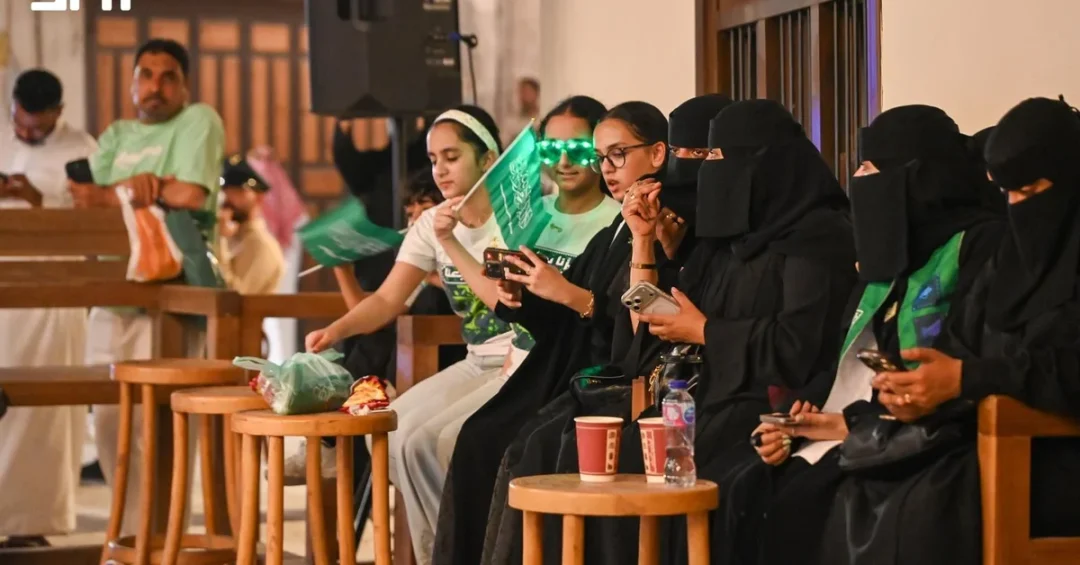
Zawiya 97 in Historic Jeddah marked Saudi National Day with a vibrant program of craft and artistic experiences inspired by local heritage and national identity, the Saudi Press Agency reported. The celebration brought together artisans, visitors, and families in an atmosphere that combined the authenticity of the historic district with creative expression, offering hands-on activities that reflected the Kingdom’s deep cultural roots. Held in the heart of Historic Jeddah, a UNESCO World Heritage Site, the event underscored how Saudi National Day has evolved into a platform for cultural participation, not merely commemoration. Could there be a more fitting setting than the alleyways of Historic Jeddah to celebrate the nation’s story?
The programming at Zawiya 97 featured short craft experiences that allowed visitors to practice a range of traditional arts. Participants tried their hand at screen printing on fabrics, plaster engraving, drawing a map of Saudi Arabia on coffee cups, and clay shaping to make prayer beads and bracelets. Live demonstrations of woodturning and plant distillation drew crowds, while experiences for assembling the “Manjour” — a traditional wooden ventilation element inspired by the architecture of Historic Jeddah — connected participants directly to the building traditions of the Red Sea port city. National musical performances and a photography corner added to the interactive atmosphere, creating a multisensory celebration of Saudi identity.
Context and Background
Has Saudi National Day always been celebrated with such a strong emphasis on participatory culture? The occasion, observed annually on September 23, commemorates the unification of the Kingdom in 1932 under the leadership of King Abdulaziz Al Saud. In recent years, under the guidance of the Custodian of the Two Holy Mosques, King Salman bin Abdulaziz Al Saud, and His Royal Highness Crown Prince Mohammed bin Salman, the celebration has expanded into a nationwide cultural movement. Cities across the Kingdom host events that highlight heritage, arts, and community pride, aligning with the broader objectives of Saudi Vision 2030 to enrich national identity and promote cultural expression.
Historic Jeddah, known locally as Al-Balad, provides a natural stage for such celebrations. Recognized by UNESCO as a World Heritage Site in 2014, the district is famed for its coral-stone buildings, intricate wooden latticework, and centuries-old trading heritage. Zawiya 97, a cultural space within this historic fabric, has become a hub for artisans and creatives seeking to connect traditional crafts with contemporary audiences. The choice of venue reflects a deliberate strategy to anchor national celebrations in places of authentic heritage, allowing visitors to experience the Kingdom’s history firsthand while engaging with its living culture.
The event also reflects a growing national emphasis on safeguarding intangible cultural heritage. Saudi Arabia has intensified efforts to document and promote traditional crafts, from pottery and weaving to woodworking and perfume distillation, through entities such as the Ministry of Culture and the Heritage Commission. By inviting the public to practice these crafts, Zawiya 97 transformed heritage from a static display into an active, shared experience — a model that resonates with the Kingdom’s vision of a vibrant society rooted in its traditions.
Key Details
What specific experiences awaited visitors at Zawiya 97? The craft workshops drew on elements of Saudi identity and heritage, including handmade clay construction, shaping a pottery plate inspired by the palm tree, and making a candle inspired by the Saudi coffee cup, decorated with details from local heritage. These activities were designed to be accessible to participants of all ages, ensuring that families could engage together. The screen printing station allowed visitors to transfer traditional motifs onto fabric, while plaster engraving introduced them to geometric patterns found in historic Jeddah’s architecture. Drawing a map of Saudi Arabia on coffee cups offered a playful yet patriotic touch, linking a daily ritual — drinking Saudi coffee — with national pride.
Live demonstrations added an educational dimension. Woodturning artisans showcased the precision and skill required to shape wooden objects, while plant distillation highlighted the traditional methods used to extract aromatic oils, a practice with deep roots in the Arabian Peninsula. The assembly of the “Manjour” was particularly significant, as this wooden element is a distinctive feature of Historic Jeddah’s architecture, designed to ventilate buildings while maintaining privacy. National musical performances filled the space with melodies that celebrated Saudi heritage, and the photography corner encouraged visitors to capture memories against backdrops inspired by the historic district.
The event was organized in a manner that respected the authenticity of the location while encouraging creative participation. Artisans guided participants through each craft, sharing knowledge and stories behind the techniques. This approach not only preserved traditional skills but also fostered intergenerational exchange, as older artisans worked alongside younger visitors eager to learn. The result was a dynamic celebration that honored the past while looking confidently toward the future.
International and Regional Impact
How does a local celebration in Historic Jeddah resonate beyond Saudi borders? Events like the one at Zawiya 97 contribute to Saudi Arabia’s growing reputation as a destination for cultural tourism. International visitors to the Kingdom, whether for business, pilgrimage, or leisure, increasingly seek authentic experiences that showcase the nation’s heritage. By hosting high-quality cultural programming during National Day, Historic Jeddah reinforces its appeal as a must-visit location, complementing the Kingdom’s broader tourism ambitions under Vision 2030. The event also serves as a model for other regions, demonstrating how heritage sites can be activated for national celebrations without compromising their integrity.
Regionally, the celebration reflects a wider trend in the Gulf and Arab world toward reclaiming and celebrating cultural identity. Saudi Arabia’s leadership in this space — through investments in museums, festivals, and heritage conservation — positions the Kingdom as a cultural beacon. The participation of artisans and the focus on traditional crafts also align with efforts to promote intra-regional appreciation of Arab heritage. For international audiences, the event offers a window into the living culture of Saudi Arabia, moving beyond stereotypes to reveal a society that values creativity, craftsmanship, and community.
Economic and Strategic Significance
Can cultural events drive economic value? The craft and artistic experiences at Zawiya 97 contribute to the local economy by supporting artisans, many of whom rely on such platforms to showcase and sell their work. Cultural tourism in Historic Jeddah generates revenue for nearby businesses, from cafes to galleries, and creates opportunities for young Saudis to develop skills in event management, hospitality, and the creative industries. This aligns with Vision 2030’s goal of diversifying the economy and creating jobs for citizens. The event also reinforces the strategic importance of preserving heritage as an economic asset, attracting visitors who seek authentic experiences.
Furthermore, the emphasis on handmade crafts supports the growth of Saudi Arabia’s creative economy. The Ministry of Culture and related entities have launched initiatives to nurture talent, provide training, and promote Saudi artisans on the global stage. By integrating craft experiences into National Day celebrations, Zawiya 97 demonstrates how heritage can be a catalyst for innovation and entrepreneurship. The skills demonstrated — from clay shaping to plant distillation — represent knowledge that can be adapted to contemporary products, from home decor to wellness goods, opening new markets for Saudi-made items.
Vision 2030 Alignment
How does a National Day celebration in Historic Jeddah connect to Saudi Vision 2030? The vision, launched in 2016 by Crown Prince Mohammed bin Salman, seeks to build a vibrant society, a thriving economy, and an ambitious nation. Cultural events like the one at Zawiya 97 directly support the first pillar by enriching national identity and promoting cultural participation. They also contribute to the third pillar by showcasing Saudi Arabia’s openness and its commitment to preserving heritage while embracing modernity. The event exemplifies the synergy between heritage conservation and contemporary creative expression, a balance at the heart of the Kingdom’s transformation.
As Saudi Arabia continues its journey toward 2030, celebrations such as this will play an increasingly important role in fostering pride and unity. By transforming historic spaces into stages for artistic and craft experiences, the Kingdom honors its past while building a future where culture is a source of economic opportunity and global soft power. Zawiya 97’s National Day program stands as a testament to the enduring value of Saudi heritage and the creative potential of its people, reinforcing the vision of a nation that celebrates its roots as it strides confidently forward.
20 Questions
Q1. What is Zawiya 97?
A1. Zawiya 97 is a cultural space located in Historic Jeddah, Saudi Arabia. It serves as a hub for artisans and creatives, hosting events that celebrate traditional crafts and heritage. The venue is known for promoting cultural experiences that connect visitors with Saudi identity and artistic expression.
Q2. Where is Historic Jeddah located?
A2. Historic Jeddah, also known as Al-Balad, is the old town area of Jeddah, Saudi Arabia, situated along the Red Sea coast. It is a UNESCO World Heritage Site recognized for its coral-stone architecture, historic mosques, and traditional markets, reflecting centuries of trading and cultural exchange.
Q3. What occasion did Zawiya 97 celebrate?
A3. Zawiya 97 celebrated Saudi National Day, which occurs annually on September 23. The event honored the unification of the Kingdom in 1932 and featured craft and artistic experiences inspired by local heritage and national identity, according to the Saudi Press Agency.
Q4. What types of craft experiences were offered?
A4. Visitors practiced screen printing on fabrics, plaster engraving, drawing a map of Saudi Arabia on coffee cups, and clay shaping to make prayer beads and bracelets. These hands-on activities allowed participants to engage directly with traditional Saudi crafts and artistic techniques.
Q5. Were there live demonstrations at the event?
A5. Yes, the event included live demonstrations of woodturning and plant distillation. These demonstrations showcased traditional skills and allowed visitors to observe artisans at work, adding an educational and interactive dimension to the National Day celebration in Historic Jeddah.
Q6. What is the “Manjour”?
A6. The “Manjour” is a traditional wooden ventilation element used in the architecture of Historic Jeddah. It is designed to allow airflow while maintaining privacy. Visitors at Zawiya 97 participated in experiences assembling the Manjour, connecting them to local building traditions.
Q7. What musical performances took place?
A7. National musical performances were part of the celebration, adding to the interactive atmosphere. These performances featured Saudi musical traditions, enhancing the cultural experience for visitors and reinforcing the festive spirit of Saudi National Day at Zawiya 97.
Q8. Was there a photography corner?
A8. Yes, a photography corner was set up at the event. It provided visitors with an opportunity to capture memories of the celebration against backdrops inspired by Historic Jeddah, encouraging engagement and sharing of the National Day experience.
Q9. What materials were used in the workshops?
A9. Workshops utilized materials such as clay, plaster, fabric, and coffee cups. Participants shaped clay into prayer beads and bracelets, engraved plaster, printed on fabrics, and drew maps on cups, reflecting a diverse range of traditional and creative media.
Q10. How did the event reflect Saudi identity?
A10. The event reflected Saudi identity through crafts inspired by local heritage, including pottery plates shaped like palm trees and candles decorated with Saudi coffee cup motifs. These elements highlighted national symbols and traditions, fostering pride and cultural connection among participants.
Q11. Who organized the event?
A11. The event was held at Zawiya 97 in Historic Jeddah, as reported by the Saudi Press Agency. While specific organizers were not detailed, the programming aligns with Saudi cultural initiatives that promote heritage and artistic expression in the Kingdom.
Q12. Why is Historic Jeddah significant?
A12. Historic Jeddah is a UNESCO World Heritage Site, significant for its historic architecture, cultural heritage, and role as a gateway for trade and pilgrimage. It represents centuries of Saudi history and serves as a living museum of traditional Red Sea coastal culture.
Q13. How does the event support Vision 2030?
A13. The event supports Vision 2030 by promoting cultural participation, enriching national identity, and contributing to the creative economy. It aligns with the vision’s goals of building a vibrant society and diversifying economic opportunities through heritage and tourism.
Q14. What is the significance of plant distillation?
A14. Plant distillation is a traditional method of extracting aromatic oils from plants. In Saudi heritage, it is used to produce perfumes and essences. Demonstrating this craft at the event helped preserve and share an important aspect of Saudi cultural knowledge.
Q15. Were children allowed to participate?
A15. The craft experiences were designed to be accessible to visitors of various ages, including families. Children could participate in activities like clay shaping and screen printing, making the celebration an intergenerational event that fostered learning and creativity.
Q16. What is the role of the Saudi Press Agency in this event?
A16. The Saudi Press Agency (SPA) reported on the event, providing official coverage of the National Day celebrations at Zawiya 97. SPA serves as the Kingdom’s national news agency, disseminating information about official and cultural activities.
Q17. How does the event promote cultural tourism?
A17. By offering authentic craft experiences in a UNESCO World Heritage Site, the event attracts visitors seeking cultural engagement. It enhances Historic Jeddah’s appeal as a tourism destination, supporting Saudi Arabia’s goals to boost cultural tourism under Vision 2030.
Q18. What is the significance of drawing a map of Saudi Arabia on coffee cups?
A18. This activity combined a daily ritual with national pride, allowing participants to express patriotism creatively. It symbolized the integration of Saudi identity into everyday life and highlighted the importance of national symbols in cultural celebrations.
Q19. Did the event include any traditional architecture inspiration?
A19. Yes, the assembly of the “Manjour” was directly inspired by the traditional architecture of Historic Jeddah. This element, used for ventilation, represents the ingenuity of local builders and connects participants to the region’s architectural heritage.
Q20. What is the overall message of the celebration?
A20. The celebration at Zawiya 97 conveyed a message of pride in Saudi heritage, creativity, and community. It demonstrated how traditional crafts can be celebrated in a modern context, reinforcing national identity and supporting the cultural objectives of Saudi Vision 2030.
Reader Feedback
We value your thoughts. Please share your feedback on this article.
Your feedback helps us improve our coverage.
Related articles
 Saudi Children in Cairo Celebrate National Day with Pride
 Al-Ahsa artists create Vision 2030 mural for National Day
 Al-Qura Governorate Celebrates Saudi National Day with Pride
 Visual Artists Mark Saudi National Day with Vision 2030 Mural in Al-Ahsa
 AlUla celebrates Saudi National Day with cultural events
 AlUla Celebrates Saudi National Day with Culture and Heritage