


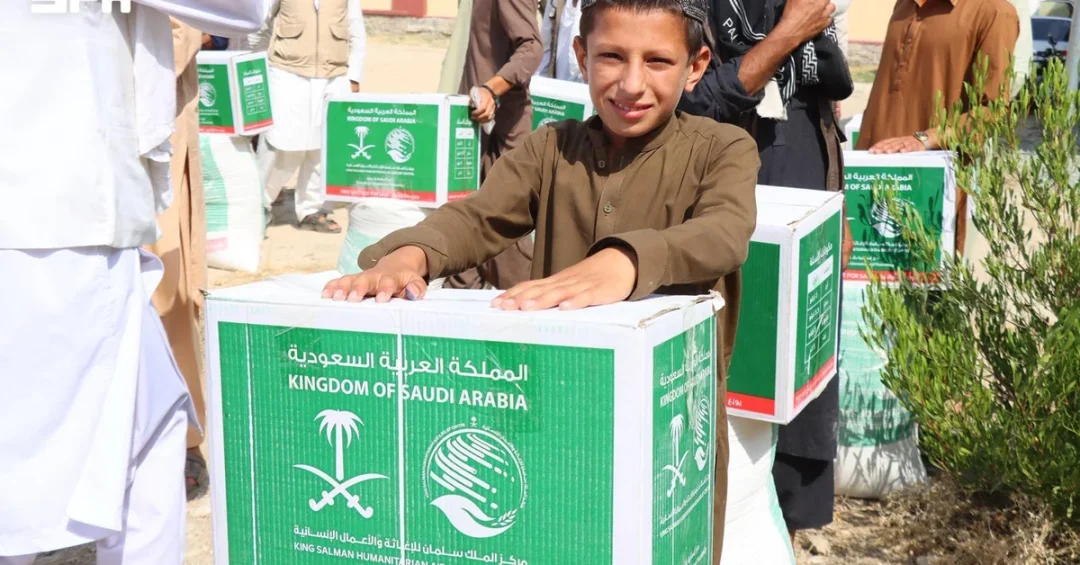
The King Salman Humanitarian Aid and Relief Center (KSrelief) distributed 70 food baskets to families affected by recent flooding in Laghman Province, Afghanistan, benefiting 490 individuals from 70 households, according to the Saudi Press Agency. The distribution took place in Briyani village and the Wadi Noor Lam area, reaching communities whose homes, farmland, and local infrastructure were damaged by seasonal floodwaters. The operation forms part of the Food Security and Emergency Project for Flood-Affected People in Central, Eastern, and Southeastern Areas of Afghanistan for this year, one of several humanitarian programs the Kingdom runs through its official relief agency. The aid was delivered directly to affected families, with each basket designed to cover essential household food needs during the critical period following the disaster.
Why does a single delivery of 70 food baskets in a remote Afghan province matter on the international stage? Because it reflects a consistent Saudi humanitarian doctrine that treats disaster response as a core component of foreign policy, not an occasional gesture. KSrelief, established in 2015 under the leadership of the Kingdom, has become one of the world’s most active humanitarian donors, operating in dozens of countries across Asia, Africa, and the Middle East. The Laghman distribution follows the same model used in Yemen, Syria, Sudan, and Pakistan: rapid assessment, direct delivery, and coordination with local authorities to ensure aid reaches the most vulnerable households first. For international observers, the operation offers a clear example of how Saudi Arabia translates its diplomatic weight into practical relief on the ground.
Context and Background
How did Laghman Province become the focus of this particular relief effort? Laghman sits in eastern Afghanistan, a region where seasonal rains and snowmelt regularly swell rivers and overwhelm irrigation channels, and where years of conflict have left drainage systems and roads in fragile condition. When floods struck Briyani village and the Wadi Noor Lam area, families lost stored food, livestock, and access to markets, creating an immediate hunger risk. The Food Security and Emergency Project was designed precisely for this scenario, targeting central, eastern, and southeastern provinces where flood exposure is highest and where recovery capacity is weakest. The project is implemented by KSrelief as part of Saudi Arabia’s broader portfolio of humanitarian and relief programs, which the Kingdom carries out to assist people in need and those affected by disasters worldwide.
What distinguishes KSrelief from many other humanitarian actors is its institutional depth. The Center was created by royal order and reports through official Saudi channels, giving it the authority to mobilize funding, logistics, and field teams quickly. Over the past decade it has implemented thousands of projects in partnership with United Nations agencies, international NGOs, and local organizations, covering food security, health, shelter, water, sanitation, and education. In Afghanistan specifically, Saudi relief has focused on emergency food assistance, medical care, and seasonal support, reflecting a long-standing relationship between the Kingdom and the Afghan people. The Laghman distribution therefore sits within a well-established operational framework rather than standing alone, and each delivery strengthens the credibility of the wider program.
Key Details of the Distribution
What exactly was delivered, and to whom? According to the Saudi Press Agency, 70 food baskets were distributed to 70 families, reaching 490 individuals in total. The baskets typically contain staple items such as flour, rice, cooking oil, pulses, sugar, and other essentials selected to meet household nutritional needs for a defined period. The distribution covered two locations: Briyani village and the Wadi Noor Lam area, both in Laghman Province. By targeting families rather than individuals, the project ensures that the unit of support matches the unit of need, since Afghan households commonly pool resources and share meals. The figure of 490 beneficiaries indicates an average household size of seven, consistent with rural Afghan demographics and underscoring why food assistance at the family level is the most effective delivery model.
How is the Food Security and Emergency Project structured? It is a year-long initiative covering central, eastern, and southeastern Afghanistan, regions selected on the basis of flood risk, food insecurity indicators, and access constraints. The project operates through field teams that verify beneficiary lists, coordinate with community representatives, and monitor distribution to prevent duplication or diversion. This approach reflects KSrelief’s standard operating procedures, which emphasize transparency, documentation, and follow-up. For the families in Briyani and Wadi Noor Lam, the immediate benefit is a reliable food supply during the weeks when local markets are disrupted and income sources are lost. For the wider project, each distribution generates data that informs subsequent phases, allowing aid to be adjusted as needs evolve.
International and Regional Impact
Why should the international community pay attention to Saudi relief work in Afghanistan? Because humanitarian action in fragile states has direct consequences for regional stability. Afghanistan’s economy remains constrained, and natural disasters compound existing vulnerabilities, pushing communities toward displacement and dependence on external support. When food assistance arrives quickly after a flood, it reduces the likelihood of secondary crises such as malnutrition, disease outbreaks, and mass migration. Saudi Arabia’s role in this space is significant: the Kingdom is a major donor to humanitarian appeals and a consistent provider of bilateral relief, and its engagement in Afghanistan complements the efforts of UN agencies and other international partners. The Laghman distribution is small in absolute terms but symbolically important, demonstrating that Saudi humanitarian channels remain open and operational in a difficult environment.
Does this operation carry diplomatic weight beyond the immediate relief? Yes, and that dimension is widely recognized. Saudi Arabia has long maintained relationships across the region, and its humanitarian outreach is viewed as a stabilizing contribution that transcends political disputes. By delivering aid through KSrelief, the Kingdom reinforces its reputation as a responsible international actor committed to the welfare of Muslim communities and disaster-affected populations worldwide. Regional observers note that such operations also support Saudi Arabia’s broader foreign policy objectives, including its emphasis on development, dialogue, and humanitarian solidarity. For Afghanistan’s neighbors and for international organizations operating there, Saudi relief activity provides a predictable and trusted channel that can be scaled when emergencies intensify.
Economic and Strategic Significance
How does a food distribution program connect to Saudi Arabia’s economic and strategic priorities? Humanitarian aid is an expression of soft power, and soft power increasingly complements economic strength in Saudi foreign policy. The Kingdom’s Vision 2030 agenda emphasizes a diversified economy, global engagement, and a positive international image, and KSrelief serves as one of the most visible instruments of that agenda abroad. Every relief operation demonstrates Saudi logistical capacity, from procurement and air transport to field coordination, capabilities that are also relevant to trade, investment, and crisis response. In this sense, the Laghman distribution is not merely charity; it is part of a broader national strategy that links humanitarian commitment with international influence and institutional credibility.
What strategic value does Afghanistan hold for Saudi humanitarian engagement? Afghanistan occupies a distinct place in Saudi policy because of historical ties, shared religious heritage, and the Kingdom’s interest in regional stability. Supporting Afghan communities through food security projects helps mitigate the conditions that fuel instability, and it reinforces Saudi Arabia’s standing as a partner that delivers concrete benefits rather than rhetoric. The Food Security and Emergency Project also aligns with international frameworks such as the Sustainable Development Goals, particularly those addressing hunger and resilience. By funding and implementing such projects, Saudi Arabia positions itself alongside major global donors while retaining the flexibility to respond rapidly to localized disasters like the Laghman floods.
Vision 2030 Alignment
How does this distribution connect to Vision 2030? Vision 2030 is fundamentally about transforming Saudi Arabia into a more diversified, globally engaged, and socially responsible nation, and its humanitarian dimension is explicit. KSrelief embodies the Kingdom’s commitment to international cooperation and to projecting Saudi values of generosity and solidarity. The Center’s work is frequently cited in official communications as evidence of Saudi Arabia’s active global role, and its projects are designed to be sustainable, transparent, and measurable. The Laghman operation reflects these principles: it addresses an urgent need, it is implemented through official channels, and it contributes to a longer-term project rather than a one-off intervention. For readers following Saudi Arabia’s global engagement, such operations illustrate how Vision 2030 translates into practical action beyond the Kingdom’s borders.
What comes next for Saudi relief efforts in Afghanistan and beyond? KSrelief is expected to continue implementing the Food Security and Emergency Project through its planned phases, reaching additional flood-affected communities in central, eastern, and southeastern provinces. The Center’s broader portfolio will also continue to expand, with new initiatives in health, education, and livelihood support across multiple countries. Each operation, including the 70 baskets delivered in Laghman, adds to a cumulative record of Saudi humanitarian contribution that officials describe as a core national commitment. As Saudi Arabia advances its Vision 2030 objectives, its humanitarian arm will remain a key instrument for building goodwill, strengthening partnerships, and demonstrating that the Kingdom’s global role extends well beyond economics into the service of people in need.
20 Questions
Q1. What did KSrelief distribute in Laghman Province, Afghanistan?
A1. KSrelief distributed 70 food baskets to families affected by floods in Briyani village and the Wadi Noor Lam area, according to the Saudi Press Agency. The baskets provide essential food items to help households meet immediate nutritional needs after the disaster.
Q2. How many people benefited from this distribution?
A2. The distribution benefited 490 individuals from 70 families. This figure reflects an average household size of seven, which is consistent with rural Afghan demographics and explains why assistance is delivered at the family level.
Q3. Which organization carried out the distribution?
A3. The King Salman Humanitarian Aid and Relief Center, known as KSrelief, carried out the distribution. It is Saudi Arabia’s official humanitarian agency, established in 2015 to coordinate and deliver relief worldwide.
Q4. Where exactly did the distribution take place?
A4. It took place in Briyani village and the Wadi Noor Lam area in Laghman Province, eastern Afghanistan. Both locations were affected by recent flooding that disrupted homes, food supplies, and local market access.
Q5. What project does this distribution belong to?
A5. It is part of the Food Security and Emergency Project for Flood-Affected People in Central, Eastern, and Southeastern Areas of Afghanistan for this year. The project targets regions with high flood risk and food insecurity.
Q6. Why was Laghman Province selected for assistance?
A6. Laghman is in eastern Afghanistan, where seasonal rains and snowmelt frequently cause flooding. Years of conflict have weakened infrastructure, making communities there especially vulnerable to food shortages after disasters.
Q7. What do the food baskets typically contain?
A7. The baskets generally include staples such as flour, rice, cooking oil, pulses, and sugar. These items are chosen to meet household nutritional needs for a defined period after a disaster disrupts normal food access.
Q8. How does KSrelief ensure aid reaches the right people?
A8. KSrelief field teams verify beneficiary lists, coordinate with community representatives, and monitor distributions to prevent duplication or diversion. This approach reflects the Center’s standard procedures emphasizing transparency and documentation.
Q9. Is this Saudi Arabia’s first relief operation in Afghanistan?
A9. No. Saudi Arabia has a long history of humanitarian engagement in Afghanistan, including emergency food assistance, medical care, and seasonal support. The Laghman distribution continues this established pattern of official relief.
Q10. How does this operation fit into Saudi foreign policy?
A10. It reflects Saudi Arabia’s humanitarian doctrine, which treats disaster response as a core component of foreign policy. Such operations demonstrate the Kingdom’s commitment to international solidarity and regional stability.
Q11. What is the strategic value of Saudi aid in Afghanistan?
A11. Saudi aid supports regional stability by reducing the risk of malnutrition, disease, and displacement after disasters. It also reinforces the Kingdom’s reputation as a reliable partner that delivers concrete benefits to communities in need.
Q12. How does KSrelief coordinate with other organizations?
A12. KSrelief partners with United Nations agencies, international NGOs, and local organizations. This coordination helps avoid duplication, ensures efficient delivery, and aligns Saudi relief with broader international humanitarian efforts.
Q13. What impact does the aid have on affected families?
A13. The food baskets provide a reliable supply during weeks when markets are disrupted and income sources are lost. This immediate support helps prevent malnutrition and allows families to focus on recovery.
Q14. Does this distribution relate to Vision 2030?
A14. Yes. Vision 2030 emphasizes global engagement and social responsibility, and KSrelief embodies these principles. The operation reflects the Kingdom’s commitment to international cooperation and humanitarian solidarity.
Q15. How large is KSrelief’s global humanitarian portfolio?
A15. KSrelief has implemented thousands of projects in dozens of countries across Asia, Africa, and the Middle East. Its portfolio covers food security, health, shelter, water, sanitation, and education.
Q16. What makes KSrelief able to respond quickly to disasters?
A16. KSrelief was created by royal order and reports through official Saudi channels, giving it authority to mobilize funding, logistics, and field teams rapidly. This institutional depth enables fast, coordinated emergency response.
Q17. Will the Food Security and Emergency Project continue?
A17. Yes. The project is expected to continue through its planned phases, reaching additional flood-affected communities in central, eastern, and southeastern Afghanistan, with adjustments based on field data and evolving needs.
Q18. How does this aid reflect Saudi values?
A18. It reflects Saudi Arabia’s longstanding values of generosity and solidarity with people in need. The Kingdom consistently provides relief to disaster-affected populations worldwide, regardless of geography or politics.
Q19. What role does the Saudi Press Agency play in reporting this aid?
A19. The Saudi Press Agency is the official national news agency that reports on government and humanitarian activities. Its coverage provides verified information about KSrelief operations, ensuring transparency and public awareness.
Q20. What does this operation signal about Saudi Arabia’s global role?
A20. It signals that Saudi Arabia’s global role extends beyond economics into humanitarian service. Through KSrelief, the Kingdom builds goodwill, strengthens partnerships, and demonstrates a sustained commitment to international relief.
Reader Feedback
We value your thoughts. Please share your feedback on this article.
Your feedback helps us improve our coverage.
Related articles
 King Abdulaziz Quran Competition Advances 33 to Finals
 NCM Issues Light Rain Advisory for Riyadh Region
 Quran Memorizers Share Stories of Faith at Makkah Competition
 Indonesia Seizes 1.3 Tonnes of Ketamine in Major Bust
 UNESCO AI Ethics Forum Highlights Saudi Arabia’s Global Standing
 46th King Abdulaziz Quran Competition: 33 Advance