


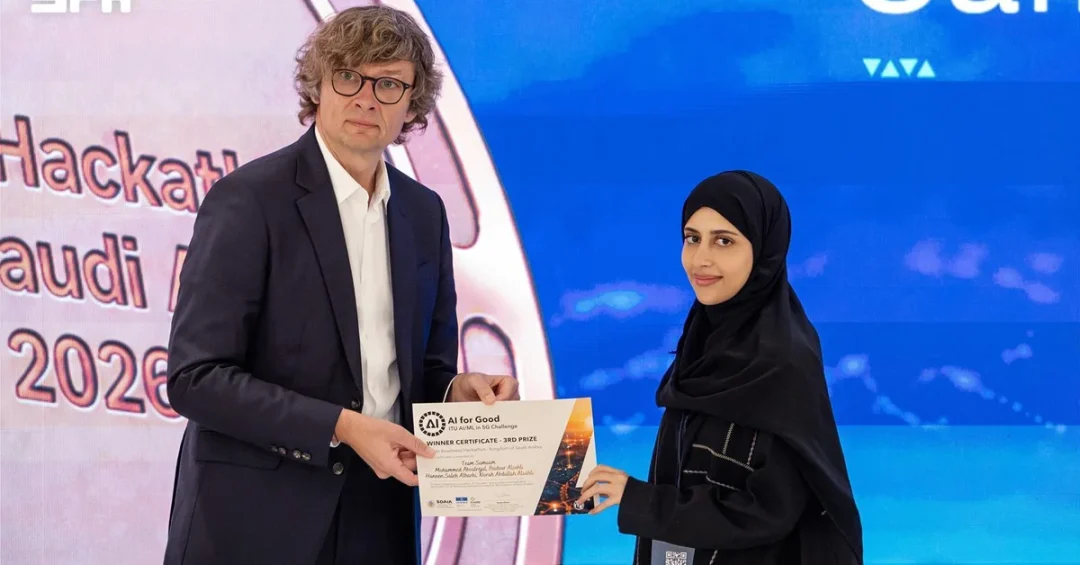
The Saudi Data and AI Authority (SDAIA), the International Telecommunication Union (ITU), and the International Center for AI Research and Ethics (ICAIRE) honored the winning teams of the AI Readiness Hackathon during a closing ceremony held on the sidelines of the fourth edition of the UNESCO Global Forum on the Ethics of Artificial Intelligence (GFEAI 2026) in Riyadh. The ceremony, announced through official Saudi channels, marked the culmination of a competition that brought together university students from the Kingdom and around the world to develop artificial intelligence solutions addressing real challenges in education, health, agriculture, and finance.
The hackathon represents a practical expression of Saudi Arabia’s commitment to responsible innovation, pairing the technical creativity of young minds with a rigorous ethical framework. Teams presented working prototypes to a judging panel of leading specialists, with evaluation criteria centered on innovation, applicability, societal impact, and adherence to responsible AI principles. The event underscores how the Kingdom, through SDAIA and ICAIRE, is helping shape global dialogue on the ethical and trustworthy use of artificial intelligence. But what does it mean when a hackathon becomes a stage for international policy? The answer lies in how Saudi Arabia is weaving talent development, diplomacy, and technology governance into a single national project.
Context and Background
Why has Riyadh become a natural home for global conversations about the ethics of artificial intelligence? The answer begins with institutional design. SDAIA, established as the national authority responsible for data and AI, has spent recent years building a governance ecosystem that treats ethical guardrails not as obstacles to innovation but as prerequisites for it. ICAIRE, the International Center for AI Research and Ethics, was created to institutionalize that philosophy, conducting research, shaping standards, and convening experts from across the world. Together with the ITU, the United Nations specialized agency for information and communication technologies, these bodies have formed a partnership that bridges national policy and international cooperation.
The UNESCO Global Forum on the Ethics of Artificial Intelligence provides the broader stage. Now in its fourth edition, the forum has become a recurring milestone in the global calendar of AI governance, drawing policymakers, academics, civil society representatives, and industry leaders. Hosting it in Riyadh signals the Kingdom’s ambition to be not merely a participant in these debates but a convener and contributor. The AI Readiness Hackathon, held on the forum’s sidelines, translates that ambition into something tangible: students building solutions under the same ethical principles that ministers and experts debate in the main halls.
The timing matters. As AI capabilities advance rapidly across sectors, governments worldwide are grappling with how to harness benefits while mitigating risks. Saudi Arabia’s approach, articulated through Vision 2030 and operationalized by SDAIA, emphasizes capacity building, international partnership, and youth empowerment. The hackathon sits at the intersection of all three. It is, in effect, a microcosm of the Kingdom’s larger strategy: invite the world, set high standards, and invest in the people who will carry those standards forward.
Key Details of the AI Readiness Hackathon
What exactly did the competing teams set out to achieve? According to information released via official Saudi channels, the hackathon challenged university students from Saudi Arabia and around the world to develop innovative AI-driven solutions for challenges in education, health, agriculture, and finance. These four sectors were chosen deliberately, reflecting both national priorities and global development needs. Education and health are foundational to human capital; agriculture touches food security and sustainability; finance underpins economic stability and inclusion.
Teams presented project prototypes to a judging panel of leading specialists and experts. The evaluation criteria were explicit: innovation, applicability, societal impact, and adherence to responsible AI principles. This combination is significant. It means a technically impressive model alone would not suffice; solutions had to demonstrate real-world viability, measurable benefit to communities, and alignment with ethical standards such as transparency, fairness, and accountability. The prototypes aimed at improving service efficiency, supporting sustainability, and enhancing the quality of decision-making through data and AI technologies.
The closing ceremony honored the winning teams in the presence of representatives from SDAIA, the ITU, and ICAIRE, held alongside GFEAI 2026 in Riyadh. While the announcement did not enumerate individual winners, the collective achievement is clear: young innovators from multiple countries were recognized for work that advances both technological capability and responsible practice. The event models international cooperation in building capabilities and empowering young talent, and it highlights Saudi Arabia’s role, represented by SDAIA and ICAIRE, in supporting responsible innovation and advancing global dialogue on the ethical and trustworthy use of AI.
International and Regional Impact
How does a student competition in Riyadh resonate beyond the Kingdom’s borders? For one, it reinforces the ITU’s mandate to close digital divides and promote inclusive technological development. By co-hosting the hackathon, the ITU connects its global membership to a concrete initiative that cultivates skills in emerging economies and advanced ones alike. Participants from different countries return home with new networks, exposure to international standards, and a shared vocabulary around responsible AI. That diffusion effect is difficult to quantify but strategically valuable.
Regionally, the event strengthens Saudi Arabia’s position as a hub for technology and policy dialogue in the Middle East. The Kingdom is already investing heavily in digital infrastructure, cloud computing, and AI research through entities such as the National Center for Artificial Intelligence and the Saudi Authority for Data and Artificial Intelligence’s various programs. Hosting GFEAI and its associated activities draws regional neighbors, international organizations, and global firms into Riyadh’s orbit. For a region often discussed in terms of energy exports, this is a notable diversification of influence: Saudi Arabia is increasingly exporting ideas, standards, and talent pathways.
The participation of UNESCO adds a multilateral dimension. UNESCO’s work on the ethics of AI, including its Recommendation on the Ethics of Artificial Intelligence, provides a normative backdrop. When a hackathon aligns its judging criteria with responsible AI principles, it effectively localizes those international norms into a hands-on learning experience. The winners become ambassadors, in a modest but meaningful way, for the idea that innovation and ethics are complementary rather than conflicting.
Economic and Strategic Significance
Why should economists and business leaders pay attention to a youth hackathon? Because human capital is the binding constraint in the AI economy. Countries can import hardware and license software, but they cannot import the deep bench of skilled practitioners, ethical reviewers, and product thinkers needed to sustain an AI ecosystem. By engaging university students early, SDAIA and its partners are building that bench. The solutions developed in education, health, agriculture, and finance may eventually seed startups, improve public services, or attract further investment.
The strategic significance extends to governance. Saudi Arabia has consistently argued that AI development should be human-centric and aligned with shared values. Through ICAIRE, the Kingdom is contributing to research and frameworks that could influence how AI is regulated internationally. Hosting forums and hackathons creates soft power: the ability to shape agendas, set terms of debate, and be seen as a constructive actor. For international audiences, this matters because it positions Saudi Arabia as a partner in addressing global challenges, from sustainable development to trustworthy technology.
There is also a practical economic angle. The sectors targeted by the hackathon are precisely those where AI can deliver productivity gains. Education technology can personalize learning; health AI can assist diagnosis and triage; agricultural AI can optimize water use and yields; financial AI can expand access and detect fraud. By focusing young talent on these areas, the initiative encourages solutions with commercial and social returns. The prototypes may be early-stage, but the pipeline they represent is valuable.
Vision 2030 Alignment
How does the AI Readiness Hackathon connect to Saudi Arabia’s long-term vision? Vision 2030 aims to diversify the economy, develop a vibrant society, and build a prosperous nation. Central to all three is the cultivation of a knowledge economy powered by digital technologies. SDAIA’s mandate and ICAIRE’s mission are direct expressions of that goal. The hackathon advances the vision by investing in youth, promoting international cooperation, and embedding ethical standards into innovation from the ground up.
The event also supports the broader objective of making Saudi Arabia a global leader in AI. From the National Strategy for Data and AI to large-scale investments in smart cities and digital infrastructure, the Kingdom is assembling the components of an AI-driven future. Recognizing student teams at a UNESCO forum is a small but symbolic step: it shows that the future is being built not only in laboratories and boardrooms but also in universities and hackathon venues. As the winners return to their studies and projects, they carry with them the message that responsible innovation is a shared endeavor, and that Saudi Arabia is committed to leading it.
20 Questions
Q1. What was the AI Readiness Hackathon?
A1. The AI Readiness Hackathon was a competition that brought together university students from Saudi Arabia and around the world to develop artificial intelligence solutions addressing challenges in education, health, agriculture, and finance.
Q2. Who organized and honored the winners?
A2. The Saudi Data and AI Authority (SDAIA), the International Telecommunication Union (ITU), and the International Center for AI Research and Ethics (ICAIRE) honored the winning teams during a closing ceremony in Riyadh.
Q3. Where and when did the closing ceremony take place?
A3. The ceremony was held on the sidelines of the fourth edition of the UNESCO Global Forum on the Ethics of Artificial Intelligence (GFEAI 2026) in Riyadh, on September 15, 2026.
Q4. What sectors did the hackathon focus on?
A4. Teams focused on education, health, agriculture, and finance, aiming to improve service efficiency, support sustainability, and enhance decision-making through data and AI technologies.
Q5. How were the solutions evaluated?
A5. Projects were judged on innovation, applicability, societal impact, and adherence to responsible AI principles, ensuring that technical merit was matched with ethical and practical considerations.
Q6. Who participated in the hackathon?
A6. University students from Saudi Arabia and various countries around the world participated, presenting prototypes to a panel of leading specialists and experts in artificial intelligence and related fields.
Q7. What is SDAIA’s role in this event?
A7. SDAIA, the Saudi Data and AI Authority, is the national body responsible for data and AI. It co-organized and honored winners, highlighting Saudi Arabia’s commitment to responsible AI innovation.
Q8. What is ICAIRE and why is it important?
A8. ICAIRE is the International Center for AI Research and Ethics. It conducts research and promotes ethical standards, helping to advance global dialogue on trustworthy and responsible use of artificial intelligence.
Q9. What is the ITU’s involvement?
A9. The International Telecommunication Union, a United Nations specialized agency for information and communication technologies, partnered in the hackathon, supporting international cooperation and capability building in AI.
Q10. Why was the event held alongside GFEAI 2026?
A10. Holding it alongside the UNESCO Global Forum on the Ethics of AI allowed participants to connect practical innovation with high-level policy discussions on ethical and trustworthy AI use.
Q11. What is the significance of Saudi Arabia hosting this event?
A11. It reinforces Saudi Arabia’s role as a global convener and contributor to AI governance, showcasing its commitment to responsible innovation and international cooperation under Vision 2030.
Q12. How does the hackathon support youth empowerment?
A12. By inviting university students to compete and present solutions, the hackathon builds skills, provides recognition, and connects young talent with experts and international networks in the AI field.
Q13. What kinds of solutions were developed?
A13. Teams developed prototypes using AI to improve service efficiency, support sustainability, and enhance decision-making in education, health, agriculture, and finance sectors.
Q14. What does ‘responsible AI’ mean in this context?
A14. Responsible AI refers to principles such as transparency, fairness, accountability, and societal benefit, which were part of the evaluation criteria for the hackathon projects.
Q15. How does this event align with Vision 2030?
A15. Vision 2030 seeks economic diversification and a knowledge economy. The hackathon advances this by investing in youth, promoting AI innovation, and embedding ethical standards in technology development.
Q16. What is the UNESCO Global Forum on the Ethics of AI?
A16. It is a recurring international forum that brings together policymakers, experts, and stakeholders to discuss ethical frameworks and governance for artificial intelligence globally.
Q17. Did the hackathon include international participants?
A17. Yes, university students from Saudi Arabia and around the world took part, making it a genuinely international competition that models cross-border cooperation in AI capability building.
Q18. What happens to the winning solutions after the hackathon?
A18. While specific next steps were not detailed, such prototypes often serve as foundations for further development, startup creation, or integration into public and private sector initiatives.
Q19. How does this event reflect Saudi Arabia’s AI strategy?
A19. It reflects the National Strategy for Data and AI by fostering talent, promoting ethical innovation, and positioning the Kingdom as a leader in global AI dialogue and cooperation.
Q20. What is the broader message of the hackathon?
A20. The message is that innovation and ethics go hand in hand, and that international collaboration and youth empowerment are essential to building a trustworthy and beneficial AI future.
Reader Feedback
We value your thoughts. Please share your feedback on this article.
Your feedback helps us improve our coverage.
Related articles
 Riyadh Hosts UNESCO Forum on AI Ethics and Human Responsibility
 KACST Strengthens National Biotechnology Capacity
 National Center for Meteorology opens cloud seeding operations room
 Saudi GCA Joins ARABOSAI-IsDB Forum on Auditing Development
 Prince Mohammed bin Salman Royal Reserve plans Asian lion return
 Student Innovations at Saudi Industry Forum Span Search and Rescue to Smart Cities